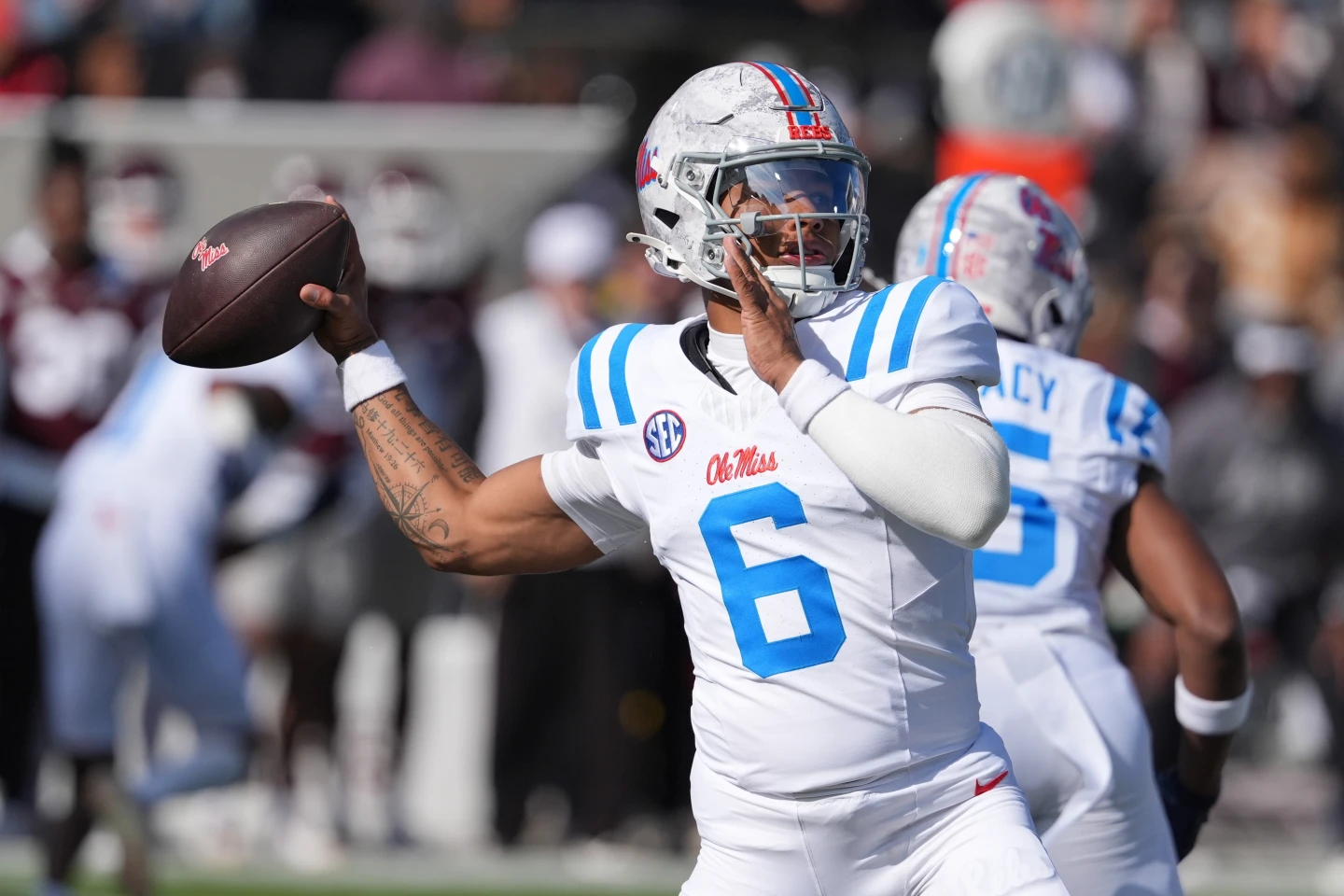
I think first and foremost, a big thank you is due to Sean McDonough. The call he had on this game was fantastic, and he proved why he was named the 2025 NSMA National Sportscaster of the Year. He gave us the call of the year, and now has some people wondering why he is ESPN’s B-team play-by-play guy. Now to the game itself…
Going into this game, both Georgia fans and the general public seemed to forget just how close Ole Miss was to beating Georgia in Athens on October 18th. The Rebels led by 9 in the 4th quarter and are a 4th&1 stop away from winning that game. Yet that didn’t stop seemingly every single member of the national media from picking Georgia. Plus, all of the general public put their money on Georgia. DraftKings reported that 95% of the money was on Georgia’s moneyline and 89% was on Georgia -6.
But Ole Miss did to Georgia exactly what they couldn’t in Athens. Put them away. When Georgia punched late, Trinidad Chambliss and the offense had a counterpunch. The Ole Miss defense gave up field goals instead of touchdowns for the most part in the second half. After I had time to digest the game, I thought about how that game in Athens earlier this year probably won Ole Miss this game.
There is a certain aspect in sports that is unquantifiable: game pressure. Each player deals with it differently, and you really don’t know how someone will react until they are in the moment. Trinidad Chambliss folded under the pressure of the moment in Athens earlier this year. ESPN actually asked him about it, and he made acknowledgments about his 4th quarter struggles in the first game. However, this time coming into the second half down 9, he didn’t just handle the game pressure; it felt like he attacked it.
I mean, some of the throws Chambliss made in that second half probably gave Kirby flashbacks to his time at Alabama facing Johnny Manziel. Scramble drills that resulted in some wild plays to keep drives alive or hit them for explosives. Those plays that Chambliss was able to make with his legs were impactful outside of the yards they gained. They gassed the Georgia defense. They had their hands on their hips, they were slower in their rushes, and were less effective in their run fits. That allowed Kewan Lacy to get going in the second half as well.
Since I haven’t yet given them credit. The Ole Miss defense got better throughout the year. A big storyline in the second half of the season was about how Georgia’s defense had improved. There wasn’t a lot of noise about how Ole Miss had gotten better. I guess if your Head Coach leaves, that automatically means you’re not allowed to improve as a team. They did, though. The biggest improvement was in their run defense. In game one in Athens, the Rebels gave up 221 yards on 49 carries, good for an average of 4.5. Game two, however, 124 yards on 37 carries, good for 3.4 yards a carry. In Athens, the Rebels didn’t force a punt; on Thursday, they forced 4. Their Pass defense was also better. I think that is a result of their improved run defense putting Georgia in disadvantaged situations on 2nd and 3rd down.
Now that we have given the Rebels their due credit, it’s time for a rant or two…
Questions regarding Georgia’s philosophy
I’ll be honest. I truly do not understand the philosophy regarding aggressiveness from Kirby Smart. Let me make one thing clear: I’m not questioning the outright play calling. I will never be in his realm in terms of what Kirby Smart knows about football. But I do feel like I have a good sense of momentum and clock management. There were two instances that I just don’t get…
The first comes after Georgia took a 9-point lead. The Bulldogs had three drives in which they were up 9 points. They went as follows: 3 plays, 3 yards, punt; 3 plays, 4 yards, punt; 6 plays, 12 yards, missed field goal. There was a lack of aggressiveness in those drives that was apparent. The only thing that makes those drives confusing is the fact that Kirby Smart would get aggressive after Georgia’s lead dwindled and dissipated. It gave the feeling of having a good grip on a rope, and once it starts slipping, you just start grabbing at it, hoping to hold on.
The second comes on Georgia’s last true offensive possession. With 1:13, Georgia has the ball at the Ole Miss 8. They run for 5 yards, run for 3 yards. Those caused Ole Miss to burn their two timeouts. They then decide to throw for it on 3rd down and don’t get it. Why? It seems that you had committed yourself to a conservative approach through the first 2 plays, then you get aggressive? The only reason it matters is that Georgia had all kinds of problems stopping Ole Miss between the 20’s, the entire second half. Their kicker had shown you he had plenty of leg to make a long field goal as well. You would think Georgia would have been content running down the clock and going into overtime, a format that would have favored the Dawgs, with what would have been momentum on their side going into the overtime period
Philosophy wasn’t Georgia’s only problem Ole Miss was too
There was a troubling underlying stat for Georgia that they kind of covered up for most of the year. The offensive efficiency has been a problem all year for the Dawgs. Offensive efficiency at its core is your ability to sustain drives. That’s fine when you’re one of the top teams in the country at turning red zone opportunities into touchdowns. But when those touchdowns stop, the cracks start to show. Twice in the second half, Georgia had red zone opportunities turn into field goals. They just could not finish the drives that they were successful on in the second half, and it cost them dearly.
Lastly, as a personal gripe, they had a complete and utter inability to maintain containment on Trinidad Chambliss. Which some of that is absolutely a credit to Chambliss. But specifically, the play that Chambliss made to Kewan Lacy on 3rd down, I watched Daylen Everette flatten his rush off, which allowed Chambliss to flip himself back to the left. Daylen is a corner, and pass rushing is not his job, but man, was that a crucial mistake.
To Georgia Fans
I will preface this by acknowledging that I am most likely talking to a loud minority, but. No, it wasn’t the officials’ fault that Georgia lost. I get it, targeting is frustrating, inconsistent, and needs to be addressed. It also isn’t a loss that should make you want to fire Mike Bobo or (and yes, I did see some people say this) have Kirby Smart step down. Ole Miss won this game because they executed when it mattered most better than Georgia did. Plain and simple. For as long as Kirby Smart is the Head Coach, Georgia will continue to be in this position, and it is physically impossible to win them all. Not to mention this is a relatively young team, and they will most likely be in a similar position next year. But for the love of god, as a fanbase, we have got to learn to lose better.
Let ’em Run – Late P5 Preview at Gulfstream Park, Sponsored by BRISnet
Well let’s ride again here at Gulfstream Park, where it is sure to be fast and firm, and we will take a look at the runners in the late P5. Interesting to point out right off the bat, trainer Saffie Joseph Jr. has 4 horses running, but has given only one mount to his “go to” guy, Edgar Zayas Jr., and it is also his ONLY mount of the day (Race 11) hmmmm…
Gulfstream Park Race 7 – 3:20 EST | 5 ½ Furlongs | Synthetic | CLM25K
A synthetic sprint race, with a smallish field of 7, but a tough race to figure out. Going to go with one of several invaders from Woodbine, #3 Moon Landing 6-1. Jockey Tyler Gaffalione is in the saddle, and trainer Martin Drexler is overdue to hit the winners circle (5-0-2-2). A clean break would seal the deal. The #5 Catch a Tiger 8-1 could make some noise right out of the gate if runner takes to synthetic after a number of turf attempts. Jockey Micah Husbands adds to the appeal as does trainer Steve Owens record, off this kind of layoff (30%). Also has the highest last race speed rating per Brisnet, which adds to the appeal.
Race 8 – 3:50 EST | 1 1/16 Mile | Dirt | MSW 84K
This is a LOADED MSW race with only one 1st time starter. The #7 Cruisin Crossbay 10-1, did not do much 1st time out, but working out super for the return. Jockey Micah Husbands and trainer Saffie Joseph Jr. team up for a lot of wins. Trainer Joseph boasts a 35% sprint to route on dirt, for the 2nd start of a runner… gotta like that stat. Taking a look at #2 Lennie G 20-1 for trainer Dale Romans, who is heating up here at Gulfstream. An interesting stat when going from Maiden Claiming to MSW is a 26% strike rate for Romans. Not that a 100K Maiden Claiming at Churchill is your average claiming event.
Race 9 – 4:20 EST | 5 Furlongs | Turf | OC62K
Would like to see some scratches help the #8 Vindicate Cha Cha 8-1 get a little closer to the rail for the quick run into the 1st turn in this turf sprint. Jockey change to Javier Castellano is a plus. Runner can put up some serious fractions, but hoping here that some maturity in her 5 y.o. campaign allows Castellano to dole out the speed a little better. Either way, she will be prominent on the front end from the start. #4 Greenfield Cougar 4-1 is a runner who would benefit if there are crazy early splits put up. If jockey Joe Bravo gets her out of the gate cleanly, could set up for a big closing kick in the stretch.
Race 10 – 4:50 EST | 1 1/16 | Dirt | The Sunshine Classic 75K
First of two stakes races to close out Saturdays’ card, with a small field of six, headed by #6 Neoequos 3-1, who has been keeping serious company since running in the Kentucky Derby back in May. Could see a lonely lead out front for this runner, and workouts for return say that is a real possibility. The Brisnet #1 Prime Power at +7 points adds to the appeal, but what will likely be a very short price. The #5 Lightning Tones 5-2, will be coming hard down the lane, and race 3 back would fit nicely here. Change to jockey Jose Morelos is a plus in a route race.
Race 11 – 5:20 EST | 1 Mile | Turf | The Sunshine Filly and Mare Turf 75K
The ultra consistent runner #7 Ashima 3-1, is posed for a big run as defending champ. Third off a layoff, and trainer Salvatore Santoro has her ready to fire. Versatile sort, will give jockey Javier Castellano options. Trainer Santoro has some serious stats to back up top pick. So….this is Edgar Zayas only mount of the day, on a runner with the least racing experience in the field, the #5 Sapphire Girl 15-1, for trainer Saffie Joseph Jr. Last time out was 1st time on turf, and looked super breaking maiden, but stepping up here first time with winners. Got some time off after that victory, but is working out without missing a beat.
So tune in Friday at 3PM with special guest John O’Hara, Managing Partner of Four Leaf Clover Stable, LLC. Host John Kostin will have a lively Q. and A., with some new perspectives on the state of thoroughbred horseracing. Then check out Podcast on Saturday at 12:30 where we break down the Late P5 at Gulfstream Park.
So catch us on multiple streaming apps, and social channels. So bet smart, cheer hard, fast horses equal serious fun, until next time…Let’em Run.
We are set for a battle of the underdogs in Phoenix Saturday night as both Ole Miss and Miami upset their quarter-final opponents. Miami was able to take down Ohio State as a 9.5-point underdog. Ole Miss beat Georgia as a 5.5-point underdog. Both are considered unlikely to be here, yet the least likely matchup is the one we are gearing up for. While Miami was the less likely of the two, they answered a lot of questions about their identity going forward…
PHYSICALITY. Plain and simple. Miami had an argument for the best lines of scrimmage in the country entering the year. But those in-season losses to Louisville and SMU made us forget who they were. All of their wounds were self-inflicted. Penalties, ill-timed turnovers, and lots of turnovers at times all played a factor in Miami’s losses.
But they have found their identity once again in the College Football Playoffs. Their penalties are down, and they have won the turnover battle in both of their CFP matchups. Which has allowed them to flex the talent that they have on this roster.
The lines of scrimmage have gotten a lot of shine thus far. But do not let that overshadow their defensive backs and skill position players, who have won them football games with explosive plays. When I think about that Texas A&M game, I think of Malachi Toney’s touchdown and Bryce Fitzgerald’s 2 interceptions. When I think of the Ohio State game, I think of Keionte Scott’s pick-6.
They are an extremely well-rounded team whose play style has mirrored that of Saban’s early teams at Alabama. Miami has not been asking Carson Beck to do a whole lot, mainly because they haven’t needed him to. They have won games on the ground and through their defense. However, this Ole Miss team might be the offense that could derail that play style…
How Ole Miss can ruin Miami’s homecoming
Ole Miss is going to have to start by sustaining drives. This is not going to be an easy task against this Miami front 4. Ruben Bain and the boys are going to create interior pressure at a much higher rate than Georgia could. That will, in turn, allow Miami to have more effective containment of Trinidad Chambliss. Back to sustaining drives, though, Ole Miss’s longest scoring drive was in the first quarter against Georgia when they took 4:27 off the clock and kicked a field goal.
Ole Miss also needs to create turnovers and hope that Miami commits a higher number of penalties than they have in the first two games of the playoffs. This doesn’t exactly bode well for Ole Miss, seeing as how they are T-80th in the country in turnover margin and T-75th in penalties per game.
So what does go in Ole Miss’s favor? Trinidad Chambliss is miles ahead of Julian Sayin at this point in their careers. As a whole, Ole Miss’s offense is a better, more complete unit than Ohio State’s offense was this year. But all totaled they key factor in this game for Ole Miss is Kewan Lacy. He has been one of the best running backs in college football this year and will have to be on Thursday night if the Rebels are going to win. The best way to slow down a great pass rush is with a good running game. This will also lead to balance on offense and longer drives overall for the Rebels.
Ole Miss’s defense needs to have a bend but don’t break mentality. It is what won them the Sugar Bowl. Twice, Georgia was in the red zone against the Rebels and came away with three. Meanwhile, Ole Miss’s offense was perfect on its red zone possessions against Georgia. A perfect 4/4. Those trends will need to continue for the Rebels if the dream season is to live on.
Final Thoughts+ Prediction/Betting lines
As much as I would love for Ole Miss to win a National Title and really stick it to Lane Kiffin and the ginormous yapper he has on him. I do not see how they will be able to hang with the physicality of Miami for 60 minutes. I think the people of South Florida will be feeling like it’s 2001 all over again and right some wrong that occurred the last time they played in the Fiesta Bowl.
Main Street Sports stands on the edge of a shutdown that could reshape how fans watch local games across the country. Everything now hinges on a bid from London‑based DAZN, which is trying to acquire Main Street and its sixteen FanDuel‑branded regional sports networks.
A Crisis Spreading Across the Country
The crisis touches every region where the networks still operate. FanDuel RSNs carry teams across the Midwest, the South, the Mountain West, the Great Lakes, and the West Coast. Pressure grows each day as missed payments ripple through the leagues and force executives to confront the future of local sports broadcasting.
DAZN Sees a Major Opening in the U.S. Market
DAZN views the turmoil as a rare opportunity to enter the U.S. market in a major way. The streamer wants to acquire all sixteen networks and build direct relationships with MLB, the NBA, and the NHL. The move would expand DAZN far beyond combat sports and place it alongside Netflix, Apple, Amazon Prime, and YouTube as a major player in live sports.
Missed Payments Trigger Alarm Across Leagues
The trouble began when Main Street failed to make a December payment to the St. Louis Cardinals. The situation escalated on January 6, when thirteen NBA teams did not receive their scheduled rights payments. Those missed payments triggered alarm inside league offices, where executives now warn that the next few weeks will determine the fate of sixteen networks and twenty eight teams.
Shutdown Looms if No Deal Is Reached
The deadline falls between late January and early February. If DAZN and Main Street cannot reach a deal, Main Street plans to shut down after the 2026 NBA and NHL seasons. That collapse would return local rights to many teams for the first time in decades and accelerate a shift that has been building for years.
Leagues Preparing Backup Plans
If the DAZN deal collapses, the leagues have backup plans. The NBA and NHL expect to launch their own streaming services in the 2026 and 2027 seasons. Major League Baseball already controls broadcasts for the Diamondbacks, Padres, and Rockies, and expects to add the Washington Nationals, who broke away from MASN. MLB has told its remaining FanDuel teams that it can take over their broadcasts by spring training.
Experts Say Leagues May Welcome the Shift
Sports media branding expert Jeff Dennis believes the leagues may not fear that outcome.
“Every major U.S. league is working toward a more complete direct to consumer model,” Dennis said. “If teams regain their local rights, leagues like MLB, the NBA, and the NHL could finally bundle local games into their own streaming packages, something they’ve never been able to do under the regional sports network system.”
The Warning Signs Were Always There
The warning signs were visible long before Main Street Sports took control of the former Diamond Sports networks. Diamond’s bankruptcy exposed a system collapsing under the weight of cord cutting, shrinking subscriber revenue, and long term rights deals that no longer matched the economics of modern television.
When Main Street stepped in, it inherited the same broken model, the same debt pressure, and the same unsustainable contracts. In hindsight, the deal may have been doomed from the start. Main Street never had the financial cushion or structural advantages needed to fix a business that had already fallen apart, and the missed payments to the Cardinals and thirteen NBA teams only confirmed what many insiders feared: the RSN model was running out of road.
A Forty‑Year Model Nears Its End
Former Warner Communications executive Frank Carney sees the moment as the end of a long era.
“The regional sports network model we built in the nineteen eighties generated hundreds of millions of dollars and helped fuel ESPN’s national rise through the cable bundle,” Carney said. “But in 2026 that bundle no longer delivers the revenue it once did. Rights deals built on those old economics are now impossible to sustain, and that is why so many regional networks are fighting to survive.”
Some RSNs Remain Strong
Not every RSN is in danger. Team‑owned networks remain stable and insulated from the collapse.
“The team‑owned RSNs aren’t in danger. They stay strong because the teams control the product,” said sports media consultant Bill Jensen.
A Decision That Will Shape the Future
The regions at risk stretch across the country. Midwest fans could lose long standing outlets in Detroit, Milwaukee, Cleveland, Ohio, and Minneapolis. Southern markets like Miami, Atlanta, and Tampa Bay face the same uncertainty. Western markets in Los Angeles and San Antonio also hang in the balance.
These networks carry teams that anchor local identity and regional pride, and their disappearance would leave major gaps in the media landscape.
The next few weeks will determine whether DAZN rescues the networks or whether the leagues reclaim local rights. Either outcome will change how millions of fans watch their hometown teams. The regional sports model that dominated for forty years now stands at its final hour, and the industry is preparing for a future that will look very different from its past.