Business
Move over caviar, the hottest luxury ingredient is crab
Published
4 hours agoon
By
Jace Porter
It’s a perplexing time in the world of luxury ingredients. Prestigious products have become inextricably tied to fast food. Caviar now adorns chicken nuggets; truffle features in supermarket hummus and Starbucks egg bites; wagyu beef is getting smashed into burgers and has made the menu at Burger King in the UK. Even lobster—bright red and festive—has gone from attention-getting centerpiece to mac-and-cheese mix-in.
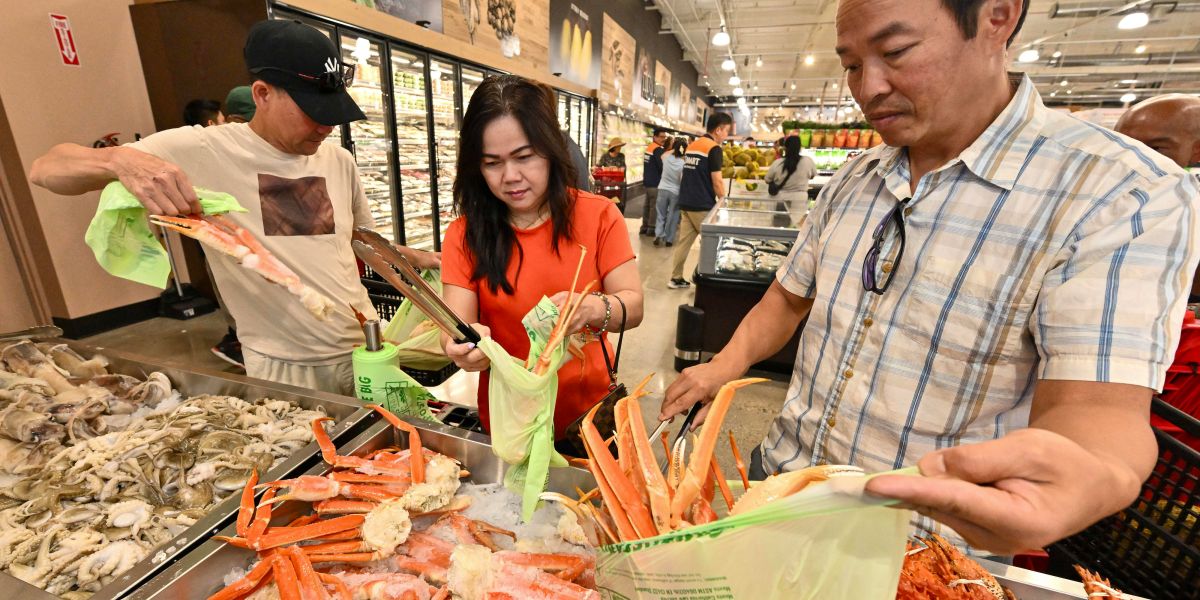
Yet crab retains its mystique. It’s beloved for its delicately flavored, finely textured meat—and for its fatty, rich roe and tomalley, culinary categories unto themselves. Now large, live specimens from the far corners of the world, like snow crab from Japan and red king crab from Norway, are this season’s luxury signifiers.
“Even the cheapest crab that we sell is typically double the price of what Maine or Nova Scotia lobster costs,” says Ian Purkayastha, founder of Regalis Foods. “King crab pricing is definitely at an all-time high.” Because their stocks and availability have been harshly affected by political and ecological upheavals, the crustaceans now wholesale for $70 to $85 a pound, he said. Retail consumers could spend upward of $1,200 to have a single, live 10-pound Norwegian red king crab delivered to their homes from Regalis. That, believe it or not, is the good news, he adds: “It’s just going to continue to go up and up and up in price. It’s not like you can farm a king crab.” He won’t be surprised if wholesale king crab prices top $100 a pound within five years.
The $888 Menu
Take stock of current splurge-worthy dishes and dinners, and you’ll see: American diners and restaurant operators are embracing the luxury of crab. With the explosion of omakase-style dining, quality is trumping quantity more than ever. Take, for instance, Sushidokoro Mekumi. Newly opened in New York’s Hudson Square, this outpost of a two-Michelin-star restaurant in Kanazawa, on Japan’s west coast, offers a crab-centric omakase dinner for $888 per person, excluding drinks, for a few weeks this winter.
The meal’s current star is male snow crab, transported from Kanaiwa, a port town in Ishikawa prefecture, to New York in two days, at a wholesale cost of as much as $675 each. Three are needed for each evening’s seating of eight people. All December seatings are sold out, but January spots are available.
Mekumi’s chef Hajime Kumabe keeps it simple to convey just how good the ingredient is: “We almost never add anything else—just a little salt as seasoning.” Among the 18 to 20 courses are kani gayu, a delicate rice porridge made only from crab, crab broth, rice and salt; mokuzugani, or Japanese mitten crab, simply grilled over binchotan charcoal; and kobako gani, a female snow crab boiled immediately after it’s caught by fishermen in Japan, trained to do it to the restaurant’s specifications. Its meat is arranged with both its internal and external roe and served in its shell.
(An even more precious, and expensive, crab will splash into New York at the end of the year. Taiza gani, a snow crab from the cold waters off Kyoto is so rare that even in Japan it’s known as the “phantom crab.” Only five boats are permitted to fish it. It will be served for two nights at the new Tribeca kaiseki restaurant Muku; the $1,295 menus quickly sold out.)
Crab’s preciousness doesn’t just stem from its pristine state or the distance it’s traveled; it’s also in the labor it takes to bring it to the plate. At Yamada, the New York kaiseki restaurant that just scored four stars from the New York Times, it can take chefs 45 minutes of concentrated work to extract the meat from just one 2-pound kegani, or horsehair crab—just one of the crustaceans likely to appear in its $295, 10-course early winter menu. You might also find Hokkaido snow crab on the chawanmushi, a savory egg custard, and Dungeness crab in the closing donabe course.
The $100 Rice
Outside New York, crab features at the twice-a-week kaiseki-inspired Crab Experience at Kinkan, a Thai-Japanese restaurant in Los Angeles. “Crab is my favorite thing,” says chef-owner Nan Yimcharoen, who grew up cooking and eating it with her grandmother in Bangkok. Over the course of the 11-course, $250 dinner, she serves dishes like sake steamed live Hanasaki gani—a spiny king crab from Hokkaido—and open-face scallop-shrimp shumai, topped with snow crab and sawagani, a tiny Japanese river crab, fried and eaten whole.
At Angler, the live-fire seafood restaurant on San Francisco’s Embarcadero, savvy diners know to order the $100 off-menu crab rice. The course is composed of two dishes; a crab shell filled with the meat covered in Angler’s XO sauce, and koshihikari seaweed rice with crab butter, sake-cured salmon roe and crispy garlic chips. The crab variety changes seasonally and with the day’s catch: King crab is on the horizon; box and Dungeness crabs have featured recently. (If they can’t get good ones from California’s waters, the dish just isn’t available.)
Dungeness, which James Beard called “a meal that the gods intended only for the pure in palate,” is also a marquee attraction (and the highest priced menu item) at two of the country’s notable regional Indian restaurants. At Unapologetic Foods’ Semma in New York’s West Village, diners are advised to preorder the $145 Kanyakumari Nandu Masala for two, which features a 1- to 1.5-pound crab cooked with cumin, black pepper, coriander seeds “and other spices too numerous to mention,” says chef Vijay Kumar.
The crab comes with coconut rice and crisp-edged parotta, for sauce sopping and textural contrast to the silky crabmeat. (Crab is an obsession across Unapologetic Foods’ restaurants.) Meanwhile at Nadu, chef Sujan Sarkar’s new Chicago restaurant, about 15 diners per week order the Keralan Crab Milagu Fry, available in big and bigger sizes for $135 and $185. For it, a whole Dungeness crab is cooked with Tellicherry peppercorn-tomato sauce and served with ghee rice.
The $2,000 Crab Deal
And then there’s the ceremony around live king crab. This fall at Octo, a Korean-Chinese restaurant in midtown New York, Steve and Christina Jang (owners of nearby Koreatown stalwart New Wonjo BBQ) began offering a feast featuring the creature in three parts: steamed with butter, garlic, soy sauce, cabbage and mushrooms over vermicelli noodles; dry-fried Sichuan style; and as fried rice, with the tomalley. An 8-pound crab, enough for five or six people, recently went for $850, they said, adding that they’re keeping the price low while they get the word out.
At Carbone Riviera, which opened in the Bellagio, Las Vegas, in November, food has to work overtime to compete with flash: along with artworks by Miró, Picasso and Renoir, the restaurant has Fortuna, a 33-foot-long Riva yacht to give select guests a better view of the hotel’s famous fountains.
The restaurant’s king crab might just be the crustacean for the job. It comes prepared “Mulberry Style,” to reflect the abundant Italian and Chinese flavors on Mulberry Street, running through New York’s Little Italy and Chinatown. Priced from $175 to $200 per pound, a large one could tip the scales at upwards of $2,000. It is, potentially, the most expensive item at a place that is, for many people, what luxury is all about.
You may like
Business
CEOs reveal their 2026 New Year’s resolutions: 8-day bike races, AI training, 7 hours of sleep
Published
24 minutes agoon
December 24, 2025By
Jace Porter
The end of the year is approaching, offices are thinning out and auto-replies are being set as companies wind down for the holiday season. It’s a time that business leaders reflect on their 2025 performance, while also speaking their 2026 ambitions into existence. The same goes for their personal lives—and CEOs have already drummed up their New Year’s resolutions.
Chief executives leading the likes of American genealogy giant Ancestry, $2.4 billion wellness platform Wellhub, ticketing business Eventbrite, and facial chain Glowbar are all weighing in on their goals. Each has their own distinct target—whether that be finally getting seven hours of shut-eye, or racing mountain bikes across South Africa for eight days. One is intent on getting a leg-up in the AI race, while another wants to revive a family tradition from her childhood.
Beyond the boardroom, CEOs are setting goalposts for their own growth. Here’s what they’re hoping to achieve in 2026:
8-day mountain biking race
“I’m an obsessive planner in that I set specific new goals for friends/family, my profession (CEO or Virta), personal health, and adventures I want to do. Next year, I’m doing an 8-day mountain biking stage race in South Africa with a partner.
For personal ‘health,’ I might also add a short meditation retreat—meditation is something I’ve found very helpful since 2013.”
Sami Inkinen, the cofounder and CEO of Virta Health Group.
Walking 20,000 steps every day
“On a personal level, I’m an avid walker. I love walking and try to walk as much as I can. So, for me, one New Year’s resolution I am really trying to stay strong on is walking at least 20,000 steps per day. Some days that is more accomplishable than others, but that is something as we head into the new year that I will be trying to conquer every day.
To get those 20,000 steps a day, I try to walk everywhere I can. And luckily for me, New York and Philadelphia are two great walking cities where I spend a majority of my time. And it also helps when I’m visiting a city where we have multiple Insomnia Cookies bakeries, so all that walking will be part of my strategy to get to 20,000 steps per day.
And on a business level, continuing to expand our Insomnia Cookies unparalleled reach across the globe to deliver our warm, delicious cookies to more Insomniacs.”
Seth Berkowitz, the CEO and founder of Insomnia Cookies.
Live presently and embrace the little moments
“My resolution is to live presently and embrace both the big and small IRL moments that build life’s memories—whether that’s creating new experiences through travel, spending time with loved ones, or exploring my own interests in culture and entertainment.”
Julia Hartz, the CEO and cofounder of Eventbrite.
Vision board over New Year’s resolutions
“I don’t make New Year’s resolutions because historically I haven’t kept them, and it makes me feel discouraged. Instead, I create an updated virtual vision board for how I want the year to FEEL. I think a lot of times, we create resolutions that are specific to an action that it’s easy to lose track [of]. When you focus on how you want to feel for the year, it’s easier to see what fits into that, and what doesn’t.”
Rachel Liverman, the CEO and founder of Glowbar.
Preserve family memories to last for generations
“My dad passed away in late August after living an amazing 87 years. That’s gotten me focused on being more intentional about time with my family and staying rooted in the things that matter most.
One of my resolutions is to go through all of his old slides and videos, scan and preserve them, and add them to our family tree so we can share those memories together. My only regret is not doing it sooner—we should all take the time to capture these stories while our parents and grandparents are still here to help us understand the moments behind the photos. It’s a meaningful way to stay connected and ensure those memories live on for future generations.”
Howard Hochhauser, the CEO and President of Ancestry.
Stay ahead on AI
“Professionally, I want to stay ahead of the curve in AI and identity. The industry is moving so fast that staying updated is almost a sport. You cannot just follow trends. You have to understand which ones will define the next decade and which ones are just noise.
I also want AI to flourish on a fairer and safer ground, so society can benefit from its breakthroughs without sacrificing trust or accountability. Personally, my resolution is to grow as a father and partner while raising two children. Balancing family and work is not something you master once. It is a daily commitment. I want my children to grow up in a world that is fair and democratic, and that starts with how I show up at home.”
Ricardo Amper, the CEO and founder of Incode.
7+ hours of sleep and 4 trips without kids
“Like most people, my resolutions are all about wellbeing. And yes, I’m very much being a CEO about it, treating [wellness] like business objectives with clear targets and tracking. Sleep is honestly where I’ve been struggling most, so that’s my main focus: 7+ hours with good recovery scores at least five nights a week, tracked through one of Wellhub’s partner apps.
I’m also keeping up with 240 minutes of cardio and strength training weekly, which breaks down to one hour, four days a week that I can squeeze in between meetings and family time. And personally, I want to take four trips with my wife without the kids. Even short ones count. That quality time together is everything.”
Cesar Carvalho, CEO and cofounder of Wellhub.
Reviving a childhood tradition and staying grounded
“My resolution is to reconnect with things that ground me. For example, I moved to LA for easy access to nature, yet I don’t always take advantage of it, even though I know I feel 100 times better when I disconnect outside; so, in 2026 I want to commit to a weekly hike or beach walk. I know prioritizing that time will be a gift to my mental and physical health.
I’m also bringing back a childhood tradition: Friday night family dinners at home. Growing up, it was a ritual we all looked forward to, and I want to create that same end of week celebration with my family.”
Loren Brill Castle, CEO and founder of Sweet Loren’s.
Business
AI in 2026: CFOs predict transformation, not just efficiency gains
Published
55 minutes agoon
December 24, 2025By
Jace Porter
Artificial intelligence was certainly top of mind for chief financial officers this year. AI-enabled transformation and ROI are key topics of discussion between CFOs, their boards, the broader C-suite, and other stakeholders.
As 2025 draws to a close, it’s time for predictions about what’s to come in the new year. Fortune asked more than a dozen CFOs of prominent companies: How do you think AI will continue to shape finance in 2026?
The finance chiefs broadly expect AI, including agentic AI, to shift from experimentation to proven, enterprise-wide impact, transforming the finance function. At the same time, they stress that success will depend on factors such as strong governance, clean and trusted data, modernized architectures, and human judgment. Overall, they frame AI less as a mere efficiency tool and more as a catalyst to reinvent finance as a proactive, strategic driver of the business.
Below are CFOs’ predictions for 2026:
Gina Mastantuono, president and CFO, ServiceNow: “In 2026, AI will be judged less on promise and more on proof. Enterprises will continue to expect measurable gains in speed, resilience, and decision quality, not pilots and prototypes. The real shift will be enterprise-wide, with AI embedded into how companies plan and allocate capital, operate, serve customers, and manage risk. That level of impact requires trusted data, clear accountability, and leaders willing to redesign how decisions get made. AI will not replace human experience or judgment, but it will quickly expose where it’s missing and reward organizations that connect vision to AI-powered execution at scale.”
Marie Myers, EVP and CFO, Hewlett Packard Enterprise: “AI isn’t on the horizon; it’s here. In 2026, AI will move beyond experimentation to become a core enabler of finance operations. For HPE, that means our intelligent agents will automate quarterly close, forecasting, and analysis, delivering real-time insights and actionable predictions. Success will hinge on strong governance, human oversight, ROI discipline, and building digital acumen that empowers talent and upskills their expertise in this AI era. In 2026, CFOs need to shift from financial gatekeepers to transformational architects who drive strategy and shape decisions.”
Zane Rowe, CFO, Workday: “There has never been a more exciting time to be a CFO with AI unlocking new opportunities for value creation through unprecedented data and insights. Most of the focus has been on experimentation and discovering the art of the possible, but this year, leaders will shift from ‘What can AI do?’ to ‘How do we build the foundation for scale?’. They will manage a more nuanced AI portfolio that balances launching pilots with rolling out proven solutions, and they will prioritize the unglamorous but critical work of data governance, process redesign, and maintenance of new technologies. Success in 2026 will be defined by how we mature our AI strategy to ensure it is both agile, durable, and enterprise-grade.”
Mandy Fields, CFO, e.l.f. Beauty: “From where a CFO sits, AI simultaneously helps broaden our view to get a better macro picture and can help put a sharper focus on very specific points of interest. e.l.f. Beauty is growing globally, and AI has visibility across it all. Going into next year, we’ll continue to explore how we best leverage AI in finance to lean into its strengths. It’s a pretty similar approach to our high-performance teamwork culture in which we encourage the team to pursue and thrive in the areas where they have expertise, learn continuously and move at e.l.f. speed.”
Scott Grossman, CFO, Ensono, a managed IT services company: “Historically, AI struggled with the complexity of financial data, but 2026 will mark a turning point. Advances in generative AI and predictive analytics will enable finance teams to move beyond automation toward real-time insights and scenario modeling. AI will help CFOs anticipate risks, optimize capital allocation, and improve decision-making with unprecedented speed and accuracy. The future of finance is not just about crunching numbers, but rather about transforming data into strategic foresight.”
Joy Mbanugo, CFO, CXApp Inc., an AI-powered enterprise workplace experience platform: “At full potential, AI enables finance teams to run hundreds or thousands of M&A scenarios before the first board discussion; predict customer churn before it impacts revenue; stress-test capital allocation decisions across dozens of macroeconomic environments; and identify the small subset of R&D investments most likely to generate the majority of returns. The real unlock is moving finance from reporting what happened to shaping what happens next. The hard truth: if AI is only being used to do the same work faster, its value is being underutilized. The real power comes from doing different work, strategic work that drives outcomes, not just efficiency. AI in finance isn’t just about speed. It’s about transformation.”
Mike Weiner, CFO, Genpact, a business services and technology company: “In 2026, AI won’t be a future concept for finance; it will be a business necessity. Leaders will need to move beyond pilots and start treating AI and agentic systems as real team members that take on work and drive outcomes. At Genpact, we’re already seeing this shift. Our agentic accounts payable solutions are enabling more accurate, autonomous data capture, greater touchless processing, better cash visibility, and stronger supplier relationships, while reducing costs for both our clients and ourselves as Client Zero. Success will require continuing to rethink processes, data, talent, and ways of working.”
Michael Bourque, CFO, Convera, a B2B cross-border payments company: “AI will shape finance in 2026 more by helping leaders operate in a higher-cost, higher-volatility world. As cheap capital remains off the table, CFOs will lean on AI to optimize liquidity, manage debt, and prioritize spending with tighter margins. With currency volatility becoming the baseline through early 2026, AI-driven models will be critical for monitoring FX exposure and adjusting strategies in real time. As growth is increasingly driven by government spending rather than consumers, finance teams will use AI to assess policy impacts and sector-specific risk. Most importantly, AI will support scenario planning, enabling CFOs to run multiple forecasts and stay flexible amid uncertainty.”
Evan Goldstein, CFO, Seismic, a sales and revenue AI-powered platform: “AI will continue to force finance leaders to enact more discipline around how technology investments are evaluated and measured. Simply put, the era of buying AI for AI’s sake is over. CFOs will remain willing to invest in AI but will require clarity on how it’s tied to business outcomes like improved efficiency, productivity, or sustainable growth. There’s no universal metric for AI ROI, as success depends on the function and problem being solved. Whether it’s reducing front office administrative time or improving sales conversion rates, finance leaders will increasingly demand clear, operational proof of value before expanding AI spend.”
Jason Godley, CFO at Xactly, an intelligence revenue platform: “2026 will be the year when the lines around disparate software applications truly blur. Traditionally, software systems have generally served a single leader, like a CFO or CMO, instead of a broader set of business stakeholders. Since a CFO’s mission is to help run a business—not just a budget – the core finance and accounting systems will enter a phase of end-to-end connectivity, visibility, flexibility, and interconnectedness with all business applications across departments, like marketing, sales, and supply chain. The orchestration of these systems, data, and workflows through the use of generative AI will serve to augment end-to-end visibility and cross-functional scenario analysis, planning, and reporting.”
John Schwab, CFO, Vertex Inc., an indirect tax software provider:”In 2026, AI will move finance from retrospective reporting to real-time decision making. Embedded in ERP, agentic AI will accelerate the close, sharpen forecasting and cash visibility, and automate controls and compliance, cutting manual work while improving auditability. The real differentiator is governed data and operating models that keep humans in the loop and tie AI to measurable outcomes and risk standards. CFOs who modernize architecture and skills will convert pilots into durable productivity, faster cycle times, and stronger margins.”
Kevin Rhodes, CFO, Extreme Networks, an AI-powered cloud networking: “For CFOs and finance leaders, it’s going to become absolutely critical to have some level of AI literacy and an ability to identify use cases to improve productivity in your organization. It’s not just a matter of knowing how to use it, but understanding how to evaluate potential investments in AI platforms, lead and guide your teams in adoption, and assess which areas will be impacted by AI deployments. We’re advancing toward a future where nearly every business decision will involve AI, and having that background will be key for success at all levels, but particularly for leaders. It’s likely that, given our projected AI-powered future, AI-illiterate leaders will disappear in the next few years.”
Conor Tieney, CFO, AEye, Inc., a provider of lidar and intelligent perception software: “Right now, many CFOs are holding off on broad AI adoption because the market is saturated with overlapping tools and unclear value propositions. Consolidation needs to happen before widespread implementation. In 2026, AI will continue to disrupt low-value, transactional activities, freeing teams to focus on higher-value strategic work. But success depends on fixing foundational systems; layering AI over broken processes won’t deliver results. Predictive analytics and competitive benchmarking will become essential, enabling CFOs to anticipate market shifts and optimize decisions with speed and precision. Those who embrace streamlined, integrated AI solutions will gain a clear competitive edge.”
Business
‘Precarious’ is Wall Street’s defining word for 2026
Published
1 hour agoon
December 24, 2025By
Jace Porter
As we head into 2026, markets are generally pretty bullish. Despite a couple of policy-related hiccups and bubble scares in 2025, the S&P 500, Dow Jones, and Nasdaq all posted healthy returns. And why shouldn’t that continue?
Analysts are of the opinion that the good times will continue to roll—not least because of the massive stimulus packet set to land in the One Big Beautiful Bill Act. However, there’s also an understanding among Wall Street analysts that the conditions for success are getting narrower and narrower. For example, much of the market’s optimism this year has derived from the promise of AI despite questions mounting about how and when the bets will pay off. If any news to the spook confidence emerges, it could have an outsized impact on stocks.
Likewise, the economy has managed to weather the potential downsides of tariffs, immigration policy, inflation, and employment. So far, employers have managed to find a balance: Reduced business confidence and higher prices, leading to reduced headcounts, have been offset by a shrinking labor market as people have been told to, or have chosen to, leave the U.S.
But what if you had to sum all of this up in one word? Well, thanks to the powers of AI, you can. Fortune fed the 2026 outlooks of 15 of Wall Street’s biggest banks into a Perplexity model, and asked it to summarise them all with a single word:
It spat out “precarious.”
Perplexity’s reasoning will be familiar to many of its human users. It said the documents “acknowledge 2026 as a year of powerful secular trends coupled with structural vulnerabilities. Markets are resilient but fragile, dependent on narrow conditions holding while risks accumulate across geopolitical, monetary, and valuation dimensions.”
The AI paradox
The most tenuous—one might say precarious—balance for investors to strike in 2026 is the equilibrium between opportunity and hysteria when it comes to AI.
In a note titled “Promise and Pressure,” J.P. Morgan Wealth Management’s CEO Kristin Lemkau noted that in 2026 “AI is set to transform industries and investment opportunities, but it also brings the risk of over enthusiasm.” Big Tech has tripled its annual capital investment (capex) spending from $150 billion in 2023 to what could be over $500 billion in 2026, JP notes, and nearly 40% of the S&P 500’s market cap feels the direct influence of either the perceptions or realities related to AI usage.
The dotcom bubble remains a warning for many. JPM writes that it has established five barometers to establish similar irrational exuberance. On the first, capacity, the institution notes the industry is comfortably keeping up with demand. The second is the abundance and availability of credit, which the AI trade has, noting: “public markets will be willing to finance the largest tech companies, which all have tighter spreads than the broad investment grade index.”
The third is obscuring risk, for example, through lax underwriting or financial standards. The bank noted it is “searching for signs” of such behaviour, and highlighted concerns about “circular” investments within the AI supply chain.
On the speculation front, there was a relatively clean bill of health: “Exuberance is building, but it would need to reach much higher levels before we would grow more cautious.” And finally on the gap between valuations and cash flows, the wealth management arm highlighted that in the dotcom era companies went public with no revenue, but now “AI companies have generated their returns entirely through earnings growth.”
It concluded: “It seems clear that the ingredients for a market bubble are present. That said, we think the risk that a bubble will form in the future is greater than the risk that we may be at the height of one right now.”
The macro front: “precarious”
2026 looks “anything but dull” according to Deutsche Bank’s global outlook. Internal political fragmentation will be a hindrance in Europe, economists Jim Reid and Peter Sidorov wrote, while the U.S.-China rivalry may rear its head in November when the current year-long trade truce expires.
Recession probabilities “are somewhat elevated given the precarious nature of the labor market,” the duo added.
In recent months, the U.S. economy has posted meagre job creation though the unemployment rate has stayed fairly steady as the labor force shrinks. As Macquarie’s David Doyle explained to Fortune earlier this year: “We’re in this equilibrium, but if the layoffs pick up even a little bit you could see that throw the equilibrium off, and unemployment starts to rise. The flip side of that is once we get beyond that near-term softness, near-term weakness, it’s possible things go the other way and unemployment can fall.”
He was echoed by Goldman Sachs, with chief economist Jan Hatizius writing in his outlook that the main vulnerability for the U.S. economy is the labor market, with softness potentially placing the country into recession territory. While Goldman is optimistic this will be avoided, Hatzius said it is “too soon to dismiss” the prospect.
Labor chatter has also been the key force shaping the trajectory of the Fed in recent months, allowing for cuts despite the other side of the mandate—inflation—sitting stickily above the target of 2%. Indeed, some analysts aren’t expecting it to be close to target for a few years yet.
In its outlook for 2026, Bank of America’s senior economist Aditya Bhave and his team wrote they believe core inflation will still sit at 2.8% come the end of 2026, and 2.4% come the close of 2027. In the near term, this will derive from tariff pressure, as well a one-off price level adjustment for the men’s World Cup.
If such price rises do come to pass, it could halt the easing cycle many analysts are expecting from the Fed over the next few years—even if the central banks has a more dovish chairman at the helm.
The consumer question
Since the end of the pandemic, Wall Street has been continually taken aback by the remarkable resilience of U.S. consumers.
What emerged toward the end of 2025, however, is that not consumers have the same fate: They are a so-called K-shaped economy has emerged. As Moody’s Mark Zandi previously told Fortune earlier this year, while the wealthy cruise on regardless, roughly half the U.S. states are effectively in a recession: Lower-income households are “hanging on by their fingertips financially,” he said.
But despite the concerns about the conflicts the U.S. economy must navigate to succeed, the overall outlook remains bullish. Vanguard, for example, pointed to the fact that 2025 had been a positive year against the odds, noting: “Despite major headwinds in 2025 like rising tariffs, sudden plateauing of labor supply and growth slowdowns, economies held firm.”
Deutsche Bank concluded: “While our global economists and strategists are largely positive for 2026, expect no lay-up in volatility and sentiment swings.”
CEOs reveal their 2026 New Year’s resolutions: 8-day bike races, AI training, 7 hours of sleep
Check Out Alabama Barker’s Hottest Shots!
AI in 2026: CFOs predict transformation, not just efficiency gains
Trending
-
Politics8 years agoCongress rolls out ‘Better Deal,’ new economic agenda
-
Entertainment8 years agoNew Season 8 Walking Dead trailer flashes forward in time
-
Politics8 years agoPoll: Virginia governor’s race in dead heat
-
Entertainment8 years agoThe final 6 ‘Game of Thrones’ episodes might feel like a full season
-
Politics8 years agoIllinois’ financial crisis could bring the state to a halt
-
Entertainment8 years agoMeet Superman’s grandfather in new trailer for Krypton
-
Business8 years ago6 Stunning new co-working spaces around the globe
-
Tech8 years agoHulu hires Google marketing veteran Kelly Campbell as CMO