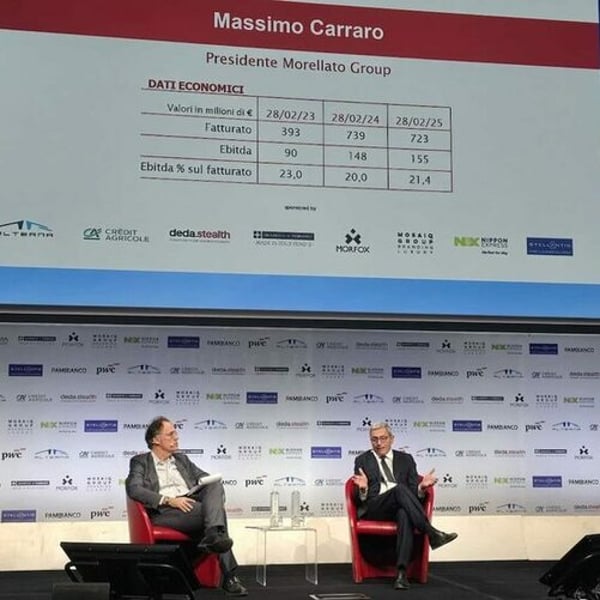
From the stage of the 30th Pambianco Fashion Summit, Massimo Carraro, chairman of Morellato Group, outlined the strengths and future goals of the €723 million group (financial year ended last February) he leads, whose origins date back to 1930, when it began as a small jewellery and watch workshop.
Massimo Carraro (right) on stage at the 30th Pambianco Fashion Summit with David Pambianco – FNW
“The turning point came in the mid-1990s, when we had the idea of ‘jewellery to live in’—not precious but beautiful and, above all, suited to the new lifestyles of women and, later, men,” the entrepreneur recalls. “Another successful intuition was to complement jewellery with watches, for the first time in the premium segment. Finally, the decision to open directly operated stores—first physical and then online—allowed us to gather data and consumer insights that have helped us perform well in wholesale, too.”
Today, Morellato Group owns 15 in-house brands (Morellato, Sector No Limits, Philip Watch, Lucien Rochat, Live Diamond, Oui&Me, La Petite Story, Chronostar, and FAVS), as well as the Italian chains Bluespirit and D’Amante and the international banners Christ (operating in Germany and Austria), Brinckmann & Lange, Cleor, and Noélie. There are seven brands under licence: Karl Lagerfeld, Maserati, Chiara Ferragni, Trussardi, Esprit, Jette, and Guido Maria Kretschmer.
“Acquisitions have been an important part of our growth, but they have also created a complex situation to manage. We have succeeded by integrating the entire supply chain: today we generate around 80% of our sales abroad, and all the products we sell worldwide are made in-house, sometimes even adapting them to different markets with flexibility,” Carraro explains. “In production terms, the most important country is still Italy, especially for gold; however, we have, for example, facilities in India for diamonds and in Thailand for sustainable silver.”
Another driver of growth for Morellato Group has been the decision in recent years to move increasingly into the world of fine jewellery, built to last, and into diamonds—”a strategy that has led to an increase in our average basket value,” the chairman notes.
“Finally, e-commerce has also played its part, now accounting for more than 20% of revenue; moreover, market research tells us that around 80% of customers who visit our stores have first browsed online, so most sales can be considered omni-channel,” adds Carraro, who, looking to the group’s future, says: “For the current financial year we should reach turnover of around €750 million, with EBITDA above 20%. We have always financed all our acquisitions independently; we believe we are ready to continue our growth and we have other opportunities in the European market in the pipeline.”
Looking further ahead, Morellato concludes: “We remain a family business today, although all the group’s companies now have external managers. We know that the family model, in the long run, can have its limits, so I do not rule out a stock-market listing or other types of transactions in the future.”
This article is an automatic translation. Click here to read the original article.
The demerger of Unilever‘s ice cream division, to be named ‘The Magnum Ice Cream Company,’ which had been delayed in recent months by the US government shutdown, will finally go ahead on Saturday, the British group announced.
Reuters
Unilever said in a statement on Friday that the admission of the new entity’s shares to listing and trading in Amsterdam, London, and New York, as well as the commencement of trading… is expected to take place on Monday, December 8.
The longest federal government shutdown in US history, from October 1 to November 12, fully or partially affected many parts of the federal government, including the securities regulator, after weeks without an agreement between Donald Trump‘s Republicans and the Democratic opposition.
Unilever, which had previously aimed to complete the demerger by mid-November, warned in October that the US securities regulator (SEC) was “not in a position to declare effective” the registration of the new company’s shares. However, the group said it was “determined to implement in 2025” the separation of a division that also includes the Ben & Jerry’s and Cornetto brands, and which will have its primary listing in Amsterdam.
“The registration statement” for the shares in the US “became effective on Thursday, December 4,” Unilever said in its statement. Known for Dove soaps, Axe deodorants and Knorr soups, the group reported a slight decline in third-quarter sales at the end of October, but beat market expectations.
Under pressure from investors, including the activist fund Trian of US billionaire Nelson Peltz, to improve performance, the group last year unveiled a strategic plan to focus on 30 power brands. It then announced the demerger of its ice cream division and, to boost margins, launched a cost-saving plan involving 7,500 job cuts, nearly 6% of the workforce. Unilever’s shares on the London Stock Exchange were steady on Friday shortly after the market opened, at 4,429 pence.
This article is an automatic translation. Click here to read the original article.
Burberry has named a new chief operating and supply chain officer as well as a new chief customer officer. They’re both key roles at the recovering luxury giant and both are being promoted from within.
Matteo Calonaci becomes chief operating and supply chain officer, moving from his role as senior vice-president of strategy and transformation at the firm.
In his new role, he’ll be oversee supply chain and planning, strategy and transformation, and data and analytics. He succeeds Klaus Bierbrauer, who’s currently Burberry supply chain and industrial officer. Bierbrauer will be leaving the company following its winter show and a transition period.
Matteo Calonaci – Burberry
Meanwhile, Johnattan Leon steps up as chief customer officer. He’s currently currently Burberry’s senior vice-president of commercial and chief of staff. In his new role he’ll be leading Burberry’s customer, client engagement, customer service and retail excellence teams, while also overseeing its digital, outlet and commercial operations.
Both Calonaci and Leon will join the executive committee, reporting to Company CEO Joshua Schulman.
JohnattanLeon – Burberry
Schulman said of the two execs that the appointments “reflect the exceptional talent and leadership we have at Burberry. Both Matteo and Johnattan have been instrumental in strengthening our focus on executional excellence and elevating our customer experience. Their deep understanding of our business, our people, and our customers gives me full confidence that their leadership will help drive [our strategy] Burberry Forward”.
Traditional and occasion wear designer Puneet Gupta has stepped into the world of fine jewellery with the launch of ‘Deco Luméaura,’ a collection designed to blend heritage and contemporary aesthetics while taking inspiration from the dramatic landscapes of Ladakh.
Hints of Ladakh’s heritage can be seen in this sculptural evening bag – Puneet Gupta
“For me, Deco Luméaura is an exploration of transformation- of material, of story, of self,” said Puneet Gupta in a press release. “True luxury isn’t perfect; it is intentional. Every piece is crafted to be lived with and passed on.”
The jewellery collection features cocktail rings, bangles, chokers, necklaces, and statement evening bags made in recycled brass and finished with 24 carat gold. The stones used have been kept natural to highlight their imperfect and unique forms and each piece in the collection has been hammered, polished, and engraved by hand.
An eclectic mix of jewels from the collection – Puneet Gupta
Designed to function as wearable art pieces, the colourful jewellery echoes the geometry of Art Deco while incorporating distinctly South Asian imagery such as camels, butterflies, and tassels. Gupta divides his time between his stores in Hyderabad and Delhi and aims to bring Indian artistry to a global audience while crafting a dialogue between designer and artisan.