Moët Hennessy and its former finance chief are embroiled in a legal dispute after the drinks company accused him of violating a non-disclosure agreement by allegedly leaking internal information related to a sexual-harassment case.
LVMH unit faces legal clash as ex-CFO challenges dismissal terms – DR
Mark Stead signed the NDA in July 2024 as part of a settlement agreement following his dismissal for alleged expense abuses, including a stay at a luxury hotel in New York. The settlement included severance benefits and required Stead to adhere to strict confidentiality and non-disparagement terms.
The company has since alleged that Stead provided confidential details to news outlet La Lettre in relation to its handling of a complaint filed by Maria Gasparovic, a former colleague and senior manager. During a hearing in Paris on Friday, Moët Hennessy’s legal representative claimed that the September 2024 article published by La Lettre contained information that could only have come from Stead.
Stead’s attorney, Eric Charlery, denied the allegations and described the dismissal as “a ploy,” arguing that the legal proceedings were intended to punish Stead for supporting Gasparovic. Charlery has asked the court to annul the NDA, which he claims prevents his client from speaking out about the harassment allegations affecting his partner. Stead is also pursuing claims for unfair dismissal and damages, with a total compensation request that may exceed €4 million ($4.7 million).
Charlery stated that Moët Hennessy escalated the situation by publicly accusing both Stead and Gasparovic in La Lettre of attempting to blackmail the company into a larger financial settlement. He argued that the accusation damaged Stead’s reputation and constituted a breach of the settlement’s non-disparagement clause.
“Mark Stead is now a pariah,” Charlery told the tribunal. “When a company run by Bernard Arnault accuses you of blackmail, word gets around.”
Moët Hennessy initially filed a lawsuit seeking €135,000 from Stead for breaching the settlement. The company has also filed a defamation complaint against Gasparovic.
The case comes amid a series of legal disputes at LVMH Moët Hennessy Louis Vuitton SE, the parent company of Moët Hennessy. The group has undergone a management reshuffle and staff reductions. In a separate case, a former digital sales executive recently sought €1.7 million in damages, alleging that he was dismissed for reporting sales to Russia that evaded sanctions. Gasparovic is also pursuing her own legal action against the company, which has, in turn, filed a defamation countersuit.
Charlery said that Stead had agreed to the NDA “to have peace,” but noted that the conflict has continued and Stead is now facing difficulties finding a comparable senior finance role.
LVMH did not respond to a request for comment. Charlery declined to comment further outside the courtroom. A ruling in Stead’s case is expected on Nov. 19.
Puma will supply team kit to Formula One champions McLaren this season in a multi-year global deal that also covers activities in IndyCar, World Endurance from 2027, virtual racing, and the all-female F1 Academy series. No financial details were given.
Formula One F1 – Abu Dhabi Grand Prix – Yas Marina Circuit, Abu Dhabi, United Arab Emirates – December 7, 2025 McLaren’s Lando Norris celebrates after becoming the 2025 Formula One World Champion – REUTERS/Jakub Porzycki
“Our sport is in incredible shape, and it’s been fantastic to see an influx of major fashion and lifestyle brands who are looking for deep and meaningful ways to engage with our growing global fanbase,” said McLaren Racing CEO Zak Brown.
McLaren previously had a deal with Castore, with some media reports suggesting that was worth 30 million pounds ($40.41 million) a year.
Puma also equip Ferrari and Aston Martin. Williams have meanwhile switched to US lifestyle brand New Era.
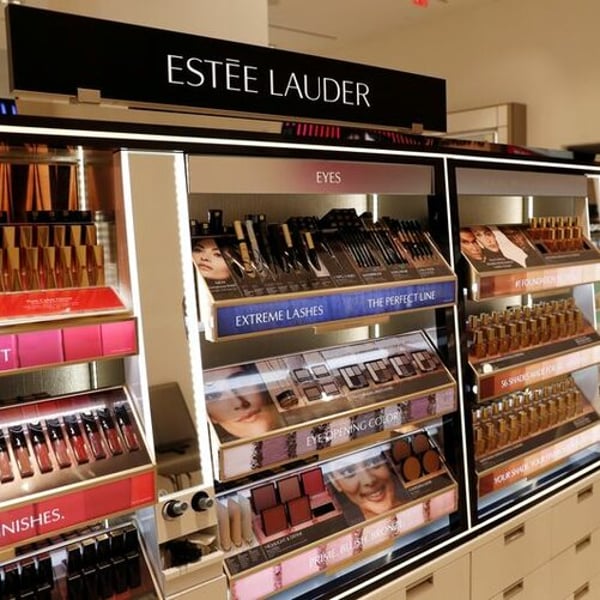
Estee Lauder was sued by a self-described “disruptive” startup that accused the cosmetics giant of effectively putting it out of business by stealing technology to boost sales from jet-setting travellers in hotels.
Nomi has accused Estee Lauder of stealing its technology – Bloomberg
In a complaint filed on Friday night in Manhattan federal court, Nomi Beauty said Estee Lauder has been “driving literally billions in new revenue” to itself after abandoning contracts in 2018 and 2020, including means to determine consumers’ actual preferences for cosmetics instead of their stated preferences.
Nomi- the name is a homophone for “know me,” as in the customer- said its “secret sauce” was intended to help the parent of Clinique and MAC lipstick generate more revenue from luxury hotel duty-free shops and in-room purchases, and become less dependent on traditional retail stores. Rather than honour its contracts or follow through on discussions to purchase Nomi outright, Estee Lauder allegedly starved Nomi’s hotel partners of products, while rolling out competing programs in China, Costa Rica, Malaysia, the UK and the US.
These programs “rely on the very same trade secrets Nomi had been educating Lauder about for years,” the complaint said. Nomi is seeking unspecified compensatory, punitive, and triple damages. Estee Lauder did not immediately respond to requests for comment.
“Nomi’s stolen innovations brought Estee Lauder into the information age, and Estee Lauder continues to profit from them wildly,” Nomi’s lawyer Matthew Schwartz said in an email. Both companies are based in New York.
Since last February, Estee Lauder has pursued a “Beauty Reimagined” strategy, including prestige launches and a streamlining of its supply chain, to revive sliding sales. The strategy also called for up to 7,000 job cuts.
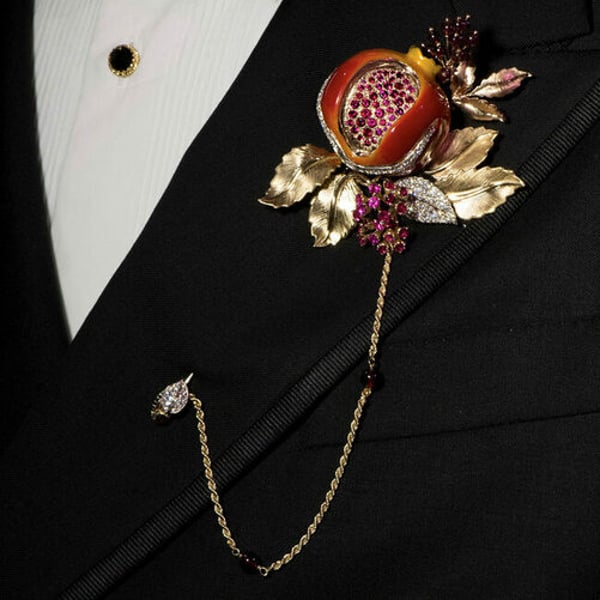
Long reserved for women or military dress, brooches adorned men’s chests during Milan Fashion Week, a throwback to a bygone era but with jewellery now signalling individuality, not just status.
A brooch by Dolce & Gabbana – Aleksej Shelikhov- Facebook
From huge flowers or watch brooches at Dolce & Gabbana to pins at Armani, the bling passed from hands to jackets during the fall/winter 2026/2027 shows in the Italian city.
“I like these small details, people have to pay attention to them,” said reggaeton star Rauw Alejandro, in the front row at Prada.
Chinese buyer John Chen, 45, sported a gold brooch in the shape of a triangle, the Milanese brand’s logo, on a green sweater just below his neck. “I started wearing brooches about five years ago. I like to play with them” to personalise outfits, he told AFP.
In Armani’s refined yet relaxed collection, some men sported a tie pin on their jacket lapel, while male and female models wore matching sparkling brooches. At designer Rowen Rose, a large orange stone was used to fasten a green or yellow scarf to a matching sweater.
“It gives an extra touch. It’s a good accessory- it’s become very masculine,” said Fabio Annese, a 26-year-old Milanese interior designer sporting a heart-shaped brooch at Dolce & Gabbana.
Known for its extravagant style, D&G has been selling brooches for men since entering the jewellery world in 2015, and they are “still important in more formal collections,” a spokesperson said. Among their offerings are crosses, crowns, scarabs, and flowers in gold and embellished with diamonds, the last costing a cool 7,500 euros (around $8,800).
The trend is in many ways a return to the past. In Europe, until the 18th century, the “most important” jewellery was worn by men, explained Emanuela Scarpellini, professor of contemporary history at the University of Milan.
Wealthy and powerful men used it as a sign of their status, the glittering accessories often signalling membership of a noble family or a religious order, or military rank. It was only with the rise of the middle-classes and businessmen in the 19th century that came “the idea that men should dedicate themselves to work, with a more sober attitude,” Scarpellini said at the launch of a new Milan exhibition.
“The Gentlemen,” on show at the Palazzo Morando until September, reveals how men’s jewellery since then usually served a purpose, such as watches, cufflinks and tie pins. Nowadays “there’s a new freedom,” as with clothing, said exhibition curator Mara Cappelletti, a professor of jewellery history.
“There are fewer jewellery pieces with a function, and more with a freer choice,” she told AFP. “Many of the objects men wear today were not designed for a male audience,” she said, adding that many were vintage. “The brooch has never been so popular.”
Cappelletti noted that the trend was boosted by singers and actors wearing a lot of jewellery, noting a photograph of Italian singer Achille Lauro sporting a huge white gold and diamond sculpted piece on his chest, with matching earrings. All provided by the jeweller Damiani, which sponsors the pop star.






 Politics8 years ago