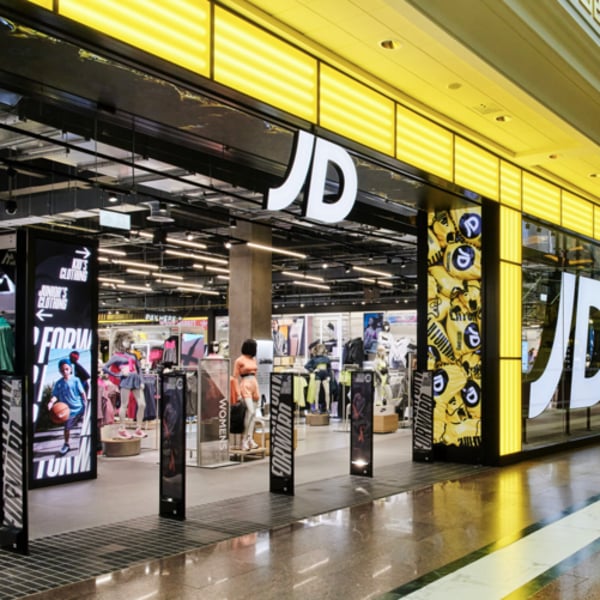
Retail giant JD Sports Fashion has issued a trading update for Q2 and the first half and while like-for-like (LFL) sales dipped in both periods, ‘organic’ sales rose (organic for JD refers to currency-neutral sales factoring out acquisitions). Importantly too, it said its new giant Manchester store is performing strongly.
And while many headlines chose to focus on the negatives, it’s perhaps significant that the firm’s share price rose almost 3% as the markets opened.
The company itself chose to focus on the improved LFL sales trend for Q2 in North America but said Europe and the UK combined were affected by “tough prior year comparatives” due to last year’s Euro 2024 football tournament (clearly the Women’s Euros this year didn’t have the same impact).
But it said it saw a good performance in apparel, although footwear was softer “given end of cycle for key product lines”.
JD also said it made “strong progress” against its strategic objectives across its omnichannel customer proposition, store footprint, supply chain and North America operations, and costs and cash are being “well controlled”.
It now expects FY26 profit before tax and adjusting items (PBTAI) to be in line with current market expectations, “albeit we continue to assess potential impacts from US tariffs”.
The numbers
So, let’s look at the actual figures for Q2 and H1. For the second quarter – the 13 weeks to 2 August – group LFL sales fell 3% but they rose 2.2% on an organic basis. That divided into a 2.3% LFL drop for North America but a 4.8% organic rise; a 1.1% LFL dip for Europe and a 5.4% organic increase; a 6.1% LFL drop for the UK and a 4.5% organic drop in its home market; and a 0.3% LFL increase for Asia pacific with a 9.3% organic rise there.
And for the first half – the 26 weeks to 2 August – group LFL sales fell 2.5% while they rose 2.6% organic. Again, looking at individual regions North America was down 3.8% LFL and up 3.1% organic; Europe dipped 0.4% LFL and rose 5.9% organic; the UK dropped 3.3% LFL and fell 1.8% organic; and Asia pacific was down 2.4% LFL and up 6% organic.
It’s clear from this that the UK remains a problem market for the company and that performances are much better in North America, Europe (even with the aforementioned tough comparatives) and the still-very-small Asia Pacific.
Looking at these regions in more detail for the second quarter, the company said it had plenty of activity in North America, its largest regional market (accounting for 36% of Q2 sales). DTLR and Shoe Palace took over the operations of 198 City Gear stores on 1 June; its new JD/Finish Line e-commerce platform went live in H1; and Shoe Palace’s Morgan Hill distribution centre (west coast of the US) went live in May, with JD/Finish Line planning to go live at the end of this year. This will make Morgan Hill the JD Group’s first multi-fascia distribution centre, “unlocking significant improvements in speed to store replenishment and online fulfilment”.
Its performance in the market was “resilient”, led by JD and DTLR, against strong Q2 comparatives. And it saw a “good performance in newer footwear lines (following a shift in the product launch schedule from Q1, as previously highlighted), partially offsetting the impact of key product lines being at the end of cycle”.
It also saw a “strong performance in apparel, albeit a smaller proportion of our category mix in North America”, and a “much improved overall online performance, supported by a better online range and focused marketing”.
In Europe, its group Heerlen distribution centre (in the Netherlands) “continues to ramp up”, and is on track to launch automation this year (for stores, with online to follow in H1 next year).
Europe is its second-largest regional market at 34% of sales with the UK third on 26% of sales. That said, the UK is hugely significant given that it contains a much smaller number of consumers than North America or Europe and therefore punches above its weight per head.
Both Europe and the UK faced difficult comparisons with last year when the Men’s Euros football tournament boosted sales of replica kits and saw healthy in-store cross-selling. Last year also saw strong sales of athletic footwear for women that were difficult to replicate.
But it talked up a “resilient underlying performance in apparel, supported by a strong product offer” and said footwear performance in both regions was supported by newer footwear lines (especially performance-based) and value-oriented footwear.
It also said it maintained in-store pricing disciplines in both regions. Controlled price investments were made in the online offer to boost its competitive position and increase engagement with online customers. This was reflected in higher European online traffic and conversion in Q2.
As for openings globally for the first half as a whole, it opened new JD fascia flagship stores in the UK (Trafford Centre, Manchester), North America (Las Vegas and Vancouver) and Asia Pacific (Melbourne), with “positive early learnings and strong results in particular from the Trafford Centre store”.
View from the top
CEO Régis Schultz said of all this: “We are making strong progress in developing our omnichannel customer proposition, store footprint and supply chain, and we are controlling our costs and cash effectively.
“Across our regions and fascias, in general we see a resilient consumer, albeit very selective on their purchases. We therefore remain cautious on the trading environment going into H2.
“We are well placed to continue growing our market share in the key growth regions of North America and Europe, and confident about the medium-term growth prospects for our industry.
“Reflecting this, we are reaffirming our commitment to enhanced shareholder returns, and announcing today a new £100 million share buyback following the successful completion of the first £100 million programme last month.”