On Friday, the fourth day of the womenswear ready-to-wear shows, Milan’s fashion scene showcased the breadth of its creativity with a packed programme in which a host of houses came to the fore, from established names and young labels to emerging talents, expressing a thousand and one facets of femininity. From Sportmax’s minimalist, chic woman to Blumarine’s romantic dark lady, via the sculptural matryoshka of Institution by Galib Gassanoff, spring/summer 2026 promises to be exciting.
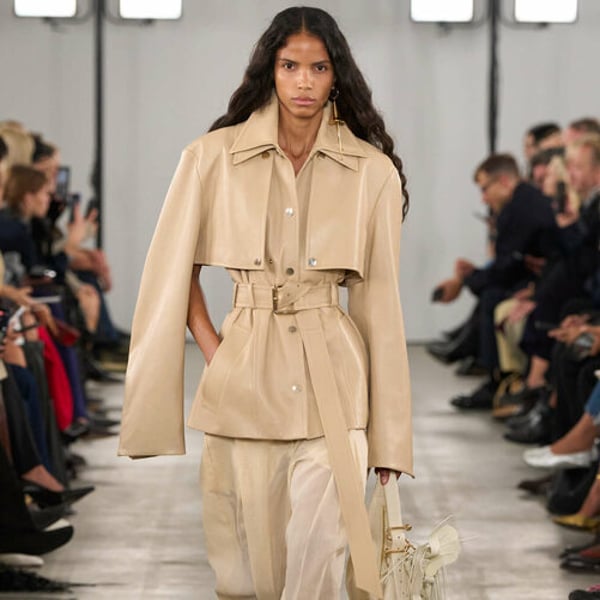
Sportmax opened proceedings early in the morning with a beautiful collection that struck the perfect balance between raw minimalism and a diffuse sense of softness. Most looks were monochrome, beginning with an ultra-light palette of powdery, nude and cream tones that caught the light, and moving through to head-to-toe black. Silhouettes were elongated, sometimes to excess, as with faded baggy jeans so long they coil around the ankles.
Highly structured trench coats, sleeveless maxi coats, double jackets and leather blousons are cut with precise lines in crisp wools, gabardines and supple leathers, falling straight down the body.
Yet the overall impression was one of lightness — of floating, even — heightened by the introduction of airy, sheer fabrics, such as satin silk that ripples through long, fluid dresses, or organza used to make T-shirts and trousers, to stand in for jacket panels to lighten them, or as fine layers superimposed on certain looks.
To emphasise movement, garments were often layered one over another or deconstructed, as in these long leather trench coats whose upper part detaches into a Perfecto-bolero, reminiscent of the shoulder capes of yesteryear under which one can slip the arms with complete freedom. A multitude of gilt bells worn as earrings, bracelets or necklaces also set the rhythm with a heady chime.
The Blumarine woman also revealed her dual personality, by turns romantic and dark, through a wardrobe full of contrasts — between flou and tailoring, soft and deep hues.
“I wanted to explore the idea of a Gothic romanticism transported into spring. Fragility and freedom clash with strength and power. It’s up to the audience to decide which of these two attitudes will prevail,” said creative director David Koma backstage, adding that in the end, “it’s the soft side that stands out more, supported by structure.”
The fluctuating aspect of the outfits and the play of transparencies tipped the balance towards a hyper-feminine, sensual aesthetic. Twirling ribbons and cascades of chiffon ruffles compose vaporous blouses, dresses and capes. Airy silks and chiffons were layered, sometimes gathered, smocked or fringed. Black lace and guipure steered everything towards a slightly sultry boudoir world. Large crosses in sparkling stones, worn as earrings or layered as multiple pendants, underscored this subversive streak.
The designer also called on the butterfly, the Italian house’s emblematic motif. With their colourful wings, a multitude alight as embroidery on a cardigan or on a sheer, flesh-toned dress. Elsewhere, a butterfly encircled the bust on a white lace bra-top. Sometimes it morphed into a dragonfly and — on closer inspection — even a spider.
The duality of the Blumarine woman was very much in evidence. The pagoda sleeves of the sinuous frock coats and peignoirs with long trains that dress her for evening were reminiscent of butterfly wings as they are of bat wings.
With his new brand Institution, Azeri-born Georgian Galib Gassanoff offered one of the most compelling propositions on the Milanese scene. This has not escaped the very select Milanese boutique Antonia, which is dedicating its windows to him this week. After a well-received debut collection in February, the designer pursued his project with coherence, offering more commercial pieces this season, which he will show next week in Paris at the Maison Pyramide showroom.
For next summer, Gassanoff continues to draw on the ancestral know-how of Azerbaijan, in particular the braiding technique used to make woven or knotted carpets. He reprised this process, replacing wool threads with reclaimed shoelaces to create sculptural dresses and tops. He also introduced reedmace (Typha latifolia), which grows in marshes and is woven by women in the south of the country. Working with these communities, he had them braid a series of majestic, swirling gowns and a poncho.
Another inspiration is the “chepken”, a traditional coat with oversleeves. The designer transformed this piece into a tailored jacket, nipped in and rounded at the sides. The curved shape recalls Christian Dior’s famous Bar suit, but here the construction was modernised. Two long panels of fabric fall from the shoulders like stoles, under which the arms can slip. In another version, the jacket was slit at the sides and these two false sleeves fold over the front, tied around the chest, transforming it into an elegant top.
A host of other ingenious ideas also proved alluring. Like a top whose front was covered with white wooden buttons from the archives of historic button-maker Ascoli Bottoni; smock-like organza overlays, puffed out at belly height, that encased the silhouette in different colours; or large apron-like leather plastrons, fashioned from long shoelace straps or various braids, worn hanging from the neck.
This article is an automatic translation. Click here to read the original article.
Next has won the bidding race to take over the Russell & Bromley premium footwear business, ending almost a century-and-a-half of family ownership.
Russell & Bromley
Working with bidding partner and stock clearance specialist Retail Realisation, it’s set to takeover the 147-year-old retailer under a pre-pack administration deal.
Crucially, it means 33 of the company’s standalone stores/outlets and nine concessions (many of them in Fenwicks branches) are likely to eventually close.
The extent of the challenges Russell & Bromley faced can be seen from the fact that this is only a £2.5 million cash deal. Next is also paying £1.3 million for some of the retailer’s current stock with Retail Realisation handling the clearance of the rest.
Assuming the deal gets court approval on Wednesday afternoon, Next will own the intellectual property and just three of the stores.
Those stores are in London’s Chelsea and Mayfair, as well as the Bluewater shopping centre in Kent. Interestingly, that Bluewater store is just a stone’s throw away from the former House of Fraser branch that this year will reopen as a Next megastore.
The remaining stores and concessions will continue to trade for “as long as [they] can” as Interpath’s Will Wright and Chris Pole “assess options for them”. Russell & Bromley currently has around 440 employees.
A source close to another bidder, Auralis, told The Times it was disappointing that its offer, which aimed to safeguard jobs and stores, wasn’t given greater priority by those running the sale.
Russell & Bromley CEO Andrew Bromley called the sale decision a “difficult” one but insisted it’s “the best route to secure the future for the brand… we would like to thank our staff, suppliers, partners and customers for their support throughout our history”.
So what are Next’s plans now. That’s not clear. There had been a lot of attention focused on its likelihood of closing the store chain in the run-up to the sale but on Wednesday, Next said that it will “build on the legacy” of the business and “provide the operational stability and expertise to support Russell & Bromley’s next chapter”.
Next had also been reported to be eyeing a similar deal for LK Bennett, but Sky News reported that it has stepped away from this.
It remains one of the most acquisitive retailers on the UK high street, however, and in recent years has bought brands such as Cath Kidston, Joules, FatFace, Made and Seraphine. It also has deals to handle other key brands in the UK market such as Gap, Victoria’s Secret and Laura Ashley.
Global asset management firm GoldenTree will buy a chunk of a $1 billion bankruptcy financing for luxury retailer Saks Global, Bloomberg News reported on Tuesday, citing people familiar with the matter.
A Neiman Marcus store, part of the Saks business – Neiman Marcus
GoldenTree, which is founded by billionaire Steve Tananbaum, has committed to buy a roughly $200 million portion of the so-called debtor-in-possession financing, according to the report.
Saks Global and GoldenTree did not immediately respond to Reuters requests for comment.
The high-end US department store conglomerate filed for Chapter 11 bankruptcy protection on January 13, after a debt-laden takeover.
Warped, a proudly Australian menswear brand, made its debut at the recent Pitti Uomo 109, unveiling its first-ever collection for Autumn–Winter 2026/27. Warped channels a strong, functional and authentic masculinity, free of artifice: a man capable of moving with equal ease through the Australian outback or a metropolis, without ever betraying himself. This vision translates into a collection that combines ready-to-wear, streetwear and active-functional pieces, underpinned by rigorous material research, responsible production, and a strong connection to Australia’s history and identity.
Jack Cassidy Williams, right, wearing Warped alongside one of his sons
The brand is so steeped in the free-spirited, authentic ethos of Mitch “Crocodile” Dundee, a cult figure of 1980s cinema who helped shape the image abroad of the no-nonsense Australian, that even the founder- who arrived in Milan with his two sons, aged 18 and 15, already active in the company- looks like the very character created by Paul Hogan.
“Crocodile Dundee is not just a film to us; it’s a way of being in the world. It’s about a man who hunts crocodiles with his bare hands in the outback and stays true to himself even under the dazzling lights of the metropolis,” Warped founder Jack Cassidy Williams explained to FashionNetwork.com. “It’s the story of a man who enters a sophisticated system without changing who he is. Functional, direct, honest. This is who we are. We’re not here to bend to fashion’s unwritten rules, but to bring our own way of doing things: less artifice, more reality.”
Warped
“Everything in the collection is handmade by my family. We design it, select the fabrics, create the patterns, and develop everything together- my children and I- in Australia. Traditional garments with modern finishes, in terms of handle and functionality; we even offer waterproof clothing, such as GOTS-certified waterproof cotton. Then there’s denim. All the fabrics are 100% made in Italy,” Cassidy Williams continues. At the heart of the collection is extensive fabric research: 100% RWS wool; high-stretch scuba fabrics and bi-stretch wool; cotton denim with a 3D weave effect; water-repellent cottons, viscose and viscose/linen blends for suits, jackets and trousers; high-performance, ultra-comfortable fabrics; and kangaroo-leather laces- a material five times as strong as cowhide- hand-finished with raw edges and authentic details.
“The collection is, in a way, a tribute to America, because the theme is the so-called ramblin’ man, or the free man; it’s basically about my whole life,” says the Australian entrepreneur. “All those people who decided to forge their own journey, to walk the path of life without following someone else. Like Hank Williams, Jack Kerouac, Duke Ellington, Bird, Muddy Waters, Pinetop, or Woody Guthrie- men who honoured life. Nowadays it’s so difficult to be free that freedom really is a state of mind. It’s our first collection through and through; we practically finished it before boarding the plane,” Cassidy Williams laughs heartily, then slips on a floppy wide-brimmed hat, slings a kangaroo hide over his shoulder and, as he pretends to crack a whip in the air, looks even more like Mitch Dundee- all after letting us taste a kangaroo salami and crocodile snacks…
Warped
“Our family has a textile tradition of great depth- more than sixty years- so Warped also works with the best global manufacturers in the mid-luxury segment: lace from France, fabrics from Italy, and other high-quality materials sourced from factories in Turkey, Japan and Korea,” Jack Cassidy Williams continues. “These factories were chosen not for trend’s sake, but because they’re unique- each one different from the next.”
Warped’s menswear collection for Autumn–Winter 2026/27 comprises around 40 looks spanning ready-to-wear, streetwear, and active-functional pieces. Jackets, suits, trousers, shorts, shirts, and T-shirts sit alongside a street and sportswear offer that includes hoodies, joggers and technical garments, all designed to be comfortable, durable, easy to care for, and genuinely wearable day to day.
Alongside the Warped men’s line, the company presented the Golden Age Sportswear (G.A.S) label in Milan, while the Warped Woman, and G.A.S Woman’s Street collections will debut in Italy from next Spring/Summer.
This article is an automatic translation. Click here to read the original article.