
Fashion
Milan opens in style with Armani’s exhibition and Diesel’s treasure hunt

Published
September 24, 2025
For once, Milan Fashion Week opened on Tuesday with a series of events beyond the traditional catwalk shows. On the one hand, there was the inauguration at the Pinacoteca di Brera of a magnificent exhibition dedicated to Giorgio Armani’s creations drawn from his archives; on the other, an unusual immersion in a field strewn with giant eggs at Diesel. And let’s not forget Demna’s film at Gucci, featuring a host of Hollywood stars.
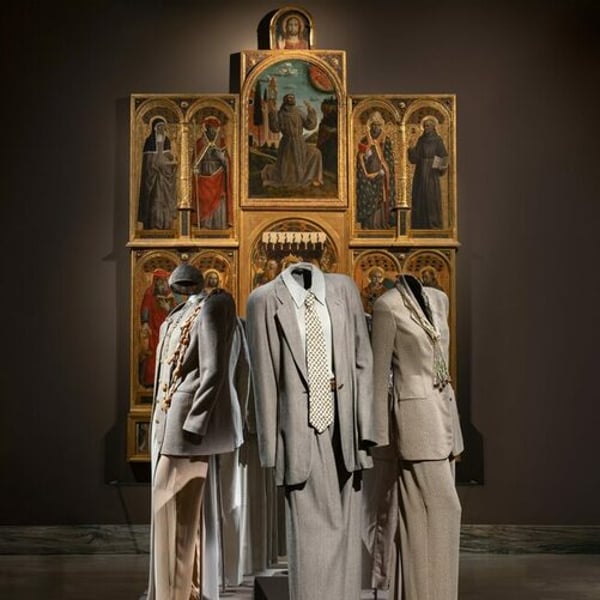
A year ago, the Pinacoteca di Brera approached Giorgio Armani with the idea of organising a retrospective of his work to mark the 50th anniversary of his fashion house. The concept? To showcase his creations in the prestigious museum. The result is an exhibition of great finesse, reflecting his quietly elegant, fluid fashion, perfectly integrated into this unique setting that celebrates beauty.
Forget haute couture! To stand alongside the masterpieces of the Italian Rinascimento, from Raphael to Piero della Francesca, Botticelli, Titian, Mantegna and Tiepolo, Giorgio Armani opted for a discreet, respectful approach to the treasures housed by the Milanese institution.
Altogether, 129 silhouettes from Armani’s wardrobe for women and men, designed for everyday wear, have been selected from his archives, spanning his beginnings in the 1980s to the present day. Each one is strikingly modern.
The exhibition “Giorgio Armani: Milano, Per Amore”, which runs until January 11, reinvents the visitor journey, rather like attending a catwalk show, moving from rigorous tailoring to eveningwear in a stimulating dialogue between fashion and art. A little like the “Louvre Couture” exhibition held in Paris earlier this year. But in the case of Giorgio Armani and the Pinacoteca di Brera, the premise feels far more pertinent.

Clothes take shape before our eyes, as if worn in motion by floating, transparent mannequins. They sway, surge and seem to whirl through the rooms, where they are most often grouped on a central island in small clusters, so as not to obstruct circulation. Like fleeting shadows or discreet visitors, they enliven the space with delicacy. Their placement has been chosen with meticulous care according to the colours, materials, particular details and the works on display.
A series of light-grey suits and trouser suits in linen or lightweight wools, cut fluidly, echo the pale drapery of the veiled women praying in Gentile and Giovanni Bellini’s great painting “Saint Mark Preaching in Alexandria”. One of the Pinacoteca’s recreated chapels, with its Quattrocento frescoes, houses a 1989 jacket-and-trouser ensemble in black silk velvet, whose collar extends into the back as a white square decorated with Maltese crosses.
Elsewhere, a look with a long Prussian-blue velvet shawl from 1997 turns its back to us, as if absorbed by the paintings it faces. The room dedicated to Caravaggio, with the legendary “Supper at Emmaus”, plays on chiaroscuro with black outfits illuminated by rhinestone and pearl embroidery. Around a bend in the corridor stands Richard Gere’s unforgettable seducer look for the 1980 film “American Gigolo”, apparently come incognito to admire the paintings by Bernardino Luini and Vincenzo Foppa.

A change of pace at Diesel. To present its spring-summer 2026 collection, the label has swapped its catwalk show for a playful, galactic presentation. In the large courtyard of its Milan headquarters, the flagship brand of Renzo Rosso’s Italian group OTB installed 55 giant plastic eggs, each housing a look from the collection worn by flesh-and-blood models. These formed the components of a life-size interactive urban game, which will kick off as soon as the presentation ends.
Lorries parked outside were waiting to take eggs and mannequins to the four corners of the city, to the most unexpected places—bars, churches, sex shops, and hotels—to set in motion a gigantic treasure hunt, the Diesel Egg Hunt, for which over 4,000 participants have signed up.
Equipped with a dynamic map guiding them to the various looks, they will take the Lombard capital by storm throughout the evening, meeting up at the end of the route in Piazza Beccaria, in the city centre, where the brand has set up a rendezvous point with live music, a bar and entertainment. The first five to arrive will be able to choose a look from the collection, which will be tailor-made for them, while other prizes are planned for the next twenty or so winners.

“We’ve staged some fairly spectacular shows in recent seasons; this time we wanted to surprise our audience with something new that really involves the whole city and our fans. It’s also a way of making fashion more democratic. In fact, it was so stressful to organise that next time we’re going back to the catwalk format!” confided creative director Glenn Martens, smiling as he hides between two eggs.
The designer, already stretched by the collection he must also prepare for Maison Margiela, continues his work on denim, multiplying his explorations of texture. A treatment applied to the inside of the blue denim garment creates tie-dye flame effects on the outside. Another denim is woven with a double viscose-satin thread, brought particularly to the fore. Elsewhere, laser-cut pockets accentuate the garment’s deconstruction.
Some fabrics are faded, as in this oversized T-shirt tunic with washed-out slogans. Many outfits are deliberately crumpled and worn for an overall distressed effect. Floral motifs appear on tights pulled over pumps, on draped skirts and tops, or on light chiffon dresses worn two at a time, one over the other.
The wild streak is never far away in Diesel collections, highlighted here by panels of imaginary animal skins used as patches, placed at chest level or over briefs, linking the top and bottom of a dress, Bermuda shorts or a T-shirt. This animal side also appears in the jewellery, with ominous salamanders climbing up the ears and snake skeletons coiling round the neck as necklaces.
This article is an automatic translation.
Click here to read the original article.
Copyright © 2025 FashionNetwork.com All rights reserved.

Published
December 5, 2025
Burberry has named a new chief operating and supply chain officer as well as a new chief customer officer. They’re both key roles at the recovering luxury giant and both are being promoted from within.
Matteo Calonaci becomes chief operating and supply chain officer, moving from his role as senior vice-president of strategy and transformation at the firm.
In his new role, he’ll be oversee supply chain and planning, strategy and transformation, and data and analytics. He succeeds Klaus Bierbrauer, who’s currently Burberry supply chain and industrial officer. Bierbrauer will be leaving the company following its winter show and a transition period.

Meanwhile, Johnattan Leon steps up as chief customer officer. He’s currently currently Burberry’s senior vice-president of commercial and chief of staff. In his new role he’ll be leading Burberry’s customer, client engagement, customer service and retail excellence teams, while also overseeing its digital, outlet and commercial operations.
Both Calonaci and Leon will join the executive committee, reporting to Company CEO Joshua Schulman.

Schulman said of the two execs that the appointments “reflect the exceptional talent and leadership we have at Burberry. Both Matteo and Johnattan have been instrumental in strengthening our focus on executional excellence and elevating our customer experience. Their deep understanding of our business, our people, and our customers gives me full confidence that their leadership will help drive [our strategy] Burberry Forward”.
Copyright © 2025 FashionNetwork.com All rights reserved.
Published
December 5, 2025
Traditional and occasion wear designer Puneet Gupta has stepped into the world of fine jewellery with the launch of ‘Deco Luméaura,’ a collection designed to blend heritage and contemporary aesthetics while taking inspiration from the dramatic landscapes of Ladakh.
“For me, Deco Luméaura is an exploration of transformation- of material, of story, of self,” said Puneet Gupta in a press release. “True luxury isn’t perfect; it is intentional. Every piece is crafted to be lived with and passed on.”
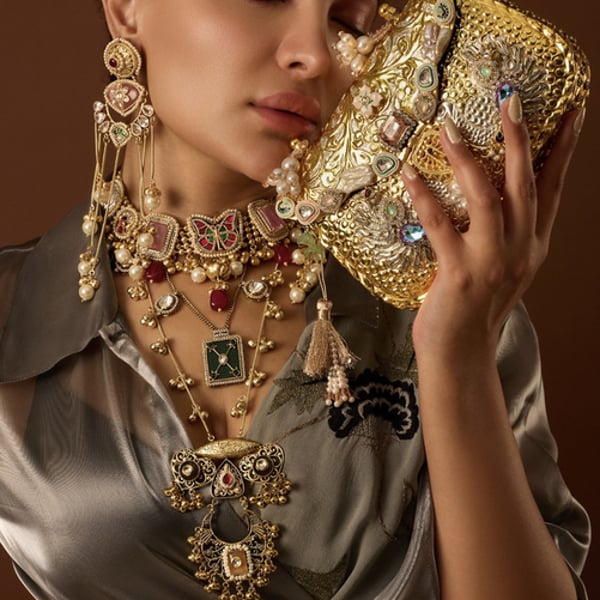
The jewellery collection features cocktail rings, bangles, chokers, necklaces, and statement evening bags made in recycled brass and finished with 24 carat gold. The stones used have been kept natural to highlight their imperfect and unique forms and each piece in the collection has been hammered, polished, and engraved by hand.

Designed to function as wearable art pieces, the colourful jewellery echoes the geometry of Art Deco while incorporating distinctly South Asian imagery such as camels, butterflies, and tassels. Gupta divides his time between his stores in Hyderabad and Delhi and aims to bring Indian artistry to a global audience while crafting a dialogue between designer and artisan.
Copyright © 2025 FashionNetwork.com All rights reserved.


‘Bachelor’ Winner Cassie Randolph Marries Brighton Reinhardt

Kanye West and Bianca Censori Travel to South Korea Together

SpaceX to offer insider shares at record-setting $800 billion valuation
-

 Politics8 years ago
Congress rolls out ‘Better Deal,’ new economic agenda
-
Entertainment8 years ago
New Season 8 Walking Dead trailer flashes forward in time
-
Politics8 years ago
Poll: Virginia governor’s race in dead heat
-
Entertainment8 years ago
The final 6 ‘Game of Thrones’ episodes might feel like a full season
-
Entertainment8 years ago
Meet Superman’s grandfather in new trailer for Krypton
-
Politics8 years ago
Illinois’ financial crisis could bring the state to a halt
-
Business8 years ago
6 Stunning new co-working spaces around the globe
-
Tech8 years ago
Hulu hires Google marketing veteran Kelly Campbell as CMO