Connect with us

Fashion

Milan menswear Sunday: Domenico Orefice, Qasimi, Victor Hart, Santoni, and Tod’s
Published

on


Published


January 19, 2026

Sunday witnessed two striking runway debuts – Domenico Orefice and Victor Hart, a touching display by Qasimi and two very fine presentations by key Italian marques, Santoni and Tod’s.
 

Domenico Orefice: Italy has a new fashion cult

Domenico Orefice is a Neapolitan designer who hangs out in Tuscany but just staged his first runway show in Milan.

Domenico Orefice – Fall-Winter2026 – 2027 – Menswear – Italie – Milan – ©Launchmetrics/spotlight

Even before the debut, Orefice had built a cool cult following and Italian fashionistas fascinated by the dark glory of his clothes.
 
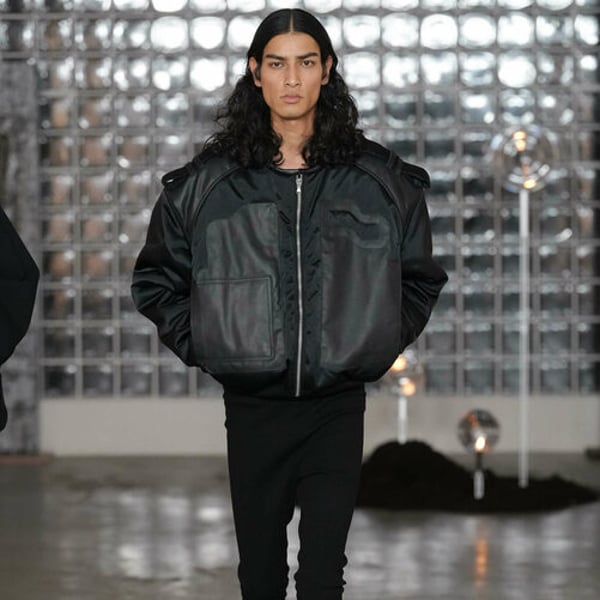
Targeted at clubbers and night-owls, this autumn 2026 collection bristled with attitude. Opening this display with a rockstar blouson paired with a mega-high shaggy collar worn with leggings and piratical boots. The first of many bold jackets – furnished with funnel necks.  His dark green flight jacket had such a huge collar when it splayed open it became like a cape.

For gals, he whipped up trompe l’oeil white cotton shirts featuring pearl necklaces and ties; or cotton piqué dresses shirts completed by shearling cummerbunds. Best of all, a rust-hued distressed leather jacket that looked like it had been unearthed somewhere, so bold was the attitude.

Domenico Orefice – Fall-Winter2026 – 2027 – Menswear – Italie – Milan – ©Launchmetrics/spotlight

Judging from this, no wonder that Dover Street marketed its first big order of Domenico Orefice last year.
 
All presented in the nerve-center of the next generation in Italian fashion, the Carla Sozzani Foundation in north Milan, where the rhythmic art of her partner Kris Rus provided the perfect backdrop to Orefice’s edgy fashion art. Because that is what it is.
 

Victor Hart: Denim dandies

On a chilly Sunday, a select few gathered to enjoy the debut runway on the official calendar of Victor Hart. 

Victor Hart – Fall-Winter2026 – 2027 – Menswear – Italie – Milan – ©Launchmetrics/spotlight

 
It’s a novel, denim-driven brand founded by Victor Reginald Bob Abbey-Hart, a Ghanaian designer who has made his home in Paris. A graduate of the city’s Haute Future Fashion Academy, Victor has a very definite point of view when it comes to denim.
 
His big idea was developing some bold denim jacquards coats and cloaks, several of them worn proudly by members like Carlo Capasa, the president of the Camera della Moda, Italian fashion’s governing body, which controls all runway seasons in Milan.
 
Staged by some 200 people in a redeveloped south Milan factory, with even more people crowding around the entrance outside, the show had considerable charm. Inside, a little bit amateur hour, as the show music stopped and started twice, before the first model finally appeared.

Victor Hart – Fall-Winter2026 – 2027 – Menswear – Italie – Milan – ©Launchmetrics/spotlight

Using a great casting, Victor sent out all manner of denim treatments – mock muddy, streaky or blotched – in a collection of hipster, hybrid workwear. Oversized safari; ballooning carpenters’ pants; slit at the side warehouse coats; priestly soutanes.
 
All word by models, brilliantly made-up with vertical black stripes down their faces, or silver smears on jowls or necks.  And topped with a mix of fedoras or electric blue woollen beanies with gold pins, worn at a jaunty tilt Simon Adebisi-style. Which is how Victor wore his when he took his bow to a very warm ovation.
 

Qasimi: Mode as memories

Sunday morning opened with the latest collection from Qasimi, a brand that marries Gulf inspirations with Western designs.

Qasimi – Fall-Winter2026 – 2027 – Menswear – Italie – Milan – ©Launchmetrics/spotlight

Though often evoking architectural, offset loops, spirals and overhanging fabric made the clothes fluid and full of motion. Many looks fluttered as the models marched by in this autumn/winter 2026 collection, staged in a former factory on Via Tortona in south central Milan.
 
Asymmetric layering was the key to the collection, where lapels varied in length, shoulders sprouted single scarves and sleeves often seemed to have a life of their own.
 
It could have been a mess, but in designer Hoor Al Qasimi’s capable hands, it became an evocative time capsule, where the clothes conjured up distant reminiscences. All staged underneath Lebanese artist Dala Nasser’s undulating natural dyed hangings.

Qasimi – Fall-Winter2026 – 2027 – Menswear – Italie – Milan – ©Launchmetrics/spotlight

The collection, Hoor explained, “reflects on how memory lives within clothing. Each garment becomes a vessel – carrying fragments of the past, acts of repair, and the quiet way we protect what we hold onto.”
 
A touching reference to this brand’s own particular history, seeing as its founder Khalid bin Sultan died so tragically early, aged 39. Though his gentle legacy lived on elegantly in this show today in Milan.
 

Santoni: Patina with rugged 

Santoni has always made very classy shoes, notable for their unique Velatura patina. This season, it combined all that with a dash of more rugged chic.

Santini fall/winter 2026 collection
Santini fall/winter 2026 collection – FashionNetwork.com

Like its superb new Karl Ice mountain boot. Finished on top with mountain hooks and chunky laces; underneath with a remarkable Cervino sole, where an orange frame can be flipped from a smooth surface to a steel pointed version. Perfect for navigating icy conditions.
 
The house employed the same technique on the very smart Carlo Boot where loafer meets upper in a happy marriage. 
 
Santoni’s sense of sheer excellence always impresses. As some remarkable work by artisans moulding a skin for scores of hours managed to develop a remarkable new lace-up whose upper has no side stitches. Unheard of before in footwear. Underneath their colleagues then hand nailed tiny brass nails on the perimeter of the sole. Think – footwear as an objet d’art.
 
The house even laid on a swish cocktail bar, where one could celebrate the best boots of the season: glistening brown, custom-made, bespoke crocodile lace-up gentlemanly hiker boots. Don’t expect much change out of $15,000 if you want to order a pair.
 

Tod’s: Expect the Winter Gommino to rule the coming Winter Olympics

Few boots seem more right for this season than the Winter Gommino, Tod’s chunky bootie, presented in multiple shades this Sunday.

Tod's autumn/winter 2026 collection
Tod’s autumn/winter 2026 collection – Courtesy

 
They were the keynote to a swish presentation inside Villa Necchi, Milan’s most famous modernist villa, whose entrance featured a team of four artisans making pairs by hand in suede, antiqued leather or even cashmere.
 
“We wanted to underline the meticulous attention to detail needed to make a pair of Winter Gommino and highlight the excellence of the leather we used,” explained Tod’s patron and CEO, Diego Della Valle.
 
With excitement building daily in northern Italy for next month’s games, the Winter Gommino seems like an ideal companion for cold winter days in the mountains.
 

Tod's autumn/winter 2026 collection
Tod’s autumn/winter 2026 collection – Courtesy

While in terms of ready-to-wear, the focus was on Tod’s Pashmy, a soft rare leather that evokes the famed fine wool of the Himalayas. Used with aplomb in the latest Coach Jacket or in a blazer with patch pockets dubbed, the Castello Jacket. 
 
Not a bad look for some après ski.
 

Copyright © 2026 FashionNetwork.com All rights reserved.


Source link

Continue Reading

Fashion

Europeans present united front against Donald Trump’s threats of punitive tariffs

Published

on


Published


January 19, 2026

Donald Trump continues to destabilise the international economic balance. On Saturday, the U.S. president once again strained relations with his longstanding partner, Europe.

Donald Trump at the White House, Washington, D.C. (United States), 16 January 2026 – AFP

In a lengthy statement on his social network, Truth Social, Trump threatened eight countries, including France, Germany and the UK, with additional tariffs in response to their opposition to his plans to seize Greenland, provoking indignation across Europe. On Sunday, ahead of a meeting of European Union (EU) ambassadors in Brussels, they responded by insisting they would remain “united.”

“Tariff threats undermine transatlantic relations and risk leading to a dangerous spiral. We will continue to remain united and coordinated in our response. We are determined to defend our sovereignty”, said Denmark, Finland, France, Germany, the Netherlands, Norway, Sweden and the UK.

Since his return to office a year ago, the American president has regularly spoken of taking control of the vast autonomous Danish territory, citing national security concerns in the face of Russian and Chinese advances in the Arctic.

He stepped up his rhetoric again on Saturday, following the dispatch in recent days of European troops to the vast island, as part of Danish manoeuvres.

“Denmark, Norway, Sweden, France, Germany, the United Kingdom, the Netherlands and Finland have travelled to Greenland for an unknown purpose. (…) These countries, playing this very dangerous game, have taken an unacceptable risk,” wrote the American president on Truth Social. “After centuries, it is time for Denmark to return it – world peace is at stake!” he thundered.

He threatened these countries with new tariffs until “an agreement is reached for the full and complete sale of Greenland.”

This 10% surcharge will take effect from February 1 and could rise to 25% by June 1. Since August 7, the United States has applied a floor rate of 15% for products originating in the European Union.

Before the return of the Trump administration, rates, particularly in the fashion sector, were generally below 7%. The current situation is likely to add to the uncertainty over customs arrangements. If Trump follows through on these threats, rates could potentially rise to 25% on February 1 and 40% on June 1.

‘Dangerous spiral’

The Republican has deployed trade barriers as a blunt instrument in international relations, including against Washington’s traditional partners. But he is taking an unprecedented step here: the United States, a pillar of NATO, is threatening its allies with sanctions in order to seize a territory belonging to one of its partners, Denmark, a sovereign and democratic country.

The European Union warned against a “dangerous spiral.”

“A very bad thing,” said British Prime Minister Keir Starmer, while his Swedish counterpart, Ulf Kristersson, asserted: “We will not be intimidated.”

The move was also condemned by Emmanuel Macron. “Tariff threats are unacceptable and have no place in this context. Europeans will respond in a united and coordinated way if they are confirmed. We will ensure that European sovereignty is respected,” wrote the French president on X, on Saturday evening.

“As members of NATO, we are determined to strengthen Arctic security, a common transatlantic interest,” the eight European countries said in a joint statement on Sunday.

“The pre-coordinated Danish exercise ‘Arctic Endurance’, conducted with our allies, meets this need. It poses no threat to anyone,” they stressed.

“We express our full solidarity with the Kingdom of Denmark and the people of Greenland. Building on the process begun last week, we are ready to engage in a dialogue based on the principles of sovereignty and territorial integrity that we firmly defend,” they added.

One of Greenland’s most prominent government ministers, Naaja Nathanielsen, welcomed the strong reactions, saying she was “grateful and full of hope.”
Danish foreign minister, Lars Løkke Rasmussen, said he was “surprised” by Trump’s announcements. Trump, who has said that he would “one way or another” seize Greenland, nevertheless said he was “immediately open to negotiations with Denmark and/or other European countries.”

‘Not for sale’

Danish and Greenlandic leaders were received in Washington on Wednesday, with Copenhagen noting the impossibility of reaching an immediate agreement.

Demonstration in Nuuk on January 17
Demonstration in Nuuk on January 17 – AFP

In Denmark and Greenland, several thousand demonstrators gathered on Saturday to denounce these territorial ambitions. In the centre of Nuuk, the capital of Greenland, protesters gathered under a light drizzle, wearing caps stamped “Make America Go Away” (a play on the MAGA slogan) and singing traditional Inuit songs, an AFP journalist observed on the ground.

In Copenhagen, a red-and-white human tide, in the colours of the Greenlandic and Danish flags, marched in front of the U.S. embassy, chanting the name of Greenland in Greenlandic: “Kalaallit Nunaat!” “Greenland is not for sale,” chanted demonstrators.

While the United States considers that Denmark is unable to guarantee security in the region, the Danish government points out that it has invested almost 90 billion kroner (12 billion euros) to strengthen its military presence in the Arctic.

France, Sweden, Germany and Norway, joined by the Netherlands, Finland, Slovenia and the UK, sent military personnel to the island this week for a reconnaissance mission as part of the Danish “Arctic Endurance” exercise organised with NATO allies.

According to the latest poll published in January, 85% of Greenlanders are opposed to Greenland becoming part of the United States. Only 6% are in favour.

With AFP

This article is an automatic translation.
Click here to read the original article.

Copyright © 2026 FashionNetwork.com All rights reserved.


Source link

Continue Reading

Fashion

Walmart reshuffles executive team ahead of Furner’s takeover as global CEO

Published

on


By

Reuters

Published


January 19, 2026

Walmart announced a series of executive changes on Friday as John Furner prepares to take over as CEO of the world’s largest retailer on February 1, replacing Doug McMillon.

Archivo

The moves aim to maintain the Bentonville, Arkansas-based retailer’s growth momentum and bellwether position in the industry by promoting four longtime executives and expanding their responsibilities.

David Guggina will become ‌CEO of Walmart’s largest division, Walmart U.S., replacing Furner in that role. Currently serving ​as chief e-commerce officer of Walmart U.S., Guggina has spent nearly eight years at the retailer in various positions, including executive vice president of supply chain operations.

The U.S. CEO position is highly coveted, as Walmart ‍typically promotes leaders from this division, which generates around two-thirds of its annual revenue, to the top corporate job.

Walmart also promoted Chris Nicholas to CEO of its $100 billion Walmart International division, a day after announcing that current head Kathryn ⁠McLay would leave the company. Nicholas currently leads Sam’s Club, where he will be replaced by the ‍chief merchandising officer for Walmart U.S., Latriece Watkins.

Additionally, Seth Dallaire, currently Walmart U.S. chief growth officer, will expand his responsibilities globally ‌as ‌chief growth officer of Walmart Inc, the company said in a statement.

All leadership changes take effect on February 1.

“These leadership changes mark a key step in how we organize for the future. Even the best teams need the right structure to win,” Furner said.

According to a company filing, Furner’s annual base salary is set at $1.5 ⁠million. He will receive ⁠a one-time stock award ​worth $10 million and be eligible for an annual equity award valued at approximately $17 million in fiscal 2027.

The moves come at a critical time for Walmart as it navigates domestic inflation pressures and strains on lower-income U.S. households. President Donald Trump‘s volatile ‍trade policies have weighed on the company’s operations and supply chain relationships with key growth markets, including China, India, and Mexico.

Despite these challenges, Walmart has performed strongly. The company has reported quarterly revenue growth for nearly a decade straight, and its shares ​hit a record high this week. The stock gained 21% in ‍2025, significantly outpacing the 1.3% rise in the S&P 500 Consumer Staples index. Walmart’s shares were flat at $118.67 in morning trading on ​Friday.

© Thomson Reuters 2026 All rights reserved.


Source link

Continue Reading

Fashion

EU and Mercosur sign ‘historic’ trade agreement

Published

on


Published


January 19, 2026

The Latin American countries of Mercosur and the European Union signed a “historic” treaty in Paraguay on Saturday, creating one of the world’s largest free-trade zones, despite concerns within both blocs. Together, they account for 30% of global GDP and more than 700 million consumers.

The free trade agreement between the European Union and Mercosur was signed on Saturday in Paraguay. – AFP

The agreement had been under negotiation since 1999 between the EU and the founding countries of Mercosur (Argentina, Brazil, Paraguay and Uruguay). A majority of EU member states have recently backed it, despite opposition from several, including France. Numerous demonstrations against the treaty have taken place in several EU countries, while large sections of civil society in Mercosur countries are also opposed.

“We choose fair trade over tariffs, a long-term productive partnership over isolation,” declared president of the European Commission, Ursula von der Leyen, shortly before signing the agreement.

“And above all, we intend to deliver concrete, tangible benefits to our people and our businesses,” she added.

It is a “clear signal in favour of international trade” in a context of “tensions”, said Santiago Peña, President of Paraguay, who currently holds Mercosur’s rotating presidency.

The treaty eliminates tariffs on more than 90% of bilateral trade and boosts European exports of cars, machinery, chemicals, wines and spirits. In return, it eases access to the European market for South American beef, poultry, sugar, rice, honey and soya beans, with duty-free quotas that are causing alarm among affected sectors.

The agreement comes at a time when U.S. President Donald Trump has spent the past year increasing a range of U.S. tariffs. On Saturday, Trump threatened to impose further tariffs of up to 25% on products from a number of European countries, “until the outright sale of Greenland.”

European and South American opponents

The president of the European Council, António Costa, said in Asunción on Saturday that the agreement sent “a message of defence of free trade, based on rules, multilateralism and international law as the basis for relations between countries and regions”, in contrast to the “instrumentalisation of trade for geopolitical ends.”

For its supporters, the EU-Mercosur agreement will help revive Europe’s ailing economy and strengthen diplomatic relations with Latin America.

But some also see the signing as a threat to sectors on both sides of the Atlantic. In South America, observers remain wary of the treaty’s effects, particularly on local industrial companies. In Argentina, the impact on the automotive industry could result in the loss of 200,000 jobs, according to estimates, notes Luciana Ghiotto, who holds a doctorate in social sciences from the University of Buenos Aires.

For its European detractors, it will disrupt agriculture with cheaper products that do not necessarily comply with EU standards, due to insufficient controls. It has met resistance from farmers and livestock producers in a number of European countries, who have mobilised in large-scale protests against its signing, in France, Poland, Ireland and Belgium.

To calm anger in the sector, the European Commission has drawn up a series of clauses and concessions in recent months, including strengthened guarantees for the most sensitive products. A large farmers’ rally is scheduled for next Tuesday in Strasbourg, outside the European Parliament, which must still vote on the treaty in the coming months.

However, beyond agriculture, the signing has pleased European business representatives. European business, which represents 28 European industry associations (ranging from construction to services, and also including the textile, clothing and footwear industries), welcomed the agreement on Saturday.

Euratex has been advocating for the agreement for months.

“According to Euratex data, in the first seven months of 2025, EU textile and clothing exports to Mercosur reached 299.5 million euros, an increase of 4.4% compared to the same period in 2024,” the federation noted in the autumn.

“Clothing exports saw a particularly strong rise, up 9.2%, while textile exports increased by 2%.”

A similar tone can be heard across many organisations. European business argues that “by 2040, the agreement is expected to add 77.6 billion euros to EU GDP, translating into a 39% increase in EU exports to Mercosur.”

Buoyed by the potential for their industries, the federations are now calling on MEPs to ratify the text.

Strasbourg is, therefore, likely to come under heavy pressure from both supporters and opponents of the agreement in the months ahead.

With AFP

This article is an automatic translation.
Click here to read the original article.

Copyright © 2026 FashionNetwork.com All rights reserved.


Source link

Continue Reading

Trending

Copyright © Miami Select.