Miami Beach Commissioners will soon decide whether to sue Florida over a sweeping land-use preemption bill that city leaders say strips local control from development decisions and sidelines residents from the approval process.
The panel is to vote on Wednesday on a resolution by Commissioner Alex Fernandez that would authorize City Attorney Ricardo Dopico to pursue “any and all necessary and appropriate legal action” challenging HB 399, which lawmakers approved last week amid bipartisan opposition.
At issue is a section of the bill creating a new category for “large destination resorts,” which could require cities like Miami Beach to approve certain development applications without the usual public hearings or discretionary review by local Boards.
Under HB 399, qualifying resorts — defined as properties spanning at least five contiguous acres, with 500 or more rooms and a 70% average occupancy rate over three years — could bypass traditional zoning processes when seeking special exceptions or variances.
Miami Beach officials argue that the provision would override the city’s land development regulations and eliminate meaningful opportunities for residents to weigh in on key local development decisions.
“Clearly this bill egregiously interferes with our residents’ right to public input and local land use authority,” Fernandez told Florida Politics.
“If this is signed into law, I want Miami Beach to be prepared to defend the rights of our residents and the city’s responsibility to govern.”
HB 399 is part of a broader, multi-year push by state lawmakers to supersede local zoning authority, which supporters — like the bill’s sponsor, Hialeah Republican Rep. David Borrero — argue has contributed to Florida’s housing shortage.
The bill also requires local governments to base development fees on actual review costs, adopt more objective standards for determining project compatibility and provide written justifications when denying proposals.
Miami Beach officials and other critics say the measure represents another encroachment by Tallahassee into local decision-making — a trend that has intensified in recent years.
The city previously clashed with the Legislature over other preemption measures, including a successful 2024 effort to loosen restrictions on demolishing older coastal buildings and other land-use policies affecting historic preservation.
“Tallahassee is not the zoning Board of Miami Beach,” Mayor Steven Meiner said ahead of the Legislature’s final vote last week.
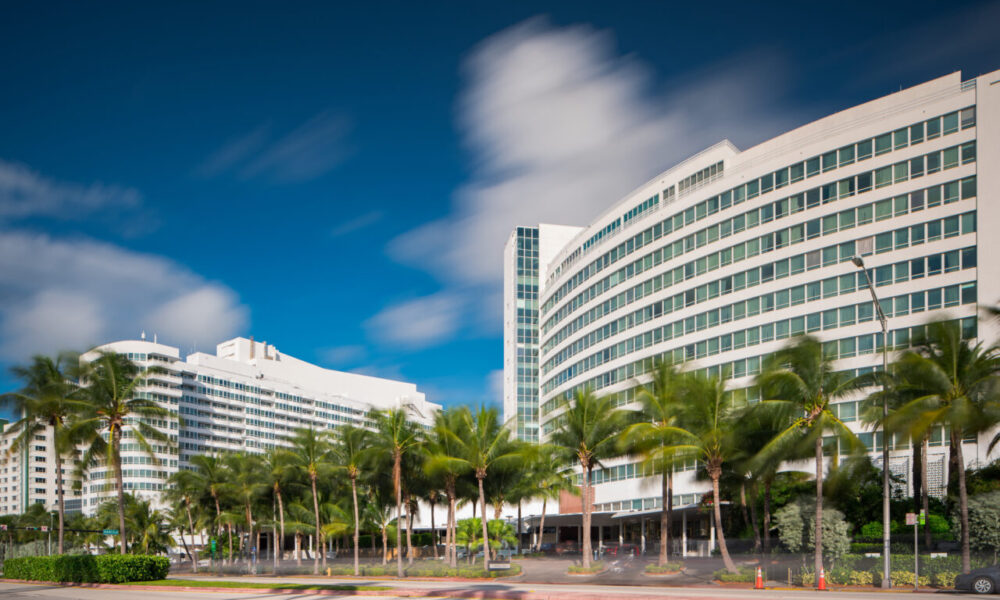
The latest flashpoint centers, in part, on the Fontainebleau hotel, one of Miami Beach’s most prominent oceanfront properties. HB 399 includes language allowing certain large resort renovations — such as a proposed overhaul of the Fontainebleau’s pool deck — to move forward without undergoing the full local review process.
The Fontainebleau project, which would feature water park-like amenities, including 11 slides — one of which would have an approximately 120-foot drop, among the largest in the country — has drawn positive polling and support from the tourism industry.
But it has also attracted criticism from some residents, local officials and state lawmakers like Miami Gardens Democratic Sen. Shevrin Jones, who warned on the Senate floor of some slides that could be built close to neighboring condominium balconies, raising concerns about noise, privacy and compatibility with surrounding uses.
Despite those objections, lawmakers rejected an amendment Jones proffered to strip the Fontainebleau provision from the bill. Jones ultimately voted against the bill.
So did Miami Beach Republican Rep. Fabián Basabe, who urged city leaders this week to focus on existing local authority rather than litigation.
“I would caution the public not to be distracted by efforts to shift all attention to Tallahassee. We have seen this before. The City has repeatedly misrepresented state legislation despite having all the tools it needs locally,” he said in a statement.
“If the City Attorney chooses to pursue litigation, that is their role. But the Mayor, City Manager, and Commission must do theirs. They should focus on site plan review, traffic and infrastructure, water and sewer capacity, drainage and resiliency, enforcing safety standards, and compliance with local regulations.”