
Politics
Miami Beach police question resident at her home over online post about Mayor

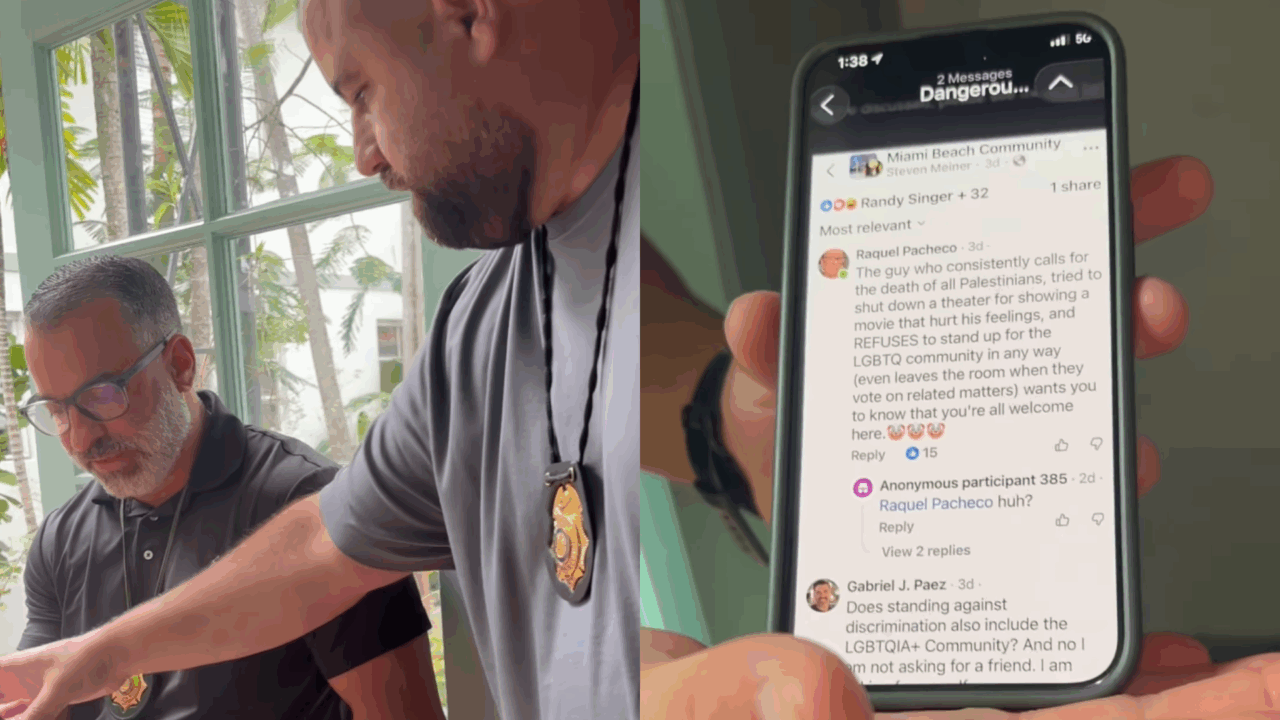
A Miami Beach resident, veteran and repeat political candidate says city police questioned her at home over a critical Facebook post she wrote about the Mayor — and she has posted a video online to prove it.
One of the officers appears to have provided security to Meiner and two City Commission candidates at a campaign event in October.
More on that later.
In the video, which Raquel Pacheco posted to Instagram, two Miami Beach Police officers arrived unannounced at her Flamingo Park home. They questioned her about a comment she made on a Facebook post in which Mayor Steven Meiner described the city as a welcoming place.
Pacheco asked, through her front door, whether she is facing criminal charges.
“Am I being charged with a crime? OK, you are here to investigate a statement that I allegedly made on Facebook,” Pacheco said, before opening the door once the officers confirmed they weren’t there to arrest her.
The officers say they wanted “to have a conversation” about the comment, which Pacheco neither confirmed nor denied she wrote. They said they were there “to prevent someone from getting agitated or agreeing with the statement” and acting violently.
The comment at issue described Meiner as someone “who consistently calls for the death of all Palestinians” — a reference to the Mayor’s since-aborted effort to evict a theater for screening a documentary about the West Bank critical of Israel — and “REFUSES to stand up for the LGBTQ community.”
“We’re not saying it’s true or not,” the shorter of the two officers said before re-reading the post’s reference to Palestinians. “That could probably incite somebody to do something radical. That’s all we’re here to talk about, and we wanted to get your side of it.”
He then advised Pacheco to “refrain from posting things like that.”
Pacheco said she will “maintain my First Amendment rights.”
“This is America, right?” she said.
She then posted the video online, writing in part, “If you need further evidence that Miami Beach has descended into a (fascist) nightmare, you’re not paying attention.”
She later told reporters the experience felt like intimidation.
“My overwhelming feeling was that freedom of speech as I know it died at my front step yesterday,” Pacheco said in an interview with CBS News. “It’s an incredibly, incredibly sad thing.”
In a statement to Axios Miami, the Miami Beach Police Department said the visit was conducted “out of an abundance of caution,” citing heightened national concerns about antisemitism and the fact that the post referenced an elected official. The Department characterized the encounter as a “brief, consensual” check to ensure there was no immediate threat, emphasizing its commitment to constitutional protections.
A Department spokesperson confirmed that Meiner’s Office flagged the post, prompting Intelligence Unit detectives to review it. Meiner defended the police follow-up in a statement to Axios, calling the Facebook claim false but framing the response as a safety assessment.
“This is a police matter,” he said in a statement. “Others might have a different view and that is their right.”
Photos of an October campaign event that Miami Beach business owner Margueritte Ramos posted on Facebook show the shorter of the two officers leaning against a wall in a home, where Meiner addresses a small audience.

A group photo taken outside the event features Meiner and 2025 Commission candidates Fred Karlton and Minique Pardo Pope, both of whom lost their respective races. Many of the attendees wear hats that read, “Miami Beach Mayor Steven Meiner.”

Pacheco, a U.S. Army National Guard veteran and former Chair of the Miami Beach Personnel Board, ran unsuccessfully for the Miami Beach Commission in 2021 and Senate District 36 in 2022. While she declined in the video to confirm whether the comment was hers, it came from her Facebook account, and she previously shared posts online accusing Israel of genocide using Nazi-era language like “final solution.”
Meiner, who is Jewish, has not publicly called for the death of Palestinians. Meiner has drawn criticism for opposing LGBTQ-friendly measures in the city, including one to rename a street after San Francisco politician Harvey Milk and another condemning the Miami-Dade School Board for rejecting recognition of LGBTQ History Monty.
Former Commissioner David Richardson accused Meiner of “building a record of voting against the LGBTQ community.” Meiner said he took offense to the claim, pointing to his vote for a measure designating October as LGBTQ History in Miami Beach.
In an interview with the Miami Herald, Pacheco described the police visit as an “intimidation tactic” meant to stifle her right to free speech. She has since enlisted the services of lawyer Miriam Haskell of the nonprofit Community Justice Project, who told the Herald the police “were sent to intimidate her and chill dissent, plain and simple.”
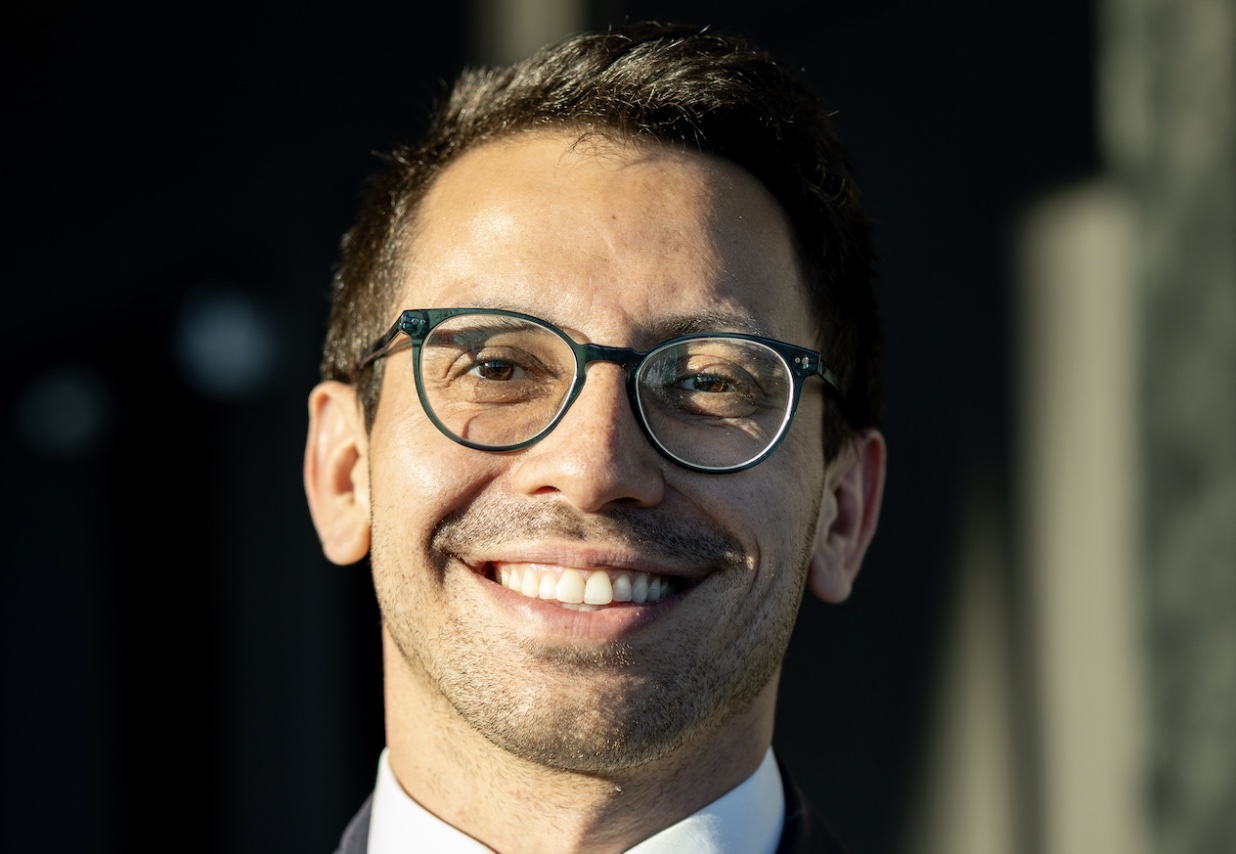
Gubernatorial candidate James Fishback has lashed out at coverage of his campaign finance report, saying he raised more than the $950 his campaign originally reported during the final quarter of 2025 and blaming the media for getting it wrong.
“To be clear, we didn’t raise only $950. It was yet another lie by the fake news media to hurt our surging campaign,” he said.
The Republican candidate has finally provided proof that he raised more than $950, filing an amended report. Unfortunately for his campaign, his new total still significantly trails numbers from other GOP candidates, and much of what he did raise came from out-of-state donors, raising questions about how much support he actually has in Florida.
Since opening his campaign account in late November, Fishback has raised just under $19,000. But the burn rate has been significant, with the candidate spending just over $12,000, giving him a bit more than $6,000 on hand.
The spend includes more than $6,800 in “reimbursement” to Treasurer Alex Munguia, but it’s unclear what the reimbursement is for, raising further questions about the report.
Of the 360 contributions including in-kind, just 200 come from inside the state. Other donors claimed residency in Texas, California, New York, New Mexico and various other places with no vested interest in what happens in Tallahassee.
Campaign Manager Emma Wright said the almost $19,000 brought in is just a taste of the financial juggernaut to come, saying the campaign “hosted our first fundraiser of the year last Friday at the Ritz Carlton, Singer Island and are on track to hit $250,000 in donations.”
Even that aspirational goal, minus whatever is spent having fundraisers at the Ritz Carlton and paying staff and funding travel, falls short of the roughly $45 million raised thus far by the front-runner, U.S. Rep. Byron Donalds, a Black conservative Fishback relishes calling a “slave.” It also is well under the nearly $5.5 million brought in by former House Speaker Paul Renner.
Fishback’s Florida First PAC still has yet to record activity, though given the precedent set by the campaign account, they could always amend their filing.
On the bright side, a filing Jan. 12 shows the aforementioned Munguia was successful in recovering his credentials for the electronic filing system, meaning submitting future reports should be seamless.


Duke Energy Florida is removing its storm cost recovery charge from customers’ bills one month earlier than originally planned.
The charge was added to customers’ bills to help Duke offset additional costs associated with the company’s $1.1 billion response to Hurricanes Debby, Helene and Milton.
The change means that beginning in February, rather than March, Duke customers in Florida will see an approximately $33 reduction to their monthly bills compared to January per 1,000 kilowatt-hours used.
Commercial and industrial customers’ bills will drop anywhere from 9.6% to 15.8% when compared to January, the amount of which depends on several factors, the company said.
“We understand all of our customers have been affected by the rising costs of living, many may be facing financial challenges, and some are even having to decide which bills they can afford to pay every month,” Duke Energy Florida State President Melissa Seixas said. “It was important to us that our customers get this significant rate relief as soon as possible while we continue to deliver the safe, reliable power they expect and deserve.”
More savings are on the way in March, too. Residential customers can expect to see an approximately $11 decrease per 1,000 kilowatt-hours used per month as a result of seasonal decreases Duke institutes annually from March through November to help customers save money during times when electricity use is higher due to higher temperatures.
That means in March, residential customers will enjoy a combined savings of $44 per 1,000 kilowatt-hours used on their bills compared to January.
The latest round of savings come after Duke Energy Florida made efficiency improvements at many of its natural gas plants, saving customers $340 million in fuel costs, translating to a savings on average of about $10 on customers’ monthly bills.
Additionally, Duke recently completed three new solar energy sites, collectively saving customers $750 million from displaced fuel costs. The company also passed on $65 million in Inflation Reduction Act tax credits to customers, saving them about $2.50 per kilowatt-hour used.
While costs are on the decline, Duke Energy also offers flexible payment plans for those who may need a little help. More information about the program is available on the company’s website.


Before he entered politics, Ken Welch was an accountant. So it was surprising to learn that he — or, more specifically, a political committee that supports his political ambitions — was the victim of accounting theft.
It begs the question: Is Ken Welch a victim, or is he just incompetent?
First and foremost, Welch is, of course, a victim of what appears to be, if allegations are true, a felonious theft that robbed him of more than $200,000 meant to support his re-election campaign. That many of us believe he could have avoided being a victim doesn’t change the fact that he is. The guilty party is not Welch, it’s Yolanda Brown, who is accused of making unauthorized payments from The Pelican Political Action Committee supporting Welch to a business she controls.
But there are problems too big to ignore, problems that show that while Welch is a victim, he’s also clearly incompetent.
At issue are eight unauthorized expenditures from The Pelican Political Action Committee totaling $207,500, paid between Aug. 6, 2025, and Oct. 30, 2025, to OReilly Business, which Brown controls. The expenditures range in amount from a low of $2,500 to a high of $100,000. And the total represents more than what the committee raised in the second half of 2025 combined.
Advisors tasked with managing the PC were tipped off by a campaign finance expert who manages numerous other political committees and campaign accounts who identified missing funds and suspected Brown of theft. The tip led to Welch’s advisors to uncover the possible theft from Welch’s PC.
But here’s the thing: His committee was being stolen from for months.
I first learned of this scandal in early December and let it play out to see how Welch would handle the situation. What we have now learned is that whatever he did to handle it, it wasn’t near enough.
His advisors did not make the transition away from Brown until deep into December, which means Welch was unaware of what was going on in his own political committee. All he had to do was ask his political committee team to look at a bank statement to ensure it matched what was being sent to the state in financial reports.
Every viable campaign does this. As an aside, you have no idea how frugal Charlie Crist is about his political committee. That’s why, with the exception of one expenditure for compliance, there has been no spending other than credit card fees for the first two months since the committee launched.

And unlike other victims, there is no victim compensation fund. Welch’s PC is effectively broke. Without the $25,000 contribution from the Tampa Bay Rays that accounted for more than half of his fourth-quarter fundraising, Welch would right now be laying off staff because his account wouldn’t have enough cash to cover retainers.
Taken at face value, one could chalk this up to insider political baseball, and I expect the Welch campaign to attempt to dress it up as just that.
Except that these sorts of things keep happening.
The state revoked Welch’s previous PC, the Pelican PAC, for failing to file timely reports and other required documents after 11 violation notifications. Brown, at the very end of the PC’s life, was briefly its Treasurer before being appointed Treasurer of the new one.
Even if Brown had limited involvement in the errors that condemned Pelican PAC, the embarrassing shuttering of a political committee should have already been enough for Welch to keep a closer eye on things.
But it wasn’t just that. It didn’t take long after reporting about Brown’s alleged theft from Welch’s PC to uncover a checkered past, all outlined in publicly accessible documents. One of them, and the biggest of them, was even chronicled by CBS News. Working under the name Yolanda Cheers at the time, Brown reached a plea deal in 2024 related to charges of embezzlement in California.
Brown pleaded guilty to transferring $4,000 to her own account in 2016 from the nonprofit National Equity Project, for which she controlled the accounting department. Felony charges weren’t filed until 2019 after Brown reportedly attempted to take out a loan in the name of another company she worked for, BWML & Partners.
That firm also discovered Brown had paid herself several bonuses and made unauthorized credit card purchases, including a $10,000 vacation to a vineyard. She was originally charged with six felonies, but the plea brought that down to just one count of felony grand theft by embezzlement.
The CBS News story didn’t mention Yolanda Brown, only Yolanda Cheers, so a simple internet search isn’t likely to turn that one up. However, another story in The Mercury did include her last name as Brown and was more easily accessible.
A search for Brown in LexisNexis turned up a bankruptcy in Minnesota. It happens, and I avoid passing judgment on those who have fallen into financial despair. But as someone whose job is to manage finances for other entities, a bankruptcy is a red flag.
And then there’s Welch’s judgment in general.
Throughout his tenure as Mayor, there have been a series of questionable decisions, including staffing.
In the first year of his administration, his own Deputy Mayor was forced to step down after being accused of creating a hostile work environment, and it became clear amid those allegations that plenty of people had made Welch aware of the problem.
And then there were the hurricanes. Let’s just start chronologically.
In late September 2022, Welch declared a local state of emergency as Hurricane Ian was heading toward Florida’s Gulf Coast, potentially toward the Tampa Bay region. Local leaders, including the Mayor, typically gather at the Emergency Operations Center to manage response and recovery. But Welch stayed at home, even as his top staff left their families to fulfill their city duties.
That sort of absenteeism had become a trend, with the Tampa Bay Times noting in late 2022 that from his inauguration on Jan. 6, 2022, through Sept. 7, 2022, Welch had gone to work at City Hall just 34.3% of work days.
Fast forward to the 2024 hurricane season, which saw back-to-back devastation in St. Pete from Hurricanes Helene and Milton, and Welch again found himself facing criticism for debris piles that sat for weeks on end without collection and a response many found lacking in other neighboring communities.
And speaking of hurricanes, who was the genius who decided to slash the city’s insurance on Tropicana Field to save $250,000, only to see that move cost the city millions after Hurricane Milton tore the roof from the Trop? That would be Welch.
That only scratches the surface of the unforced errors that have plagued the Welch administration and led to frustrations whispered in private among some of the city’s most powerful. Publicly, the frustration is already showing up in the 2026 mayoral campaign.
Not only did Welch’s PC suffer what appears to be a significant theft of a large percentage of its overall funds, his fourth-quarter numbers were not just stagnant, they were almost nonexistent.
In the third quarter of 2025, covering financial activity from July through September, the committee raised more than $142,000. In the fourth quarter, covering October through December, it raised just over $48,000, nearly six figures less than the previous period.
And that brings up another important question: Who gives to his campaign now?
It’s no secret that developers have long been frustrated with Welch, yet they and others with business before the city are perhaps begrudgingly contributing. The last half of 2025 saw plenty of developers cutting checks, from Altis Cardinal to Ajax Building. Even the Tampa Bay Rays, whose relationship with Welch has soured, to put it mildly, felt obliged to kick in (though they did so at half the amount they gave to Bob Buckhorn in Tampa long before his name ever appears on a ballot).
And I know for a fact that $30,000 of the $48,000 raised during the fourth quarter was bundled by one prominent fundraiser. The firm where that fundraiser works hedged their bets last quarter and also began donating to Crist.
So if Welch’s top donor is now hedging their bets, and all of the other donors can see that their money is not safe with Welch’s campaign, only a fool would donate to him in the coming months.
Already there are whispers from several corners of the political arena that Welch should drop out of the Mayor’s race.
But he won’t. He’s infamously stubborn and his pride can sometimes get in his way, leading him in this instance likely unable to acknowledge the political reality. And to his credit, he has a loyal base of support, people who have stuck with him through past scandals. But that certainly does not mean those interested in St. Petersburg’s future must underwrite a losing campaign.
Taken together, the writing is on the wall for Welch. His detached management style has created stagnation at City Hall, allegations of absenteeism, botched hurricane recovery and a failed deal to keep the Tampa Bay Rays in St. Pete. It’s costing him funds intended for re-election and, at the same time, support appears to be largely waning.
The Kathy Woodses of the world who are banking on a second Welch term need to take a hard look at continuing to support him, either financially or publicly, because now everyone is on notice.
At this point, Welch’s only hope may be that the writing is actually on a street, so the Florida Department of Transportation can come along and erase it. It’s not like Welch would do anything to stop them.


Whole Foods cofounder John Mackey’s hardest ever decision was firing his dad from his company board

Kysre Gondrezick Suffers Torn Achilles, Will Miss Athletes Unlimited Season

L’Oréal selects 13 innovative organisations to join “L’Accelerator”
-

 Politics8 years ago
Congress rolls out ‘Better Deal,’ new economic agenda
-
Entertainment8 years ago
New Season 8 Walking Dead trailer flashes forward in time
-
Politics8 years ago
Poll: Virginia governor’s race in dead heat
-
Politics8 years ago
Illinois’ financial crisis could bring the state to a halt
-
Entertainment8 years ago
The final 6 ‘Game of Thrones’ episodes might feel like a full season
-
Entertainment8 years ago
Meet Superman’s grandfather in new trailer for Krypton
-
Business8 years ago
6 Stunning new co-working spaces around the globe
-
Tech8 years ago
Hulu hires Google marketing veteran Kelly Campbell as CMO