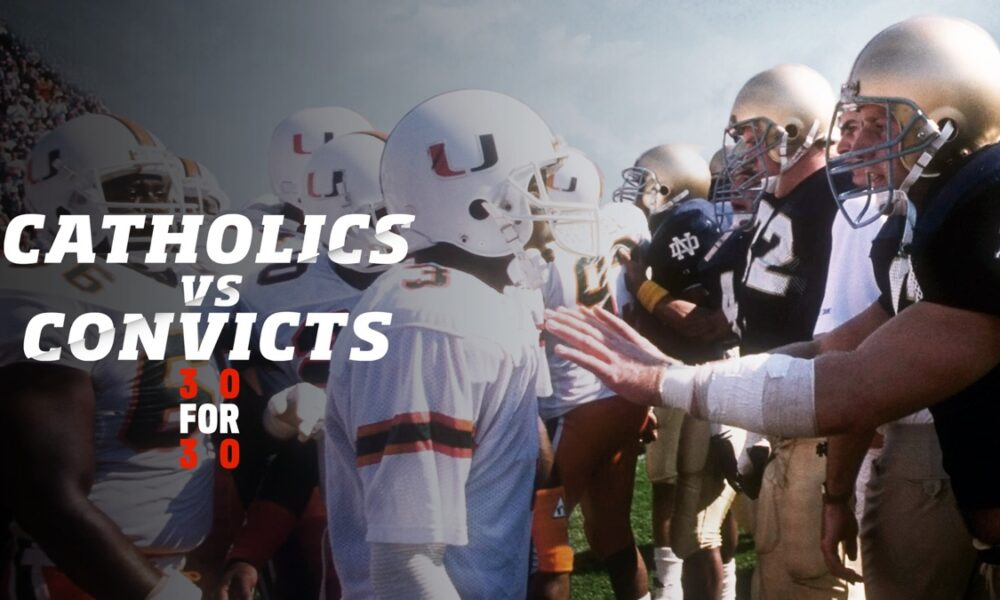
The rivalry between the University of Miami and the University of Notre Dame stands as one of the most culturally defining feuds in American sports history. What began as an intermittent non-conference series blossomed during the 1980s into an explosive clash of philosophies, aesthetics, and football power. Beyond the scoreboard, the matchup altered how college programs built national brands and forever changed the television landscape of the sport.
The Origins Of A High-Stakes Culture Clash
While Notre Dame and Miami first met on the gridiron in 1932, the modern rivalry ignited when Miami transformed into a national juggernaut under Howard Schnellenberger and Jimmy Johnson. Notre Dame represented tradition, discipline, Midwestern Catholicism, and institutional prestige. Miami embraced a swagger-filled, South Florida identity powered by speed, relentless defense, and unapologetic self-expression.
Tensions boiled over throughout the mid-1980s. Miami handed Notre Dame a sound 58-7 beating in Gerry Faust’s final game as Irish head coach in 1985. When Lou Holtz arrived in South Bend, restoring Notre Dame to national contention, the stage was set for an inevitable showdown between two polar opposite football cultures.
1988: The T-Shirt, The Tunnel Fight, And The Game
The 1988 matchup in South Bend birthed the phrase that defines the series. A group of Notre Dame students produced a bootleg T-shirt carrying the moniker “Catholics vs. Convicts,” playing into media narratives surrounding Miami’s aggressive reputation and off-field headlines.
The atmosphere inside Notre Dame Stadium reached a fever pitch before kickoff when a pregame scuffle broke out between both squads in the tunnel. The game itself lived up to every inch of hype:
The Stumble and Fumble: Top-ranked Miami pushed the Irish to the limit, but a controversial fumbled goal-line entry by Cleveland Gary proved critical.
The Final Stand: Trailing 31-30, Miami scored a late touchdown with seconds remaining. Jimmy Johnson elected to go for a two-point conversion rather than a tie. Pat Terrell knocked down Steve Walsh’s pass in the end zone to secure Notre Dame’s 31-30 victory.
Notre Dame snapped Miami’s 36-game regular-season winning streak and went on to capture the 1988 national championship. Miami responded the following year in 1989, defeating the No. 1 ranked Fighting Irish 27-10 in the Orange Bowl to claim its own national title.
The Series Pause And Modern Footprint
Following another hard-fought battle in 1990—a 29-20 Notre Dame victory—the regular series was put on hold. Notre Dame sought to diversify its national independent schedule, while Miami prepared to enter the Big East for football in 1991.
The programs renewed their historic rivalry across modern non-conference slates, including high-stakes ACC-scheduled matchups. Across every decade, the shadow of 1988 remains the gold standard for how two contrasting national brands can captivate the sports landscape.