Connect with us

Business

Meta spends more guarding Mark Zuckerberg than Apple, Nvidia, Microsoft, Amazon, and Alphabet do for their own CEOs—combined

Published

on


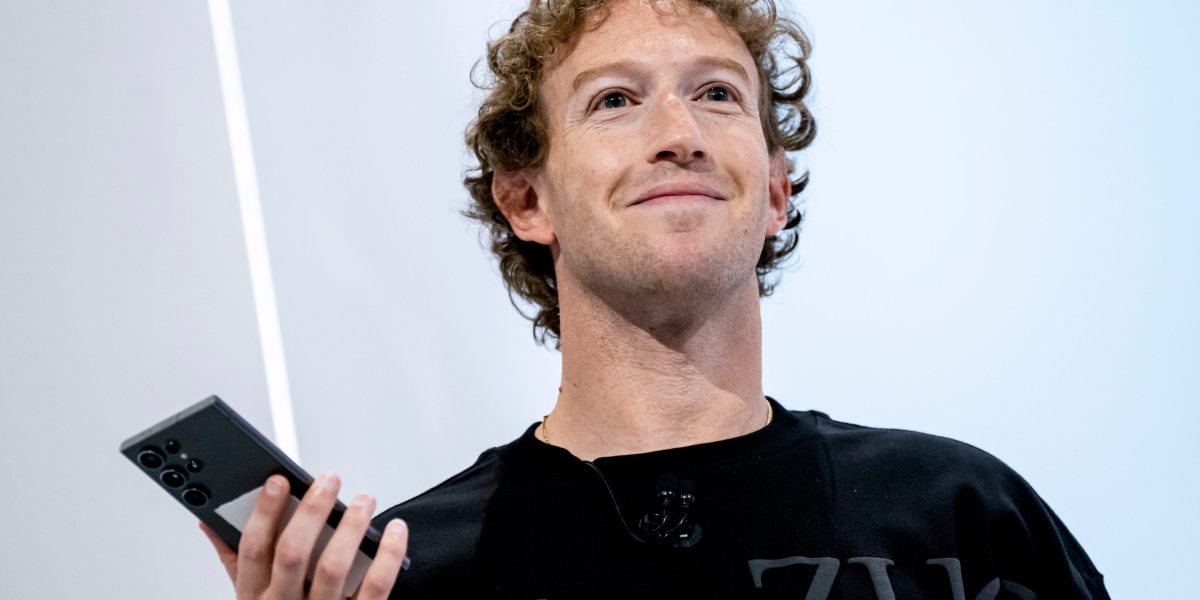
Mark Zuckerberg goes to great lengths to protect himself. It makes sense: Critics say his social networks are bad for your mental health, he’s aggressively hiring people across Silicon Valley to staff up his ambitious AI projects (which are, unto themselves, polarizing), and he owns wide swaths of land in Hawaii, which has rankled residents and activists alike. It makes sense that he might want to shield his livelihood, considering he’s almost certainly the target of public ire.

According to a new Financial Times analysis, security budgets for the chief executives of 10 major tech companies climbed above $45 million in 2024—but still, nobody protects their boss more than Meta does for Zuckerberg.

Across the board, companies like Alphabet, Amazon, Nvidia, and Palantir all increased protection budgets by more than 10% year over year, driven by heightened threats and a worsening security environment for public-facing business leaders. But Meta’s security allocation for Zuckerberg reached more than $27 million in 2024, up from $24 million the previous year.

This dwarfs the amounts spent by peers: In 2024, Nvidia spent $3.5 million to secure CEO Jensen Huang, an increase from $2.2 million the previous year. Amazon allocated $1.1 million for CEO Andy Jassy, while former CEO Jeff Bezos continued to receive $1.6 million annually toward his personal security. Apple spent $1.4 million to protect Tim Cook in 2024, which was actually lower than the $2.4 million spent in 2023. Alphabet’s security spending for Sundar Pichai reached $6.8 million, according to public data, and Tesla disclosed it spent just $500,000 to protect Elon Musk, although industry experts emphasize that this sum represents only a small portion of his actual security expenses as the world’s richest man has his own security companies like Foundation Security.

Notably, if you add up how much Apple, Nvidia, Amazon, Alphabet, Microsoft, and Palo Alto Networks spent protecting their CEOs in 2024, it’s still about $7 million—26%—less than what Meta spent to guard Zuckerberg.

Security in Silicon Valley

For what it’s worth, Meta’s security program is a bit different from the others as it covers Zuckerberg’s residences, family, and travel, since Zuckerberg is synonymous with Meta, née Facebook. As both CEO and cofounder, he also holds majority voting power—and a lot of people have strong feelings about Zuckerberg given his very public role in society, layoffs, and consumer privacy.

Security in Silicon Valley is often managed by private-security firms, many of which are staffed by former law enforcement and military professionals. Hamilton Security, founded by former FBI agent James Hamilton, provides comprehensive assessments and risk mitigation services. Gavin de Becker & Associates and LaSorsa Security & Associates are also considered major players, protecting executives like Musk and Bezos, respectively. Their services include risk assessment, intelligence monitoring, residential security with hardened features (e.g., Amazon’s bulletproof panels), 24/7 personal protective details, secure transportation, cybersecurity, anti-stalking measures, as well as preparation for assassination attempts, kidnap attempts, and digital threats such as deepfakes.

Palantir’s Alex Karp, for example, who runs a data-intelligence company with controversial defense contracts, employs a 24/7 security detail with up to four visible bodyguards. Nvidia’s Huang, who nabbed the top spot on Fortune‘s Most Powerful People in Business list this year, saw a rise in his protection budget as his net worth soared and global profile increased, including reports of being mobbed by fans.

The assassination of UnitedHealthcare CEO Brian Thompson last December led to some of the rising spend among executives, but it also forced some protocol changes as well. Some companies have removed photos of their leadership from their corporate websites, invested in home defenses and cyber protection, and enforced stricter travel policies: Lockheed Martin, for example, mandates its CEO use corporate jets.

Meta did not immediately respond to Fortune‘s request for comment on its security spend for Zuckerberg.

For this story, Fortune used generative AI to help with an initial draft. An editor verified the accuracy of the information before publishing.


Source link

Continue Reading

Business

Nvidia CEO Jensen Huang urges a return to factory careers: ‘Not everyone needs a PhD’

Published

on


“We want to re-industrialize the United States. We need to be back in manufacturing,” Huang said recently on theJoe Rogan Experience podcast. “Every successful person doesn’t need to have a PhD. Every successful person doesn’t have to have gone to Stanford or MIT.”

Huang believes more Americans need to take on manufacturing gigs—not just to pivot to where the work will be in the age of AI, but also because the entire industry could be at risk. As much as the thought of U.S. citizens heading back into factories may seem like a back-track, he said it impacts the nation’s ability to remain prosperous and build AI companies like his.

“If [the] the United States doesn’t grow, we will have no prosperity,” Huang continued. “We can’t invest in anything domestically or otherwise—we can’t fix any of our problems. If we don’t have energy growth, we can’t have industrial growth. If we don’t have industrial growth, we can’t have job growth. It’s as simple as that.”

“If not for [Trump’s] pro-growth energy policy, we would not be able to build factories for AI, not be able to build chip factories, we surely won’t be able to build supercomputer factories. None of that stuff would be possible without all of that. Construction jobs would be challenged, electrician jobs—all of these jobs that are now flourishing, would be challenged.”

Lutnick’s intergenerational manufacturing push amid talent shortages

As the cofounder and leader of the world’s most valuable company, Huang has a peek under the hood of America’s changing workforce dynamic. The CEO of the $4.53 trillion chip giant has a direct line to U.S. President Donald Trump and Secretary of Commerce Howard Lutnick, who are determined to bring U.S. manufacturing back to its glory days. 

The Trump administration is pressing for American self-reliance while curbing immigration, leading officials like Lutnick to push for an intergenerational manufacturing boom. He even framed it as a step into the future, not a stumble back into the past. 

For example, Lutnick claimed that technician jobs are promising gigs with a low barrier to entry, that can pay anywhere between $70,000 to $90,000 at the onset—no college degree required. 

“It’s time to train people not to do the jobs of the past, but to do the great jobs of the future,” Lutnick toldCNBC earlier this year. “This is the new model, where you work in these plants for the rest of your life, and your kids work here, and your grandkids work here.”

It’s an appealing proposition: avoid college debt and earn more than the average U.S. worker, all while having stability during an AI jobs wipeout. Yet many manufacturing roles have been left unfilled, despite the sector continuing to grow. 

Employment in the manufacturing surpassed pre-pandemic levels, standing at about 13 million jobs as of January 2024, according toDeloitte. It was estimated that the need for human workers in manufacturing could stand at around 3.8 million, but over half of these jobs—around 1.9 million—could remain unfilled if skill gaps aren’t addressed and the tune on the jobs doesn’t change. 

After all, only 14% of Gen Zers said they’d consider industrial work as a career, according to a 2023 study from Soter Analytics. There are a few concerns holding them back: they believe the industry doesn’t offer work flexibility, and the conditions are unsafe.

Huang even believes robots will create new jobs for humans

Huang has hope for the future of jobs, even as robot employees step onto the scene—and it’ll give yet another boost to factory jobs. 

Some tech leaders, like Tesla CEO Elon Musk, are already developing their own fleets of autonomous workers; Musk predicted his company’s Optimus humanoid robots will be used internally within Tesla by the end of 2025, and the following year, other companies will have the tech in their hands. 

It’s assumed that these robots will take over the work of employees, leaving humans high and dry—but Huang is optimistic that the tech will create new opportunities, especially for technicians.

“I’m super excited about the robots Elon’s working on. It’s still a few years away. When it happens, there’s a whole new industry of technicians and people who have to manufacture the robots,” Huang explained in the podcast. 

“You’re going to have a whole apparel industry for robots. You’re going to have mechanics for robots. And you have people who come to maintain your robots.”


Source link

Continue Reading

Business

Mike Bloomberg’s new $50 million mayor bootcamp trains local leaders not to ‘play it safe’

Published

on


Michael R. Bloomberg has believed mayors have plenty to teach each other since he was mayor of New York City and supported the effort to share good municipal ideas through his nonprofit Bloomberg Philanthropies since he left office in 2013.

However, as more nations get bogged down in what the media entrepreneur and philanthropist calls “ideological battles and finger-pointing,” Bloomberg says mayors can do even more. He is expanding his support for them internationally, with the Bloomberg LSE European City Leadership Initiative, a collaboration with the London School of Economics and Political Science and the Hertie School in Berlin. And other philanthropists are investing in building stronger municipal governments to strengthen urban communities.

“Mayors are more important than ever because cities are more important than ever,” Bloomberg told The Associated Press in a statement. “For the first time in the history of the world, a growing majority of the world’s people live in cities – and cities lie at the heart of many of the biggest challenges facing countries, including expanding economic opportunity.”

The new international initiative, established by a $50 million investment from Bloomberg Philanthropies, brings together 30 mayors and 60 senior officials from 17 countries, representing over 21 million residents.

After one meeting in October, some already see the potential.

Oliver Coppard, mayor of South Yorkshire, England, jumped at the chance to work with Bloomberg Philanthropies again. Coppard learned much at the Bloomberg Harvard City Leadership Initiative, which focuses on training American mayors, but offers 25% of its seats to international mayors. And even he was surprised by how much he had in common with the first international class of mayors. They all look for ways to get their organizations to move faster, deal with social media, and communicate better with their communities.

“It was actually really surprising,” Coppard said. “There are a bunch of areas where, we all felt, despite the very different context that we work in, we were facing very similar challenges.”

A ‘show me, not trust me’ moment for mayors

Despite the varying political ideologies and viewpoints from a wide range of countries, Coppard said what united the mayors was a desire to serve their communities better through health care, transportation, and communication.

It’s exactly what James Anderson, head of Government Innovation programs at Bloomberg Philanthropies, hoped they would find. But he says tackling those issues has broader implications that require more philanthropic involvement.

“All of these mayors are recognizing that local governments have become the bulwark for democratic legitimacy,” Anderson said. “They feel the burden of that. And they want new and better ways to rebuild trust and a sense amongst their citizenry that government — local government, in particular — sees them and can respond to their needs in impactful ways.”

Anderson said the mayors also understand they have to show how government works for its community. Public safety, trash pickup and snow plowing have taken on new significance.

“We are in a moment where trust in institutions is very low,” he said. “This is a ‘Show me, not trust me’ moment. And mayors recognize that means they need to govern differently.”

Joseph Deitch, founder of the Elevate Prize Foundation, believes that philanthropy also has to support mayors and their cities differently.

“These days, there’s so much polarization,” he said. “Everyone is defending their corner. So where can we have common ground? I think one of those places is love of our cities.”

Launching Elevate Cities in Miami

To cultivate a stronger bond to those places, Deitch has launched Elevate Cities, a new initiative that both celebrates what makes cities special and convenes community leaders to make them better. The initiative will start in Deitch’s current home with Elevate Miami, though he hopes to expand it quickly to other cities.

In November, Elevate Miami awarded $25,000 unrestricted grants to three different Miami nonprofits to increase their impact on the city. Later this month, there will be a citywide scavenger hunt to introduce Miami residents to nonprofits in the area. And in January, Elevate Miami will launch a contest to write a love song to the city.

Kim Coupounas, Elevate Cities CEO, says that getting people to recognize all the positive things happening around them in their city makes it easier to cultivate civic pride. It also makes it easier for municipal leaders to get support from the community.

“We’re really trying to engage all of the city,” she said. “There’s so much potential and possibility that can come to life because we join hands and recognize what a good place we live in and what more can happen here.”

Bloomberg said he hopes the new Bloomberg LSE European City Leadership Initiative and other programs supporting municipal leaders will help spread good ideas and the diversity of viewpoints needed to try new strategies for their cities.

“If mayors want to do big things, they can’t afford to play it safe,” he said.

_____

Associated Press coverage of philanthropy and nonprofits receives support through the AP’s collaboration with The Conversation US, with funding from Lilly Endowment Inc. The AP is solely responsible for this content. For all of AP’s philanthropy coverage, visit https://apnews.com/hub/philanthropy.


Source link

Continue Reading

Business

‘It absolutely matters politically’: Swing-district Republicans alarmed at spiking health insurance premiums tipping midterms

Published

on


Republicans in key battleground U.S. House districts are working to contain the political fallout that may come when thousands of their constituents face higher bills for health insurance coverage obtained through the Affordable Care Act.

For a critical sliver of the Republican majority, the impending expiration of what are called enhanced premium tax credits after Dec. 31 is a pressing concern as they potentially face headwinds in a 2026 midterm election that will be critical to President Donald Trump’s agenda.

One of those is first-term U.S. Rep. Ryan Mackenzie, R-Pa., whose victory for the Allentown-area seat last year was among the narrowest in the nation.

Mackenzie is part of a bipartisan group that has been pressing for an eleventh-hour compromise, advocating for an extension of the tax credits that tries to fix perceived flaws and bring down health care costs. But the push is a long shot due to entrenched GOP opposition to the health overhaul known as “Obamacare.”

“I think that we need to deal with the reality of where we are now and even if you have a broken system, that doesn’t mean that you shouldn’t provide or offer relief to individuals who are dealing with those high costs right now,” Mackenzie said in an interview with The Associated Press.

Democrats have been laying the groundwork, starting with this fall’s shutdown fight, to make the health care issue a focus of next year’s campaigns.

The party’s strategy for capturing the House majority centers on pinning higher bills for groceries, health insurance and utilities on the policies of Trump and Republicans.

Republicans torn over an extension

In Washington, Republicans from competitive House districts have authored or signed onto bills that would temporarily extend the tax credits. A new bipartisan proposal unveiled Thursday has drawn support from roughly 15 Republicans and 20 Democrats so far.

“I have 40,000 people in my district who rely on this health care and doing nothing to prevent a spike in their premiums is wrong,” said U.S. Rep. Jen Kiggans, R-Va., a sponsor of the plan.

Thirteen Republicans — including Mackenzie — signed a letter in late October to the House speaker, Rep. Mike Johnson, R-La., encouraging the temporary extension of the tax credits, saying letting them “lapse without a clear path forward would risk real harm to those we represent.”

Johnson hasn’t committed to a short-term extension vote before Jan. 1 and has dismissed the looming premium increases as affecting a small percentage of Americans.

More than 24 million people have ACA health insurance, including farmers, business owners and other self-employed people who don’t have other health insurance options through their work.

Many benefit from subsidies that lower their out-of-pocket cost. Those subsidies include the enhanced premium tax credits, which were added and then extended under Democratic President Joe Biden when his party was the majority in Congress.

Some Republicans — including Mackenzie — couch their support for an extension with the caveat that changes must be made. One is rooting out insurance broker fraud. Another is backing off subsidies for higher earners.

Time is running out

U.S. Rep. Kevin Kiley, one of the California Republicans whose districts have been redrawn to favor a Democrat, sponsored a bill to extend the tax credits for two years. His bill would also impose an income eligibility cap to exclude higher earners.

Kiley said the current system isn’t working, but there’s not enough time to make systematic reforms before millions of Americans “just suddenly pay double on their premiums.”

U.S. Rep. Jeff Van Drew, R-N.J., also has a bill to temporarily extend the credit, and said letting the subsidy lapse will make it harder for Republicans to retain the majority next year.

“People say, ‘well, it’s not that many people,’” Van Drew said. “The kind of election we’re going to have in the midterms in multiple districts is going to be decided by one or two points. It’s going to be close. It’s going to be tight, and it does matter. It absolutely matters politically.”

U.S. Rep. Richard Hudson of North Carolina, chair of the House Republicans’ campaign arm, said the tax credits won’t be “decisive” in next year’s election when other things are likely to be on voters’ minds.

Democrats will run on affordability

But U.S. Rep. Suzan DelBene of Washington state, who chairs the House Democrats’ campaign arm, said swing-district Republicans won’t be able to distance themselves from the expiration of the tax credits.

“The number one issue across the country is affordability and health care is a key part of that,” DelBene said.

The Congressional Budget Office projects that 3.8 million more people will be uninsured in 2035 if the tax credits aren’t extended. But the tax credits also come with a cost: Extending them would increase the deficit by $350 billion over the next decade.

The expiration of the tax credits means enrollees will see annual premiums more than double — from an average of $888 in 2025 to $1,904 in 2026, according to health care research nonprofit KFF. That’s an increase of 114%.

The size of the increases varies by state, age and income and will be more extreme in Mackenzie’s district, according to state data, which puts the average premium increase at 178%.

A primary field of Democrats is shaping up for the nomination to challenge Mackenzie. They say they’re hearing from people who are struggling to afford rising premiums.

One of those Democrats, Ryan Crosswell, said rising insurance costs are a “breaking of promises” by Trump, Republicans and Mackenzie. Another Democrat, Carol Obando-Derstine, called the impending expiration a “crisis of (Mackenzie’s) own making.”

Mackenzie says he’s made it clear repeatedly that he supports an extension, but that “I am not the speaker, I don’t set the calendar or the agenda. I’m not the leader, I can’t call up bills.”

Enrollees facing hard choices

In Mackenzie’s district, more than 20,000 people received the enhanced tax credits in 2025, according to state data. He won his race last year by 1 percentage point, or about 4,000 votes.

One of those 20,000 people in Mackenzie’s district is Patrick Visconti, who switched to a low-premium, high-deductible plan because he couldn’t afford to keep his plan with a premium that is more than doubling from under $200 to over $500 a month.

Visconti, 59, who works as a self-employed landscaper and a bus driver, said the plan he picked is “crappy coverage.”

“I’d rather pay the $200 a month. But I can’t get anything for $200,” Visconti said.

Lynn Weidner, a home care worker in Mackenzie’s district who works nearly 80 hours a week, said her $400 premium will increase to $680. But, she said, she’s leaning toward selecting the plan because she has various conditions — including an iron deficiency — that require regular medical care.

“So I’m trying to find places where I can cut money so that I can afford my insurance come January, which is stressful,” Weidner said.


Source link

Continue Reading

Trending

Copyright © Miami Select.