
Business
Meta is sinking $10 billion into Louisiana to build its wildest AI aspirations, setting the template for the grid buildout
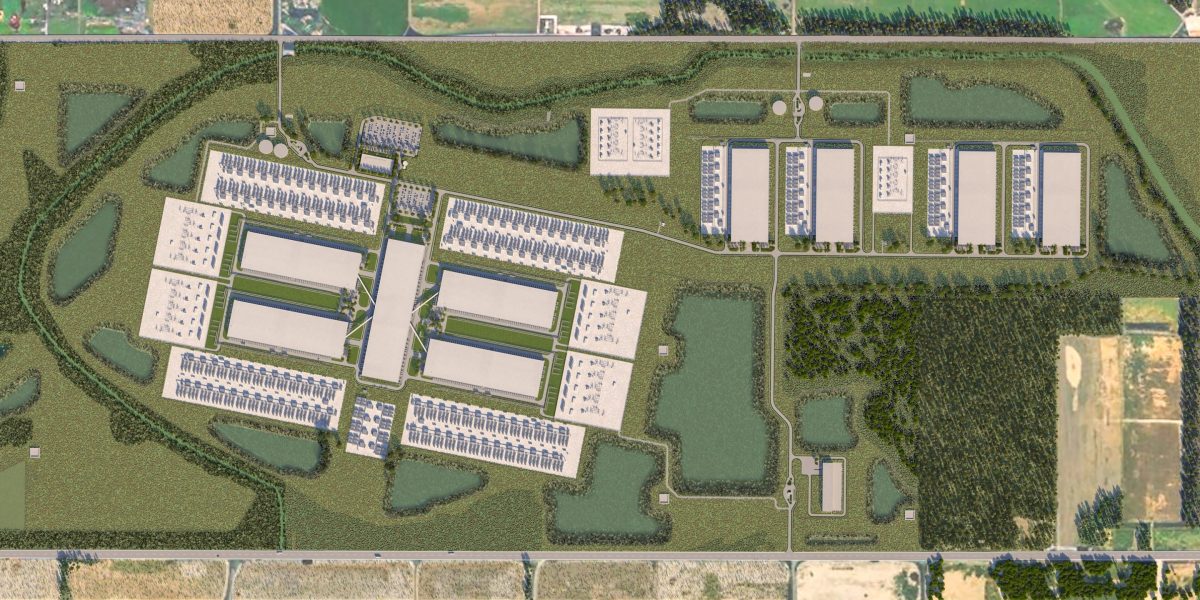
On a quiet patch of former farmland in northeastern Louisiana, a fleet of excavators has leveled more than 2,000 acres of reddish clay earth. This is rural Richland Parish, once a floodplain tangled with meandering bayous and wild canebrake where black bears still wander and a quarter of the 20,000 residents live below the poverty line.
Enter Meta—the sixth-largest company in the world by market cap. The tech giant is keen on making Richland home to its wildest AI aspirations—courtesy of a tremendous amount of new gas-fired power. The region has ample land and sits adjacent to Louisiana’s huge Haynesville Shale gas field.
In December, construction began on Meta’s biggest-yet data center: a $10 billion complex of nine buildings, housing bank upon bank of servers that will take up over 4 million square feet, an area larger than Disneyland.
Meta chairman and CEO Mark Zuckerberg isn’t stopping there. He dubbed the project “Hyperion” in July—a data center “supercluster” that eventually could use the energy equivalent of 4 million homes and become the world’s biggest data center project. Zuckerberg said Hyperion would cover a “significant part of the footprint of Manhattan.”
The project entails more than 2 gigawatts of computing capacity—Zuckerberg said it could eventually expand to 5 gigawatts—programmed to train open-source large language models. Meta lagged in the AI race with previous flops and the multibillion-dollar “Metaverse” boondoggle. Now he’s framing Hyperion and his construction spree as the pursuit of “superintelligence,” while poaching AI talent using $250 million pay packages and buying a 49% stake in Scale AI.
It’s the latest in a grandiose game of Big Tech one-upmanship in AI, competing with the likes of Google, Microsoft, Amazon, and OpenAI.
“We are making all these investments because we have conviction that superintelligence is going to improve every aspect of what we do,” Zuckerberg said in Meta’s July 30 earnings call. A Meta spokesperson told Fortune it’s impossible to say exactly what the complex will power since it’s unclear how AI will have evolved when it opens in 2030.
The sheer size has left locals in this quiet region stunned.
“I think, like a lot of people, my initial reaction was kind of blown away that a site [so] rural was selected for something like that,” said Justin Clark, pastor of First Baptist Church in nearby Rayville. “As we started learning more about what it was and what the scope entailed, that feeling just continued. An amazement of, ‘Good grief.’”
Clark looks forward to welcoming new workers to the area but admits it’s difficult to truly visualize the scope. At a recent chamber of commerce banquet, they were told it’s the largest construction site in North America: “That’s unbelievable,” he marveled.
Altogether, Big Tech’s new data centers will be incredibly energy and water hungry. Keeping the Hyperion servers cool and functional will require twice the power of New Orleans—and eventually more.
As AI’s boom shifts into ever-higher gears, speculation abounds about how utilities will quench Big Tech’s deepening thirst for electricity. In the case of Meta (22 on the Fortune 500), regional utility Entergy will build three new gas-fired turbines with a combined capacity of 2.3 gigawatts—the first such buildout in decades—sparking pushback from ratepayers worried about consumer costs and from climate advocates who fear a backslide from green energy goals.
The scramble for AI dominance has positioned utilities as the gatekeepers of the hyperscaler market, weighing the benefits of massive capital investments for an emergent industry—whose future payoffs remain murky—versus potential rate hikes and the risk of stranded assets for decades to come.
State regulators gave Entergy the green light Aug. 20—two months earlier than expected—potentially setting the template for future deals between utilities and Big Tech to build new power plants, increasingly in more rural locales with affordable land. Entergy and regulators called the deal a model for the nation’s data center and power proliferation.
“This deal could signal to other states that this is how data centers should be governed and operated,” Louisiana Public Service Commissioner Davante Lewis told Fortune. “This would be a test across the nation. I’ve heard that from investors; I’ve heard that from credit agencies; I’ve heard that from fellow data centers—whatever comes out of the Meta deal may be the framework for them all.”
Meta
Meta’s Hyperion as the template
Hyperion has plenty of local political support, but it also managed to unite some environmentalists and Big Oil in opposition, the latter of which voiced concerns about increased power costs for their refineries and petrochemical plants.
“We’re not naive to the fact that it is a complex situation,” said Clark, noting conflicting local loyalties. “Some people who’ve lived in that area for generations feel displaced because of the development. At the same time, we don’t have any real say on whether it’s going to happen.”
The Louisiana Energy Users Group—including Exxon Mobil, Chevron, and Shell—said the project increases Entergy’s Louisiana energy demand by 30%, creating unprecedented financial risks to existing utility ratepayers.
Regardless, Entergy (No. 355 on the Fortune 500) now has the official go-ahead for its gas plants from the Public Service Commission (PSC), the five-person elected body that regulates utilities in the state. Lewis was the only one to vote in opposition. The hearing raised the same questions looming over the nation: How much energy is enough? Can states risk turning down massive economic development investments? And, after the advent of China’s DeepSeek—proving AI can become cheaper and more efficient—could the stampede for power be built on a bubble?
The country already counts about 3,800 data centers—many built during the earlier cloud-computing boom—with the biggest chunk concentrated in Virginia’s so-called Data Center Alley, where 500 facilities find easy access to fiber-optic connectivity for high transfer speeds. But most of those are relatively small compared to what’s needed to power AI. This year alone, hyperscalers announced hundreds of billions of dollars to feed the growing generative AI needs.
Amazon, Google, and Microsoft are investing anywhere from $75 billion to $100 billion each into building data centers in 2025—numbers that would have strained the imagination of any economist just a couple of years ago. Meta’s data center budget is about $70 billion—way up from $28 billion last year—and expected to “ramp significantly” more in 2026 as part of Meta’s “massive bet” on superintelligence, Zuckerberg said.
These projects depend on an astonishing amount of new power. A recent report from the U.S. Department of Energy estimates data centers’ grid needs could triple by 2028, consuming up to 12% of the nation’s electricity. OpenAI’s Stargate received an upfront investment of $100 billion in January for the $500 billion data center complex proposed in Texas, where more than 100 new gas plants are proposed to power it and other projects—though many will never come to fruition. Still, industry research group Enverus projects the next five years will bring roughly 46 gigawatts of gas-fired electricity online, a 20% jump in new construction.
Experts agree some surge in electric capacity nationwide is needed. It’s the exact extent that’s unknown, said Cathy Kunkel, energy analyst for the Institute for Energy Economics and Financial Analysis.
Electricity demand in the U.S. held steady for 15 years but, last year, it increased by 3%— marking the fifth-highest rise this century. More jumps are projected for years to come.
Meta’s and Entergy’s plans to meet that demand are “precedent setting,” Kunkel said.
Buoyed by the Meta project, Entergy’s stock has hit record highs. Meta, meanwhile, has taken on a significant chunk of the upfront costs in Richland.
According to the contract, Meta will pay the power costs for the $3.2 billion gas plants for the first 15 years—more than the typical 10-year contract, but not as much as the 25 years critics sought—as well as some transmission costs. Meta also committed to help build 1.5 gigawatts of solar and battery power throughout Louisiana, eventually winning the support of the Sierra Club, but not other environmental groups.
The arrangements could signal to the market this is the “new gold standard,” Lewis said. That’s a red flag for opponents.
“The problem here is that this is going to set precedent,” Logan Burke, of the Alliance for Affordable Energy, testified Aug. 20. “This settlement puts all of us, all of your constituents and customers in the state, at the mercy of a non-public contract between two corporations.”

Fortune
Risks of overbuilding or fears of shortages?
The staggering scale of the project and the resource demands it entails have raised alarm bells for some in Louisiana, where the electric grid is already fragile.
In May, over 100,000 south Louisiana customers lost power after demand outstripped supply.
“The Richland data center is to be the largest in the world,” said Margie Vicknair-Pray, coordinator with the Sierra Club’s Louisiana chapter that broke with the national group’s support. “How can we ensure that blackouts won’t become more frequent? What we have yet to fully understand is the impact the data center will have on the land, our resources, and the people.”
While Meta has a non-binding promise to build more renewable energy, the Louisiana Legislature passed a new law that adds natural gas to the definition of green energy, allowing Zuckerberg and others to count Entergy’s gas turbines as “green.”
Gas-fired plants pose other hurdles. There’s a shortage of turbine manufacturing in the global supply chain. Gas turbines are essentially sold out for the next five years.
With the state bypassing the standard, lengthier review process, Lewis questions whether Entergy and Meta need extra turbines. “Why are we only focusing, quite frankly, on generation buildup?” he wondered, rather than grid efficiency and flexibility. He warned of Meta potentially walking away early, leaving ratepayers stuck with excess costs.
Entergy spokesman Brandon Scardigli told Fortune that “natural gas-fueled generation is the lowest reasonable cost option available that can support the 24/7 electrical demands of a large data center like Meta.”
The other wild card is the expectation for improvements in computing and power efficiency. Kunkel concluded an inevitability. The projects will use less energy, she said, “either because they get more efficient or because they don’t and go bankrupt.”
It could mean utilities—and Big Tech—find themselves pouring capital into new gas generation no one needs.

Meta
What and where else?
As huge data centers spread throughout rural locales nationwide, Vicknair-Pray questioned the impact of air and noise pollution on farmers and ranchers, and especially the massive water consumption that could impact their livelihoods.
“How will the water be shared?” she asked. “And what happens if the farmers are unable to water their crops?”
The nonpartisan think tank Energy Innovation proposes that hyperscalers invest primarily in renewable energy and battery storage developments, with some new gas-fired power used only as needed for backup.
Mike O’Boyle, senior director of electricity policy at Energy Innovation, believes building too many new gas turbines poses unnecessary risks. “I know the environment right now, federally and in the industry, is ‘Build, build, build,’ as fast as we can.” But costs must be considered. “We’re in a limited resource environment where supply is much lower than demand, and it’s causing prices to skyrocket.”
Beyond Virginia, data centers currently are concentrated in the biggest states, such as Texas and California. But part of what makes data centers attractive to developers is they open industrial development for economically depressed areas that aren’t near ports or airports—such as Richland Parish.
Adam Robinson, an energy analyst with Enverus, looked at where the buildout may head next. He said many factors are considered by developers: Power and land prices and availability, grid and fiber-optic connectivity, and the time it takes to connect to the grid.
Robinson predicts a lot of development in the PJM Interconnection (Pennsylvania-New Jersey-Maryland) region from New Jersey through the Rust Belt and into Illinois. The region is attracting hyperscalers thanks to competitive power markets, good connectivity, and high data-transfer speeds.
Developers looking for large plots of affordable land also are looking West, while co-location and smaller developers are more focused on cheap land and tax incentives in Texas and the Deep South, Robinson said. Louisiana, for instance, exempted the Meta deal from sales taxes.
Pastor Clark recognizes that tech progress is inevitable in Richland and everywhere else.
“It is happening,” he said, “so we want to make the best of it.”