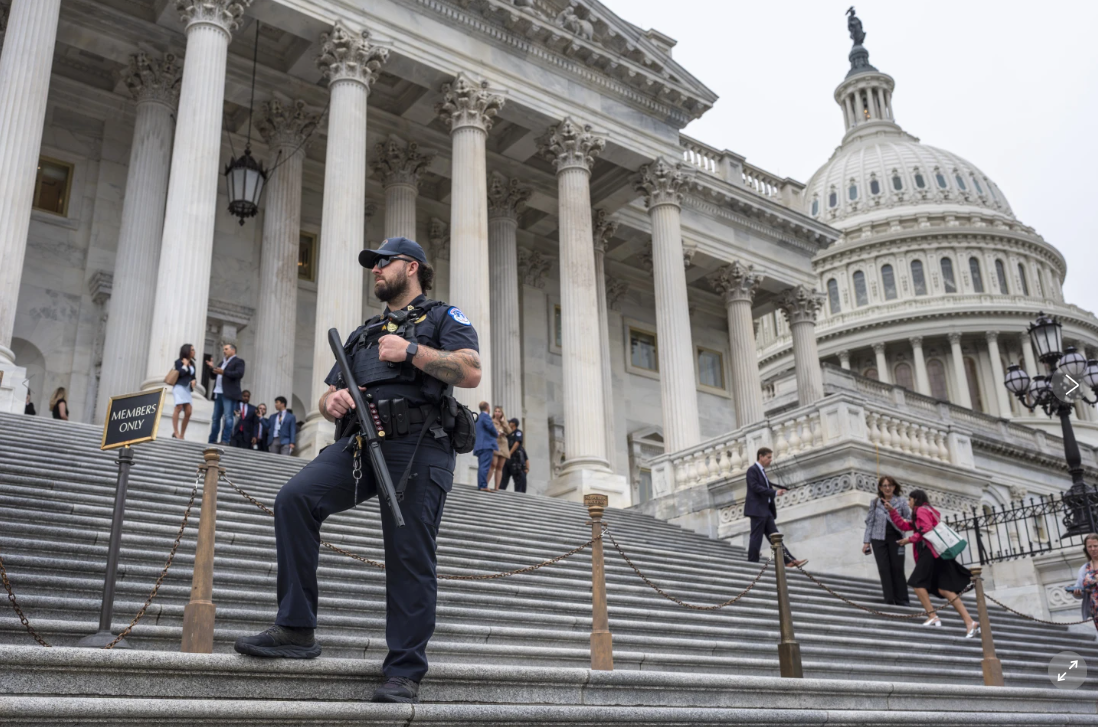
As House Speaker Mike Johnson gathered lawmakers this week to mourn Charlie Kirk, he summed up the grief felt by many on Capitol Hill — and the pervasive fear.
“For so many of us, it has felt as if the ground was shaken,” said Johnson.
The killing of Kirk, the prominent conservative activist and Turning Point USA founder, has unnerved lawmakers in both parties, amplifying their long-standing concerns about safety in a heated political climate where threats against political rivals and calls to violence have become frighteningly common.
Responding to those concerns, Senate Majority Leader John Thune on Thursday night engineered unanimous passage of a measure that will allow senators to use money designated for their offices and staff for security purposes. Members of the House are pushing for increased security funding as well.
It’s all part of a significant shift for lawmakers who increasingly feel that their engagement in public life requires the same kinds of security precautions long reserved for the president and members of the Cabinet.
Unlike the president and other top executive branch officials, rank-and-file lawmakers are often unaccompanied by security agents when they are off Capitol Hill, which is guarded by the U.S. Capitol Police. Some members of Congress pay for private security out of private or campaign funds.
The number of threat assessment cases handled by the Capitol Police has grown steadily over the past four years. The department says it tracked more than 9,000 cases of reported threats in 2024 and is on track to handle roughly 14,000 by the end of this year.
“This is a national security issue. This is a big deal and we’re taking it very seriously,” said Florida Rep. Anna Paulina Luna, who was in a group of GOP lawmakers who met with Johnson multiple times this week to push for more security money in a package to fund the federal government.
Luna said many of the lawmakers have faced security threats — to themselves or their loved ones — that are the subject of law enforcement investigations. Lawmakers say they now routinely face death threats, “swatting” calls, bomb scares and vandalism at their offices.
“We’ve been needing this,” Luna said. “The fact that it took for this to happen to even address this is crazy to me, but it needs to be dealt with.”

The government funding bill passed by the Republican-controlled House on Friday would add about $88 million in security money for lawmakers and members of the Supreme Court and executive branch.
A temporary program that offers a monthly stipend for House members doubled its funding to $10,000 per member from $5,000. The House Administration Committee launched the program in July after the assassination of Minnesota state Rep. Melissa Hortman and her husband.
Through the program, House lawmakers are also allowed to spend up to $20,000 on in-home security equipment.
The cash infusion does not affect the president, who is protected by a separate budget for the Secret Service, or the Capitol Police, which guards the Capitol complex — the Capitol, Supreme Court, the Library of Congress and scores of offices staffed by government and political officials.
“Federal judges have marshals. Obviously, the executive has federal law enforcement. Members of Congress are unprotected,” said Rep. Maxwell Frost. “We’re in a heightened time of political violence,” Frost said, adding that he thought it was “ridiculous” that lawmakers had to use their personal or campaign funds to protect themselves.
Rep. Debbie Wasserman Schultz, D-Fla., is calling for a “comprehensive” security plan for all House members, including security personnel who would travel with the lawmakers.
She said that in the past she had hesitated to increase security because it puts a barrier between her and constituents. But the recent high-profile killings of political figures, as well as the shooting of her friend, then-Rep. Gabby Giffords in 2011, has convinced her that the protection is necessary.
“It’s really to me become a necessity to protect our constituents, to protect us, to protect our staff, our family members,” Wasserman Schultz said. “The risk is too great.”
___
Republished with permission of the Associated Press.
Florida Democrats say an amendment shot down by the U.S. House Rules Committee could have protected the Everglades from energy exploration.
U.S. Rep. Debbie Wasserman Schultz, a Weston Democrat, pushed for a change in language in the Improving Interagency Coordination for Pipeline Reviews Act (HR 3668) during Committee proceedings. That bill, filed by U.S. Rep. Richard Hudson, a North Carolina Republican, would expedite review of natural gas or liquified gas pipelines by the Federal Energy Regulatory Commission (FERC).
Wasserman Schultz’s amendment to the bill would have excluded the Everglades and other Florida navigable waters from that change, still requiring extensive review to put a pipeline through Florida’s largestnational park. However, the Rules Committee did not allow the amendment to come to a vote.
“While we spend billions to restore the Everglades, House Republicans voted to pollute it,” Wasserman Schultz posted on social media.
She said the amendment was worked on with the support of most Democrats in Florida’s congressional delegation, including U.S. Reps. Kathy Castor, Lois Frankel, Darren Soto and Frederica Wilson. Wasserman Schultz is the Democratic co-chair of the congressional delegation.
The proposed change “tried to exempt the Everglades from this dirty water bill, but House Republicans rejected it,” Wasserman Schultz said.
Republicans characterized the legislation differently, with some members from Florida.
U.S. Rep. Cory Mills, a New Smyrna Beach Republican, said he supported advancing the bill from the Committee to the floor.
“I voted to support HR 3668, the Improving Interagency Coordination for Pipeline Reviews Act, to cut red tape and speed up approvals for natural gas pipelines and LNG terminals,” he posted. “This bill puts FERC in charge of NEPA (National Environmental Policy Act) reviews, sets strict timelines, improves agency coordination and strengthens pipeline security. This is how we lower energy costs and boost American energy independence.”
FERC is responsible for reviewing and issuing permits for new or expanded gas lines. The legislation, as written, would shift oversight responsibilities from state governments to the agency and eliminate the need for state certifications.
Democratic U.S. Rep. Sheila Cherfilus-McCormick is staying true to the old maxim, “Never let a crisis go to waste.”
This week, her re-election campaign sent texts to voters imploring them to donate to help her in “fighting back” against what she calls a “politically motivated” attack against her.
She’s referring, of course, to federal charges filed in November accusing her of stealing $5 million in Federal Emergency Management Agency (FEMA) funds to bankroll her 2021 congressional campaign.
“2 weeks ago, I took a stand and voted to demand transparency, truth and accountability from our leaders. The next day, the attacks began. An indictment was filed. This was not random. This was politically motivated retaliation,” the text said.
“But this isn’t about silencing one person. It’s about sending a clear message to anyone who dares to challenge powerful interests: ‘Fall in line — or pay the price. Well, I’m fighting back — but I need you with me. DONATE NOW.”
The text then links to a donations pagethat, among other things, says, “She voted for the truth. They answered with retaliation.”
The fundraising text.
A perusal of Cherfilus-McCormick’s votes from around two weeks back reveals what she is likely referring to: “yes” votes on measures concerning the release of files connected to convicted sex offender Jeffrey Epstein.
Notably, none of the 426 other members of the House who voted to release the Epstein files were federally indicted for embezzling COVID funds in recent weeks.
The grand jury indictment against Cherfilus-McCormick, announced Nov. 19, alleges she and her brother secured funding intended for a COVID vaccine distribution program, but when overpayments were made, she rerouted the money through several accounts that later donated to her campaign.
U.S. Attorney General Pam Bondi described the alleged act as “a particularly selfish, cynical crime.”
Cherfilus-McCormick, 46, has maintained and reiterated that she is innocent of wrongdoing, calling the charges “unjust” and “baseless.”
“The timing alone is curious and clearly meant to distract from far more pressing national issues,” she said a day after the indictment was announced, noting that she has “fully cooperated” with a yearslong investigation into the matter. “I look forward to my day in court. Until then, I will continue fighting for my constituents.”
The fundraising site.
Should Cherfilus-McCormick be found guilty of all counts in the indictment, she could face up to 53 years in prison.
Cherfilus-McCormick isn’t the only federal lawmaker from Florida to fundraise off of her legal travails. Last year, following a House Ethics Committee report that there was “substantial evidence” he paid for sex, including with a 17-year-old, former U.S. Rep. Matt Gaetz sent out a fundraising plea citing his troubles.
“I need your help,” Gaetz, a Republican, said in an email through his political committee last December. “I’ve fought for you in Congress for eight years against the worst of the Radical Left and Uniparty. Now, they’re seeking their revenge.”
Gaetz, who resigned the month before, called the scrutiny over his alleged impropriety a “witch hunt.”
Former Republican U.S. Rep. George Santos of Long Island used the exact phrase to describe the fraud and money-laundering charges he faced in May 2023, about seven months before his peers in the House expelled him.
Republican U.S. Rep. Greg Steube introduced a resolutionlast month to expel Cherfilus-McCormick. Other than its referral to the Ethics Committee, no action has been taken on the bill.
Cherfilus-McCormick represents Florida’s 20th Congressional District, which spans parts of Broward and Palm Beach counties. She faces Primary challenges from Dale Holness and Elijah Manley, the latter of whom she is suing for defamation over the FEMA funds issue.
Republicans Sendra Dorce and Rodenay Joseph are also running in the district, which leans heavily Democratic.
Florida Politics contacted Cherfilus-McCormick’s Communications Director, Kailyn McBride, seeking comment about the Congresswoman’s texts, but received no response.
Toxic PFAS “forever chemicals” are found in nearly half of all U.S. drinking water. These harmful chemicals are linked to cancer, developmental issues, and immune system damage. They enter our water systems through industrial discharges, firefighting foams, and landfill runoff. Once present, they are nearly impossible to remove using traditional methods.
For years, families, utilities, and local governments have faced a difficult choice: accept unsafe water or pay for costly, slow, and incomplete cleanup methods.
After 10 years of research and development, Eco World Water has the solution.
At Eco World Water, we have completed four months of rigorous pilot testing with an independent laboratory, under protocols reviewed by the Florida Department of Environmental Protection. The verified lab results confirm that our system can reduce PFAS to non-detectable levels in a safe, reliable, and quick manner. More importantly, the system produces clean, safe water in minutes, not days.
For a national problem needing a scalable solution, this is a breakthrough with transformative potential.
Per- and polyfluoroalkyl substances (PFAS) earned the nickname “forever chemicals” for a good reason. They persist in the environment for decades, are resistant to conventional treatment, and pose serious risks to public health. That is why our verified results are so significant.
For too long, PFAS have been viewed as an unsolvable challenge. We can now say with confidence: problem solved. Our system demonstrates that communities don’t have to accept “forever chemicals” as a fact of life. PFAS-free water is not theoretical. It’s operational.
Just as important, Eco World Water’s patented, modular technology is a complete, all-in-one system built for permanent installation. It takes up significantly less space than traditional wastewater treatment systems and can be scaled to meet the needs of communities, large or small. Its modular design also enables a version that fits inside a shipping container, ideal for rapid deployment to disaster relief zones or remote locations where clean water is urgently needed.
The system turns raw wastewater into water that meets drinking quality standards, not just removing PFAS, but also eliminating a wide range of harmful contaminants like heavy metals, pharmaceuticals, and pathogens. It’s fast, compact, and easy to operate, bringing clean water where it’s needed most, without the delays or complexity of traditional systems.
This is the result of more than 10 years of focused research and development. Eco World Water’s mission is simple: give every community access to clean, safe, and affordable water. With these latest independent lab-verified results, we are delivering on that mission.
This progress comes at a crucial moment in the quest for clean water.
States across the country are preparing for more demanding PFAS standards and increased federal oversight. Billions of dollars in federal infrastructure funding are available to support water system upgrades. Yet many communities still lack tools that can meet those expectations. Our technology can adapt to the needs of each site and provides a clear, cost-effective path toward compliance with new federal mandates.
Families deserve water they can trust. Local governments deserve options that don’t strain their budgets. Communities deserve solutions that meet the urgency of the clean water moment.
Eco World Water is ready to deliver.
After decades of frustration and uncertainty, we now have a verified solution. Water with undetectable PFAS levels is not just an aspiration. It’s a proven, tested reality.
___
Steve Adelstein is the Executive Chair of Eco World Water.