Connect with us

Business

Meet the Philadelphia-based graphic designer who took inspiration from bodegas, Bollywood and hot dog carts for Zohran Mamdani’s iconic campaign

Published

on


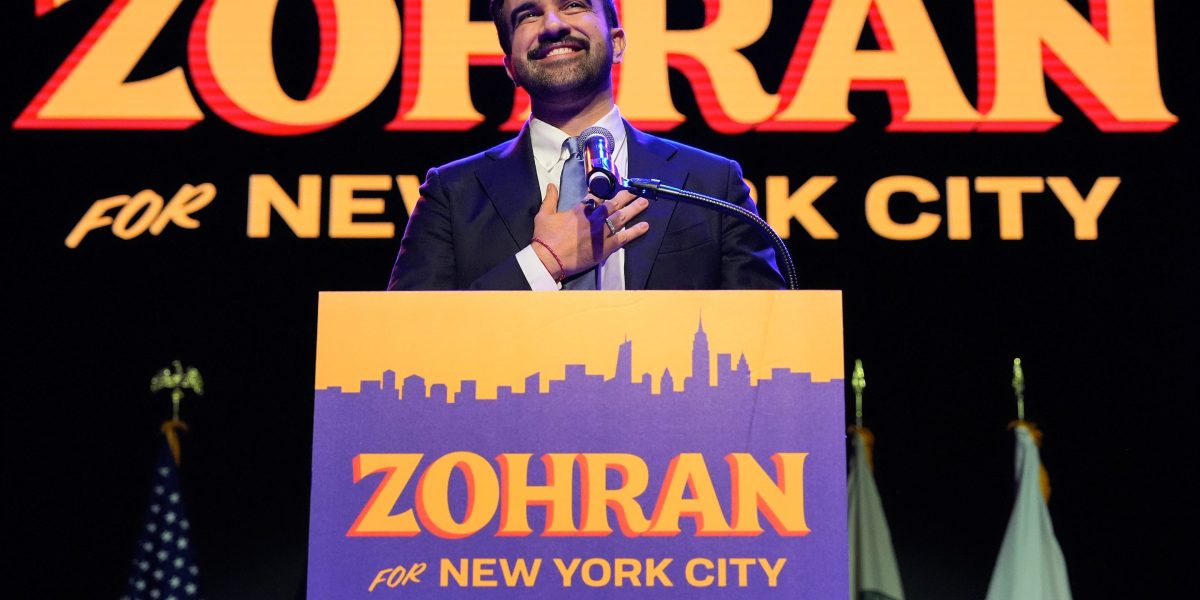
The vivid blue campaign signs with bold orange lettering were impossible to miss as Zohran Mamdani made his historic and improbable run for New York City mayor this summer.

On storefront windows and telephone poles from Queens to the Bronx, the “Zohran for New York City” signs stood out from the standard red, white and blue campaign fodder. The lettering was seen by many as an intentional reference to old-school Bollywood posters — a subtle nod to Mamdani’s Indian heritage.

But Aneesh Bhoopathy, the Philadelphia-based graphic designer behind the visuals, said the campaign also drew from the vibrant primary colors that help bodegas, yellow cabs, hot dog vendors and other small businesses stand out amid the city bustle.

The stylized font — with its drop shadow effect and vintage comic book look — was meant to evoke the old school, hand-painted signs that can still be found in some neighborhoods, he said.

“Succinctly, it’s New York,” said Bhoopathy, who previously lived in New York and helped on past campaigns for Mamdani and the Queens chapter of the Democratic Socialists of America.

It was also trendsetting.

Mamdani’s main adversary, former New York Gov. Andrew Cuomo, even rebranded midcampaign. The Democrat initially launched his mayoral run using a red, white and blue color scheme and a decidedly unfussy font, reminiscent of bumper stickers used by President John F. Kennedy in 1960.

But after his defeat to Mamdani in the June Democratic primary, Cuomo kicked off his general election run as an independent candidate by rolling out a new logo featuring the silhouette of the Statue of Liberty’s crown and a new color scheme: blue and orange — Mamdani’s colors, but also the colors of the Knicks and Mets.

Mamdani, who will be the city’s first Muslim and South Asian mayor, is the son of two prominent Indian American luminaries, Columbia University professor Mahmood Mamdani and filmmaker Mira Nair, who is known for “Monsoon Wedding” and other Hollywood films.

The campaign’s aesthetic wasn’t merely stylistic, observed David Schwittek, a professor of digital media and graphic design at Lehman College, a city-owned college in the Bronx.

“They evoke the working-class fabric of New York City: the bodegas, taxi cabs, and halal carts that not only sustain the city but also reflect its cultural richness,” he said.

The decidedly retro vibe also likely helped foster “positive associations to happier political times,” at least among Democratic voters, suggested Gavan Fitzsimons, a business professor at Duke University who studies the impact of branding on voters and consumers.

“It has the feel of something from a prior era, an earlier time when politics was less divisive and the Democrats were perhaps more organized, more successful,” he said.

The branding was reminiscent of the distinctive campaign font that became a calling card for U.S. Rep. Alexandria Ocasio-Cortez, another youthful liberal New Yorker who shot to political fame, said Richard Flanagan, a political science professor at the College of Staten Island.

The Democrat’s posters during her stunning 2018 victory over U.S. Rep. Joseph Crowley for a seat representing parts of Queens and the Bronx similarly drew on her heritage and working class New York.

The brightly-colored, upward slanting lettering reminded some of prewar labor union designs and others of Mexican “Lucha libre” flyers, particularly since it incorporated the inverted exclamation mark used in written Spanish.

Court Stroud, a marketing professor at New York University, said it’s difficult to quantify how much the campaign visuals contributed to Mamdani’s success, but they certainly made him recognizable and memorable in an initially crowded field of mayoral hopefuls.

“The playfulness of his campaign design created a brand that supporters wanted to wear and share,” he said. “Mamdani’s team showed how using visual design as a secret handshake can make politics feel real and community driven.”

Campaign experts said it’s also too early to say whether Mamdani’s campaign designs will ultimately have the same staying power nationally as Ocasio-Cortez’s distinctive look, which has since become a staple of progressive candidate branding.

“It’s still rare for candidates to move away from the tried and true red, white, and blue,” said Lisa Burns, a professor of media studies at Quinnipiac University in Connecticut. “I don’t see that changing any time soon.”

The popularity of Mamdani’s designs were certainly felt during the New York City mayoral race, helping inspire off-beat, viral campaigns such as the “Hot Girls for Zohran” merch worn by model Emily Ratajkowski and other young celebs.

Schwittek said the key takeaway from Mamdani’s visual coup was that effective branding isn’t generic or safe, but specific and deliberate.

“In a sea of sanitized political messaging, Mamdani’s visuals stand out because they mean something,” he said. “That’s the lesson.”

Good campaign design should also still ring true to the candidate, added Bhoopathy.

“None of the boldness and vibrancy here works without a candidate that is as energetic and full of life as the city that raised him,” he said.


Source link

Continue Reading

Business

Quant who said passive era is ‘worse than Marxism’ doubles down

Published

on


Inigo Fraser Jenkins once warned that passive investing was worse for society than Marxism. Now he says even that provocative framing may prove too generous.

In his latest note, the AllianceBernstein strategist argues that the trillions of dollars pouring into index funds aren’t just tracking markets — they are distorting them. Big Tech’s dominance, he says, has been amplified by passive flows that reward size over substance. Investors are funding incumbents by default, steering more capital to the biggest names simply because they already dominate benchmarks.

He calls it a “dystopian symbiosis”: a feedback loop between index funds and platform giants like Apple Inc., Microsoft Corp. and Nvidia Corp. that concentrates power, stifles competition, and gives the illusion of safety. Unlike earlier market cycles driven by fundamentals or active conviction, today’s flows are automatic, often indifferent to risk.

Fraser Jenkins is hardly alone in sounding the alarm. But his latest critique has reignited a debate that’s grown harder to ignore. Just 10 companies now account for more than a third of the S&P 500’s value, with tech names driving an outsize share of 2025’s gains.

“Platform companies and a lack of active capital allocation both imply a less effective form of capitalism with diminished competition,” he wrote in a Friday note. “A concentrated market and high proportion of flows into cap weighted ‘passive’ indices leads to greater risks should recent trends reverse.” 

While the emergence of behemoth companies might be reflective of more effective uses of technology, it could also be the result of failures of anti-trust policies, among other things, he argues. Artificial intelligence might intensify these issues and could lead to even greater concentrations of power among firms. 

His note, titled “The Dystopian Symbiosis: Passive Investing and Platform Capitalism,” is formatted as a fictional dialog between three people who debate the topic. One of the characters goes as far as to argue that the present situation requires an active policy intervention — drawing comparisons to the breakup of Standard Oil at the start of the 20th century — to restore competition.

data-srcyload

In a provocative note titled “The Silent Road to Serfdom: Why Passive Investing is Worse Than Marxism” and written nearly a decade ago, Fraser Jenkins argued that the rise of index-tracking investing would lead to greater stock correlations, which would impede “the efficient allocation of capital.” His employer, AllianceBernstein, has continued to launch ETFs since the famous research was published, though its launches have been actively managed. 

Other active managers have presented similar viewpoints — managers at Apollo Global Management last year said the hidden costs of the passive-investing juggernaut included higher volatility and lower liquidity. 

There have been strong rebuttals to the critique: a Goldman Sachs Group Inc. study showed the role of fundamentals remains an all-powerful driver for stock valuations; Citigroup Inc. found that active managers themselves exert a far bigger influence than their passive rivals on a stock’s performance relative to its industry.

“ETFs don’t ruin capitalism, they exemplify it,” said Eric Balchunas, Bloomberg Intelligence’s senior ETF analyst. “The competition and innovation are through the roof. That is capitalism in its finest form and the winner in that is the investor.”

Since Fraser Jenkins’s “Marxism” note, the passive juggernaut has only grown. Index-tracking ETFs, which have grown in popularity thanks to their ease of trading and relatively cheaper management fees, are often cited as one of the primary culprits in this debate. The segment has raked in $842 billion so far this year, compared with the $438 billion hauled in by actively managed funds, even as there are more active products than there are passive ones, data compiled by Bloomberg show. Of the more than $13 trillion that’s in ETFs overall, $11.8 trillion is parked in passive vehicles. The majority of ETF ownership is concentrated in low-cost index funds that have significantly reduced the cost for investors to access financial markets. 

In Fraser Jenkins’s new note, one of his fictitious characters ask another what the “dystopian symbiosis” implies for investors. 

“The passive index is riskier than it has been in the past,” the character answers. “The scale of the flows that have been disproportionately into passive cap-weighted funds with a high exposure to the mega cap companies implies the risk of a significant negative wealth effect if there is an upset to expectations for those large companies.”


Source link

Continue Reading

Business

Why the timing was right for Salesforce’s $8 billion acquisition of Informatica — and for the opportunities ahead

Published

on


The must-haves for building a market-leading business include vision, talent, culture, product innovation and customer focus. But what’s the secret to success with a merger or acquisition? 

I was asked about this in the wake of Salesforce’s recently completed $8 billion acquisition of Informatica. In part, I believe that people are paying attention because deal-making is up in 2025. M&A volume reached $2.2 trillion in the first half of the year, a 27% increase compared to a year ago, according to JP Morgan. Notably, 72% of that volume involved deals greater than $1 billion. 

There will be thousands of mergers and acquisitions in the United States this year across industries and involving companies of all sizes. It’s not unusual for startups to position themselves to be snapped up. But Informatica, founded in 1993, didn’t fit that mold. We have been building, delivering, supporting and partnering for many years. Much of the value we bring to Salesforce and its customers is our long-earned experience and expertise in enterprise data management. 

Although, in other respects, a “legacy” software company like ours — founded well before cloud computing was mainstream — and early-stage startups aren’t so different. We all must move fast and differentiate. And established vendors and growth-oriented startups have a few things in common when it comes to M&A, as well. 

First and foremost is a need to ensure that the strategies of the two companies involved are in alignment. That seems obvious, but it’s easier said than done. Are their tech stacks based on open protocols and standards? Are they cloud-native by design? And, now more than ever, are they both AI-powered and AI-enabling? All of these came together in the case of Salesforce and Informatica, including our shared belief in agentic AI as the next major breakthrough in business technology.

Don’t take your foot off the gas

In the days after the acquisition was completed, I was asked during a media interview if good luck was a factor in bringing together these two tech industry stalwarts. Replace good luck with good timing, and the answer is a resounding, “Yes!”

As more businesses pursue the productivity and other benefits of agentic AI, they require high-quality data to be successful. These are two areas where Salesforce and Informatica excel, respectively. And the agentic AI opportunity — estimated to grow to $155 billion by 2030 — is here and now. So the timing of the acquisition was perfect. 

Tremendous effort goes into keeping an organization on track, leading up to an acquisition and then seeing it through to a smooth and successful completion. In the few months between the announcement of Salesforce’s intent to acquire Informatica and the close, we announced new partnerships and customer engagements and a fall product release that included autonomous AI agents, MCP servers and more. 

In other words, there’s no easing into the new future. We must maintain the pace of business because the competitive environment and our customers require it. That’s true whether you’re a small, venture-funded organization or, like us, an established firm with thousands of employees and customers. Going forward we plan to keep doing what we do best: help organizations connect, manage and unify their AI data. 

Out with the old, in with the new

It’s wrong to think of an acquisition as an end game. It’s a new chapter. 

Business leaders and employees in many organizations have demonstrated time and again that they are quite good at adapting to an ever-changing competitive landscape. A few years ago, we undertook a company-wide shift from on-premises software to cloud-first. There was short-term disruption but long-term advantage. It’s important to develop an organizational mindset that thrives on change and transformation, so when the time comes, you’re ready for these big steps. 

So, even as we take pride in all that we accomplished to get to this point, we now begin to take on a fresh identity as part of a larger whole. It’s an opportunity to engage new colleagues and flourish professionally. And importantly, customers will be the beneficiaries of these new collaborations and synergies. On the day Informatica was welcomed into the Salesforce family and ecosystem, I shared my feeling that “the best is yet to come.” That’s my North Star and one I recommend to every business leader forging ahead into an M&A evolution — because the truest measure of success ultimately will be what we accomplish next.

The opinions expressed in Fortune.com commentary pieces are solely the views of their authors and do not necessarily reflect the opinions and beliefs of Fortune.


Source link

Continue Reading

Business

The ‘Great Housing Reset’ is coming: Income growth will outpace home-price growth in 2026

Published

on


Homebuyers may experience a reprieve in 2026 as price normalization and an increase in home sales over the next year will take some pressure off the market—but don’t expect homebuying to be affordable in the short run for Gen Z and young families.

The “Great Housing Reset” will start next year, with income growth outpacing home-price growth for a prolonged period for the first time since the Great Recession era, according to a Redfin report released this week. 

The residential real estate brokerage sees mortgage rates in the low-6% range, down from down from the 2025 average of 6.6%; a median home sales price increase of just 1%, down from 2% this year; and monthly housing payments growth that will lag behind wage growth, which will remain steady at 4%.

These trends toward increased affordability will likely bring back some house hunters to the market, but many Gen Zers and young families will opt for nontraditional living situations, according to the report. 

More adult children will be living with their parents, as households continue to shift further away from a nuclear family structure, Redfin predicted.

“Picture a garage that’s converted into a second primary suite for adult children moving back in with their parents,” the report’s authors wrote. “Redfin agents in places like Los Angeles and Nashville say more homeowners are planning to tailor their homes to share with extended family.”

Gen Z and millennial homeownership rates plateaued last year, with no improvement expected. Just over one-quarter of Gen Zers owned their home in 2024, while the rate for millennial owners was 54.9% in the same year.

Meanwhile, about 6% of Americans who struggled to afford housing as of mid-2025 moved back in with their parents, while another 6% moved in with roommates. Both trends are expected to increase in 2026, according to the report.

Obstacles to home affordability 

Despite factors that could increase affordability for prospective homebuyers, C. Scott Schwefel, a real estate attorney at Shipman, Shaiken & Schwefel, LLC, told Fortune that income growth and home-price growth are just a few keys to sustainable homeownership. 

An improved income-to-price ratio is welcome, but unless tax bills stabilize, many households may not experience a net relief, Schwefel said.

“Prospective buyers need to recognize that affordability is not just price versus income…it’s price, mortgage rate and the annual bill for living in a place—and that bill includes property taxes,” he added.

In November, voters—especially young ones—showed lowering housing costs is their priority, the report said. But they also face high sale prices and mortgage rates, inflated insurance premiums, and potential utility costs hikes due to a data center construction boom that’s driving up energy bills. The report’s authors expect there to be a bipartisan push to help remedy the housing affordability crisis.

Still, an affordable housing market for first-time home buyers and young families still may be far away.

“The U.S. housing market should be considered moving from frozen to thawing,” Sergio Altomare, CEO of Hearthfire Holdings, a real estate private equity and development company, told Fortune

“Prices aren’t surging, but they’re no longer falling,” he added. “We are beginning to unlock some activity that’s been trapped for a couple of years.”


Source link

Continue Reading

Trending

Copyright © Miami Select.