Connect with us

Business

Meet the only campus protester still locked up by Trump, a 32-year-old Palestinian who grew up in the West Bank with aunts and uncles in Gaza

Published

on


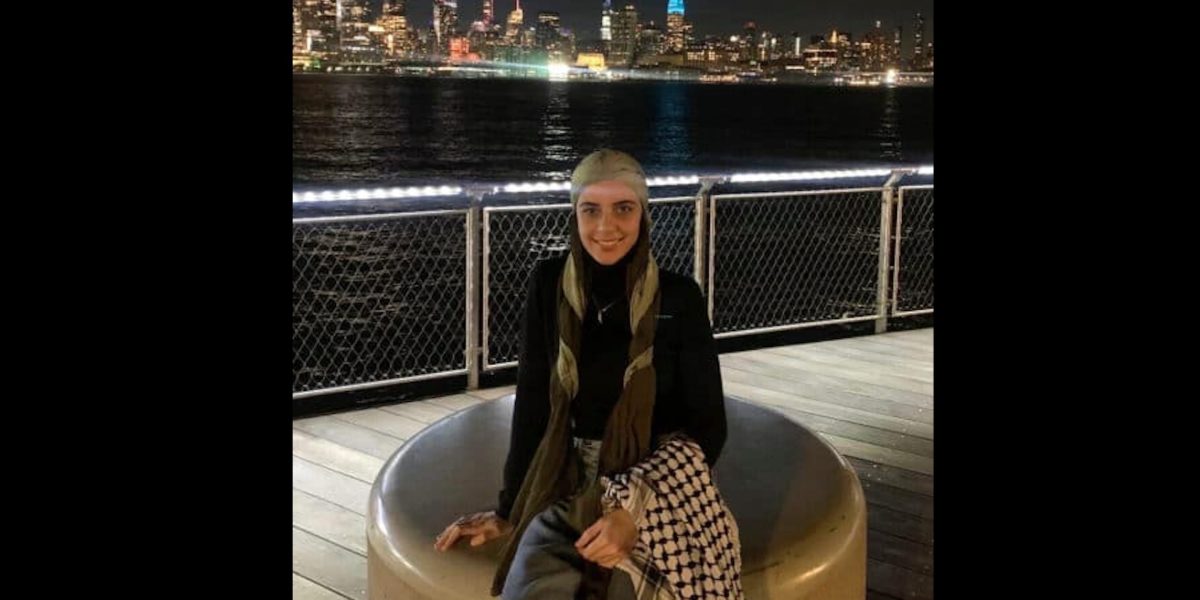
Growing up in the West Bank, Leqaa Kordia was separated from family in Gaza by Israeli restrictions on movement between the territories. So aunts and uncles in Gaza would call from the beach there, allowing Kordia to share her cousins’ laughter and glimpse the waves.

Now many of those relatives are dead, killed in the war that has destroyed much of the Strip. And more than 200 days after Kordia was swept up in the Trump administration’s crackdown on pro-Palestinian protesters, she despairs over being unable to give her family a voice.

“Most days I feel helpless,” said Kordia, 32, speaking from a Texas immigration detention center where she has been jailed since March. “I want to do something, but I can’t from here. I can’t do anything.”

Kordia, a Palestinian who has lived in New Jersey since 2016, was one of the first arrested in the government’s campaign against protesters, many of them prominent activists. All the others have gained release.

Only Kordia — mischaracterized by the government, largely overlooked by the public and caught in a legal maze — languishes in detention. That is, in part, because her story differs from most others who thronged campuses.

When she joined demonstrations against Israel outside Columbia University, she wasn’t a student or part of a group that might have provided support. As the arrests of activists like Mahmoud Khalil drew condemnation from elected officials and advocates, Kordia’s case largely remained out of the public eye.

And Kordia has been reluctant to draw attention to herself.

In her first interview since her arrest, Kordia said recently that she was moved to protest because of deep personal ties to Gaza, where more than 170 relatives have been killed. The government has cast those ties as suspect, pointing to Kordia’s money transfers to relatives in the Middle East as evidence of possible ties to terrorists.

Lawyers for the Department of Homeland Security didn’t reply to calls for comment. An agency spokesperson declined to answer questions about the case.

In a blistering decision this week, a federal judge found the Trump administration unlawfully targeted protesters for speaking out. That ruling isn’t binding, though, in the highly conservative district where Kordia’s case is being heard.

“The government has tried again and again to muster some kind of justification to hold this young woman in custody indefinitely,” said her immigration attorney, Sarah Sherman-Stokes. “It doesn’t seem to matter to them that they have no evidence.”

‘Go to the streets’

Kordia grew up in the West Bank city of Ramallah. Her parents divorced when she was a child and her mother remarried, eventually becoming a U.S. citizen. In 2016, Kordia came to the U.S. on a visitor’s visa, staying with her mother in Paterson, New Jersey, which is home to one of the nation’s largest Arab communities.

Soon after, Kordia enrolled in an English-language program and obtained a student visa. Her mother applied to let Kordia remain in the U.S. as the relative of a citizen.

The application was approved, but no visas were available. Government lawyers say Kordia has been in the U.S. illegally since she left school in 2022, surrendering her student status and invalidating her visa. Kordia said she believed then that her mother’s application assured her own legal status and that she mistakenly followed a teacher’s advice.

Kordia worked as a server at a Middle Eastern restaurant on Paterson’s Palestine Way while helping to care for her half brother, who has autism.

Those routines were upended in October 2023, after Hamas attacked southern Israel, killing about 1,200 people and taking 251 hostage. Israel responded with a massive military campaign, killing more than 66,000 Palestinians, according to Gaza’s Health Ministry, part of the Hamas-run government.

In calls with relatives in Gaza “they were telling me that ’We’re hungry. …We are scared. We’re cold. We don’t have anywhere to go,” Kordia said. “So my way of helping my family and my people was to go to the streets.”

Kordia said she joined more than a dozen protests in New York, New Jersey and Washington, D.C. In April 2024, she was arrested with 100 other protesters outside Columbia’s gates — charges quickly dismissed by prosecutors and sealed.

Soon after taking office, President Donald Trump issued executive orders equating the protests with antisemitism. DHS intelligence analysts began assembling dossiers on noncitizens who criticized Israel or protested the war, based on doxing sites and information from police.

“To all the resident aliens who joined in the pro-jihadist protests, we put you on notice,” Trump said in a fact sheet accompanying the orders. “Come 2025 we will find you and we will deport you.”

Surveillance, arrest and confusion

In March, immigration agents showed up at Kordia’s home and workplace, as well as her uncle’s house in Florida. “The experience was very confusing,” she said. “It was like: Why are you doing all this?”

Kordia hired a lawyer before agreeing to a March 13 meeting with Immigration and Customs Enforcement officials in Newark. She was detained immediately and flown to Prairieland Detention Center, south of Dallas.

Once there, she was assigned a bare mattress on the floor and denied religious accommodations, including Halal meals, her lawyers said.

When her cousin, Hamzah Abushaban, visited Kordia about a week after her arrest, he was taken aback by the dark circles under her eyes and her state of confusion.

“One of the first things she asked me was why was she there,” Abushaban said. “She cried a lot. She looked like death.”

“I must’ve asked her a thousand times, like, you’re sure you didn’t commit a crime?” he said. “What she thought and I thought was probably going to be a few more days of being detained has turned into almost, what, 7 months now.”

Kordia said that she didn’t understand the reasons for her detention until a week or two later, when a television at the facility was tuned to news of protester arrests.

“I see my name, literally in big letters, on CNN and I was like, what’s going on?” she said.

Payments scrutinized

Administration officials touted Kordia’s arrest as part of the deportation effort against those who “actively participated in anti-American, pro-terrorist activities.” A DHS press release noted her arrest the previous year at a “pro-Hamas” demonstration, mistakenly labeling her as a Columbia student.

Court papers show New York police gave records of her dismissed arrest to DHS — an apparent violation of a city law barring cooperation with immigration enforcement. Federal officials told police the information was needed in a criminal money laundering investigation, a police spokesperson later said.

At a bond hearing weeks later, government attorneys argued for Kordia’s continued detention, pointing to subpoenaed records showing she had sent “large amounts of money to Palestine and Jordan.”

Kordia said she and her mother had sent the money, totaling $16,900 over eight years, to relatives. A $1,000 payment in 2022 went to an aunt in Gaza whose home and hair salon had been destroyed in an Israeli strike. Two more payments last year went to a cousin struggling to feed his family.

“To hear the government accusing them of being terrorists and accusing you of sending money to terrorists, this is heartbreaking,” Kordia said.

An immigration judge, examining transaction records and statements from relatives, found “overwhelming evidence” that Kordia was telling the truth about the payments.

That judge has twice ordered her released on bond. The government has challenged the ruling, triggering a lengthy appeals process — highly unusual in immigration cases that don’t involve serious crimes.

Typically, when the government goes after someone for overstaying a visa, they are rarely arrested, let alone held in prolonged detention, said Adam Cox, a professor of immigration law at New York University.

“The kind of scale and scope and publicness of the campaign against student protesters by the Trump administration is really nothing like we’ve seen in recent memory,” said Cox, who studies the rise of presidential power in immigration policy.

‘One person left behind’

Kordia has sought release in federal court, the same path taken by Khalil and others. Whether she succeeds may depend on an appeals court in New York, which heard arguments this week from government attorneys who contend that such relief should be largely off-limits to noncitizens.

Khalil, who was freed in June, said he had followed Kordia’s case closely, asking lawyers to relay messages and reminding his supporters “that there is one person left behind.”

“She came straight from the West Bank, escaping the daily ordeals of settlers and administrative detention only to deal with a version of that here,” said Khalil, referring to Israel’s practice of jailing some Palestinians indefinitely without charge or trial. “It breaks my heart that she’s going through all of this.”

As detention stretches on, Kordia said it’s been difficult to follow developments in the war, let alone maintain contact with relatives caught in the conflict.

But it’s provided many hours to think about a time when the war is finally over and she can find peace.

That would start by being reunited with her mother and other relatives, she said, and maybe one day having a family of her own. She dreams of opening a cafe and introducing people to Palestinian culture through food. She wants to pursue an American life.

“That’s all I wanted, to live with my family in peace in a land that appreciates freedom,” she says. “That’s literally all that I want.”


Source link

Continue Reading

Business

Binance has been proudly nomadic for years. A new announcement suggests it’s chosen an HQ

Published

on


For years, Binance has dodged questions about where it plans to establish a corporate headquarters. On Monday, the world’s largest crypto exchange made an announcement that indicates it has chosen a location: Abu Dhabi, the capital of the United Arab Emirates.

In its announcement, Binance reported that it has secured three global financial licenses within Abu Dhabi Global Market, a special economic zone inside the Emirati city. The licenses regulate three different prongs of the exchange’s business: its exchange, clearinghouse, and broker dealer services. The three regulated entities are named Nest Exchange Limited, Nest Clearing and Custody Limited, and Nest Trading Limited, respectively.

Richard Teng, the co-CEO of Binance, declined to say whether Abu Dhabi is now Binance’s global headquarters. “But for all intents and purposes, if you look at the regulatory sphere, I think the global regulators are more concerned of where we are regulated on a global basis,” he said, adding that Abu Dhabi Global Market is where his crypto exchange’s “global platform” will be governed.

A company spokesperson declined to add more to Teng’s comments, but did not deny Fortune’s assertion that Binance appears to have chosen Abu Dhabai as its headquarters.

Corporate governance

The Abu Dhabi announcement suggests that Binance, which has for years taken pride in branding itself as a company with no fixed location, is bowing to the practical considerations that go with being a major financial firm—and the corporate governance obligations that entails.

When Changpeng Zhao, the cofounder and former CEO of Binance, launched the company in 2017, he initially established the exchange in Hong Kong. But, weeks after he registered Binance in the city, China banned cryptocurrency trading, and Zhao moved his nascent trading platform. Binance has since been itinerant. “Wherever I sit is going to be the Binance office,” Zhao said in 2020.

The location of a company’s headquarters impacts its tax obligations and what regulations it needs to follow. In 2023, after Binance reached a landmark $4.3 billion settlement with the U.S. Department of Justice, Zhao stepped down as CEO and pleaded guilty to failing to implement an effective anti-money laundering program.

Teng took over and promised to implement the corporate structures—like a board of directors—that are the norm for companies of Binance’s size. Teng, who now shares the CEO role with the newly appointed Yi He, oversaw the appointment of Binance’s first board in April 2024. And he’s repeatedly telegraphed that his crypto exchange is focused on regulatory compliance.

Binance already has a strong footprint in the Emirates. It has a crypto license in Dubai, received a $2 billion investment from an Emirati venture fund in March, and, that same month, said it employed 1,000 employees in the country. 


Source link

Continue Reading

Business

Leaders in Congress outperform rank-and-file lawmakers on stock trades by up to 47% a year

Published

on


Stocks held by members of Congress have been beating the S&P 500 lately, but there’s a subset of lawmakers who crush their peers: leadership.

According to a recent working paper for the National Bureau of Economic Research, congressional leaders outperform back benchers by up to 47% a year.

Shang-Jin Wei from Columbia University and Columbia Business School along with Yifan Zhou from Xi’an Jiaotong-Liverpool University looked at lawmakers who ascended to leadership posts, such as Speaker of the House as well as House and Senate floor leaders, whips, and conference/caucus chairs.

Between 1995 and 2021, there were 20 such leaders who made stock trades before and after rising to their posts. Wei and Zhou observed that lawmakers underperformed benchmarks before becoming leaders, then everything suddenly changed.

“Importantly, whilst we observe a huge improvement in leaders’ trading performance as they ascend to leadership roles, the matched ‘regular’ members’ stock trading performance does not improve much,” they wrote.

Leadership’s stock market edge stems in part from their ability to set the regulatory or legislation agenda, such as deciding if and when a particular bill will be put to a vote. Setting the agenda also gives leaders advanced knowledge of when certain actions will take place.

In fact, Wei and Zhou found that leaders demonstrate much better returns on stock trades that are made when their party controls their chamber.

In addition, being a leader also increases access to non-public information. The researchers said that while companies are reluctant to share such insider knowledge, they may prioritize revealing it to leaders over rank-and-file lawmakers.

Leaders earn higher returns on companies that contribute to their campaigns or are headquartered in their states, which Wei and Zhou said could be attributable to “privileged access to firm-specific information.”

The upper echelon also influences how other members of Congress vote, and the paper found that a leader’s party is much more likely to vote for bills that help firms whose stocks the leader held, or vote against bills that harmed them. And stocks owned by leadership tend to see increases in federal contract awards, especially sole-source contracts, over the following one to two years.

“These results suggest that congressional leaders may not only trade on privileged knowledge, but also shape policy outcomes to enrich themselves,” Wei and Zhou wrote.

Stock trades by congressional leaders are even predictive, forecasting higher occurrences of positive or negative corporate news over the following year, they added. In particular, stock sales predict the number of hearings and regulatory actions over the coming year, though purchases don’t.

Investors have long suspected that Washington has a special advantage on Wall Street. That’s given rise to more ETFs with political themes, including funds that track portfolios belonging to Democrats and Republicans in Congress.

And Paul Pelosi, former House Speaker Nancy Pelosi’s husband, even has a cult following among some investors who mimic his stock moves.

Congress has tried to crack down on members’ stock holdings. The STOCK Act of 2012 requires more timely disclosures, but some lawmakers want to ban trading completely.

A bipartisan group of House members is pushing legislation that would prohibit members of Congress, their spouses, dependent children, and trustees from trading individual stocks, commodities, or futures.

And this past week, a discharge petition was put forth that would force a vote in the House if it gets enough signatures.

“If leadership wants to put forward a bill that would actually do that and end the corruption, we’re all for it,” said Rep. Anna Paulina Luna, R-Fla., on social media on Tuesday. “But we’re tired of the partisan games. This is the most bipartisan bipartisan thing in U.S. history, and it’s time that the House of Representatives listens to the American people.”


Source link

Continue Reading

Business

Macron warns EU may hit China with tariffs over trade surplus

Published

on


French President Emmanuel Macron warned that the European Union may be forced to take “strong measures” against China, including potential tariffs, if Beijing fails to address its widening trade imbalance with the bloc.

“I’m trying to explain to the Chinese that their trade surplus isn’t sustainable because they’re killing their own clients, notably by importing hardly anything from us any more,” Macron told Les Echos newspaper in an interview published on Sunday.

“If they don’t react, in the coming months we Europeans will be obliged to take strong measures and decouple, like the US, like for example tariffs on Chinese products,” he said, adding that he had discussed the matter with European Commission President Ursula von der Leyen.

Macron has just returned from a three-day state visit in China, where he pressed for more investment as Paris seeks to recalibrate its relationship with the world’s second-largest economy. France’s goods trade deficit with China reached around €47 billion ($54.7 billion) last year, according to the French Treasury. Meanwhile, China’s goods trade surplus with the EU swelled to almost $143 billion in the first half of 2025, a record for any six-month period, according to data released by China earlier this year.

Tensions between France and China escalated last year after Paris backed the EU’s decision to impose tariffs on Chinese electric vehicles. Beijing retaliated by imposing minimum price requirements on French cognac, sparking fears among pork and dairy producers that they could be targeted next.

‘Life or Death’

Macron said the US approach to China was “inappropriate” and had worsened Europe’s position by diverting Chinese goods toward the EU market.

“Today, we’re stuck between the two, and it’s a question of life or death for European industry,” Macron said, while noting that Germany — Europe’s biggest economy — doesn’t entirely share France’s stance.

In addition to Europe needing to become more competitive, the European Central Bank too has a role to play in strengthening the EU’s single market, Macron said, arguing that monetary policy should take growth and jobs into account, not just inflation, he said.

He also said the ECB’s decision to continue selling the government bonds it holds risks pushing up long-term interest rates and weighing on economic activity.

“Europe must — and wants to — remain a zone of monetary stability and credible investment,” Macron said.


Source link

Continue Reading

Trending

Copyright © Miami Select.