
Business
Meet the millennial managers ‘stuck between a rock and a hard place’: they’re taking ‘sanity days,’ dodging layoffs and trying to stay out of the ER

“I ended up in the ER,” says a senior communications director in his late 30s who works in the public sector, describing waking from a nightmare with chest pains, pins and needles in his left arm, and being short of breath. He was convinced he was having a heart attack. The director, who requested anonymity given the public-facing nature of his role, told Fortune that a doctor diagnosed him with a panic attack, while his therapist suggested it was related to burnout from stress at work, while stopping short of making that diagnosis.
“Essentially, he said, ‘Your org has culpability, they have done this to you.’”
As Fortune reported in July, millennials broke the managerial tipping point in 2025, as the cohort aged roughly 29 to 44 has displaced Gen X as the largest percentage of leaders in the workforce. But what does it mean for “the burnout generation” to be the ones in charge? They’ve found themselves leading in a climate dramatically different than the one their own bosses walked into—often with minimal mentorship or guidance along the way.
Over the past three months, Fortune has heard from more than a dozen millennial managers, coast to coast, private-sector to nonprofit, and found a once-optimistic cohort now sandwiched between old-guard expectations, a daily onslaught of modern pressures, and the promise and peril of new work trends. Several of them, like the comms director who visited the ER, requested anonymity to speak freely about their own struggles and those of their colleagues and organizations.
Some common refrains emerge. Millennials entered the workforce seeking to work for empathetic organizations and leaders who would care about them, and now they’re on the receiving end of a heightened version of those same expectations from Gen Z subordinates. They also revealed a crisis of mentorship, as few of them could reference healthy models of leadership or specific training regimens that equipped them for the responsibilities they have. On the front lines of what Glassdoor chief economist Daniel Zhao describes as an ongoing burnout crisis, millennial managers are forging new models of empathy and flexibility, but often at significant personal cost. As Zhao told Fortune in July, “Millennials right now are in a place where their career pressures might be highest, but there are also these other personal pressures that are really stressing millennials out … in a sense, they’re stuck between a rock and a hard place.”
‘Not very well prepared’
“Millennials as a generation are not very well prepared to take over and … be in charge of all the workforces,” said Andrew Rotz, a financial wellness advisor at Fruitful, who contrasted his experience with his service in the U.S. Navy. As a junior officer in the military, he said, you get “hands-on, on-the-job training” to prepare you for being “in charge of larger and larger organizations.” In the private sector, it’s more like, “Oh, you’ve been here a while, you’re doing a good job, here’s a promotion. That doesn’t instill confidence in the rest of the organization.”
Rotz, who is in his late 30s, added that he’s not saying the military is a perfect model, citing “internal politics,” among other things, “but it’s much better thought out than any civilian process I’ve seen and mostly gets it correct.”
He urged employers to increase workplace transparency, as he has seen major decisions being made too often based on subjective and half-baked perspectives, or a more fully-thought-out process not being shared widely enough. In one instance, he described being responsible for hiring and training a team within roughly 45 days of his own start date with “zero insights into our objectives, metrics, goals” because he wasn’t privy to the strategy behind the org’s decisions. “It ended up being just blame, stress, and lack of accountability” when it became clear that the brand-new team wasn’t going to meet its deadlines. Rotz added that he was being activated from the Navy Reserves to Active Duty for a while and would likely be deployed overseas when this article was published.
Numerous interviewees described abandoned ambitions, or a reluctance to climb higher. “I have 0% interest in moving up,” said the comms director who visited the ER. “I manage with empathy and flexibility but above there’s still a stiff upper lip,” he said, describing a scenario where middle managers who care about their staff get caught in the middle on an “old-style attitude” and a younger cohort who unanimously reject the traditional career ladder. Of his Gen Z staff, he said, “They’ve all said, ‘I don’t want it.’” He said he worries about the next generation of leadership because the millennial management class is so burned out, and his own ambition has been capped: “Why do i want to spend my life in meetings?”
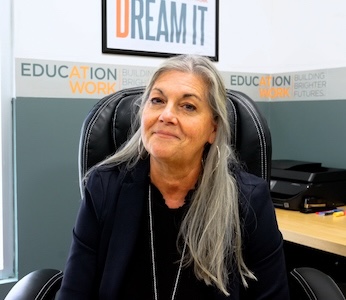
Jane Swift, the former governor of Massachusetts who currently leads Education at Work, a nonprofit focused on the intersection of higher education and the workforce, told Fortune she sees the erosion of structured training programs and successor planning as a crisis in the making: “So we’ve done away with all these training programs, and it all happened when we stopped having these job ladders, right?” Referencing her own political affiliation with the Republican Party and its cliches about instinctively siding with bosses, she said this is a nonpartisan issue, bigger than the old talking point of “blaming the workers” because “people wanted to change jobs all the time.”
Swift described a chicken-or-the-egg problem where employers stopped being loyal to employees but employees also figured out that they needed to job-hop to advance in the careers. The end result is no “job ladders” like the ones she encountered when she entered the workforce in the 1980s, where you come into a training program with a clear progression afterwards. “We’re not training people as managers, so we have to go and figure that out,” but entry-level training is lacking, too. She said she feels “crazy” talking to some business leaders, because “AI is eating” entry-level jobs, but most of them want people with a few years of experience first. “Nobody trained millennials to be managers,” she said, “because we did away with these training programs.”
Economic experts are increasingly raising the possibility that the ladder to success may be taking on a different shape in the 2020s. Alex Bryson of University College London, who focuses on Gen Z’s rising sense of “despair,” told Fortune that he stumbled on a striking quote in his work, although he hasn’t seen research to back it up more substantively: “Moving on up the ladder, it feels as if, perhaps, for some of them, somebody’s removed some of the rungs.”
Nick Maggiulli, chief operating officer at Ritholtz Wealth Management and author of the New York Times best-seller The Wealth Ladder, told Fortune that “something weird’s going on” because the economy “wasn’t built to handle this many people with this much money.” He said that the wealth ladder isn’t meant to be climbed forever, and you often need to step back and ask yourself: “Do I need to keep climbing? Is this right for me?”
An empty feeling
Several millennial managers described hit-the-ceiling moments where more money or status brought little additional happiness, and often more problems to solve. A 37-year-old radiology director at a health system in Massachusetts said he’s gotten multiple pay increases and makes double what he did 10 years ago, but after a certain monetary threshold around $150,000, he stopped feeling the impact of a higher income. “I still feel just the same … probably just as happy or unhappy.” (He also noted that inflation and his four kids have eaten into his wallet a fair amount.)
One particular promotion, he recalled, “sort of felt empty. I remember the day my boss brought me [the financial terms] and nothing felt different. I just thought, ‘I have more things to solve now, more problems to solve.’”
Across healthcare, education, tech, and non-profit sectors, managers described relentless cycles of attrition, regime change, and ever-ratcheting expectations from above. Some of this is pandemic-related. The comms director who went to the ER over stress said that he believes there was a need to “take the foot off the pedal” when the pandemic ended, but he saw an older generation of managers realizing, “Oh, that’s how hard they can work.” He said return-to-office mandates were designed for the lowest-performing 5% of the workforce instead of the top 5%, and this is backwards.
A software engineer who works in big tech described emotional whiplash coming out of the pandemic. “It’s been rough the last couple years, honestly, with layoffs and a lot of uncertainty, and return to office.” She said she had “some really difficult conversations” about the end of remote work, on top of which she has to maintain a notoriously high standard at what she described as a ruthless company. “Doing great at other companies is not enough for here.”
She said a gallows humor has set in among her managerial peers, as they openly talk about what entrepreneurial project they’ll start when their own inevitable layoff arrives. Their Slack channel is called #buying-small-biz, she said, and it grew as an offshoot of one where they talked about how much they hated the end of remote work policies. “We all have to be thinking about what’s next, and we’re like, ‘Okay, cool, what business are we gonna start? When inevitably, you know …. Everybody knows what’s coming.” Commenting on the plight of herself and fellow managers, she added: “We’re definitely squeezed.”
Sanity days
Kaylan, a 38-year-old manager who leads a team at a major healthcare system that assists with escalated claims and benefit issues, similarly recounted how persistent understaffing carried potential medical risk. Calling herself a “high achiever,” she said that when most of her team juggles three projects on any given day “at one point I was probably working on 15 different projects in some way, shape, or form.”
She said she stopped and took stock of her workload when her own director was admitted to the hospital. Referring to this person as a mentor-type figure who has supported her growth and her career, she said her director didn’t elaborate on their hospital visit, but she suspects it was from stress. “That made me open my eyes and say, ‘You know, I don’t want to burn myself out to the point where I’m so stressed that I, too, end up in the hospital.’” She said that she took that cue to begin working with a therapist and began talking about different ways to implement boundaries for a healthier way of working.
Given their close relationship, she said it was a “wake-up call” for both of them, and they joke about mental health, somewhat darkly. She says she has a lot of PTO days unused and “I jokingly tell my director that those are my sanity days. And he laughs, because he’s like, ‘Man, I should probably take some sanity days with you.’” She clarified that they are really just “mental health days,” but both she and her director are better at giving good advice than taking it. She said she thinks the workforce in general has to start doing something differently “so we don’t all end up in the hospital because of stress.”
The myth and trap of the ‘cool boss’
There’s also a peculiar tension in the millennial management style: Determined not to replicate the rigid, hierarchical approach of their Gen X and boomer predecessors, millennials often strive to be the “cool boss”—open, transparent, and supportive. But sources told Fortune this approach can muddy the waters between leadership and friendship, engendering new vulnerabilities.
The radiology director described the start of his managerial career in a manner similar to what Rotz described: someone who seemed capable who was elevated without much training or guidance. In his mid-20s, he said, he was “thrust into a leadership position somewhat against my will.” He described a lack of standout mentors while saying that he has had some good mentorship on the clinician side of his practice, and one boss in particular was great “but also had immense responsibilities and so our 1:1s become more operational and less about my personal growth.” This boss sent him to a leadership program that lasted six months and still impacts his management style today: “It was great.” As an individual contributor, though, he said he underwent a “horrible onboarding program” and he worked to fix that when he got into management himself.
The radiology director said he struggled for years with managing people who started as his peers, trying to balance being “the cool leader” and navigating the situation as a new authority figure. “I let the lines blur because I was able to retain some of the people who were still my peers,” he said. “I did have to start setting boundaries because one of my buddies [and direct reports] would text me, saying, ‘Hey, I’m hungover.’”
A senior engineer at Netflix distinguished between millennials who try to be a “cool boss or a friend boss” and their more reserved Gen X counterparts: “My millennial manager is much more in tune with the human side … but the boundary has always been clear.” He framed it as an issue with an “intense” workload that can stretch far beyond a traditional 9-to-5 commitment. “If we work late one day, we come to work later the next day, or something like that. It can be intense, because you end up thinking about work when you’re outside, because there’s so much happening.”
Heather Hagen, director of employment services at a nonprofit in Colorado, spoke positively about the mentorship she’s received and about leading with empathy for her team. Hagen said she’s fascinated by the idea that millennials wear a “mask” as managers, that sometimes slips off when they get tough with their reports. She said she chooses to take on more responsibilities at work so her staff doesn’t get burned out, but acknowledges that she’s creating a culture of heightened expectation for her reports. “Maybe that’s kind of self-serving in the end, because I know that if I have a solid team who’s doing the work, I don’t have to deal with other people’s burnout, or other people leaving.” She described it as “I want this for you, but also, like, if everything goes bad, it would really be a problem for me.”
Hagen said she learned earlier in her career when it was “kind of like the veil lifted.” A former executive director told her “the reality of the finances” would always determine management priorities, even at a non-profit. She added that she thinks many millennial managers understand this, but they still seem to want to “package it up in a way that feels more caring and genuine to our teams.”