Business
Meet the ‘incubators’ behind Hollywood’s celebrity-owned brands
Published
5 months agoon
By
Jace Porter
In the mid-2010s, the actor Shay Mitchell began to spend as much time at 30,000 feet as she did on land, which is to say she had a lot of free time to consider the inconveniences of life as a frequent flier. The subject of her ire? Luggage, which was either too cheap to look good or, perhaps even worse, too expensive to be so impractical.
So on one of her flights, she grabbed the cocktail napkin that came with her complimentary beverage and began to sketch her own designs. “I was creating items that weren’t out there for me that I wanted for myself,” Mitchell told Women’s Wear Daily in 2019. “I looked up these pieces to see if they existed and they didn’t.”
For most people, that would have been the end of that, but not for Mitchell. She already had a thriving career as an actor, a popular YouTube channel, and a production company—why not add entrepreneur to her resume? But Mitchell, who broke out on small screens during her seven-season arc on hit teen soap Pretty Little Liars, needed help turning her rough napkins sketches into a business.
Enter Beach House Group, a brand incubator launched about a decade ago by veteran business builders PJ Brice and Shaun Neff. They were just getting their new partnership off the ground when Mitchell came in for a meeting.
“Shay came out of nowhere,” recalls Neff, Beach House’s bleached blonde public spokesman. “She was already on an entrepreneurial journey. You could tell her juices were flowing and she wanted to build a company.”
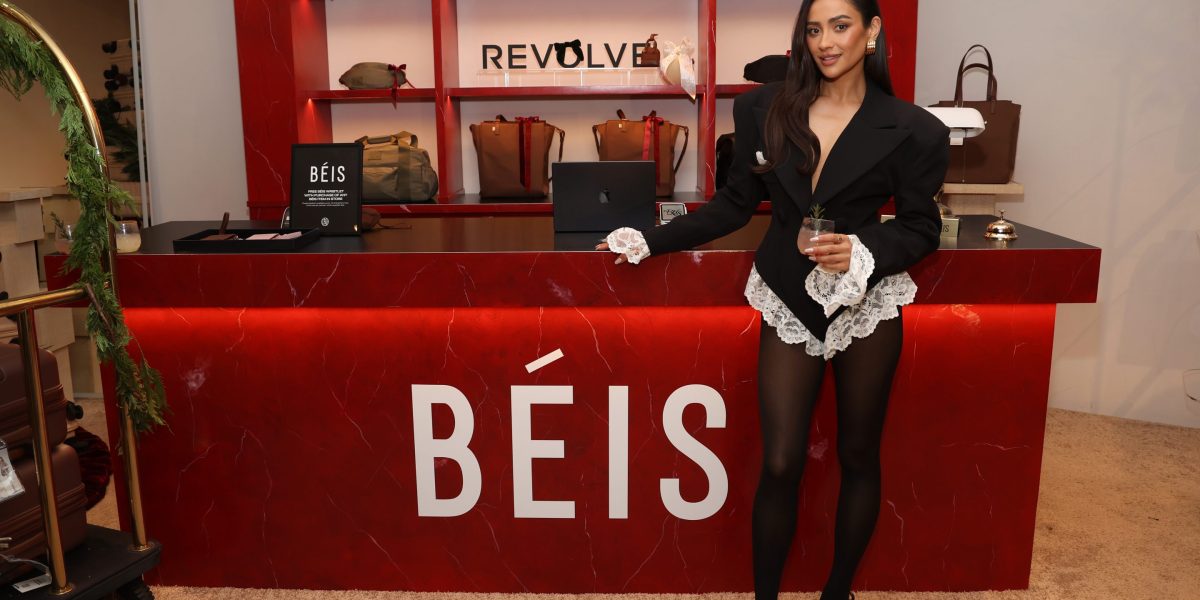
Beach House set up a joint venture with Mitchell; installed one of its own executives, Target veteran Adeela Hussain Johnson, as a co-founder, and used Brice’s connections making private label makeup bags and other accessories to get a line of duffles, backpacks, passport holders and other travel essentials into production. Béis—that’s beige in Spanish, a nod to the color of an old bag Mitchell used to travel everywhere with—launched in 2018 and, per Neff, “it was lightning in a bottle.” It hit $200 million in revenue in 2023, according to the company, and Neff tells me that number topped $300 million last year.
As celebrity-founded brands become an obsession in Hollywood, where a billion-dollar valuation is the hot new status symbol, Beach House has carved out a niche as a startup factory. It’s part of a growing number of brand incubators that help celebrities turn great ideas into very real businesses by connecting them with capital, experienced executives, back-end resources like human resources, legal and logistics, and suppliers. A lot of these incubators are small and selective: Beach House, for example, currently has just four brands in its portfolio, including oral hygiene company Moon Beauty launched in partnership with Kendall Jenner and curly hair care line Pattern with Tracee Ellis Ross. But their cultural reach can be significant.
Says Neff, a sort of Willy Wonka in Balenciaga who clearly knows how to sell anything, “Our magic sauce is that we can create ideas out of nowhere and blow them up.”
Pairing talent with retail ideas
Before Neff co-founded Beach House, he made his name as the founder of ski and skate apparel brand Neff, which sold to wholesaler Mad Engine in 2017 for an undisclosed price. He then invested in sunscreen startup Sun Bum before its 2019 sale to SC Johnson for a reported $400 million. Which perhaps explains the two code-protected gates I pass through before arriving at his modern, light-filled home in the hills high above Malibu.
Steven Ferdman/WireImage
After Neff, dressed casually in camo pants and a black Pirelli baseball cap, hands me a can of Monster Tour Water, he settles in to tell me how Beach House evolved out of conversations he was having with talent looking to start their own brands. Back then, the talent agencies were more focused on landing their clients starring roles in the next blockbuster movie than helping them become founders.
Neff, meanwhile, had developed a reputation as a partner for celebrities through collaborations at his eponymous apparel brand with everyone from Scarlett Johansson to Snoop Dogg. “For close to 100% of consumer products, the only path to sell is through influencing people,” says Neff, who teamed with retail veteran Brice, founder of disposable tableware brand Cheeky, on Beach House. “That’s why we’re huge believers in talent.”
Beach House got off the ground around the same time George Clooney sold Casamigos for a cool $700 million, Rihanna launched Fenty Beauty and grew it into a nearly $3 billion business, and Ryan Reynolds invested in Mint Mobile ahead of its $1.35 billion sale. These companies added to the growing pile of evidence that the right celebrity could help supercharge the right business. Jennifer Aniston had done it in 2007, when she signed on to become the face of Smartwater in what her agent, Todd Shemarya, says was one of the first equity cash deals of the modern endorsement age.
“I knew they were very close to a sale,” Shemarya says. “And I knew that someone like Jennifer could help them sell faster, so she was worth the equity.” His bet turned out to be correct. Smartwater owner Glaceau sold to Coca Cola for $4.1 billion in 2007 in a deal that, based on conservative estimates, likely netted Aniston tens of millions. She’s since launched vegan hair-care line LolaVie, partnered with fitness company Pvolve, and become chief creative officer of supplement brand Vital Proteins.
The rise of social media—and the direct connection it fosters between star and fan—has created an environment ripe for the evolution of the endorsement deal. Once upon a time you got paid to appear in a commercial for a brand; now you own it. “It’s the idea that you should be creating equity for yourself in spaces where you traditionally created equity for others,” says Mahmoud Youseff, who helps clients at management firm Range Media launch their own ventures, like the Philly cheesesteak shop Bradley Cooper opened in New York City’s East Village late last year.
Yes, you read that right. Bradley Cooper is now a cheesesteak-preneur. Today, practically every A-lister has a brand of their own. Conservative estimates suggest there are more than 300 celebrity-affiliated alcohol brands on the market today. And celebrity beauty brands alone generated $1 billion in sales in 2023, according to the most recent available data from Nielsen. The one-two punch of the pandemic and the Hollywood actors’ and writers’ strikes gave a lot of celebrities a lot of free time in which to launch businesses. JLL Research reports that more than a third of all celebrity brands launched in 2020 or later. There’s Selena Gomez’s Rare Beauty, Dwayne “The Rock” Johnson’s Teremana Tequila, Blake Lively’s Blake Brown Beauty, Jennifer Garner’s Once Upon a Farm, Katy Perry’s De Soi, Naomi Osaka’s Kinlo, and the list goes on and on and on.

Mike Windle/Getty Images for smartwater
The space has gotten so crowded that Golden Globes host Nikki Glaser got big laughs from a ballroom full of actors in January when she quipped, “If you do lose tonight, please just keep in mind that the point of making art is not to win an award. The point of making art is to start a brand of tequila that’s so popular you never have to make art again.” It was funny because it was true. As working in Hollywood has become more precarious, the jobs less prolific, creating a business has become an attractive backup plan—what one executive in the space, Ari Bloom, calls “their 401k”—albeit one that comes with significantly more risk.
“Every time you see Ryan Reynolds sell one of his companies or Kim Kardashian get some crazy valuation or Selena Gomez be announced as a billionaire, we do see a lot of increased inbound because folks are like, ‘Now that they’re worth more than their day job, I should do that too,’” says Bloom, who works with John Legend, Naomi Osaka and others on their business ventures via his incubator A-Frame.
‘Not everyone can pull this off’
When Shaun Neff is looking for inspiration, he heads to his local Target. “I walk aisles,” he says. “I’ll just go there for an hour or two at a time.” That’s how he discovered an opening for Moon, the oral hygiene company he launched with Kendall Jenner that sells toothbrushes, toothpastes and whitening pens in sleek, attractive packaging. “It was glaring to me in the oral care aisle that it was a sea of sameness,” he says. “It was red, white and blue, Crest and Colgate. There was nothing there that was aesthetically pleasing.”
Neff calls himself the “brand guy, the one that creates stuff, locks in the vision.” It’s his job to help Beach House identify products that fill a void in the market. Take Pattern, which entered the historically overlooked Black haircare market with a suite of natural products designed for curly hair. “It’s got to be an incredible product,” says Neff. “When you start a brand, first and foremost, the product wins every time.”

TheStewartofNY/GC Images
It’s often after the concept is locked into place that Neff goes searching for a celebrity partner to plug into the brand. With Moon, he happened to run into Jenner at a party and asked for her number. She gave him the info for her mom, Kris Jenner, and a deal was born. “What’s crazy about Hollywood,” says Neff, “it’s like there are a handful of parties every year where everyone’s at. So if you’re in the scene, you’ve kind of rubbed shoulders with the majority of everyone.”
Finding the right talent partner isn’t always so easy. Neff says he’s met with hundreds of celebrities over the years about turning their ideas into companies. “It doesn’t take me more than 30 to 45 minutes to make the decision whether it’s a good idea or not,” he says.
Part of Beach House’s “magic sauce” is that it’s incredibly selective about who it brings on as partners. “Not everyone can pull this off,” says Neff, who looks for passion and commitment from any celebrity-turned-entrepreneur. “You can find out really quickly how much they want to be involved.” Mitchell—who declined an interview request for this story—is the source of many of Béis’s product innovations, like the retractable bag strap built into every piece of luggage. Before launching Béis, she also had already built, per Neff, “a credible character around travel” through her YouTube series, Shaycation, and had millions of devoted social media followers ready to buy her luggage.
When launching a brand with a celebrity, things like social media followers and an aspirational lifestyle are table stakes. “Just because you have nice hair doesn’t mean that you can sell haircare; Just because you have nice skin doesn’t mean that you can sell skincare,” says the agent Shemarya. “You have to have a connection with your consumer. There has to be something that is relatable.”
The most crucial component of any of these businesses is authenticity. If your personal brand is all about the laid-back California lifestyle, for example, maybe say yes to the CBD-infused seltzer rather than the high-proof vodka. “A lot of consumers have gotten inundated with celebrity endorsements and have gotten a little bit tired of it because they just look like a money play,” adds Shemarya. “So when there’s actually a celebrity doing something and it’s really organic, it stands out more and it works.”
Trading equity for expertise
When Sara Foster and Erin Foster, the sisters behind the Netflix series Nobody Wants This and podcast The World’s First Podcast, began exploring the idea of launching their own fashion line, a lot of people told them they should do it on their own. Why cut in a partner when they could own the vast majority of the business they were building? They ignored that advice and partnered with Centric Brands, which manufactures and distributes dozens of brands including Joe’s Jeans and Juicy. “We didn’t want to own 100% of something that we had to be 100% responsible for,” Erin Foster tells me. “The smartest thing we have done in our career is pair ourselves with people who know what they’re doing.”
The combination of the Fosters’ vision for the brand and Centric’s industry know-how has made the clothing line, Favorite Daughter, a staple of cool-girl wardrobes around the country. They say the company is now well on its way to $100 million in annual sales.

Stefanie Keenan/Getty Images for Nordstrom
Nowadays, there are dozens of ways a celebrity can become an entrepreneur, but for many of them, teaming up with an experienced partner is the obvious path. And there are no shortage of possible partners. All the major talent agencies have venture arms where, for their own slice of the equity pie, they’ll work with clients to get their vision off the ground. Then there are companies that specialize in building businesses across various categories, like Give Back Beauty and Maesa in the beauty and haircare space, Collab for coffee, and Ari Bloom’s A-Frame for socially responsible personal care and wellness brands.
No two deals are the same, but generally these are equity plays that don’t require talent to invest any of their own cash upfront. A celebrity joining an existing brand could get as little as 5% equity in a business, while someone launching their own business or joining one that is less established can get as much as 50%. Bloom tells me A-Frame likes to split the business 50-50 with its celebrity partners “so that we’re both seeing the same motivations and the same returns.”
While startups are a long-term play, celebrities will often get royalties or, in some cases, a cut of all sales associated with a specific capsule collection, to keep them incentivized until they can sell the company for a big payday.
At the 175-employee Beach House, all businesses are launched as joint ventures with the talent partner. There’s no set formula for the equity split, but because Beach House is often bringing the idea to the celebrity and providing shared services—legal, accounting, sales, compliance, distribution, etc.—it typically only doles out minority stakes. “We own ‘em, we operate ‘em,” says Neff. “We’ve created an absolute machine where we can incubate and create brands and rinse and repeat.”
But that doesn’t mean the celebrity can sit back and wait for an exit. If they want to be successful, they have to be willing to roll up their sleeves and get to work, from testing products to approving branding to promoting their brand every chance they get.
Before he was building a cheesesteak business with Cooper, Youseff helped put together Ryan Reynolds’s deal for Aviation Gin. “A big reference for that brand was watching George Clooney and Casamigos and how he lived that brand in every capacity of his life,” says Youseff. “He’d be on a boat wearing a Casamigos hat and serving Casamigos to his friends. He was not just selling it on a commercial, he was living it in his life. And you saw Ryan do the same throughout his journey with Aviation Gin to almost equal success. We want you to be doing something that doesn’t feel like a chore. This should come from your passion, it should be fun for you.”
The Foster sisters see the exits that some of their peers have had. They know they could probably sell Favorite Daughter for a lot of money. But Erin Foster says that’s not the only reason they launched the brand. “This is one of the most fun parts of our career,” she says. “I love this tactile thing that we get to create. The idea that you could go into a meeting and say, ‘I really need a shirt that’s kind of split open in the front because I’m sick of tucking it in.’ And 11 months later it’s in Nordstrom. That’s so cool to me.”
Successes and failures
The celebrity business bubble has been propped up on the belief that if you mix the right public figure with the right team and add the right support, you have a recipe for a successful business, one that one celebrity advisor says has a better chance at surviving than “just some random product that has to organically find its audience.”
But for every Hailey Bieber—who sold three-year-old beauty brand Rhode to e.l.f. Beauty for $800 million, plus earnouts that could boost the company’s total valuation to $1 billion—there’s Kristen Bell and Dax Shephard, whose diaper startup Hello Bello filed for bankruptcy in 2023. Last year, Sephora dropped TikToker Addison Rae’s line from its shelves. And before Blake Brown Beauty, Lively launched and quickly shuttered lifestyle website Preserve.
A year after launching Florence by Mills with Millie Bobby Brown, Beach House sold its stake back to the Stranger Things star. She’s since launched a fragrance with Give Back Beauty and a coffee with Collab under the Florence by Mills brand name. “The deal we struck with Millie was beauty centric, and I think she wanted to Florence a lot of things, so that didn’t really align with our core principle,” says Neff. “We did our job, we launched this thing very successfully at Ulta and we had a good run.” He adds, “knock on wood, we haven’t had a dud yet.”
So many startups have launched over the last five years that many close observers in the space expect there to be a shakeout soon. “The last few years before this were taking advantage of a trend,” says Youseff. “This year is definitely much more focused on finding real opportunities to connect both with the talent who’s launching these ventures and with the audience they’re trying to serve.”
Neff is still a big believer in launching brands with celebrity partners. But in perhaps a sign of the times, Beach House launched its most recent product without a celebrity founder by its side. Fragrance brand Noyz dropped last summer with sleek black and white packaging and scents like Unmute, which has hints of black plum, madagascar vanilla and crisp amber. “Fragrance is very magical, everyone’s riding a white horse and their hair’s perfect and the dude’s doing a hair flip with an 18-pack; none of it’s believable,” he says. “We felt like there was no one telling real and raw authentic stories.”
Ulta was a launch partner. “It was their biggest fragrance buy for a first-time brand ever,” Neff boasts. And the marketing campaign featured dozens of TikTokers, including Tara Yummy, Madeline Argy and the Kalogeras Sisters — all of whom got paid but none of whom got equity.
A full year later, TikTok still appears to be crazy for Noyz. Did Beach House just disprove its own thesis of the celebrity brand? Perhaps it created a new one: Why limit yourself to just one famous partner when you can harness the power of many instead.
You may like
Business
Stock market today: Dow futures tumble 400 points on Trump’s tariffs over Greenland, Nobel prize
Published
6 hours agoon
January 19, 2026By
Jace Porter
U.S. stock futures dropped late Monday after global equities sold off as President Donald Trump launches a trade war against NATO allies over his Greenland ambitions.
Futures tied to the Dow Jones industrial average sank 401 points, or 0.81%. S&P 500 futures were down 0.91%, and Nasdaq futures sank 1.13%.
Markets in the U.S. were closed in observance of the Martin Luther King Jr. Day holiday. Earlier, the dollar dropped as the safe haven status of U.S. assets was in doubt, while stocks in Europe and Asia largely retreated.
On Saturday, Trump said Denmark, Norway, Sweden, France, Germany, the United Kingdom, the Netherlands, and Finland will be hit with a 10% tariff starting on Feb. 1 that will rise to 25% on June 1, until a “Deal is reached for the Complete and Total purchase of Greenland.”
The announcement came after those countries sent troops to Greenland last week, ostensibly for training purposes, at the request of Denmark. But late Sunday, a message from Trump to European officials emerged that linked his insistence on taking over Greenland to his failure to be award the Nobel Peace Prize.
The geopolitical impact of Trump’s new tariffs against Europe could jeopardize the trans-Atlantic alliance and threaten Ukraine’s defense against Russia.
But Wall Street analysts were more optimistic on the near-term risk to financial markets, seeing Trump’s move as a negotiating tactic meant to extract concessions.
Michael Brown, senior research strategist at Pepperstone, described the gambit as “escalate to de-escalate” and pointed out that the timing of his tariff announcement ahead of his appearance at the Davos World Economic Forum this week is likely not a coincidence.
“I’ll leave others to question the merits of that approach, and potential longer-run geopolitical fallout from it, but for markets such a scenario likely means some near-term choppiness as headline noise becomes deafening, before a relief rally in due course when another ‘TACO’ moment arrives,” he said in a note on Monday, referring to the “Trump always chickens out” trade.
Similarly, Jonas Goltermann, deputy chief markets economist at Capital Economics, also said “cooler heads will prevail” and downplayed the odds that markets are headed for a repeat of last year’s tariff chaos.
In a note Monday, he said investors have learned to be skeptical about all of Trump’s threats, adding that the U.S. economy remains healthy and markets retain key risk buffers.
“Given their deep economic and financial ties, both the US and Europe have the ability to impose significant pain on each other, but only at great cost to themselves,” Goltermann added. “As such, the more likely outcome, in our view, is that both sides recognize that a major escalation would be a lose-lose proposition, and that compromise eventually prevails. That would be in line with the pattern around most previous Trump-driven diplomatic dramas.”
Business
Goldman investment banking co-head Kim Posnett on the year ahead, from an IPO ‘mega-cycle’ to another big year for M&A to AI’s ‘horizontal disruption’
Published
9 hours agoon
January 19, 2026By
Jace Porter
Ahead of the World Economic Forum‘s Annual Meeting in Davos, Switzerland, Fortune connected with Goldman Sachs’ global co-head of investment banking, Kim Posnett, for her outlook on the most urgent issues in business as 2026 gathers steam.
A Fortune Most Powerful Woman, Posnett is one of the bank’s top dealmakers, also serving as vice chair of the Firmwide Client Franchise Committee and is a member of the Management Committee. She was previously the global head of the Technology, Media and Telecommunications, among several other executive roles, including Head of Investment Banking Services and OneGS. She talked to Fortune about how she sees the current business environment and the most significant developments in 2026, in terms of AI, the IPO market and M&A activity. Goldman has been the No. 1 M&A advisory globally for the last 20 years, including in 2025 — and Posnett has been one of the star contributors, advising companies including Amazon, Uber, eBay, Etsy, and X.
- Heading into Davos, how would you describe the current environment?
As the global business community converges at Davos, we are seeing powerful catalysts driving M&A and capital markets activity. The foundational drivers that accelerated business activity in the second half of 2025 have continued to improve and remain strong heading into 2026. A constructive macro backdrop — including AI serving as a growth catalyst across sectors and geographies — is fueling CEO and board confidence, and our clients are looking to drive strategic and financing activity focused on scale, growth and innovation. As AI moves from theoretical catalyst to an industrial driver, it is creating a new set of priorities for the boardroom that are top of mind for every client we serve heading into 2026.
- What were the most significant AI developments in 2025, and what should we expect in 2026?
2025 was a breakout year for AI where we exited the era of AI experimentation and entered the era of AI industrialization. We witnessed major technical and structural breakthroughs across models, agents, infrastructure and governance. It was only a year ago, in January 2025, when DeepSeek launched its DeepSeek-R1 reasoning model challenging the “moats” of closed-source models by proving that world-class reasoning could be achieved with fully open-source models and radical cost efficiency. That same month, Stargate – a historic $500 billion public-private joint venture including OpenAI, SoftBank and Oracle – signaled the start of the “gigawatt era” of AI infrastructure. Just two months later in March 2025, xAI’s acquisition of X signaled a new strategy where social platforms could function as massive real-time data engines for model training. By year end, we saw massive, near-simultaneous escalation in model capabilities with the launches of OpenAI’s GPT-5.1 Pro, Google’s Gemini 3, and Anthropic’s Claude 4.5, all improving deep thinking and reasoning, pushing the boundaries of multimodality, and setting the standard for autonomous agentic workflows.
In the enterprise, the conversation has matured from “What is AI?” just a few years ago to “How fast can we deploy?” We have moved past the pilot phase into a period of deep structural transformation. For companies around the world, AI is fundamentally reshaping how work gets done. AI is no longer just a feature; it is the foundation of a new kind of productivity and operating leverage. Forward-leaning companies are no longer just using AI for automation; they are building agentic workflows that act as a force multiplier for their most valuable asset: human capital. We are starting to see the first real, measurable returns on investment as firms move from ‘AI-assisted’ tasks to ‘AI-led’ processes, fundamentally shifting the cost and speed of execution across organizations.
Of course, all this progress is not without regulatory and policy complexities. As AI reaches consumer, enterprise and sovereign scale, we are seeing a divergence in global policy that boards must navigate with care. In the United States, recent Executive Orders — such as the January 2025 ‘Removing Barriers’ order and the subsequent ‘Genesis Mission’ — have signaled a decisive shift toward prioritizing American AI dominance by rolling back prior reporting requirements and accelerating infrastructure buildouts. Contrast this with the European Union, where the EU AI Act is now in full effect, imposing strict guardrails on ‘high-risk’ systems and general-purpose models. Meanwhile, the UK has adopted a “pro-innovation” hybrid model: on the one hand, promoting “safety as a service”, while also investing billions into national compute and ‘AI Growth Zones’ to bridge the gap between innovation and public trust. For our clients, the challenge is no longer just regulatory compliance; it is strategic planning and arbitrage – deciding where to build, where to deploy, who to partner with, what to buy and how to maintain a global edge across a fragmented regulatory landscape.
As we enter 2026, the pace of innovation isn’t just accelerating; it is forcing a total rethink of business processes and capital allocation for every global enterprise.
- Given the expectation and anticipation for IPOs this year, what is your outlook for the market and how will it be characterized?
We are entering an IPO “mega-cycle” that we expect will be defined by unprecedented deal volume and IPO sizes. Unlike the dot-com wave of the late 1990s, which saw hundreds of small-cap listings, or even the 2020-2021 surge driven by a significant number of billion-dollar IPOs, this next IPO cycle will have greater volume and the largest deals the market has ever seen. It will be characterized by the public debut of institutionally mature titans, as well as totally disruptive, fast moving and capital consumptive innovators. Over the last decade, some companies have stayed private longer and raised unprecedented amounts of private capital, allowing a cohort of businesses to reach valuations and operational scale previously unseen in the private markets. We are no longer talking about “unicorns” — we are talking about global companies with the gravity and scale of Fortune 500 incumbents at the time they go public. For investors, the reopening of the IPO window will enable an opportunity to invest in the most transformative and fastest growing companies in the world and a generational re-weighting of the public indices.
In 2018, the five largest public tech companies were collectively valued at $3.3 trillion, led by Apple at ~$1 trillion. Today, the five largest public tech companies are valued at $18.3 trillion, more than five and half times larger. Even more significant, the 10 largest private tech companies in 2018 were valued at $300 billion. Today, the 10 largest private tech companies are valued at $3 trillion, more than 10 times larger. These are iconic, generational companies with unprecedented private market caps some of which have unprecedented capital needs which should lead to an unprecedented IPO market.
Each of these companies will have their own objectives on IPO timing, size and structure which will influence if, how and when they come to the market, but the potential across the board is significant. During the last IPO wave, Goldman Sachs was at the center of IPO innovation by leading the first direct listings and auction IPOs, and we expect more innovation with this upcoming wave. The current confluence of a constructive macro backdrop and groundbreaking technological advancements is doing more than just reopening the window; it is creating a generational opportunity for investors to participate in the companies that will define the next century of global business.
- M&A activity exploded in 2025, are the markers there for another boom year?
As we enter 2026, the global M&A market has transitioned from a year of recovery ($5.1 trillion of M&A volume in 2025, up 44% YoY) to one that is bold and strategic. While the second half of 2025 was defined by a “thawing” — driven by a constructive regulatory environment, fed easing cycle and normalizing valuations — the year ahead will be defined by ambition.
We have entered an era of broad, bold and ambitious strategic dealmaking: transformative, high-conviction transactions where industry leaders are no longer just consolidating for scale, but also moving aggressively to acquire the strategic assets, AI capabilities and digital infrastructure that will define the next decade. CEO and board confidence have reached a multi-year high, underpinned by the realization that in an AI-industrialized economy, standing still is the greatest risk of all. The quality and pace of strategic discussions that we are having with our clients signals that the world’s most influential companies — across sectors and regions — are ready to deploy their balance sheets and public currencies to redraw the competitive map.
AI is no longer an isolated tech trend; it is a horizontal disrupter, broadening the appetite for strategic M&A across every sector of the economy. While the dialogue in boardrooms has moved from theoretical ‘AI pilots’ to large-scale capital deployment, the speed of technology is currently outpacing traditional governance frameworks. Boards and management teams are being asked to make multi-billion dollar, high-stakes decisions in a landscape where historical benchmarks often no longer apply. In this environment, M&A has become a tool for strategic leapfrogging — allowing companies to move both defensively to protect their core and offensively to secure the critical infrastructure and talent needed for non-linear growth. Success in 2026 will be defined by strategic conviction: the ability to turn this unprecedented complexity into a clear, actionable strategy and competitive advantage.
As AI continues to reshape corporate M&A strategy, we are also seeing financial sponsors return to the center of the M&A stage. Sponsor M&A activity accelerated sharply in 2025 — with M&A volumes surging over 50% as the bid-ask spread between buyers and sellers started to narrow, financing markets became more constructive and innovative deal structures enabled private equity firms to pursue larger, more complex transactions. With $1 trillion of global sponsor dry powder and over $4 trillion of unmonetized sponsor portfolio companies, the pressure for capital return to LPs has continued to escalate. Financial sponsors are entering 2026 with a dual-focus: executing take-privates and strategic carveouts to deploy fresh capital, while simultaneously utilizing reopened monetization paths – from IPOs to secondary sales to strategic sales — to satisfy demand for liquidity. With monetization paths reopening and valuation gaps narrowing, sponsors are entering 2026 with greater flexibility, reinforced by a healthier macroeconomic backdrop and improving liquidity conditions.
This Q&A is based on an email conversation with Kim Posnett. This piece has been edited for length and clarity.
Business
Half of veterans leave their first post-military jobs in less than a year—This CEO aims to fix that
Published
9 hours agoon
January 19, 2026By
Jace Porter
Taking a career leap can be daunting, but all professionals inevitably have to face the music; most will change jobs or industries at some point, whether they want to or not. But for U.S. veterans exiting service and heading into civilian life, the transition has been especially difficult—and it’s an issue that’s intensifying their unemployment. That’s why financial services titan USAA is putting its money where its mouth is with a $500 million initiative to get members back on their feet.
“What we created here since I took over as CEO is a completely revamped way of hiring our veterans and military spouses,” the company’s CEO, Juan C. Andrade, tells Fortune. “This is not just for the benefit of USAA—this is for the benefit of the military community.”
USAA launched its “Honor Through Action” program in 2025, committing half a billion dollars over the next five years to improve the careers, financial security, and well-being of its customers—many of whom are active military, veterans, or related to them. It’s the brainchild of Andrade, who stepped into the company’s top role in April last year. As someone who also left a longstanding career in the federal government, he understands the growing pains that come with an intimidating career pivot. And for thousands of USAA members, the situation is dire.
Around half of veterans ditch their initial post-military jobs within the first year, according to the Department of Defense’s Transition Assistance Program, and USAA’s CEO believes a lack of thoughtful transition services is largely to blame. When colonels, generals, and sergeants leave behind their high-powered jobs, Andrade says some struggle to adapt both emotionally and skills-wise.
While businesses are required to re-employ former employees who return from military duty per U.S. federal law, those stepping into civilian roles for the first time often need a helping hand. And even before they exit the military, the careers of their partners tend to suffer.
The jobless rate of military spouses has hovered around 22% over the past decade, according to Hiring Our Heroes. That’s more than four times higher than the 4.6% nationwide unemployment rate. When their partners need to relocate for a new duty assignment, spouses are 136% more likely to be unemployed within six months, according to a 2024 Defense Department survey.
This trend of low job retention among veterans and spouse joblessness can be detrimental to the financial and professional livelihoods of American military families. So Andrade is leading the charge to get them on payroll. Corporations like JPMorgan have ramped up ex-military resources, and services like Armed Forces YMCA have long been assisting veterans; But USAA’s CEO says the issue needs a more targeted approach.
“While there’s a lot of organizations that are very well-meaning and do some very good work, the approach has been fragmented,” Andrade explains. “The problem with private sector companies is [if they] have not had that experience of service, or if they don’t have a large population of employees that serve, it’s very difficult to understand the fact that they’ve lost their tribe. The fact that, in a lot of ways, they’ve lost their sense of belonging to something greater than self.”
USAA’s $500 million plan and new fellowship pathways
USAA already has several veteran employment initiatives on the docket this year. This March, the company tells Fortune it will host a nationwide U.S. Chamber of Commerce Foundation program, Hiring our Heroes, in San Antonio to connect on the issue. And in the coming months, USAA will host events with nonprofit and HR association SHRM to brainstorm the best ways to improve military hiring in the U.S.
In stride with Honor Through Action, USAA also launched two 18-month fellowship programs designed to transition military personnel into full-time company positions: Summit and Signal. In three six-month rotations, participants cycle through different parts of the financial services giant to find the best fit. The future leadership track, Summit, rotates fellows through departments including business strategy, operational planning, and product ownership. Starting anew can be isolating, so USAA is ensuring that military personnel are not walking these career paths alone—veterans are connected to mentors every step of the way.
“Those 18 months are incredibly important, because it goes to show you: What is it that you can do? How does a private company actually work? What is it that you do on a daily basis?” Andrade says. “They get one-on-one mentorship and support every step of the way with people that have already walked in their shoes and been successful, so all of that helps.”
And just like what other companies are looking for in white-collar talent, USAA places a special emphasis on AI-savvy workers. That’s where the Signal fellowship comes into play: the pathway targets applicants with tech know-how, cycling them between assignments including technical solutions and data processing. The CEO notes that the military community is teeming with tech skills, and some already come with prior training from U.S. Cyber Command roles. Aside from getting ex-military members back into work, Signal is also proving to be extremely beneficial for the business itself.
“We’re always looking for people who have the expertise and skill sets in data science or data engineering,” Andrade continues. “As they retire from the Air Force, the Army, the Navy, we bring them into a specialized program focused on their skills and how they can help us from technology experience.”
Serving an overlooked population: veteran spouses struggling with joblessness
Even when they’re not deployed, U.S. military personnel are battling wars at home—depression, financial insecurity, and homelessness. But one group is often ignored in the fight: their spouses. The husbands and wives of military personnel face sky-high unemployment rates and long-term instability due to the nature of their partners’ jobs. But Andrade recognizes them as an overlooked and underutilized pool of professionals.
“Military spouses are an incredible source of talent—they’re literally the CFO and the CEO of their home,” USAA’s CEO says. “When their spouses are deployed, when there’s a permanent change of station for their spouse, they have to leave their job. And if they don’t have that flexibility, then you know that’s why the unemployment rate is so high.”
USAA is funneling its resources to get to the root of the issue; as part of the Honor Through Action initiative, the company tells Fortune it will host Military Spouse Advisory Councils in San Antonio this March. The mission is to help shape policy, programs, and resources to better serve the unique needs of military families. That same month, the business also plans to work with other organizations in funding Blue Star Families’ release of Military Spouse Employment Research with the aim of pinpointing actionable solutions to their raging unemployment. And reflecting internally, Andrade reports that USAA will continue to lead by example.
“We can offer a lot of flexibility… Having that level of empathy and understanding becomes very critical,” he says. “This is where we hope—with Honor Through Action—to be able to help companies understand the value that [military spouses] have, but also why you need to treat them a little bit differently given their personal situation.”
Indiana Hoosiers Win National Championship Over Miami Hurricanes
Eleventy: Revenue at €127 million, Chicago store opening imminent, push in the US and Asia
Don Lemon, ICE Protesters’ ‘Disgusting’ Church Stunt Backfired, Parishioner Says
Trending
-
Politics8 years agoCongress rolls out ‘Better Deal,’ new economic agenda
-
Entertainment9 years agoNew Season 8 Walking Dead trailer flashes forward in time
-
Politics9 years agoPoll: Virginia governor’s race in dead heat
-
Politics8 years agoIllinois’ financial crisis could bring the state to a halt
-
Entertainment8 years agoThe final 6 ‘Game of Thrones’ episodes might feel like a full season
-
Entertainment9 years agoMeet Superman’s grandfather in new trailer for Krypton
-
Business9 years ago6 Stunning new co-working spaces around the globe
-
Tech8 years agoHulu hires Google marketing veteran Kelly Campbell as CMO
