Connect with us

Business

Meet the Gen Z whiz kids maniacally working ‘996’ hours with AI to help governments repave your roads: ‘I’m sure we got close to burning ourselves out’

Published

on


In the heart of Somerville, Massachusetts—a hipster enclave outside Boston—a group of Gen Z tech prodigies is flipping the script on government infrastructure.

They’re a team of twentysomethings operating on “996” schedules (that’s 9 a.m. to 9 p.m., six days a week), regularly pulling long nights and early mornings. But what really fuels them isn’t just competitive paychecks or bootstrapping their successful startup on the way to a $14 million series A. Instead, it’s a passion for transforming the world of “govtech” and redefining how governments manage and upgrade critical assets like roads and sidewalks.​

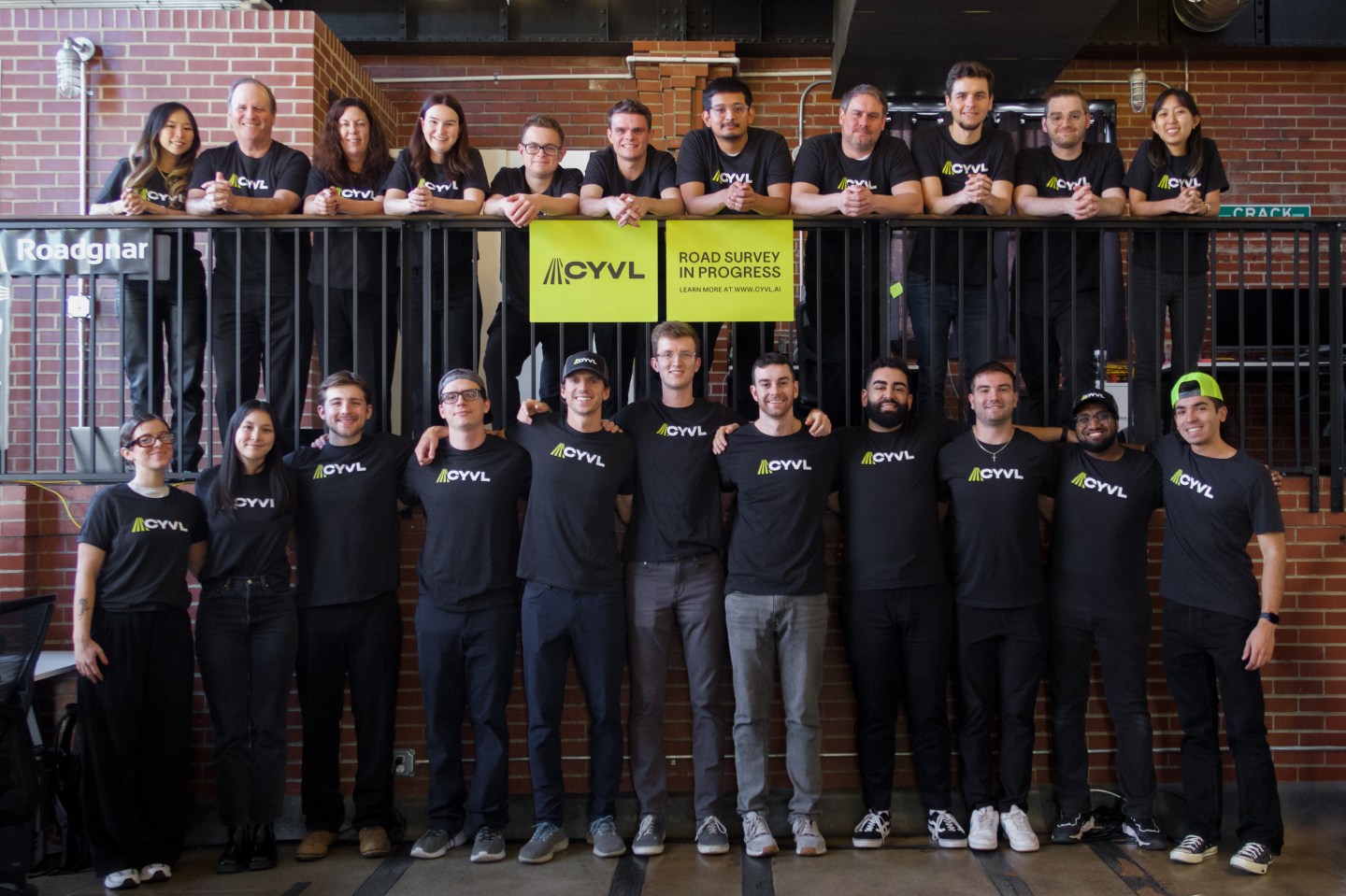
According to financial documents reviewed by Fortune, their company Cyvl, co-founded by Daniel Pelaez, Noah Budris and Noah Parker when they were all just 21 years old, has reached millions in annual revenue. It’s growing, too, into a staff of roughly 30 employees. The punishing pace remains for founders, engineering leads, and new hires alike, but they have energy to spare. The average age at Cyvl is 26 or 27, hovering around the age of its founders, according to Pelaez, who still serves as the CEO. (Pelaez said they’ve hired some more experienced people as they’ve grown, nodding to the current VP of sales, VP of products and head of government relations.)

In interviews with Fortune, Pelaez and senior software engineer John Pignato described a startup with a competitive drive, fueled by seeing peers do impressive things at close range. “We’re a team of problem solvers,” said Pignato. “I have trouble putting down problems that aren’t solved.” He said he welcomes the long hours and sees it setting him up to become a founder himself someday.

The life of a Cyvl engineer.

courtesy of Cyvl

​”Here, Daniel’s like, a year, two years older than me, and he’s doing all these impressive things,” Pignato said. “And the other founders as well … they’re in here early. They’re doing great things.” He said it was “really inspiring to me to see someone really my age, that I can relate to, doing a lot of these big things themselves.” Of the collective work ethic, he allowed, “maybe it’s a flaw,” sharing that the whole team was at the office “very late the last three nights trying to solve a problem,” but they feel they just need to finish the work they start. “Everyone feels that way.”

Full disclosure: the author grew up in Massachusetts in the waning days of the Boston Celtics basketball dynasty of the early 1990s and shared that this description of civic-minded, gritty, hard-working young technies sounds like a well-drilled sports team. When asked about this comparison, Pignato—who was wearing a green shirt at the time—acknowledged that he’s aware of the franchise’s hard-working reputation. “Yeah, I’m a Celtics fan, so I relate to it. I don’t know if I see myself in that, but … that’s what I aspire to be.”

From splitting wood to filling potholes

The story starts in Oxford, a small town in southwest Connecticut, not far from New Haven, with Pelaez home from his freshman year of studying electrical engineering at Worcester Polytechnic Institute in central Massachusetts. He told Fortune that he needed a job. He said he “didn’t have a cool internship” like his classmates, but he thought he could do something physical since he grew up working with his hands, including chopping wood for his old New England house that needed fuel for its wood-burning stove. “My grandpa was splitting wood in in his backyard in Oxford until pretty much the day he died.”

Pelaez said his parents flagged a help-wanted ad in the newspaper for the Southbury Public Works road crew. He recalled making a phone call and coming away with a job that day. “They said, ‘Sure, come in Monday, you gotta be in at 6 am.’” He said he was stunned by what he found. “There wasn’t much of a job description, it was just: get a pickup truck at 6 a.m. every day, drive around, find things that are broken, go home [and] do the same thing the next day … there was really no method to the madness.”

Pelaez said he asked his road-crew foreman, Jim, how they prioritized projects and heard back: “this is just how we run the town, we don’t have any information on the potholes, around the broken signs, around the trees that need to be cut, we just rely on people calling in or we need to drive around and find things.” Jim pulled out “huge three-ring white binders” and explained that they had paid “an arm and a leg” to a civil engineering firm for an audit and inventory of every road and sidewalk, and it was out of date after one harsh New England winter. Pelaez remembers thinking there had to be a better way to do this, since paving roads is often a town’s largest line item, but “we’re just sort of winging it, which I thought was nuts. I thought it was insane.”

‘They can’t be the only one with this problem’

When Pelaez went back to school, he said he started learning about cutting-edge technologies like LiDAR (light detection and ranging, a type of laser-mapping), robotics, and how both work to propel self-driving cars. He said he thought the same technology could actually be applied to government works. “You don’t see public works and technology or innovation ever in the same sentence and that was the first realization, like, ‘Wow, I actually think we could do something to help out Jim and the Southbury Public Works road crew. And in my mind I was thinking, they can’t be the only one with this problem.”

Cyvl
Cyvl maps out roads around the country with cutting-edge technology.

courtesy of Cyvl

During the 2019 Christmas break from his junior year at WPI, Pelaez said, he visited Jim again with his friends, both named Noah. He described what became his first ever “customer discovery interview” and recalled meeting with 30 public works departments through February 2020, just before the Covid pandemic outbreak. “It was the classic, like, we’d skip class in the morning … and we’d just drive to, like, Stowe (Vermont) public works, Harvard (Massachusetts) public works, we spoke with Worcester’s public works department at 6 a.m. because these guys get in so early.”

Pelaez said they learned in their first year that “this problem was consistent, it was a big problem, and this technology that we learned about in undergrad for self-driving cars and robotics, it really could be applied.” He also remembered a quote about technological innovation, that when you see something changing or growing exponentially, including exponential decreases in price, “pay attention to that.” He said that LiDAR sensors went from selling for $200,000 apiece, down to $100,000, down to just $5,000 when he graduated. Pelaez and the two Noahs said to themselves, “Look, I think we could use this tech for public works for governments,” realizing how “horribly inefficient” it was being done nationwide. “Every town and city in America struggles with this exact same problem.”

A sensor product that’s gotten a big AI boost

Cyvl’s flagship product is deceptively simple: a plug-and-play sensor kit shipped to city governments, installed on local vehicles, and used to scan every street, sidewalk, sign, and tree while public workers go about their daily routines. The collected data feeds into Cyvl’s Infrastructure Intelligence Platform, where proprietary AI algorithms assess conditions down to the smallest crack or sign of deficiency. Cyvl generates comprehensive, prioritized reports and actionable maintenance plans—turning what’s typically a months-long, costly manual process into an automated review accessible much faster. Governments working with Cyvl routinely see budgets stretch further, sometimes paving four times the mileage with better data and planning.​

The numbers are impressive. Cyvl says it has partnered with over 400 municipalities and completed hundreds of government projects—ranging from New England’s largest cities to tiny towns hundreds of miles away in the southeast. Active clients now number over 100, Cyvl disclosed.

​Pignato described to Fortune how he’s seen the business get another boost with rapid AI adoption. “Daniel was the one who put his foot down” in December 2024, saying they had to change the way they were working. Explaining how this had rapidly changed the company already, Pignato said that “for the longest time, we were building one product, which is that sensor that mounts on top of the car,” but AI has transformed this so that they can prototype products before physically building them, and they are getting feedback on tech performance in “minutes instead of months.” AI tools are not replacing engineers, Pignato added, they’re “removing the grunt work around producing a lot of these reports.”

Pignato shared a scene from a recent consult with a rival company that wanted advice on how to bring AI into its engineering workflow, and an awkward generational mismatch. “It was pretty funny when a lot of these, like, older guys towards the end of their career, gray hair, got on the call, and the camera turned on [to find] 26-year-olds on the other end, you definitely see the shock on their face for a little bit.” Pignato added that more and more people are reaching out from an engineering perspective, because Cyvl has shipped three or four products already this year, “which is breakneck speed.”

Life in the ‘996’ lane

Pelaez described the price that he’s paying to see Cyvl succeed. “I don’t think anyone starting their own company that expects it to be a high-growth startup should expect to work 40 hours or less. I just really don’t think that’s possible, you’re gonna have to work so freaking hard.” He described the long hours as he and the two Noahs ramped up in the early days. “For like an entire year, we did not sleep,” he said, describing marathon code-writing sessions, seven days a week for two years straight. “That was pretty crazy and, like, I’m sure we got close to burning ourselves out.”

Pelaez said they’ve learned that it’s “important to take some time for yourself” but that he also couldn’t recall the last proper vacation he’d taken. “I’ll do, sometimes, some weekend trips. I like to go camping up in New Hampshire, Vermont or Maine.” When asked about the “996” phrase, Pelaez said he’s familiar with it and it rings true. “I’ve now been trying to take one day a week just to, like, wrap up earlier and maybe [get] a workout in or maybe cook a meal myself.”

When asked about the difficult hiring climate for the rest of his generation, with Federal Reserve Chair Jerome Powell even acknowledging that “kids coming out of college and younger people, minorities, are having a hard time finding jobs,” Pelaez said he’s not seeing that at his business.

“I think, honestly, while the job search has been hard for really entry-level across all industries,” Pelaez said, “in some ways I feel like we’re benefiting from it.” He said Cyvl is looking for “young talent that’s ripe to be developed and super-hard workers is what we need to keep the energy high and new ideas flowing, so that’s been working out for us, honestly.” Adding that “the talent pool in Boston is awesome,” Pelaez said that he’s been loyal to his alma mater, hiring up a lot of WPI grads. “I feel like I’m getting old, but yeah, we continuously find awesome [talent], the brightest minds of kids graduating college and we continue to hire really strong.”



Source link

Continue Reading

Business

Leaders in Congress outperform rank-and-file lawmakers on stock trades by up to 47% a year

Published

on


Stocks held by members of Congress have been beating the S&P 500 lately, but there’s a subset of lawmakers who crush their peers: leadership.

According to a recent working paper for the National Bureau of Economic Research, congressional leaders outperform back benchers by up to 47% a year.

Shang-Jin Wei from Columbia University and Columbia Business School along with Yifan Zhou from Xi’an Jiaotong-Liverpool University looked at lawmakers who ascended to leadership posts, such as Speaker of the House as well as House and Senate floor leaders, whips, and conference/caucus chairs.

Between 1995 and 2021, there were 20 such leaders who made stock trades before and after rising to their posts. Wei and Zhou observed that lawmakers underperformed benchmarks before becoming leaders, then everything suddenly changed.

“Importantly, whilst we observe a huge improvement in leaders’ trading performance as they ascend to leadership roles, the matched ‘regular’ members’ stock trading performance does not improve much,” they wrote.

Leadership’s stock market edge stems in part from their ability to set the regulatory or legislation agenda, such as deciding if and when a particular bill will be put to a vote. Setting the agenda also gives leaders advanced knowledge of when certain actions will take place.

In fact, Wei and Zhou found that leaders demonstrate much better returns on stock trades that are made when their party controls their chamber.

In addition, being a leader also increases access to non-public information. The researchers said that while companies are reluctant to share such insider knowledge, they may prioritize revealing it to leaders over rank-and-file lawmakers.

Leaders earn higher returns on companies that contribute to their campaigns or are headquartered in their states, which Wei and Zhou said could be attributable to “privileged access to firm-specific information.”

The upper echelon also influences how other members of Congress vote, and the paper found that a leader’s party is much more likely to vote for bills that help firms whose stocks the leader held, or vote against bills that harmed them. And stocks owned by leadership tend to see increases in federal contract awards, especially sole-source contracts, over the following one to two years.

“These results suggest that congressional leaders may not only trade on privileged knowledge, but also shape policy outcomes to enrich themselves,” Wei and Zhou wrote.

Stock trades by congressional leaders are even predictive, forecasting higher occurrences of positive or negative corporate news over the following year, they added. In particular, stock sales predict the number of hearings and regulatory actions over the coming year, though purchases don’t.

Investors have long suspected that Washington has a special advantage on Wall Street. That’s given rise to more ETFs with political themes, including funds that track portfolios belonging to Democrats and Republicans in Congress.

And Paul Pelosi, former House Speaker Nancy Pelosi’s husband, even has a cult following among some investors who mimic his stock moves.

Congress has tried to crack down on members’ stock holdings. The STOCK Act of 2012 requires more timely disclosures, but some lawmakers want to ban trading completely.

A bipartisan group of House members is pushing legislation that would prohibit members of Congress, their spouses, dependent children, and trustees from trading individual stocks, commodities, or futures.

And this past week, a discharge petition was put forth that would force a vote in the House if it gets enough signatures.

“If leadership wants to put forward a bill that would actually do that and end the corruption, we’re all for it,” said Rep. Anna Paulina Luna, R-Fla., on social media on Tuesday. “But we’re tired of the partisan games. This is the most bipartisan bipartisan thing in U.S. history, and it’s time that the House of Representatives listens to the American people.”


Source link

Continue Reading

Business

Macron warns EU may hit China with tariffs over trade surplus

Published

on


French President Emmanuel Macron warned that the European Union may be forced to take “strong measures” against China, including potential tariffs, if Beijing fails to address its widening trade imbalance with the bloc.

“I’m trying to explain to the Chinese that their trade surplus isn’t sustainable because they’re killing their own clients, notably by importing hardly anything from us any more,” Macron told Les Echos newspaper in an interview published on Sunday.

“If they don’t react, in the coming months we Europeans will be obliged to take strong measures and decouple, like the US, like for example tariffs on Chinese products,” he said, adding that he had discussed the matter with European Commission President Ursula von der Leyen.

Macron has just returned from a three-day state visit in China, where he pressed for more investment as Paris seeks to recalibrate its relationship with the world’s second-largest economy. France’s goods trade deficit with China reached around €47 billion ($54.7 billion) last year, according to the French Treasury. Meanwhile, China’s goods trade surplus with the EU swelled to almost $143 billion in the first half of 2025, a record for any six-month period, according to data released by China earlier this year.

Tensions between France and China escalated last year after Paris backed the EU’s decision to impose tariffs on Chinese electric vehicles. Beijing retaliated by imposing minimum price requirements on French cognac, sparking fears among pork and dairy producers that they could be targeted next.

‘Life or Death’

Macron said the US approach to China was “inappropriate” and had worsened Europe’s position by diverting Chinese goods toward the EU market.

“Today, we’re stuck between the two, and it’s a question of life or death for European industry,” Macron said, while noting that Germany — Europe’s biggest economy — doesn’t entirely share France’s stance.

In addition to Europe needing to become more competitive, the European Central Bank too has a role to play in strengthening the EU’s single market, Macron said, arguing that monetary policy should take growth and jobs into account, not just inflation, he said.

He also said the ECB’s decision to continue selling the government bonds it holds risks pushing up long-term interest rates and weighing on economic activity.

“Europe must — and wants to — remain a zone of monetary stability and credible investment,” Macron said.


Source link

Continue Reading

Business

What bubble? Asset managers in risk-on mode stick with stocks

Published

on


There’s a time when investments run their course and the prudent move is to cash out. For global asset managers who’ve ridden double-digit gains in equities for three straight years, that time is not now.

“Our expectation of solid growth and easier monetary and fiscal policies supports a risk-on tilt in our multi-asset portfolios. We remain overweight stocks and credit,” said Sylvia Sheng, global multi-asset strategist at JPMorgan Asset Management.

“We are playing the powerful trends in place and are bullish through the end of next year,” said David Bianco, Americas chief investment officer at DWS. “For now we are not contrarians.”

“Start the year with sufficient exposure, even over-exposure to equities, predominantly in emerging market equities,” said Nannette Hechler-Fayd’herbe, EMEA chief investment officer at Lombard Odier. “We don’t expect a recession in 2026 to unfold.”

Those assessments came from Bloomberg News interviews with 39 investment managers across the US, Asia and Europe, including at BlackRock Inc., Allianz Global Investors, Goldman Sachs Group Inc. and Franklin Templeton.

More than three-quarters of the allocators were positioning portfolios for a risk-on environment through 2026. The thrust of the bet is that resilient global growth, further developments in artificial intelligence, accommodative monetary policy and fiscal stimulus will deliver outsize returns in all fashion of global equity markets. 

The call is not without risks, including simply its pervasiveness among the respondents, along with their overall high degree of assuredness. The view among the institutional investors also aligns with that of sell-side strategists around the globe. 

Should the bullishness play out as expected, it would deliver a stunning fourth straight year of bumper returns for the MSCI All-Country World Index. That would extend a run that’s added $42 trillion in market capitalization since the end of 2022 — the most value created for equity investors in history. 

That’s not to say the optimism is without merit. The artificial intelligence trade has added trillions in market value to dozens of firms plying the industry, but just three years after ChatGPT broke into the public consciousness, AI remains in the early phase of development.

No Tech Panic

The buy-side managers largely rejected the idea that the technology has blown a bubble in equity markets. While many acknowledged some pockets of froth in unprofitable tech names, 85% of managers said valuations among the Magnificent Seven and other AI heavyweights are not overly inflated. Fundamentals back the trade, they said, which marks the beginning of a new industrial cycle. 

“You can’t call it a bubble when you’re seeing tech companies deliver a massive earnings beat. In fact, earnings from the sector have outstripped all other US stocks,” said Anwiti Bahuguna, global co-chief investment officer at Northern Trust Asset Management.

As such, investors expect the US to remain the engine of the rally. 

“American exceptionalism is far from dead,” said Jose Rasco, chief investment officer at HSBC Americas. “As artificial intelligence continues to spread around the globe, the US will be a key participant.” 

Most investors echoed the sentiment expressed by Helen Jewell, international chief investment officer of fundamental equities at BlackRock, who suggested also searching outside the US for meaningful upside.

“The US is where the high-return high-growth companies are, so we have to be realistic about that. But those are already reflected in valuations, and there are probably more interesting opportunities outside the US,” she said.

International Boom

Profits matter above all else for equity investors, and huge bumps in government spending from Europe to Asia have stoked estimates for strong gains in earnings.

“We have begun to see a meaningful broadening of earnings momentum, both across market capitalizations and across regions, including Japan, Taiwan, and South Korea,” said Wellington Management equity strategist Andrew Heiskell. “Looking into 2026, we see clear potential for a revival of earnings growth in Europe and a wider range of emerging markets.”

India is one of the most compelling opportunities for 2026, according to Goldman Sachs Asset Management’s Alexandra Wilson-Elizondo, global co-head and co-chief investment officer of multi-asset solutions.

“We see real potential for India to become the Korea-like re-rating story of 2026, a market that transitions from tactical allocation to strategic core exposure in global portfolios,” she said. 

Nelson Yu, head of equities at AllianceBernstein, said he sees improvements outside of the US that will mandate allocations. He noted governance reform in Japan, capital discipline in Europe and recovering profitability in some emerging markets.

Small Cap Optimism

At the sector level, the investors are looking for AI proxies, notably among clean energy providers that can help meet the technology’s ravenous demand for power. Smaller stocks are also finding favor.

“The earnings outlook has brightened for small-capitalization stocks, industrials and financials,” said Stephen Dover, chief market strategist and head of Franklin Templeton Institute. “Small-cap stocks and industrials, which are typically more highly leveraged than the rest of the market, will see profitability rise as the Federal Reserve trims interest rates and debt servicing costs fall.”

Over at Santander Asset Management, Francisco Simón sees earnings growth of more than 20% for US small caps after years of underperformance. Reflecting the optimism, the Russell 2000 Index of such equities recently hit a record high.

Meanwhile, the combination of low valuations and strong fundamentals makes health care one of the most compelling contrarian opportunities in a bullish cycle, a preponderance of managers said.  

“Health-care related sectors can surprise to the upside in the US markets,” said Jim Caron, chief investment officer of cross-asset solutions at Morgan Stanley Investment Management. “This is a mid-term election year and policy may at the margin support many companies. Valuations are still attractive and have a lot of catch up to do.”

Virtually every allocator struck at least a note of caution about what lies ahead. The top worry among them was a rekindling of inflation in the US. If the Fed is forced by rising prices to abruptly pause or even end its easing cycle, the potential for turbulence is high.

“A scenario — which is not our base case — whereby US inflation rebounds in 2026 would constitute a double whammy for multi-asset funds as it would penalize both stocks and bonds. In this sense it would be much worse than an economic slowdown,” said Amélie Derambure, senior multi-asset portfolio manager at Amundi SA. 

“The way investors are headed for 2026, they need to have the Fed on their side,” she added.

Trade Caution

Another worry is around President Donald Trump’s capriciousness, particularly when it comes to trade. Any flareup in his trade spats that fuels inflation through heightened tariffs would weigh on risk assets. 

Oil and gas producers remain unloved by the group, though that could change if a major geopolitical event upends supply lines. While such an outcome would bolster those sectors, the overall impact would likely be negative for risk assets, they said.

“Any geopolitical situation that can affect the price of oil is what will have the largest impact on the financial markets. Clearly both the Middle East and the Ukraine/Russia situations can impact oil prices,” said Scott Wren, senior global market strategist at Wells Fargo Investment Institute.

Multiple respondents flagged European autos as a “no-go” area for 2026, citing intense competitive pressure from Chinese carmakers, margin compression and structural challenges in the transition to electric vehicles. 

“Personally I don’t believe for a minute that there will be a rebound in the sector,” said Isabelle de Gavoty at Allianz GI. 

Outside of those worries, most asset managers simply believe that there’s little reason to fret about the upward momentum being interrupted — outside, of course, from the contrarian signal such near-uniform bullishness sends.

“Everyone seems to be risk-on at the moment, and that worries me a bit in the sense that the concentration of positions creates less tolerance for adverse surprises,” said Amundi’s Derambure.  


Source link

Continue Reading

Trending

Copyright © Miami Select.
