
Business
Meet all 33 Silicon Valley power players at Trump’s high-profile tech dinner — and Elon Musk’s explanation for why he wasn’t there
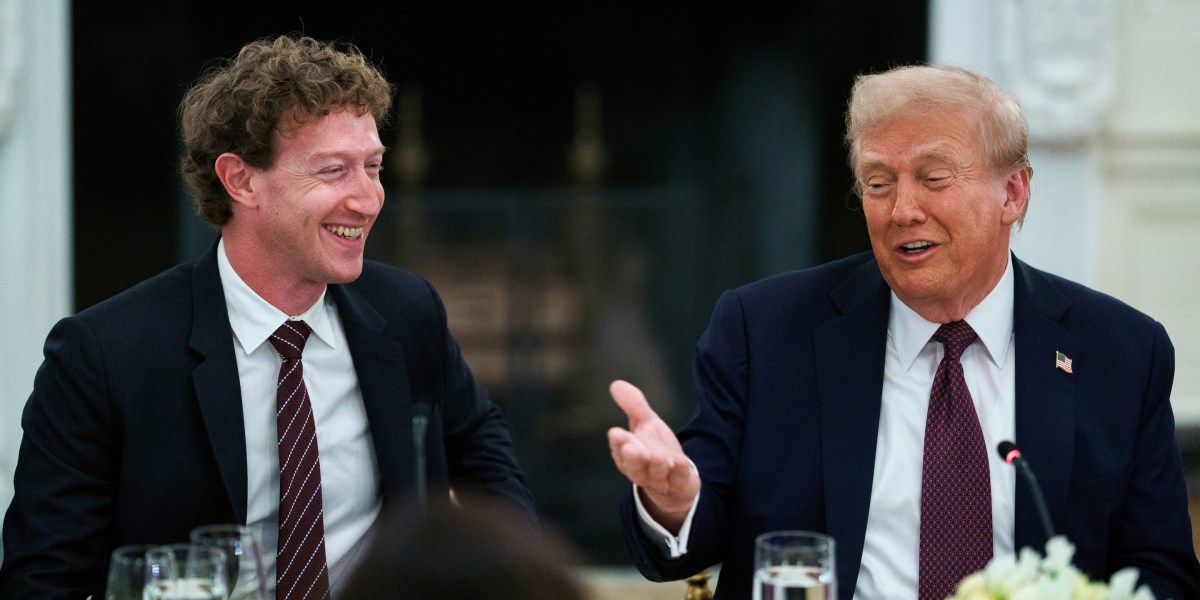
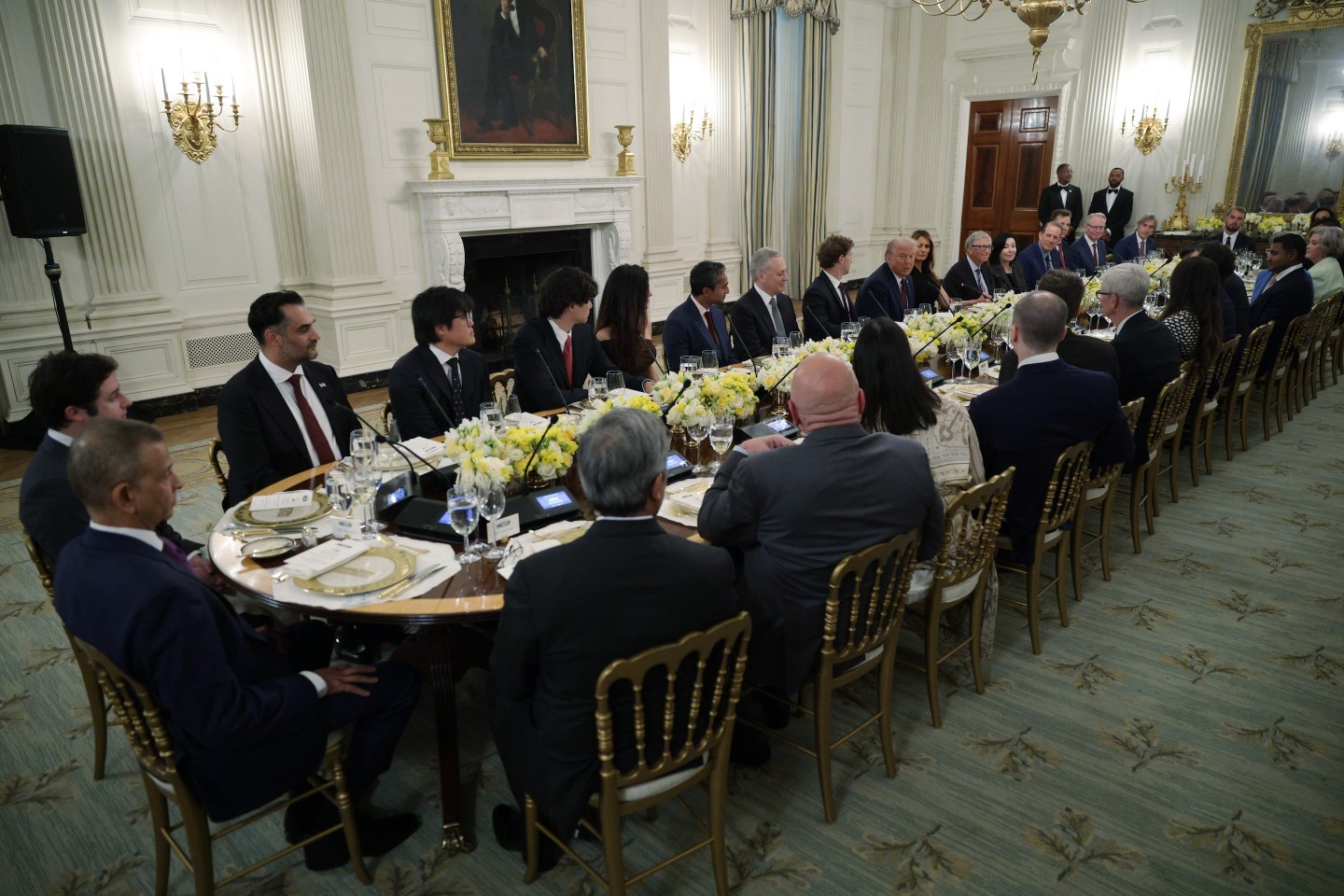
President Donald Trump convened some of Silicon Valley’s most influential figures Thursday evening at the White House, hosting a high-profile dinner that underscored the tech industry’s evolving relationship with his administration. The gathering in the newly renovated Rose Garden brought together 33 attendees, including CEOs from major technology companies, venture capitalists, and administration officials. With 13 billionaires in attendance and many others worth millions of dollars, the event was easily one of the wealthiest gatherings in the history of the White House.
Notably absent from the dinner were Elon Musk, Tesla’s CEO and former Trump ally, and Jensen Huang, Nvidia’s chief executive and Fortune‘s Most Powerful Person in Business. Musk claimed on social media that he “was invited, but unfortunately could not attend,” though initial reports suggested he was not on the guest list. Huang, meanwhile, has a pattern of skipping high-profile events, preferring direct one-on-one meetings.
The event followed an AI education summit hosted earlier that day by First Lady Melania Trump and served as the first major gathering in the Rose Garden since its renovation was completed in August 2025.
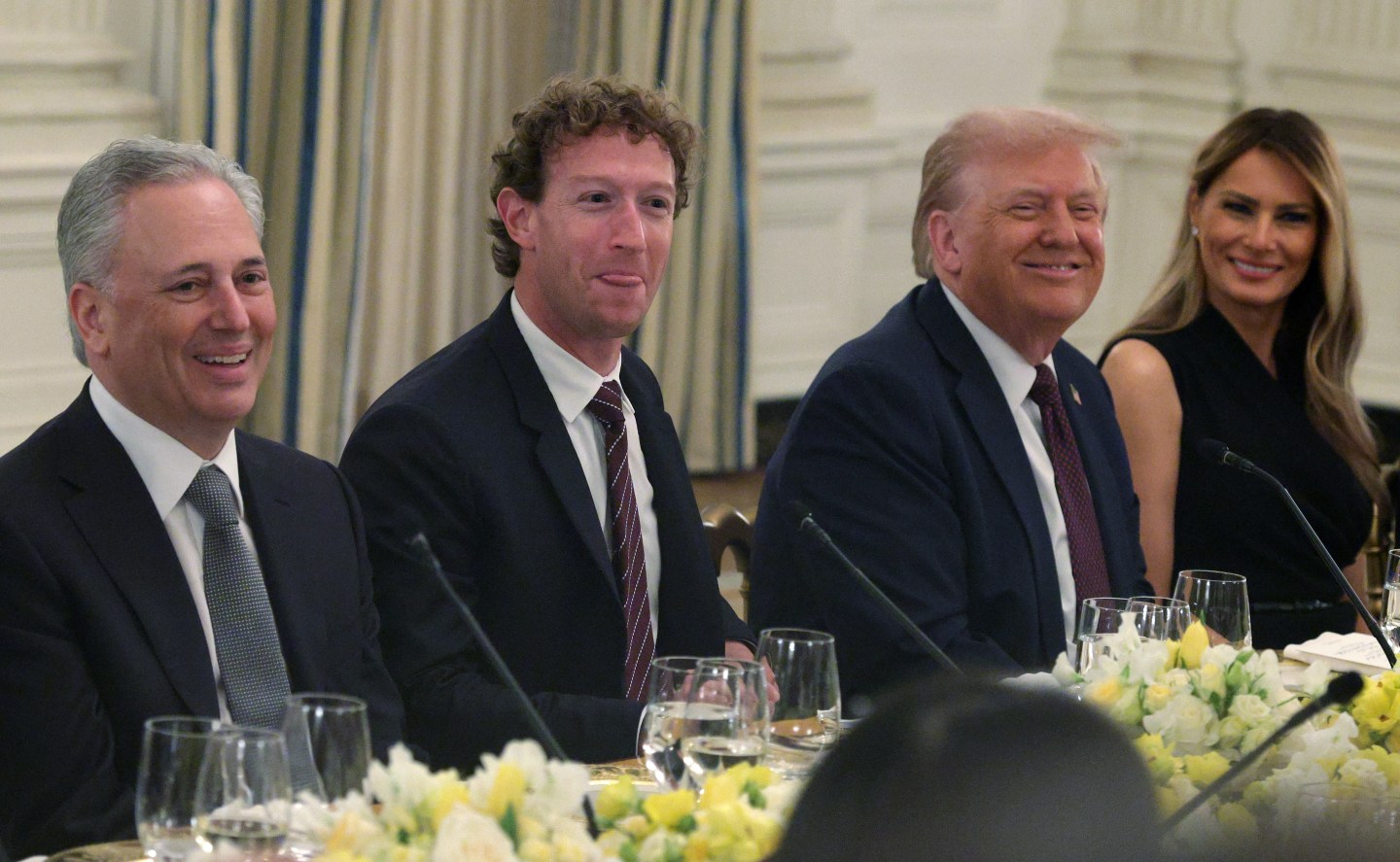
The dinner underscored Silicon Valley’s strategic realignment with the Trump administration, as companies seek favorable regulatory treatment and government contracts while positioning themselves for the AI boom. Several attendees announced significant U.S. investment commitments: Trump asked Mark Zuckerberg directly, for instance, how much he was planning on committing to the U.S., and the Facebook founder responded with $600 billion through 2028.
The event marked a significant evolution from Trump’s historically contentious relationship with Big Tech, reflecting the industry’s recognition that cooperation with the administration serves their business interests in an increasingly competitive global technology landscape.
Alex Wong/Getty Images
The 33 Attendees: Who’s who of tech and politics
1. President Donald Trump
The host and 47th President of the United States, Trump has aggressively courted the tech industry during his second term, seeking investment commitments and closer cooperation on artificial intelligence initiatives.
2. First Lady Melania Trump
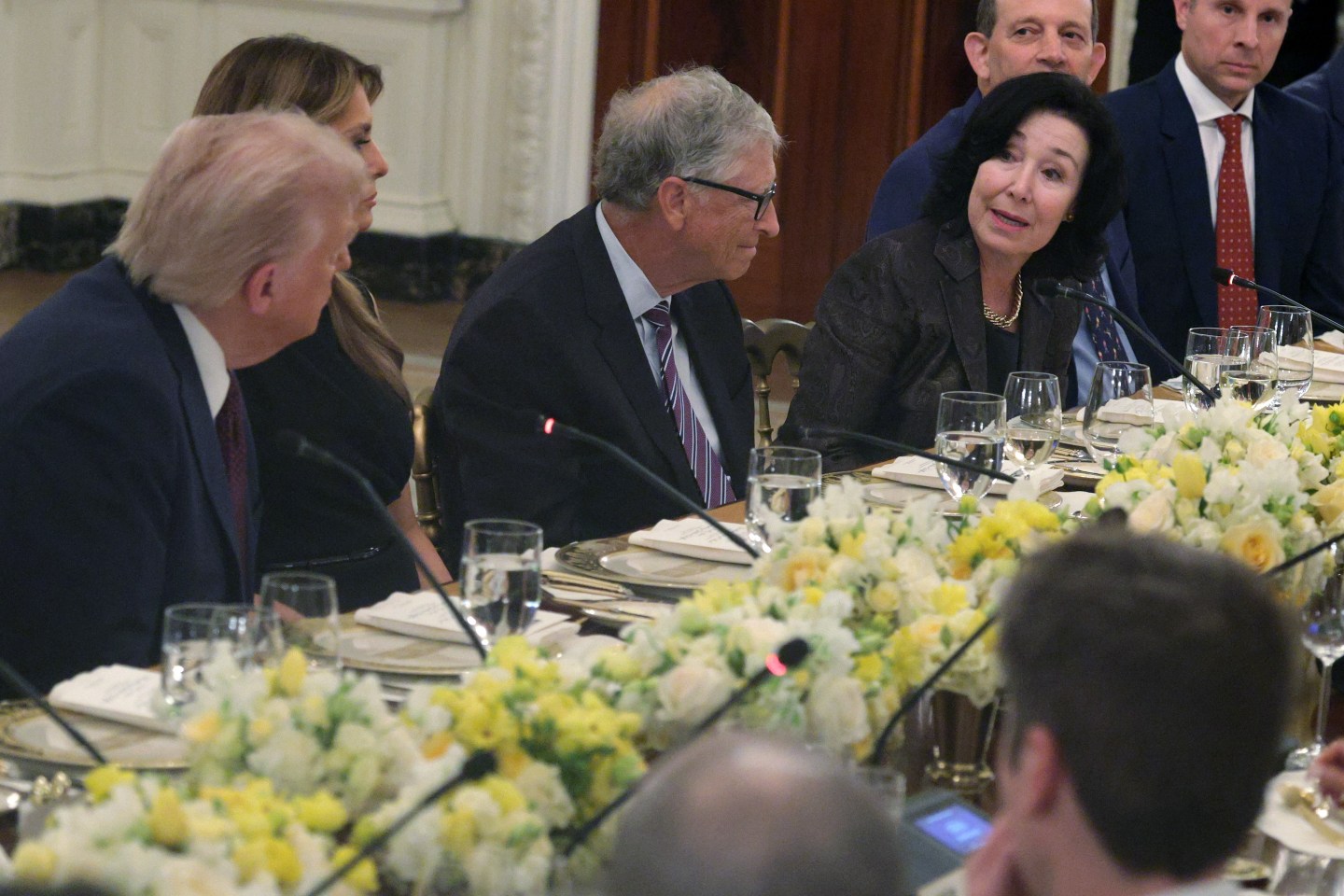
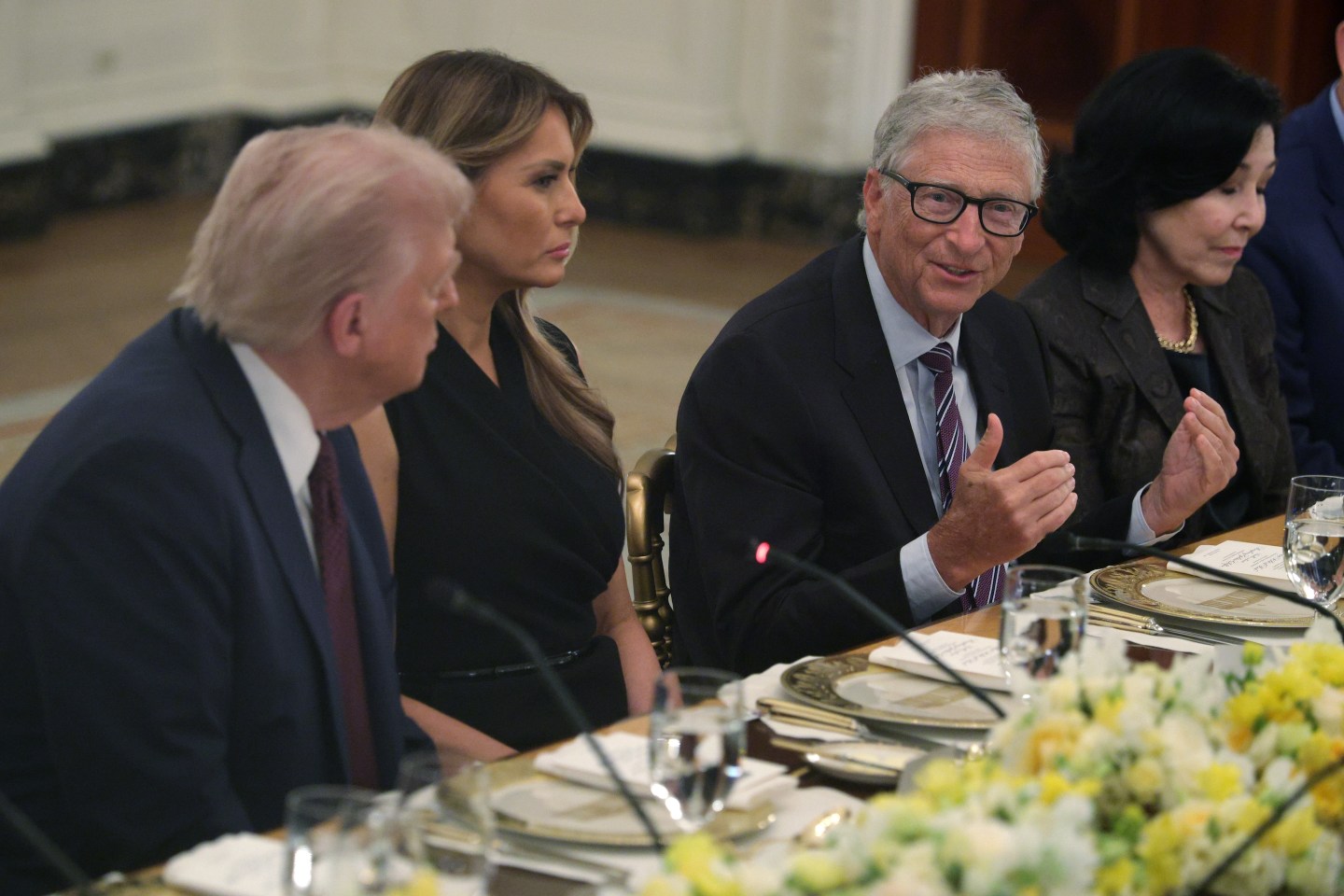
The First Lady chairs the newly formed AI Education Task Force, which held its inaugural meeting earlier that day. She sat next to Microsoft co-founder Bill Gates during the dinner.
3. Susie Wiles
Trump’s White House Chief of Staff and the first woman to hold the position. The 67-year-old veteran political strategist has been credited with running Trump’s most disciplined campaign in 2024. Born in New Jersey, she began her political career working for Congressman Jack Kemp before joining Ronald Reagan’s 1980 presidential campaign. Wiles spent much of her career in Florida politics, managing campaigns for mayors, governors, and eventually becoming Trump’s Florida campaign manager in 2016. She served as co-campaign manager for Trump’s successful 2024 bid.
4. Sergey Brin
The 52-year-old Google co-founder, born in Moscow in 1973, immigrated to the United States with his family at age six to escape Soviet antisemitism. He earned degrees from the University of Maryland and Stanford, where he met Larry Page and co-founded Google in 1998. Brin stepped down from Alphabet’s day-to-day operations in 2019 but returned to lead AI efforts following ChatGPT’s launch in 2023. With an estimated net worth of $191 billion, he ranks among the world’s wealthiest individuals. At the dinner, Trump praised Brin’s “wonderful MAGA girlfriend,” referring to Gerelyn Gilbert-Soto.
5. Gerelyn Gilbert-Soto
Brin’s girlfriend, who drew attention when Trump during the dinner, is the founder of GG Health Coach, helping people achieve better health through balanced nutrition and lifestyle changes. She appeared starstruck when Trump asked her to speak, expressing gratitude for being in his presence.
6. Sam Altman
The 40-year-old CEO of OpenAI, the company behind ChatGPT, thanked Trump for the administration’s support for OpenAI’s $500 billion Project Stargate infrastructure initiative with SoftBank and Oracle. The U.S. Department of Defense recently awarded OpenAI a $200 million contract for AI tools development.
7. Greg Brockman
The 37-year-old president and co-founder of OpenAI, born in North Dakota in 1987, attended Harvard briefly before transferring to MIT, which he left to join Stripe as its first CTO in 2013. He co-founded OpenAI in 2015 with Sam Altman and others. Known for his technical expertise and leadership in AI development, Brockman played a key role in unveiling GPT-4 in 2023. He temporarily left OpenAI during the November 2023 leadership crisis but returned as president.
8. Anna Brockman
Greg Brockman’s wife, who is Korean-American and became a notable figure during OpenAI’s 2023 leadership crisis when she reportedly cried and pleaded with board member Ilya Sutskever to reverse his decision to oust Sam Altman. The couple married in 2019 in a ceremony officiated by Sutskever at OpenAI’s offices, with a robotic hand serving as ring bearer.
9. Safra Catz
The 63-year-old CEO of Oracle is one of the highest-paid female CEOs in the United States. Born in Israel in 1961, she immigrated to Massachusetts at age six and eventually graduated from the Wharton School and University of Pennsylvania Law School. She later worked as a managing director at investment bank Donaldson, Lufkin & Jenrette before joining Oracle in 1999. She became CEO in 2014 and has overseen dozens of acquisitions during her tenure. Catz has been instrumental in Oracle’s cloud computing transformation.
10. Gal Tirosh
Safra Catz’s husband, an Israeli-born former soccer coach who prefers to maintain a low public profile. The couple married in 1997 and has two sons. Tirosh’s Israeli background has influenced his support for initiatives involving technology partnerships between the U.S. and Israel.
11. Jason Chang
The 42-year-old CEO of CSBio, a peptide and synthesizer manufacturing company in Menlo Park, California, holds a Bachelor’s in Economics from UC San Diego and a Master’s in Biochemistry from Oxford University. He joined CSBio in 2009 as director of operations and worked his way up to CEO in 2019. The company provides custom peptides and automated peptide synthesizers to the global biotech community, with a focus on both R&D and commercial manufacturing.
12. Meredith O’Rourke
Trump’s national finance director and senior advisor for his 2024 campaign is a longtime Republican fundraiser from Tallahassee, Florida. She founded The O’Rourke Group in 1997 and has been organizing high-level GOP fundraising events for nearly three decades. She graduated from Virginia Commonwealth University and has been instrumental in Trump’s campaign finance operations.
Alex Wong/Getty Images
13. Nathalie Dompé
The 35-year-old Co-CEO of Dompé farmaceutici, an Italian biopharmaceutical company, and CEO of Dompé Holdings, was born in Milan in 1990 to pharmaceutical mogul Sergio Dompé. She graduated from Bocconi University with honors in business administration. She is also the partner of investor Chamath Palihapitiya. In addition to her executive roles, she has worked as a model for brands like Vogue and Giorgio Armani. She oversees market development and strategic approval for new drugs launched in the United States.
14. Tony Fabrizio
Trump’s chief pollster and one of the nation’s leading Republican strategists, the 65-year-old has served as chief pollster on five presidential campaigns, including Trump’s successful 2016 and 2024 victories. Born in 1960, Fabrizio graduated from Long Island University and founded Fabrizio, Lee & Associates. He has worked for numerous senators, governors, and Fortune 500 companies including Visa, Bank of America, and Google. In 2017, he received the American Association of Political Consultants’ “Pollster of the Year” award for his work on Trump’s 2016 campaign.
15. Dylan Field
The 33-year-old co-founder and CEO of Figma, the collaborative design platform, Field grew up in Sonoma County, California, and briefly attended Brown University before dropping out to accept a $100,000 Thiel Fellowship in 2012. He co-founded Figma at age 19 with teaching assistant Evan Wallace. Despite early struggles and near-employee exodus, Field persevered to build Figma into a design industry leader. The company went public in 2025 with a valuation exceeding $68 billion, making Field worth approximately $6.6 billion.
16. John Hering
The co-founder and executive chairman of cybersecurity company Lookout and a partner at Vy Capital, the 42-year-old dropped out of USC to co-found Lookout, which now protects over 175 million devices globally including those used by the U.S. Department of Defense. BusinessWeek named him a Best Young Tech Entrepreneur, and Fortune included him on its 40 Under 40 list. He has also co-founded cybersecurity firms Coalition and Redacted.
17. Jared Isaacman
The 42-year-old billionaire entrepreneur and commercial astronaut, founder and chairman of payment processor Shift4 Payments, Isaacman dropped out of high school to start his first company, eventually building Shift4 into a business processing $200 billion annually. He founded defense contractor Draken International and has commanded two SpaceX missions, including Inspiration4, the first all-civilian spaceflight, and Polaris Dawn, where he performed the first commercial spacewalk. Trump nominated him as NASA Administrator in December 2024 but withdrew the nomination in May 2025 amid his feud with Elon Musk. His estimated net worth is $1.5 billion.
Alex Wong/Getty Images
18. Sunny Madra
Chief operating officer and president of AI chip company Groq, the Canadian entrepreneur has founded multiple successful startups, including Definitive Intelligence (acquired by Groq), Autonomic (acquired by Ford), and Xtreme Labs (acquired by Pivotal). Madra previously served as Vice President of Ford X, overseeing the automaker’s technology initiatives. Since 2013, he has been an active angel investor in companies including SpaceX, Notion, Uber, and Epic Games.
19. Satya Nadella
The 57-year-old CEO of Microsoft, who thanked Trump for putting policies in place for the U.S. to lead in AI, praised Trump’s approach of supporting rather than fighting technology companies, calling it crucial for maintaining America’s technological leadership globally.
20. Chamath Palihapitiya
Founder and CEO of Social Capital and co-host of the popular “All-In” podcast, the Sri Lankan-American investor and engineer has been a vocal supporter of Trump’s policies and frequently appears at high-profile political events. He was spotted outside the White House before the AI education event and has toured key areas including the West Wing.
21. Sundar Pichai
The CEO of Alphabet and Google announced a $1 billion commitment to education and job training in the U.S., with $150 million dedicated to AI-focused grants. During the dinner, Trump referenced Google’s recent legal victory, telling Pichai: “You had a very good day yesterday,” referring to the company avoiding a major antitrust breakup order.
22. Mark Pincus
The founder of Zynga, the social-gaming company behind FarmVille and other popular mobile games, Pincus has been active in Silicon Valley’s entrepreneurial ecosystem and serves as an advisor to multiple startups and venture capital firms.
23. Vivek Ranadivé
The 67-year-old Indian-American entrepreneur, chairman and CEO of the Sacramento Kings NBA team, who is also the founder of TIBCO Software, was born in Mumbai in 1957. He immigrated to the U.S. at age 16, earned degrees from MIT and Harvard Business School, and founded several technology companies, earning the nickname “Mr. Real Time” for his work in event processing software. In 2013, he became the first Indian majority owner of an NBA team when he purchased the Kings. He currently runs Bow Capital, an early-stage venture firm. His estimated net worth is $700 million.
Alex Wong/Getty Images
24. David Sacks
The White House AI and crypto czar, serving as chairman of the President’s Council of Advisors on Science and Technology, is a member of the “PayPal Mafia.” Sacks was appointed in December 2024 to oversee the administration’s artificial intelligence and cryptocurrency policies.
25. Shyam Sankar
The 44-year-old CTO and EVP of Palantir Technologies was born in Mumbai and raised in Orlando, Florida. Sankar joined Palantir as employee No. 13 in 2006 and pioneered the company’s “forward deployed engineer” model. He holds degrees from Cornell University in electrical and computer engineering and Stanford University in management science and engineering. Under his leadership, Palantir has transformed from a defense-focused startup to a publicly traded S&P 500 company. He also serves as chairman of Ginkgo Bioworks and is recognized as one of the top seven people in defense tech.
26. Jamie Siminoff
The 47-year-old founder of Ring, the smart doorbell company that Amazon acquired for over $1 billion in 2018, Siminoff created the world’s first Wi-Fi video doorbell in his garage. He holds a Bachelor’s in Entrepreneurship from Babson College and recently returned to Amazon as vice president overseeing Ring and other smart-home initiatives after a brief stint as CEO of smart-lock company Latch. His estimated net worth is $300 million.
27. Lisa Su
The 55-year-old CEO of Advanced Micro Devices (AMD), who praised Trump’s administration for supporting the semiconductor industry, noted the “incredible acceleration” the industry has seen since Trump took office and expressed gratitude for the administration’s support in building the “brains behind all of the wonderful AI” being developed.
28. Alexandr Wang
The 28-year-old former CEO of Scale AI and newly appointed chief AI Officer at Meta was born in Los Alamos, New Mexico, to Chinese immigrant parents who worked as physicists. Wang dropped out of MIT at 19 to co-found Scale AI in 2016. He briefly became the world’s youngest self-made billionaire in 2021 at age 24. In June 2025, Meta acquired a 49% stake in Scale AI for $14.3 billion, bringing Wang into Meta to head its Superintelligence Labs. He qualified for the Math Olympiad and US Physics Team as a teenager and holds over 70 patents.
Alex Wong/Getty Images
29. Sanjay Mehrotra
The 65-year-old president and CEO of Micron Technology, a leading semiconductor memory company, was born in India. Mehrotra earned bachelor’s and master’s degrees in electrical engineering and computer science from UC Berkeley and co-founded SanDisk in 1988, serving as its president and CEO until its $16 billion acquisition by Western Digital in 2016. He joined Micron in 2017 and has steered the company’s focus toward AI, 5G, and autonomous vehicles. He holds more than 70 patents and serves on multiple boards including CDW and Stanford Health Care.
30. Tim Cook
The CEO of Apple recently announced a $100 billion domestic manufacturing commitment and praised Trump’s focus on innovation. He was seated prominently at the dinner and has maintained a close relationship with the administration.
31. David Limp
The 58-year-old CEO of Blue Origin, Jeff Bezos’s space company, Limp spent over 13 years at Amazon as senior vice president of devices and services, overseeing Alexa, Echo, Kindle, Fire devices, and Project Kuiper satellite internet. He previously worked at Apple for about 10 years and served as venture partner at Azure Capital Partners. He joined Blue Origin as CEO in December 2023 to focus on manufacturing at scale and instilling urgency in the company culture. He holds degrees in computer science and mathematics from Vanderbilt University and a management degree from Stanford.
32. Mark Zuckerberg
The Meta CEO, who sat next to Trump and was the first executive called upon to speak, thanked the president for hosting and noted that “all the companies here are building huge investments in the country” for data centers and AI infrastructure. He recently ended Meta’s collaboration with third-party fact-checkers and has realigned company policies with the administration’s priorities.
33. Bill Gates
The Microsoft co-founder and philanthropist, who sat next to First Lady Melania Trump, discussed his work on advancing healthcare and vaccine technology, expressing his desire to collaborate with Trump on elevating “American innovation to the next level” to cure diseases like sickle cell anemia and HIV. Despite policy disagreements in the past, Gates praised Trump for his “incredible leadership.”
For this story, Fortune used generative AI to help with an initial draft. An editor verified the accuracy of the information before publishing.