Growing up in Concord, North Carolina, just outside Charlotte, Jacob Palmer was a classic academic achiever. “I was a good student,” he says in an interview with Fortune. “In high school, I participated in all types of extracurriculars, student leadership, I did a lot of public speaking. I had all sorts of friends.” But he said something changed during the pandemic. “School looked drastically different doing online classes and Zoom calls. It felt very intangible.” He says he figured out pretty quickly that online college “didn’t work for me. I hated it.”
Palmer said that instead of sticking with college, he tried things out, including a stint at a FedEx warehouse for several months, and a change of scenery at his grandparents in rural Virginia, where he worked at a factory for a few months.
When he returned home, in need of a job, his mom was putting in a hot tub and she mentioned the electrician working on it was “super passionate and loved his job.” Palmer said he sounded him out, estimating that he was about 29 at the time, and liked that he worked for himself. “I had a general interest in working with my hands, fixing and making things, as well as a basic understanding of electrical theory from my time in AP Physics class.” Soon afterward, he started as a full-time apprentice at a small, Charlotte-based contracting firm, earning $15 an hour at first and working his way up the ladder.
He was far from alone. Palmer’s micro-generation abandoned college in droves during the pandemic, driving 42% of an overall 15% decline in undergraduate enrollment between fall 2010 and fall 2021, according to the National Center for Education Statistics (NCES). Overall, college may have peaked, as experts have predicted a “demographic cliff” ever since 2007, when Americans started having fewer children with the coming of the Great Recession, and birthrates have not recovered since, according to the Centers for Disease Control and Prevention. Palmer was part of a movement deciding to try something else instead of college.
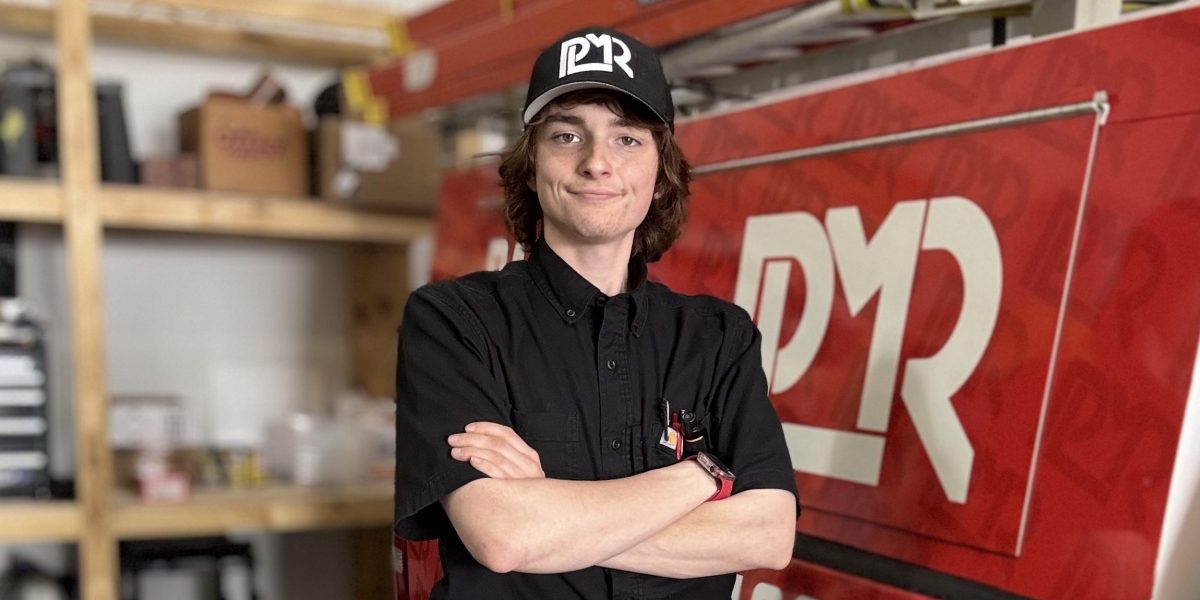
“I spent a few years just untangling the extension cords and doing the grunt work,” he said, earning hours en route to sitting for an electrical license. But even though he didn’t become a college student, he still found himself studying hard, because he had to pass his licensing exam, in January 2024. Just a month later, at 21, he opened his own business, Palmer Electrical. By the end of that year, according to profit and loss statements reviewed by Fortune, he grossed nearly $90,000. Year-to-date in 2025, he’s already exceeded that.
“I’m a one-man, one-truck operation,” he explains, adding that he started just doing work for friends, family, and “around the neighborhood.” Soon, word-of-mouth referrals began to flow. As of early September 2025, he’s booked out a month in advance. But the real kicker? He’s 23, debt-free, and fully independent. “I don’t owe anybody anything,” he says, contrasting his position with college-bound peers saddled by loans and job uncertainties.
A broader trend: the rise of blue-collar ambition
Palmer’s story is not a fluke, says Marlo Loria, Director of Career and Technical Education and Innovative Partnerships at Mesa Public Schools in Arizona—a district at the forefront of changing perceptions about the trades. “In my school district, we have students that are a lot more interested in the trades as compared to, maybe, what some national statistics are looking at,” Loria explains. While college is still a focus, she sees a distinct shift: “The hardest thing is everyone thinks college is a bachelor’s degree, right?” Loria asks. “College is just a vehicle for getting training and skills for whatever career you want, and that might take you a year, it could take you six weeks, it could take you four years.”
Jobber, a 14-year-old software provider that has helped over 300,000 people start, build, and scale home-services business, produces an annual “Blue Collar Report.” Its 2025 edition highlighted how a blue-collar career can be a more than viable alternative to college for entrepreneurs such as Palmer. It polled over 1,000 Gen Zers from age 18 to 20 and over 1,300 parents with high school and college-age kids, and found that Gen Z and their parents alike are at least rethinking college as rising costs, AI disruption, and job insecurity push the skilled trades into the spotlight, but stigma and outdated guidance from schools represent a roadblock.
Loria told Fortune that her district and others nationwide are adopting academy models that blend college, trades, and direct career pathways, giving students options beyond the four-year university pipeline. “Our youth want to know why. Why do I need to go to college? Why do I want to get in debt? Why do I want to do these things?” She said the answer that she used to hear—because I told you so—isn’t cutting it anymore, and as an educator and administrator, she has to come to understand “the reality” of social media’s dominance: “they have access to all of the information at their fingertips.” She says her approach to use a career as the “carrot” to shepherd students into their post-secondary options.
And Palmer’s field is of especial interest to Loria’s students, she added. “Electricians are really super huge right now, especially in Arizona,” she said, citing the surge in data-center building that is reshaping the regional economy. She said the boom is having a kind of “cross-cutting” effect across sectors. “To support AI, you’ve got to have electricians and you’ve got to have construction workers to build the data centers … We have Google and Apple and Meta building major multifaceted data centers here, but they say the only thing that’s going to hold back that growth will be our lack of access to construction workers.”
Jobber cites projections for skilled trades demand from the U.S. Bureau of Labor Statistics that supports Loria’s argument. From 2023 to 2033, it sees demand for the trades rising much faster than the 4% average for all occupations, with electricians (11%), plumbers (6%), and HVAC technicians (9%) representing some of the most in-demand and hardest-to-fill roles. The cost of college, meanwhile, has tripled over the last 30 years, with CollegeBoard data showing that tuition and fees costs $11,610 per year on average at public, in-state schools, and $30,780 for undergraduates from out of state. The costs of trade schools vary, but rarely surpass $15,000 for an entire program.
Blue-collar YouTuber
In Southern California, 19-year-old HVAC technician Itzcoatl Aguilar is still on the launch pad. Home-schooled, he started working in the trades at 16 and now commutes to job sites around Los Angeles, Orange County and the Inland Empire, he tells Fortune. Sometimes he works up to 12 hours a day, he added. Recently, he switched to a new company where his boss is actively mentoring him, and he sees another one or two years before he can become his own boss. Just like Palmer, he’s methodically investing in a work van and tools and prioritizing getting his own license.
While some of his high school peers enrolled in college, he saw more value in entering the workforce directly. “Having to be in a career that I would personally need to spend time away for four years, and then not even having a surety that my degree is going to … get me job security.” That was something that he just didn’t want to do, he says. Aguilar said he hasn’t even cashed a paycheck yet at his new job, so he can’t give revenue figures, and he was making something like minimum wage before, but he’s still living with his mother and two sisters (he’s the youngest of eight siblings). He’s comfortable living at home “because it really gives me an edge on financials and saving, and obviously I help out with the rent and [other bills].”
He’s also drawing additional revenue from his YouTube channel, “EwokDoesHVAC,” which he started seven months before. “I was very inspired by other HVAC channels,” he says, adding there’s a surprisingly large number of them. He discovered them after he started doing HVAC work himself. “I was very devoted to HVAC, so I did a lot of research … I did a lot of research on YouTube.” He’s grown to nearly 30,000 subscribers, he says, but he’s never had more long-form views than his first video, which identified him in the title as an “18-year-old HVAC technician.” He estimates he got 450,000 views from it (close: it was 407,000 views at time of publication). His more recent videos average roughly 10,000 views apiece.
Aguilar adds that he “always wanted to be a YouTuber,” recalling videos from elementary and middle school, “literally in the car recording, just eating a muffin, chatting, talking about what happened at school, like someone fell down a stairway. ” He said he was “seeing all the YouTubers, so I kind of wanted that.” After all, he was born in 2005, the same year YouTube was created. When asked if it’s exhausting working two jobs—HVAC and his side hustle—he says that old-fashioned sales is “very draining.” Trying to make a sale with a real person is much harder than putting himself on camera, he says, “because on the camera, you can turn it off.”
Being your own boss
Social media, Loria observes, has turbocharged interest in alternative career paths among the Gen Zers that she’s advised. “They see things on social media, influencers, for example, that are making all this money, and they think, ‘Well, that’s what I want.’” Popular blue-collar influencers include “The Expert Plumber” Roger Wakefield, who is not a Gen Zer, and Lexia “Lex the Electrician” Czumak-Abreu, who definitely is.
Loria says she taps into this social-media appetite to pitch a vision of entrepreneurship, advising students to “go learn a skill, a trade, go get your license, but also take some classes on how to be a business owner, because maybe one day you would want to run your own electrical company or your plumbing company.” She says they talk in her community about “blue-collar billionaires. They’re the ones that have the nice boats and the three houses.” Realistically, she adds, these people are not truly that wealthy, but they’re an aspirational example. Swiss investment bank UBS calls these the “everyday millionaires,” commenting on how remarkable growth is in the seven-digit wealth bracket.
Palmer tells Fortune that he’s already achieved most of his early professional goals, including being his own boss, and after his mother moved to Florida in June 2025, he moved in with his girlfriend. Up next, he said, YouTube has been taking up more of his attention recently. “Depending on how next year goes on YouTube for Palmer Electrical, that could be a big part of my future, content creation.” He adds, “I hate the word ‘influencer,’ but, you know, electrical influencer?”
It’s not about vanity, he clarifies: it’s another revenue stream. He estimates that he started out generating around $450 per month from YouTube advertising on his videos, and his most recent was $1,300 for August 2025. “Middle-school Jacob would be going crazy right now,” he adds. “He wouldn’t know what to do with himself.” Palmer’s YouTube page shows something like the opposite trajectory of Aguilar’s, as he started with less than 1,000 views for his first video but grew to 88,000 for a hit video in the summer of 2025.
Palmer can foresee a time where, like Aguilar, YouTube and content creation takes up a bigger portion of his income and his time, and that will help with the inconvenient fact of just how hard he’s working. He only took one week of “true vacation” over the last year. He is maximizing his weekends, for instance going to a beach on the weekend or work trips attending conferences in different parts of the state. Palmer notes that he’s a member of the North Carolina Electrical Inspectors Association. That’s the downside of being your own boss, he adds: “If I stop, the checks go to zero.”






 Politics8 years ago