Connect with us

Business

McKinsey challenges graduates to master AI tools as it shifts hiring hunt toward liberal arts majors

Published

on


A year-and-a-half ago, management consulting firm McKinsey had just 3,000 AI agents in its possession, with its 40,000 employees far outnumbering its agentic fleet. But in just 18 months, that number has grown more than 500% to about 20,000 AI agents supporting the company’s work, CEO Bob Sternfels said on Harvard Business Review’s Ideacast. Now, the company is evaluating how well job candidates can work with its AI tool as part of the interview process.

The consulting firm is asking candidates to use its internal AI tool Lilli in a test during its hiring process, according to consulting interview preparation company CaseBasix, which helps candidates solve McKinsey, BCG, and Bain cases. In a blog post, CaseBasix says it gathered information from internal sources who say some candidates would be asked to work with the company’s AI tool as part of a final round AI interview. The Financial Times also reported on McKinsey’s focus on business school students using Lilli, citing people familiar with the matter.

The move comes as the blue-chip company seeks to further implement AI into its operations, pursuing skills that extend beyond the interpersonal and problem-solving traits usually required of a consultant. Companies like McKinsey are looking for candidates who can be AI-ready on day one as the technology becomes essential to job functions.

In his interview with HBR, Sternfels said AI models have developed an expertise in problem-solving, and that the company would be “looking more at liberal arts majors, whom we had deprioritized,” for potential sources of creativity as the firm moves to find creative solutions beyond “logical next steps.” It’s not just McKinsey, other leaders are looking to hire liberal arts graduates like CEO of IT firm Cognizant Technology Solutions Ravi Kumar S, who says he’s recruiting candidates with liberal arts degrees. 

Putting AI skills to the test

McKinsey hasn’t shied away from AI in the hiring process. The company encourages AI use in the application process on its career page, saying that candidates can use the technology to refine résumés and practice interview questions. Though it cautions candidates to use the technology responsibly, saying use of the technology during assessments and for generating interview responses, as well as embellishment, is not permitted. 

“We welcome those who share our curiosity about AI and its potential,” the company’s career page says.

But the pilot program goes a step further. According to Casebasix, the AI interview may be an additional step in the application process, alongside the case interview and a personal experience interview for candidates in the U.S. and North America.

“In the McKinsey AI Interview, you are expected to prompt the AI, review its output, and apply judgment to produce a clear and structured response,” the Casebasix post said. The post says that McKinsey is looking to test soft skills essential to working at the consulting firm—and for working with the company’s AI—including collaboration and reasoning.

A McKinsey spokesperson did not immediately respond to Fortune’s request for comment.

An agentic workforce reshaping the nature of consulting work

Sternfels predicted the company will adopt AI aggressively within the following months. “In another 18 months I think every employee will be enabled by one or more agents,” Sternfels said on HBR’s Ideacast. “We’ll have a workforce that is human and agentic, and we’re going to have to navigate that.”

That change could dramatically shift the work that McKinsey performs. With AI agents making the company’s employees more productive, Sternfels says that the AI adoption could fundamentally change McKinsey’s model. 

“We’re migrating away from pure advisory work, away from the fee-for-service model,” Sternfels said. “We’re moving to more of an outcomes-based model, where we identify a joint business case with our clients, and we underwrite the outcome by tying our fees to the impact our work delivers for them”

But the human skills that Sternfels says AI can’t replace: creativity, aspiration, and judgment. “There isn’t truth in AI models; there isn’t judgment,” Sternfel said. “Humans need to impose those parameters.”

This story was originally featured on Fortune.com


Source link

Continue Reading

Business

Bitcoin closes in on $100,000 in surprise surge

Published

on


New Year, new hope for Bitcoin. After several months of sputtering, Bitcoin is back on the rise. On Wednesday, the original cryptocurrency surpassed $97,000 for the first time in two months and is up more than 6% in the last week. 

The jump in Bitcoin came after Federal Reserve Chair Jerome Powell issued a remarkable statement that accused President Donald Trump’s administration of directing a baseless criminal investigation at him in order to intimidate the agency. Meanwhile, the price of gold and other precious metals shot up as investors fled towards safe haven assets. 

In addition to the uncertainty over the Fed’s independence, the latest inflation numbers appear to be driving the recent Bitcoin surge. 

“The global macro backdrop is supportive as CPI came in cool on Tuesday, amidst generalized concerns about Fed independence following Powell’s speech, which put pressure on the dollar, which is generally negatively correlated to Bitcoin,” said Russell Thompson, chief investment officer at Hilbert Group.

Smaller cryptocurrencies like Ethereum and Solana have also experienced a boost of late. The former is up more than 4% in the last week to about $3,338, and the latter increased more than 3% during that time to its current price of roughly $144. 

By all accounts, 2025 was a disappointing year for Bitcoin. Despite more favorable policies from the Trump administration, most notably the Genius Act signed in July, the original cryptocurrency’s price dropped more than 6% on the year. That’s in stark contrast to the S&P 500, which grew at a rate of about 17% during that time. 

In early October, Bitcoin reached its all-time high price of more than $126,000, but the final three months of 2025 erased those gains and then some. The original cryptocurrency plummeted to $84,000 in late November, a roughly 33% drop from its high. Much of this decline was sustained after what has been termed the “October flash crash”, the day traders lost $19 billion in assets. 

While the last quarter of 2025 was one to forget for Bitcoin, its price is off to an auspicious beginning in 2026. 

Join us at the Fortune Workplace Innovation Summit May 19–20, 2026, in Atlanta. The next era of workplace innovation is here—and the old playbook is being rewritten. At this exclusive, high-energy event, the world’s most innovative leaders will convene to explore how AI, humanity, and strategy converge to redefine, again, the future of work. Register now.


Source link

Continue Reading

Business

Landmark crypto bill on knife’s edge as Coinbase CEO pulls support ahead of key Senate vote

Published

on


As the Senate Banking Committee prepares to debate long-anticipated legislation that would establish regulation for the crypto industry, the fate of the bill is in limbo after Coinbase CEO Brian Armstrong declared his opposition in a Wednesday night post on X

“We’d rather have no bill than a bad bill,” Armstrong wrote, outlining several blockchain sector critiques, including a key battle with the banking industry over offering rewards for stablecoin holdings. “Hopefully we can all get to a better draft.” 

The legislation, which focuses on market structure issues such as supervisory divisions between different federal agencies, has long been a priority for the crypto industry. The bill would address thorny questions that led to bruising lawsuits under previous administrations, including how to classify and regulate different types of cryptocurrencies. 

After helping elect a wave of pro-blockchain candidates fueled by millions in campaign donations, the crypto industry notched a major win over the summer with the passage of the Genius Act, which established a regulatory framework for stablecoins, or a type of dollar-backed cryptocurrency. But market structure has proven trickier, especially after the banking lobby pushed back against provisions in the Genius Act that allows companies to offer customers yield on their stablecoin holdings, similar to savings accounts. 

After the House of Representatives advanced their version of the market structure legislation, called the Clarity Act, in July, the Senate delayed in taking up the bill. But with the Senate Banking Committee finally set to debate amendments on Thursday morning in the markup process, arguments over the issue of yield, as well as conflict of interest ethics provisions targeted at the Trump administration, could stymie the bill’s progress. 

“There’s a real chance this could blow up in committee,” one crypto lobbyist told Fortune, speaking on the condition of anonymity to discuss sensitive industry dynamics. “People are pretty fired up here.” 

Lack of clarity

For many in the crypto industry, the success of the stablecoin-focused Genius Act over the summer was just an appetizer to the main course: wide-ranging market structure legislation that would finally grant legitimacy to the renegade sector. But after years of fierce debate, the product coming out of the Senate might be worse than no bill at all. 

The most significant wedge issue going into Thursday remains the battle over stablecoin yields. The bank lobby has argued that the Genius Act effectively created a loophole, preventing stablecoin issuers themselves from offering yield to users, but allowing partners and third parties to provide rewards. Those programs have been key to many crypto companies, such as Coinbase, which reported $355 million in stablecoin-related revenue in the third quarter of 2025 and offers yields to holders of its stablecoin, USDC. Bank lobbyists have argued that this could threaten the U.S. financial system by suctioning money out of bank deposits. 

A bipartisan group of senators has offered a compromise in the Clarity Act, which would allow crypto companies to offer yield for stablecoin-related transactions, similar to credit cards, as well as other activity. But it remained unclear whether Coinbase, one of the most outspoken and deepest-pocketed crypto figures in Washington, would support the agreement, with Armstrong’s Wednesday post seeming to indicate it would take a hard-line approach. 

“It’s still very much in negotiations right now,” said Ron Hammond, who serves as head of policy at the crypto trading firm Wintermute. “But it’s crypto and there’s always last-second drama, and so it seems to be one of the wedges here.” 

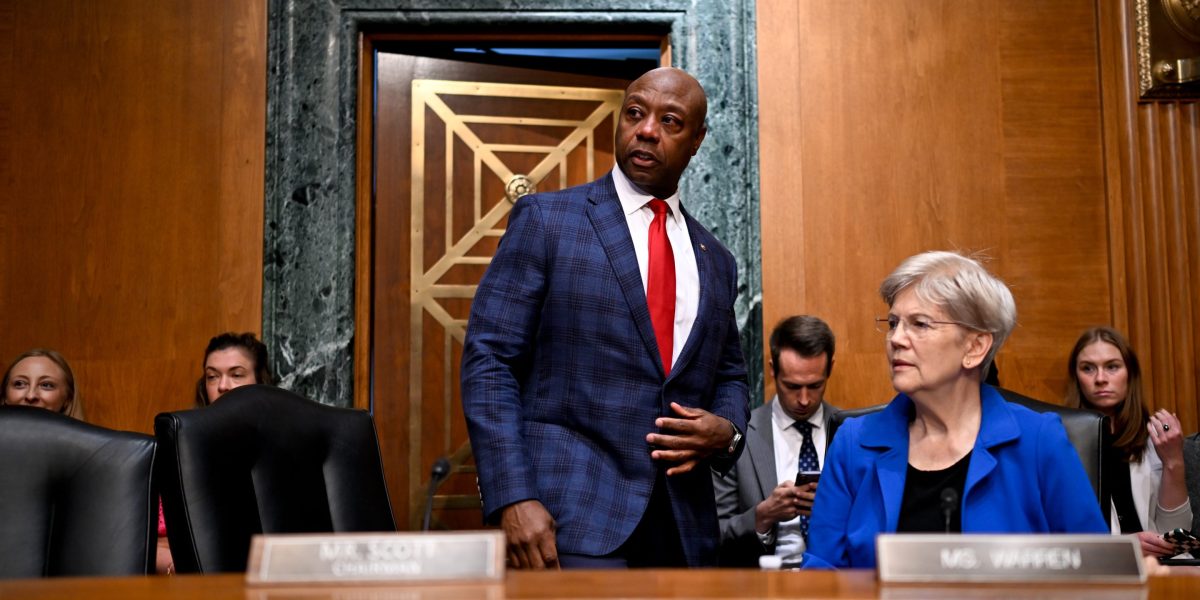
Another debate pushed by Democrats is language that would prevent politicians, including the President, from profiting off of crypto holdings or interest. The issue has become a lightning rod due to the Trump family’s deep entanglement with the crypto industry, including its digital asset platform World Liberty Financial, which recently applied for a federal bank license. But Republicans have strongly pushed back against the possibility, with Senate Banking Committee Chair Tim Scott (R-S.C.) telling CoinDesk on Wednesday that ethics provisions don’t belong in the Clarity Act. 

But a letter sent to Scott and Ranking Member Elizabeth Warren (D-Mass.) from a number of nonprofit watchdog groups, obtained by Fortune, describes the lack of provisions in the proposed bill addressing governmental conflicts of interest as “deeply concerning.” 

If Democrats such as Ruben Gallego (D-Ariz.), who has referred to an ethics provision as a “red line,” pull their support, the bill could be stuck in committee, which needs a simple majority vote, though Republicans hold the edge

The lobbyist who spoke on the condition of anonymity lamented that the bill has lurched to the left in an effort to gain bipartisan support, including through additional provisions that would regulate DeFi, or decentralized finance, as well as the listing process for crypto tokens and oversight responsibilities handed to the Securities and Exchange Commission. “They’ve lost their north star,” the lobbyist told Fortune


Source link

Continue Reading

Business

Denmark and Greenland agree to form working group over the future of the territory

Published

on


A top Danish official said Wednesday that a “fundamental disagreement” over Greenland remains with President Donald Trump after holding highly anticipated White House talks with Vice President JD Vance and Secretary of State Marco Rubio.

The two sides, however, agreed to create a working group to discuss ways to work through differences as Trump continues to call for a U.S. takeover of the semiautonomous territory of NATO ally Denmark.

“The group, in our view, should focus on how to address the American security concerns, while at the same time respecting the red lines of the Kingdom of Denmark,” Danish Foreign Minister Lars Løkke Rasmussen told reporters after joining Greenland’s foreign minister, Vivian Motzfeldt, for the talks. He added that it remains “clear that the president has this wish of conquering over Greenland.”

Trump is trying to make the case that NATO should help the U.S. acquire the world’s largest island and says anything less than it being under American control is unacceptable.

Denmark, meanwhile, announced plans to boost the country’s military presence in the Arctic and North Atlantic as Trump tries to justify his calls for a U.S. takeover of the vast territory by repeatedly claiming that China and Russia have their designs on Greenland, which holds vast untapped reserves of critical minerals.

The president did not take part in Wednesday’s meeting. In an Oval Office exchange with reporters following the talks, he reiterated his commitment to acquiring the territory.

“We need Greenland for national security,” Trump said. He added: “We’ll see how it all works out. I think something will work out.”

Before the meeting, Trump took to social media to make the case that “NATO should be leading the way” for the U.S. to acquire the territory.

“NATO becomes far more formidable and effective with Greenland in the hands of the UNITED STATES,” Trump wrote. “Anything less than that is unacceptable.”

NATO Secretary General Mark Rutte has sought to keep an arms-length away from the dispute between the most important power and the other members of the 32-country alliance unnerved by the aggressive tact Trump has taken toward Denmark.

Both Løkke Rasmussen and Motzfeldt offered measured hope that the talks were beginning a conversation that would lead to Trump dropping his demand of acquiring the territory and create a path for tighter cooperation with the U.S.

“We have shown where our limits are and from there, I think that it will be very good to look forward,” Motzfeldt said.

Denmark bolstering presence in Arctic

In Copenhagen, Danish Defense Minister Troels Lund Poulsen announced an increase in Denmark’s “military presence and exercise activity” in the Arctic and the North Atlantic, “in close cooperation with our allies”.

Poulsen said the stepped-up military presence was necessary in a security environment in which “no one can predict what will happen tomorrow.”

“This means that from today and in the coming time there will be an increased military presence in and around Greenland of aircraft, ships and soldiers, including from other NATO allies,” Poulsen said.

Other NATO allies were arriving in Greenland along with Danish personnel, he said. Poulsen declined to name the other countries contributing to an increased Arctic presence, saying that it is up to the allies to announce their own participation.

The new security commitments, at least those publicized by Greenland’s allies, appeared modest.

Germany said it would send 13 personnel this week to Greenland “to explore the framework for potential military contributions” on the island. Sweden announced Wednesday it was sending an unspecified number of personnel to Greenland for military exercises. And two Norwegian military personnel also were being sent to Greenland to map out further cooperation with allies, the country’s defense minister, Tore O. Sandvik, told newspaper VG.

NATO is also looking at how members can collectively bolster the alliance’s presence in the Arctic, said a NATO official who was not authorized to comment publicly and spoke on condition of anonymity. The official added there’s consensus “that security in the High North is a priority.”

Greenlanders want the US to back off

Greenland is strategically important because, as climate change causes the ice to melt, it opens up the possibility of shorter trade routes to Asia. That also could make it easier to extract and transport untapped deposits of critical minerals which are needed for computers and phones.

Trump says Greenland is also “vital” to the United States’ Golden Dome missile defense program. He also has said he wants the island to expand America’s security and has repeatedly cited what he says is the threat from Russian and Chinese ships as a reason to control it.

“If we don’t go in, Russia is going to go in and China is going to go in,” Trump argued anew Wednesday. “And there’s not a thing that Denmark can do about it, but we can do everything about it.”

But experts and Greenlanders question that claim, and it has become a hot topic on the snow-covered main street in Greenland’s capital, where international journalists and camera crews have descended as Trump continues his takeover talk.

“The only Chinese I see is when I go to the fast food market,” heating engineer Lars Vintner said. He said he frequently goes sailing and hunting and has never seen Russian or Chinese ships.

In interviews, Greenlanders said the outcome of the Washington talks didn’t exactly evince confidence that Trump can be persuaded.

“Trump is unpredictable,” said Geng Lastein, who immigrated to Greenland 18 years ago from the Philippines.

Maya Martinsen, 21, said she doesn’t buy Trump’s arguments that Greenland needs to be controlled by the U.S. for the sake maintaining a security edge in Arctic over China and Russia. Instead, Martinsen said, Trump is after the plentiful “oils and minerals that we have that are untouched.”

Greenland “has beautiful nature and lovely people,” Martinsen added. “It’s just home to me. I think the Americans just see some kind of business trade.”

Denmark has said the U.S., which already has a military presence, can boost its bases on Greenland. The U.S. is party to a 1951 treaty that gives it broad rights to set up military bases there with the consent of Denmark and Greenland.

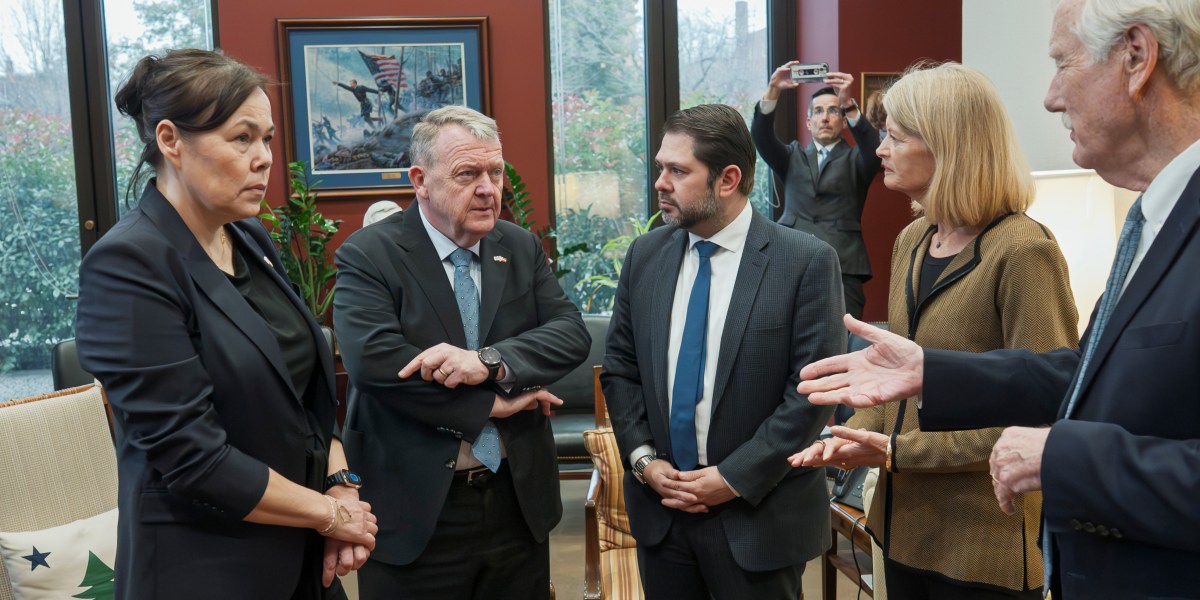
Løkke Rasmussen and Motzfeldt, along with Denmark’s ambassador to the U.S., planned to meet later Wednesday with senators from the Arctic Caucus. A bipartisan delegation of U.S. lawmakers is also heading to Copenhagen this week to see Danish and Greenlandic officials.

Both Løkke Rasmussen and Motzfeldt said while they remain at loggerheads with Trump, it remains critical to keep talking.

“It is in everybody’s interest — even though we disagree — that we agree to try to explore whether it is doable to accommodate some of the concerns while at the same time respecting the integrity of the Danish kingdom’s territory and the self-determination of the Greenlandic people,” Løkke Rasmussen said.

___

Burrows reported from Nuuk, Greenland and Ciobanu from Warsaw, Poland. Associated Press writers Stefanie Dazio and Geir Moulson in Berlin, Lisa Mascaro, Aamer Madhani and Will Weissert in Washington and Catherine Gaschka in Paris contributed to this report.



Source link

Continue Reading

Trending

Copyright © Miami Select.