Connect with us

Business

McDonald’s customers allege fast-food giant misled them, claiming McRib contains no rib meat

Published

on


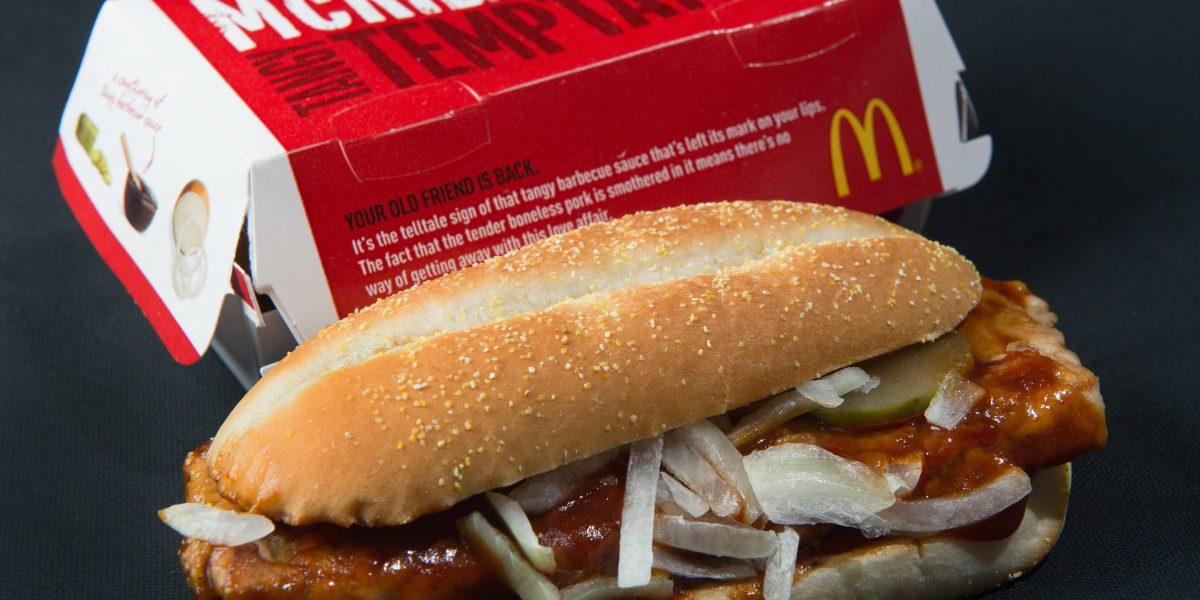
McDonald’s McRib sandwich—a limited-time menu item most recently available in November—has drawn a cult following. Now some of those same fast-food diners are suing the company, alleging the famous sandwich’s name is a misnomer.

A federal class action lawsuit filed last month in the Northern District of Illinois claims McDonald’s calling the sandwich a “McRib” is a “deliberate sleight of hand,” and contains no actual rib meat. Instead, according to the complaint, what McDonald’s calls a “pork rib patty” is actually composed of “lower-grade pork products such as, inter alia, pork shoulder, heart, tripe, and scalded stomach.”

McDonald’s told Fortune in a statement that the lawsuit “distorts the facts and the claims are meritless.”

“Our fan-favorite McRib sandwich is made with 100% pork sourced from farmers and suppliers across the U.S.–there are no hearts, tripe or scalded stomach used in the McRib patty as falsely alleged in this lawsuit,” the statement said. “We’ve always been transparent about our ingredients so guests can make the right choice for them.”

The plaintiffs seeking class-action status and unspecified damages in the lawsuit—including in New York, Illinois, California, and Washington, D.C.—allege McDonald’s intentionally misled its customers on the type of meat in the sandwich: Rib meat, as found in baby back or spare ribs, is of a premium quality that costs more than lower-quality cuts of meat, the lawsuit said. 

Folded into the plaintiff’s concerns about the ingredients in the McRib is also distress about the sandwich’s affordability. Despite the McRib not containing these higher-quality cuts, the sandwich is one of the most expensive items on the menu, costing up to $7.89 before tax, the complaint said. Combined with the item’s limited-time allure, the sandwich’s name suggests customers are getting a more premium product than they are actually ordering, according to the lawsuit.

“By including the word ‘Rib’ in the name of the sandwich, McDonald’s knowingly markets the sandwich in a way that deceives reasonable consumers, who reasonably (but mistakenly) believe that a product named the ‘McRib’ will include at least some meaningful quantity of actual pork rib meat, which commands a premium price on the market,” the complaint said. “McDonald’s does this despite knowing that the sandwich in fact does not contain any meaningful quantity of actual pork rib meat—indeed, none at all.”

The lawsuit cites a 2011 Chicago Magazine report on the McRib, which featured research from scientists behind restructured meat products, credited for the technology used to create the McRib’s patty. He has previously said structured meat products contain ingredients such as tripe, heart, and scalded stomachs.

Other fast-food companies have been similarly scrutinized for their sandwich ingredients. In 2023, a district judge dismissed a lawsuit against Subway, which alleged the chain’s tuna product contained ingredients other than tuna, including chicken, pork, and cattle, as well as no tuna at all. Subway called the claims “meritless.”

McDonald’s customers’ affordability concerns

Claims from customers upset about the quality and price of their fast-food sandwiches coincides with broader outcry about an affordability crisis, as consumer confidence plummets to a five-month low, a sign that inflation worries and weak job data are still weighing on Americans, despite some rosy economic indicators like strong GDP growth. 

McDonald’s has seen these affordability concerns firsthand, reporting in November that revenue fell short of estimates but that U.S. same-store sales were strong, driven by consumers gravitating toward affordable menu items. The fast-food giant has added several menu items and promotions, including Extra Value meals, the McValue Platform launched in January 2024, and the return of the $2.99 Snack Wrap, to appeal to budget-conscious diners.

At the same time, CEO Chris Kempczinski noted traffic from lower-income customers fell, a persistent trend for the last couple of years. High-income customers, he said, were continuing to dine out, though they were also looking for deals. 

“There’s a lot of commentary around, ‘What’s the state of the economy, how’s it doing right now?’ And what we see is, it’s really kind of a two-tier economy,” Kempczinski told CNBC in September. “If you’re upper-income, earning over $100,000, things are good…What we see with middle- and lower-income consumers, it’s actually a different story.”

The claims in the lawsuit about the price and quality of a sandwich indicate the conversation about affordability in fast food is far from over.

“Put simply: consumers have been materially misled en masse as a result of McDonald’s deceptive labeling and marketing into purchasing sandwiches that they would not otherwise have purchased, or would only have paid less for, had they known the truth,” the complaint said.


Source link

Continue Reading

Business

Down Arrow Button Icon

Published

on


The Department of Homeland Security’s deployment of more than 2,000 Immigration and Customs Enforcement officers and agents—the largest such enforcement action in U.S. history—turned fatal on Wednesday when an ICE officer shot and killed a 37-year-old woman in Minneapolis. 

The shooting was just one of several fatal incidents since ICE ramped up its mass deportation effort last year and raises questions about how officers are trained, especially as DHS has dodged questions about this process while more than doubling its number of agents since 2024. Recruitment efforts have been juiced by massive funding from the One Big Beautiful Bill Act, as taxpayers have found themselves funding an unprecedented swelling of immigration enforcement hiring.

Federal officers have also killed at least three other people, according to The Marshall Project, and have shot at least nine people since September, according to The New York Times

While ICE has ballooned to more than 22,000 agents—more than double from early 2025—the “wartime recruitment” tactics it has employed could be attracting combat-hungry or inexperienced people to the job, experts warn.

Recruitment tactics led to over 200,000 applications

DHS announced last summer its plans to hire 10,000 deportation officers, using what they internally called a “wartime recruitment,” according to an internal document reviewed by The Washington Post

ICE officials planned to spend $100 million over a one-year period to recruit gun rights and military support through influencers and geo-targeted advertising campaigns, according to The Post. The funding is part of the $1.7 billion allocated for border and interior enforcement, including $75 billion for ICE, to be spent over four years. 

The department’s strategy dedicated $8 million to influencers, including “former agents, veterans and pro-ICE creators,” with Gen Z and millennial audiences, according to internal documents reviewed by The Post. DHS planned to work with creators across traditional social media platforms like Facebook, Instagram, and X as well as platforms with more conservative users such as Rumble. DHS anticipated that their influencer would bring more than 5,000 applications. 

In addition to a salary ranging from $49,739 to $89,528 a year, DHS offers up to a $50,000 signing bonus split over three years, up to $60,000 in student loan repayment and forgiveness options, and retirement benefits. 

ICE also uses a marketing strategy called “geofencing” to send ads to the phone web browsers and social media feeds of anyone located near military bases, NASCAR races, college campuses, or gun and trade shows, according to The Post.

“The recruitment initiative utilized data-driven outreach efforts to recruit qualified patriotic Americans from across the country. As a result, ICE was able to exceed its hiring surge target while maintaining rigorous standards for training and readiness,” the agency wrote in the Jan. 3 statement. 

ICE did not respond to a request for comment.

Sarah Saldaña, former director of ICE, recently told The Post she was concerned that the speed of recruitment and the framing of jobs as a war effort in marketing campaigns increased the risk of attracting people seeking combat experience. 

The department received over 220,000 applications and hired 12,000 new officers in four months. Despite reaching their personnel goal, DHS is still recruiting more officers.  

“We continue to call on American patriots to serve the homeland because we know that there’s still more work to do — and we will not stop until every community in this nation is safe,”” said ICE Deputy Director Madison D. Sheahan in a statement.

Officer training questioned 

Renee Nicole Macklin Good was shot in her car as ICE agents approached her vehicle and demanded she open the door, according to video filmed by bystanders. An ICE officer shot her at close range and was briefly hospitalized after the vehicle hit him. 

Homeland Security Secretary Kristi Noem defended the officer who killed Macklin Good, saying that the officer “followed his training.” President Donald Trump doubled down on Wednesday, calling the video of the shooting “horrible to watch,” but said Macklin Good had “behaved horribly” and ran the agent over, even though video evidence disputes that claim. 

All new ICE agents are required to undergo the 8-week Basic Immigration Law Enforcement Training Program, during which they train 6 days a week at a facility in Georgia and learn to find, arrest, and deport people. In the past, ICE officials underwent a five-week Spanish-language training program and 16 weeks of basic training, according to the ICE website

The shooting comes after months of allegations of unprofessionalism and misconduct from advocacy groups. Even after a federal judge ordered ICE officers to wear individual badges, officers were seen without badges, according to the Chicago Sun-Times. Some new recruits showed up to training without full vetting, having failed drug tests, physical, or academic standards, and without disclosing criminal backgrounds. 

A senior DHS official told NBC News on Wednesday that ICE officers are trained to never approach a vehicle from the front and not to shoot at a moving vehicle because it will not stop it from moving towards the officer.

Representative Robin Kelly (D-IL) filed articles of impeachment against Noem on Wednesday. 

“Secretary Noem wreaked havoc in the Chicagoland area, and now, her rogue ICE agents have unleashed that same destruction in Minneapolis, fatally shooting Renee Nicole Good,” Kelly wrote in a statement announcing the move. “ It’s one thing to be incompetent and dangerous, but it’s impeachable to break the rule of law.”


Source link

Continue Reading

Business

Defense company founder embraces Trump’s industry threats: It’s ‘good to scare people sometimes’

Published

on


While some companies and analysts fret about President Donald Trump’s threat to crack down on the defense industry, the founder of a $30 billion defense tech company has emerged as an unlikely supporter of his massive overhaul.

Palmer Luckey, who founded defense tech company Anduril in 2017, came out in nearly full support of Trump’s policies. While he noted without elaborating that all the changes “might not necessarily help the defense space,” he stood by Trump’s policy changes despite the president’s rebuke of defense companies as well as their CEOs.

“I think it’s even good maybe to scare people sometimes,” Luckey said in an interview with Bloomberg TV.

A spokesperson for Anduril declined to comment beyond Luckey’s public comments.

The reforms, which the White House outlined in a Wednesday executive order caps defense company CEO’s salaries at $5 million annually until certain conditions are met. As of around 2021, Luckey, who is not the CEO but the founder of Anduril, reportedly earned $10.9 million in compensation from the Company, TechCrunch reported. Luckey told Bloomberg he pays himself a salary of $100,000 a year. The CEOs of major defense contractors RTX Corp (formerly Raytheon) and Lockheed Martin made $18 million and $23 million, respectively, in annual compensation as of 2024.

Analysts warn of threat

The order also bars defense companies from issuing stock buybacks and dividends during periods of “underperformance.” It also required future defense contracts to bundle compensation with production speed and on-time delivery rather than “short-term financial metrics.” 

As a private company, Anduril does not issue stock buybacks or dividends, although Luckey has previously said it is “definitely going to be a publicly traded company,” someday

Luckey compared Trump’s defense reforms to “grounding” a teenager and noted they were positive as a temporary measure to help improve the sector’s performance overall. He added that the government should be the one calling the shots when it comes to public money spent on defense.

“I think when you are on the dole, and effectively run on the public’s wallet, the public should be able to impose whatever restrictions they want on you,” Luckey told Bloomberg TV.

Luckey’s support for Trump’s crackdown puts him at odds with his industry and potentially his own company’s interests (as it pertains to stock buybacks and dividends) as Anduril reportedly prepares for an IPO.

Trump’s defense industry reforms represent a major shift in the U.S. government’s relationship with private companies, and analysts have warned that they could pose a threat to the sector. Shares of major defense contractors, including Lockheed Martin, Northrop Grumman, and Raytheon, each sank about 6% following the news before largely rebounding Thursday.

Yet, Anduril, which boasts Pentagon contracts for tech to defend against autonomous drones and border security systems, is on track with the new reforms “in most cases,” Luckey claimed.

He pointed to Anduril’s “Arsenal-1” plant for building autonomous vehicles in Columbus, Ohio, as evidence. Luckey said the company spent $900 million on the plant and built it faster than expected. The plant will start production this summer. He noted, though, that the company is behind schedule in developing a man-portable system to protect soldiers from drones due to the technology’s complexity.

Luckey, despite likely owning a portion of privately-owned Anduril, claims his salary comes in well below Trump’s threshold for CEO pay, and said he’s not worried about Trump’s proposed $5 million ceiling.

“If they say that I’m not allowed to pay myself $1 until I get caught up, I think they should be allowed to do that,”  he said.


Source link

Continue Reading

Business

Down Arrow Button Icon

Published

on


President Donald Trump’s yearslong threats to take over Greenland have crescendoed this week. On Wednesday, White House press secretary Karoline Leavitt said Trump is considering a range of options in pursuit of the country, and that “utilising the U.S. military is always an option at the commander-in-chief’s disposal.”

But according to foreign policy experts, Danish officials have been baffled by Trump’s threats to resort to military intervention to gain control of Greenland because there’s already a long-standing agreement in place for the U.S. to increase its military presence there. In 1951, the U.S. and Denmark signed a little-known defense agreement allowing the U.S. “to improve and generally to fit the area for military use” in Greenland and “construct, install, maintain, and operate facilities and equipment” there. 

“This agreement is very generous, it’s very open,” Mikkel Runge Olesen, a senior researcher at the Danish Institute for International Studies in Copenhagen, told Fortune. “The U.S. would be able to achieve almost any security goal that you can imagine under that agreement.”

Given the wide-reaching terms of the contract, “there is very little understanding as to why the U.S. would need to take over Greenland at this time,” Olesen added.

Though Trump’s desire for Greenland has punctuated both of his administrations (in 2019, his intentions to buy the self-governing Danish territory were immediately rebuffed by Danish Prime Minister Mette Frederiksen), world leaders have taken the president’s most recent interest in the island more seriously. Following the U.S. forces’ capture of Venezuelan leader Nicolás Maduro, Trump has invoked greater imperial authority through what he has endorsed as the “Donroe Doctrine,” alluding to the 19th century Monroe Doctrine, a foreign policy warning European powers against intervention in the western hemisphere. 

Greenland—covered in ice and home to 56,000, mostly Inuit people—has become crucial to the defense of North America thanks to its positioning above the Arctic Circle giving it access to naval and shipping routes. Combined with its abundance of rare earths, the country has become coveted by Trump, who wants to secure it not only for its wealth of natural resources, but also against the Chinese and Russian ships he claims have anchored themselves in the Arctic region.

Long-standing U.S.-Danish ties

For more than 80 years, the U.S. has had a presence on Greenland, which became a foundational part of its deepening relationship with Denmark—and the North Atlantic Treaty Organization (NATO). During WWII, Danish ambassador to the U.S. Henrik Kauffmann, defied the Nazi-controlled Danish government and essentially brokered a deal with the U.S. to give America access to Greenland. A U.S. military holding there would prevent Nazi forces from using the island as a bridge between Europe and North America.

The deal that was supposed to dissolve after the war was instead bolstered by the creation of NATO in 1949, which obligated the U.S. to provide defense for Europe against Soviet forces. A new agreement in 1951 confirmed the U.S.’ rights to establish defense areas in Greenland, and is contingent upon the continued existence of NATO to be valid. In 2004, the agreement was updated to add Greenland, which established some self-governance in 1979, as a signatory.

The U.S. has only one military base on Greenland today, the Pituffik Space Base, down from about 50 during the height of the Cold War. But should the U.S. want to expand its presence there for national security reasons, as Trump has suggested, it would require negotiations with Denmark and Greenland, Olesen said. Historically, those negotiations have been friendly.

“In practical terms, there has been a tendency on the Danish and the Greenlandic side to always look at us security requests in Greenland with a lot of goodwill and a lot of openness,” he said.

Danish Prime Minister Frederiksen, citing the 1951 agreement, implored the Trump administration to stop his talk of taking over Greenland.

“We already have a defense agreement between the Kingdom and the United States today, which gives the United States wide access to Greenland,” Frederiksen said in a statement over the weekend. “I would therefore strongly urge the United States to stop the threats against a historically close ally and against another country and another people who have said very clearly that they are not for sale.”

Trump’s motivations for taking Greenland

Garret Martin, lecturer and codirector of the Transatlantic Policy Center at American University, speculates Trump’s insistence on appearing to brush off the 1951 agreement in favor of military force or offers to purchase Greenland (despite Danish officials repeatedly saying the country is not for sale), is an extension of the 19th century “gunboat diplomacy” philosophy the president took with Venezuela.

In the case of Greenland, Trump could be wanting to send a message to Denmark the U.S. has greater military capabilities that it is willing to deploy.

“Trump believes—and is often very keen to emphasize—the United States as leverage,” Martin told Fortune. “And it’s possible he’s trying to tell Denmark, ‘Look, you are in a position of weakness. Greenland really fundamentally depends on us. Why should we have to avail ourselves of those formalities when really we’re the key player?’” 

Trump’s tactics could also come from a desire to stake claim over the rare earth metals buried deep under the Greenlandic ice, which has become more urgent to Trump as China sits on 90% of the rare earth the world needs.

Anthony Marchese, chairman of Texas Mineral Resources Corporation, told Fortune earlier this week the president’s hope of mining those rare earths is nearly a fantasy. The northern part of Greenland is mineable only six months out of the year due to treacherous weather conditions, and expensive mining equipment has to endure months in that cold climate.

“If you’re going to go to Greenland for its minerals, you’re talking billions upon billions upon billions of dollars and extremely long time before anything ever comes of it,” he said.

According to Olesen, Trump’s desire for rare earths, as well as his national security urgency, can be addressed by Danish and Greenlandic officials through negotiations, making them less of a concern. The trouble will be if Trump’s biggest motivator to move into Greenland is a symbolic show of military prowess rather than specific demands that can be addressed through diplomacy.

“It’s hard to compromise with territorial expansion,” Olesen said.


Source link

Continue Reading

Trending

Copyright © Miami Select.