The 36th edition of 080 Barcelona Fashion was held on October 14-17 in the Catalan capital. The organisers, staging Barcelona’s fashion week at its customary venue for the last time, were able to draw on a budget of €2.15 million, including a grant from the municipality of Barcelona. Where will 080 Barcelona Fashion go from here, and what are its future challenges? Marta Coca, the event’s top executive, has talked to FashionNetwork.com about all this.
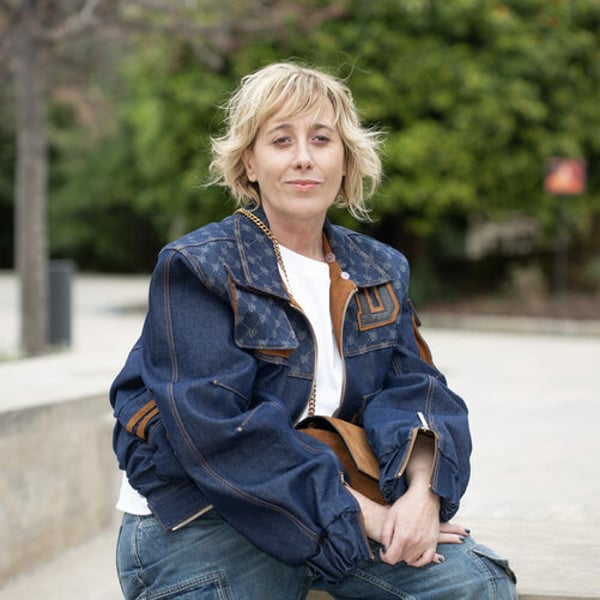
Marta Coca, head of 080 Barcelona Fashion – 080 Barcelona Fashion
FashionNetwork.com: This was the last edition of 080 Barcelona Fashion to be held at the Sant Pau Art Nouveau site. How is the search for a new venue going?
Marta Coca: We’re looking at a couple of options. Both need some interventions, and we’re evaluating them in order to assess if we can get everything done by next April. We want a completely different style from the last editions, where modernism was the stand-out feature. We’re looking for a venue that, while different, will still be identifiably Barcelona.
FNW: What are the venue’s key requirements?
MC: Capacity is one of them. In addition, we’d really like to be able to use both indoor and outdoor spaces, so that people can enjoy an outdoor area for a breather between shows. We’re keen on a venue with enough capacity for our audiences, but also with outdoor space they can enjoy, and where they’ll be able to network between shows.
FNW: A few months ago, you announced, among other things, that the municipality of Barcelona would join forces with 080 Barcelona Fashion. What form has this support taken?
MC: In this edition, it came as a small financial contribution. We don’t want to say the Municipality is an investor, we’d rather talk about a partner that will help us grow. This collaboration, on the one hand, takes the form of a financial contribution to boost content and communication at the venue where we’re staging 080. On the other, it’s aimed at organising other initiatives across the city during the fashion week. In other words, making Barcelona sparkle with fashion.
FNW: How are you planning to achieve this?
MC: We must devise the best possible format to make the event last five or six days at most, enabling us to continue to attract buyers, the media and stakeholders. The idea is that the partnership won’t be only financial, but will be characterised by a scalable project and a ubiquitous fashion presence in Barcelona, involving different areas of the city: There will be initiatives tailored to industry players, others for stakeholders and for the general public, like the Open Area we introduced this year.
We wholeheartedly believe that fashion is culture and that, if we want our brands to sell at the prices they need to sell for, we have to work on consumer education, acting as a public platform and an echo chamber. Conveying the notion that fashion has a price, that it’s not about consuming a lot, but about consuming well and making quality choices. And we must make sure Barcelona people are in love with fashion just as they are in love with art.
FNW: This was 080 Barcelona Fashion’s 36th edition. How do you see it evolving in the medium term?
MC: We see ourselves as a promoter of alliances, both locally and internationally; we see ourselves still doing what we’re doing now, while paying attention to trends and how markets are evolving. Barcelona has a fashion dimension, in aesthetic terms, but we also have brands that are linked with a social, ethical and political dimension. 080 closely monitors what’s happening around us.
We’ll continue to be obsessed with integrating artisanal techniques into our collections, because this will make us stand out, creating a DNA specific to Catalan fashion. Of course, sustainability is crucial too. No matter how long it will take for EU [sustainability] policies, including recycling and extended producer responsibility, to be deployed on the ground, we want to prepare society and brands so that they’ll be ready to incorporate them when the time comes.
FNW: What about internationalisation?
MC: For us, it’s a must. The local market is very important, but our brands, especially emerging ones, need us to help them find their niche in the global arena.
FNW: In this respect, what formulas are you planning to explore?
MC: Besides reverse missions, i.e. bringing stakeholders to Barcelona during the fashion week, we’re planning to organise commercial missions abroad. Next year, for example, in collaboration with Catalan fashion hub Modacc, we will travel to India, a fast-growing market worth exploring. Certain markets have a medium to long-term potential: In such cases, we’re aware that return on investment is not immediate, but we believe that, as a public platform, it’s where we ought to be.
Beyond this, and as a way to boost the 080 brand’s visibility, pop-up stores are very effective internationally, almost better than showrooms and trade shows. With a pop-up format, you can reach both industry buyers and consumers. A pop-up approach, clustering several brands together under the Barcelona or Spanish fashion umbrella, is working very well. Of course, you have to choose the right cities, and not every brand will fit in every market, so you have to segment very carefully.
FNW: A plan like this goes beyond the event itself. You’re set to develop these initiatives throughout the year, aren’t you?
MC: Indeed. Though we call ourselves a fashion week, we think of ourselves as a platform. We know there two key moments in the year, April and October, but we work closely with brands, and we’re engaged in a constant conversation with them throughout the year. We’re chiefly working on the local market for now, but the idea is to produce 080 content with a global reach. We need to de-seasonalise our platform because each brand has its own calendar, and business models differ considerably. We have ready-to-wear and couture brands, others working on a pre-order basis, etc. We must be willing to let all kinds of business model and companies of all sizes have space on our platform, as long as we see potential in them.
FNW: In recent years, 080 Barcelona Fashion has been attracting designers and brands that were previously showing in Madrid, such as Moisés Nieto, Carlota Barrera, Acromatyx and Ernesto Naranjo. Why do you think this is happening?
MC: There are brands coming from Madrid, others from Valencia and other cities. I think this is happening because they see that 080 is doing well, and that growth doesn’t happen overnight. We’ve had a very clear strategy for several editions, and we’re gradually putting resources and effort into it, consolidating ourselves.
We’re also building a community. Everyone is talking about communities nowadays, but it’s actually something that 080 has been focused on for a long time. In addition, we’re talking about brands whose global audience is quite concentrated, and we have the ability to serve them. In any case, some platforms are complementary: There are brands in Catalonia that may be more interested in what Madrid has to offer, like access to the [Spanish] or Latin American markets. Hopefully, they don’t regard us as competition, the point is that there are two big cities in Spain, Madrid and Barcelona, with two unique platforms that, with their offerings, are able to cater to the whole market.
FNW: 080 has pioneered giving visibility to emerging talent. Is this a well-established approach?
MC: We’re continuing along this path. In fact, a member of my team specialises in scouting new brands, so that our calendar can feature a hybrid mix of styles and a multi-generational outlook. Our idea is that new voices should account for about 20% of the brands featured in each edition. We’re also introducing new business models. Not every brand is keen to show twice a year, or to work on a seasonal basis. Many brands, especially emerging ones, produce one collection per year, and integrate it with regular drops. We think this is fantastic.
Add designer to Jaden Smith’s considerable list of professions- along with actor, singer, and rapper- after the Californian creator dreamed up an impressive Dadaist display for his debut at Christian Louboutin.
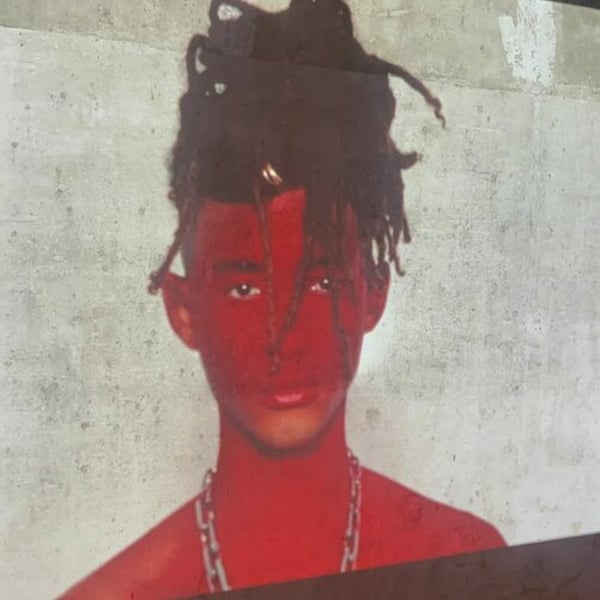
Jaden Smith’s take on the world of Christian Louboutin – FashionNetwork.com
Evoking a whole plethora of influences from Greek mythology and the Great Paris Exhibitions to Dadaism and the great movement for Civil Rights, in an elaborate set in a disused warehouse in Montparnasse. Mount Parnassus, you will recall, was the home to nine muses in arts and sciences.
Two fine works of footwear even had Greek names: The Plato Loafer, a 2017 model with Swisscheese like holes, which Smith updates with the new Neo CL signature on a steel silver coin. And the Asclepius Sling- named after the ancient god of medicine- with the same emblematic coin detail and metallic hardware on the backstrap.
“I brought my personal interest on Greek mythology in as I thought it would resonate with people, as humans at the end of the day are all very similar. I’m combining my perspective of being an African American designer, linked to my more Dadaist thinking into the heritage of a French maison,” explained courteous 27-year-old.
Mythology meets luxury – FashionNetwork.com
Close by stood a Nam June Paik worthy mound of TVs, with video showing images of Martin Luther King’s 1963 March on Washington, The Sphinx, and clips from Dadaist filmmaker Hans Richter.
“That art piece is about the overdose of information we experience. This revolution that we are in the midst of right now. And the fact that information is being thrown at us all the time. And the psychological effects of looking at 10 screens at the one time. While also drawing correlations between my ancestry and Christian’s ancestry, and the history of art,” said Smith, attired in a giant gangster jeans, an oversized parka and pearl encrusted beanie.
Another installation was a broken temple with fluted columns on which were perched Jaden’s new bags. Notably a series of humungous backpacks and biker satchels, some with a dozen exterior zippered pockets with gold lettering reading- coins, pills, keys, tools, phone, documents, phones, and chargers. Alongside a surrealist tote finished like a bucket of overflowing paint and a Dadaist style back made in a black and white photo of an urban madding crowd.
Creator Jaden Smith – FashionNetwork.com
The whole space was dubbed Christian Louboutin Men’s Exhibition, as a small group of models bathed, inevitably, in red light, circulated wearing the new footwear and bags. Large red fabric rolls made into benches allowed one to enjoy a large video montage, including Jaden as a Wagnerian hero posed in front of gothic castles. Which is where we spotted founder Christian Louboutin, in a video stirring a large vat of red paint, before symbolically handing over a paintbrush to Jaden.
“It’s about craftmanship, extreme luxury, and highest level of design. That’s what Christian Louboutin is all about,” said Smith, describing the brand’s DNA.
Eyebrows were raised when Christian appointed Jaden to the position of creative director, as Parisian designers with two decades long CVs gritted their teeth that an untrained talent got such a coveted position. However, judging by this display, Jaden Smith has the chops, talent, and grace to be very effective in this role.
One suspects the gods of style and time are probably rather pleased.
To coincide with Milan Fashion Week, the S|STYLE 2025- Denim Lab is setting up at Fondazione Sozzani for an edition devoted to the future of sustainable denim and water management in the textile industry. Led by the S|STYLE Sustainable Style platform, founded in 2020 by independent journalist and curator Giorgia Cantarini, this initiative forms part of an ongoing programme of research and experimentation into responsible innovations applied to contemporary fashion.
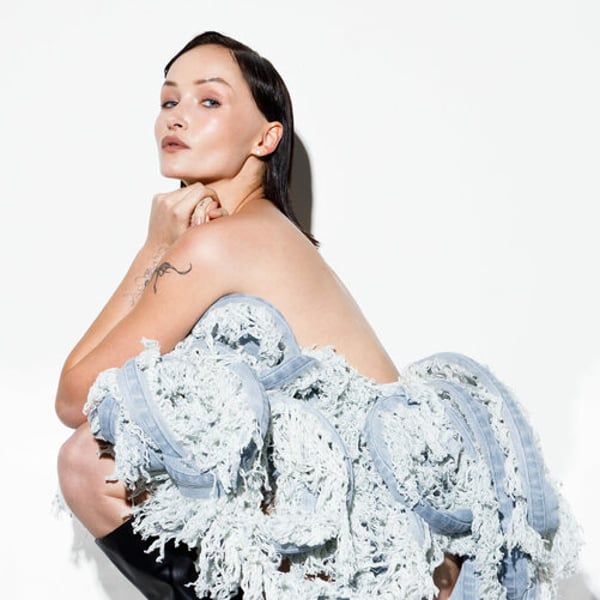
Designers brought together for the S|STYLE 2025 – Denim Lab project – Denim Lab
The exhibition, open to the public on September 27 and 28, features a site-specific art installation by Mariano Franzetti, crafted from recycled and regenerative denim. Conceived as an immersive experience, it brings fashion design, technological innovation and artistic expression into dialogue.
Water: a central issue in fashion sustainability
Developed in collaboration with Kering‘s Material Innovation Lab (MIL), the Denim Lab brings together a selection of young international designers invited to create a denim look using low-impact materials and processes. They benefit from technical support and access to textiles developed with innovative technologies aimed at significantly reducing water consumption, chemical use, and the carbon footprint of denim production.
This edition places water at its core, an essential issue for a fabric whose production has traditionally demanded substantial volumes of water, from cotton cultivation through to dyeing and finishing. Denim therefore serves as an emblematic testing ground, both familiar and closely associated with the environmental challenges facing the fashion industry.
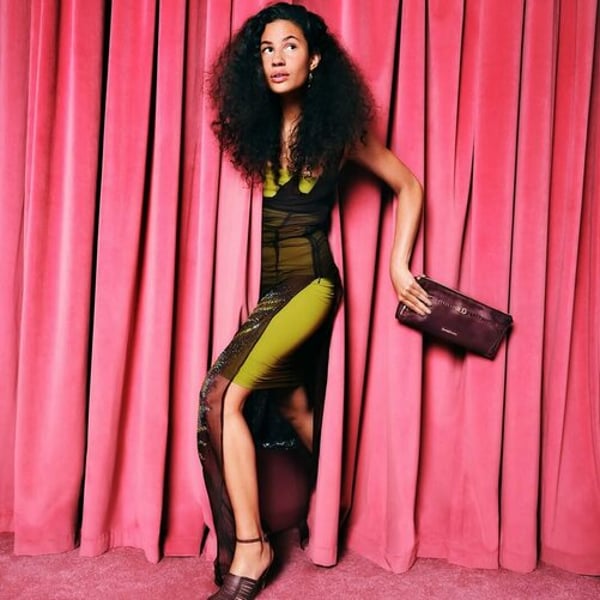
Outfit created for the Denim Lab by designer Gisèle Ntsama, one of the participants – Maison Gisèle
The fabrics were developed by PureDenim Srl, a specialist in low-impact dyeing techniques, while treatments and finishes were applied by Tonello Srl, a recognised leader in sustainable washing and finishing technologies. The selected designers, from Europe, Asia, and Africa, each offer a distinctive interpretation of denim, blending formal exploration, textile innovation and reflection on the contemporary uses of clothing.
Next has won the bidding race to take over the Russell & Bromley premium footwear business, ending almost a century-and-a-half of family ownership.
Russell & Bromley
Working with bidding partner and stock clearance specialist Retail Realisation, it’s set to takeover the 147-year-old retailer under a pre-pack administration deal.
Crucially, it means 33 of the company’s standalone stores/outlets and nine concessions (many of them in Fenwicks branches) are likely to eventually close.
The extent of the challenges Russell & Bromley faced can be seen from the fact that this is only a £2.5 million cash deal. Next is also paying £1.3 million for some of the retailer’s current stock with Retail Realisation handling the clearance of the rest.
Assuming the deal gets court approval on Wednesday afternoon, Next will own the intellectual property and just three of the stores.
Those stores are in London’s Chelsea and Mayfair, as well as the Bluewater shopping centre in Kent. Interestingly, that Bluewater store is just a stone’s throw away from the former House of Fraser branch that this year will reopen as a Next megastore.
The remaining stores and concessions will continue to trade for “as long as [they] can” as Interpath’s Will Wright and Chris Pole “assess options for them”. Russell & Bromley currently has around 440 employees.
A source close to another bidder, Auralis, told The Times it was disappointing that its offer, which aimed to safeguard jobs and stores, wasn’t given greater priority by those running the sale.
Russell & Bromley CEO Andrew Bromley called the sale decision a “difficult” one but insisted it’s “the best route to secure the future for the brand… we would like to thank our staff, suppliers, partners and customers for their support throughout our history”.
So what are Next’s plans now. That’s not clear. There had been a lot of attention focused on its likelihood of closing the store chain in the run-up to the sale but on Wednesday, Next said that it will “build on the legacy” of the business and “provide the operational stability and expertise to support Russell & Bromley’s next chapter”.
Next had also been reported to be eyeing a similar deal for LK Bennett, but Sky News reported that it has stepped away from this.
It remains one of the most acquisitive retailers on the UK high street, however, and in recent years has bought brands such as Cath Kidston, Joules, FatFace, Made and Seraphine. It also has deals to handle other key brands in the UK market such as Gap, Victoria’s Secret and Laura Ashley.