
Politics
Maria Elvira Salazar warns ICE directives could produce largest exodus of Christians ever from U.S.
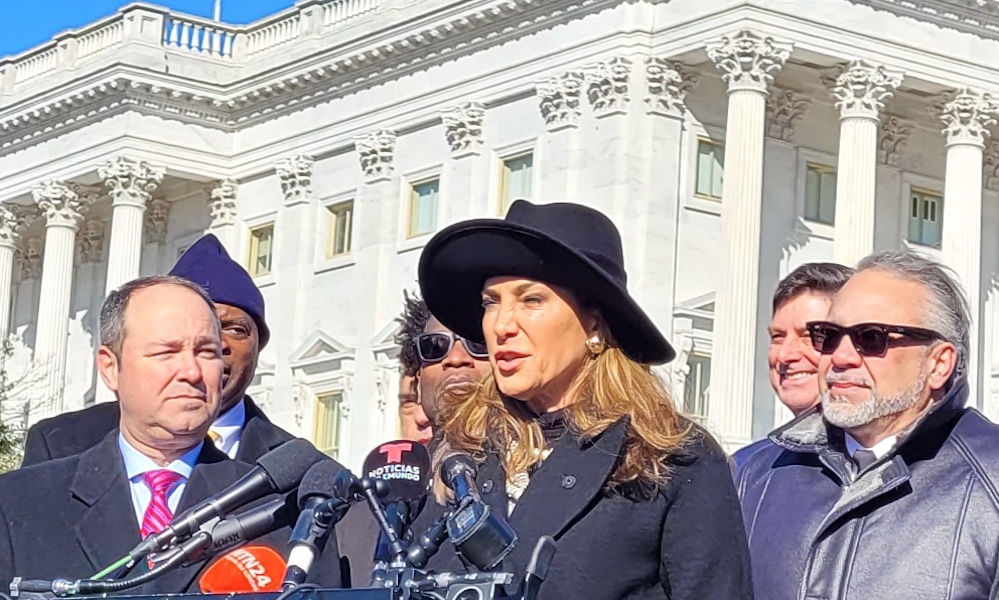
Surrounded by pastors and church leaders from across the nation, U.S. Rep. María Elvira Salazar warned that strict immigration policies are threatening worship services across the country.
“This could represent the largest forced exodus of Christians in the history of the United States,” the Coral Gables Republican said during a Washington event.
Hours ahead of President Donald Trump’s State of the Union, Salazar condemned directives to Immigration and Customs Enforcement (ICE).
Faith leaders on hand were gathered by Detroit pastor Lorenzo Sewell, a conservative minister who gave the benediction at Trump’s inauguration last year. Speakers included many from Minnesota, where immigration raids inspired unrest in the streets and, on multiple occasions, deadly confrontations between ICE and protesters.
All stressed that they supported Trump and wanted ICE to continue operations focused on violent criminals.
“We believe, for such a time as this, God has called you, Mr. President, to cause this country to dream again,” Sewell said.
But leaders shared the story of a Latino church leader in Minnesota, identified by speakers only as “Pastor José,” who was detained at a worksite with construction workers. While he had papers to stay in the country legally, they were not in his possession at the time. He ended up at an El Paso, Texas, detention facility for nearly a week before the situation was straightened out and he could return home.
Salazar said stories like that have left numerous pews empty on Sunday mornings, with many immigrants afraid to attend any public gathering lest ICE detain them.
“One in 12 Christians in America is either undocumented or lives with a family member who is,” Salazar said. ‘That means that we’re talking about 10 million Christians who are at risk of deportation.”
The message appeared to put her at firm odds with a central policy of Trump in his second term. But she insisted the President still could deliver America a solution on the complex problem of immigration reform. She and other speakers praised a clampdown on a porous border that existed under Democratic President Joe Biden.

Salazar turned to her own signature legislation, the Dignity Act. That legislation would allow undocumented immigrants who have lived in the U.S. for at least five years to obtain legal status by agreeing to pay $7,000 over seven years, repay back taxes and pay 1% of their salary to the U.S. Treasury. The program would only be open to those with a clean criminal record.
Salazar shared a podium with U.S. Rep. Marlin Stutzman, an Indiana Republican and original co-sponsor of Salazar’s legislation. Stutzman was set to attend a White House meeting ahead of the State of the Union.
“It’s easy to talk about immigration in the mass context, in the macro context, but when you start talking to people that have fallen into, fallen between the cracks on our immigration policy, all of a sudden you hear different stories,” Stutzman said.
“People are here that want to do it the right way, but they have a difficult time finding the right way because of the immigration laws that we have.”
Salazar declined to discuss if the President should change personnel leading immigration enforcement. Asked specifically about Homeland Security Kristi Noem, she said those decisions belong strictly to Trump.
But so does the right to direct immigration policy, she said. She praised the President for policies including the arrest of Venezuelan President Nicolás Maduro and ongoing pressure against the communist government in Cuba. She noted to Florida Politics that refugees are not currently fleeing those countries thanks to a brighter future becoming clear.
“See what (Secretary of State) Marco Rubio is doing,” she said. “I trust Marco because he has Cuba in his DNA. He is a constituent of mine. We know what those people and we know what the Cuban people want: freedom.”
She said if Trump put his political will behind it, the Dignity Act could pass and America’s complex immigration problems could be solved. She prayed with leaders that Trump will acknowledge that in his State of the Union address.