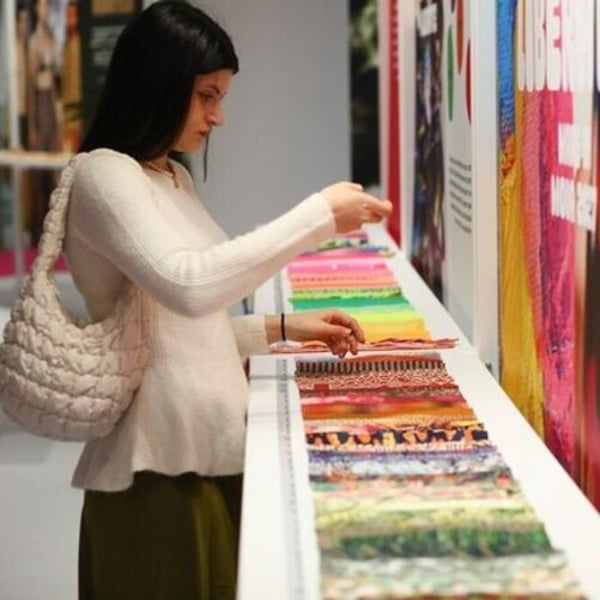
MarediModa, the leading trade fair for Made-in-Europe fabrics and accessories for the beachwear, lingerie and athleisure sectors, reaffirms its central role on the international stage. The 2025 edition, held at the Palais des Festivals in Cannes from 22 to 24 October, recorded significant growth in both attendance (+3%) and the calibre of visitors.
MarediModa 2025 at the Palais de la Croisette in Cannes.
“Over the three days of the fair we saw an increase in buyers compared with 2024,” said Claudio Taiana, president of MarediModa, in a statement, “particularly in the high and upper-mid segments of the market, with major international brands and luxury groups in attendance. By contrast, small brands and start-ups were slightly down. Italy once again ranks first by number of visitors (30%), followed by France, Spain – showing strong growth – the United Kingdom and Germany. Our customary end-of-fair survey also indicates more concrete decision-making and a renewed creative drive.”
Among the highlights of the 23rd edition was a focus on Spring/Summer 2027 trends curated by David Shah, titled “Making Waves”. A genuine call for change: making waves means going beyond the familiar, challenging convention and generating a profound and lasting impact on the fashion world.
Three projects captured the attention of visitors and exhibitors: Flash! celebrated the world of the sea with cutting-edge fabrics, exclusive prototypes and editorial photo shoots; Ath, with the claim “Freedom is not for sale”, explored the dynamism of athleisure, blending fashion and sport in a narrative of freedom and performance; Seam showcased the savoir-faire of third-party garment manufacturers, the essential link between creativity and realisation.
MarediModa 2025 at the Palais de la Croisette in Cannes
This year, The Link, the long-running talent-scouting competition dedicated to young designers from Europe’s most prestigious schools that encourages them to reinvent the codes of beachwear, underwear and athleisure, broke its records, with 128 entries from 37 countries, underscoring the initiative’s international scope and cultural value.
“Almost all of this year’s projects,” reads the jury’s report, “convey a positive and vital message, marked by a desire to rewrite the language of fashion with new symbols that are brighter, more inclusive and optimistic.”
During the event, the nine finalists presented their collections in dedicated spaces and in a catwalk show staged with the support of MarediModa and its exhibitors, who provided materials and technical assistance.
The winners of The Link 2025 were: for Beachwear, Mattia D’Aquila (Italy), Accademia PBS; for Underwear, Reka Kinga Bartha (Hungary), University of Art and Design in Cluj-Napoca; and for Athleisure, Michele Zazzeroni (Italy), NextFashion School by Carlo Secoli.
A moment from the MarediModa 2025 fashion shows at the Palais de la Croisette in Cannes
But reaching the final is already a prize in itself, to the extent that the plaque awarded is the same for everyone, so the other two finalists in Beachwear, namely Emma Parastoo Kianinia (Iran, second) and Victoria Minascurta (Moldova, third); in Underwear, namely Marielena Nicolau (Cyprus, second) and Jessica Twomey (United Kingdom, third); and in Athleisure, namely Marta Fanciulli (Italy, second) and Melissa Isacco (Italy, third), should also be mentioned.
There was also space for the now customary awards recognising companies in the sector that have reached significant business anniversaries: France’s Interlinge, which marked 25 years; Italy’s Seride, which in 2025 celebrated 50 years in business; and France’s Plymouth Française, which reached an impressive 90 years in existence.
This article is an automatic translation. Click here to read the original article.
No way forward. After a decade of uninterrupted growth, the luxury fashion sector has hit a wall. Global sector revenue was estimated at €364 billion in 2024, compared to €369 billion in 2023, showing the limits of a business model based on constant price increases.
Luxury sector players are faced with worsening results – Divulgação
In the face of this slowdown, luxury labels need to rethink their strategies to maintain their appeal, and their margins too, according to a study by Lectra based on figures from its Retviews data analysis solution.
Market in midst of strategic redefinition
Price increases, often hard to justify, in luxury products, have been stemmed by economic stagnation and dwindling consumer purchasing power. This paradigm change is forcing luxury labels to reconsider their strategies. “The current luxury market slowdown is a turning point for labels. They must now rethink their strategies, which had until now been price-centred,” said Antonella Capelli, president EMEA at Lectra.
Labels are reducing their leather goods assortment, especially for cheaper products – hermès.com
The Lectra study revealed two diametrically opposed strategies. Some labels are concentrating on the ultra-luxury segment, targeting a highly specific clientèle that is less susceptible to economic fluctuations. Others, like Louis Vuitton, Miu Miu and Prada, are trying to appeal to a new clientèle by tweaking the prices of their entry-level products.
Leather goods a desirability linchpin that needs to be optimised
In this uncertain environment, leather goods, and especially handbags, are still a mainstay in the market positioning of luxury labels. These iconic items continue to attract an extensive clientèle. Retviews figures show that China is the country where these products are selling at the highest prices, generating margins of several hundred euros per item for labels like Gucci and Prada.
China is the goose that lays the golden eggs for international luxury labels – Retviews/Lectra
Luxury labels are adjusting their assortment strategies in order to protect their high-end image and their profitability. One of their tactics, identified by Lectra, is withdrawing from the market models that are similar but less expensive, to prompt consumers to opt for their higher-priced counterparts. Luxury leather goods are therefore becoming even more expensive. A second approach observed by Lectra is product range streamlining: Bottega Veneta’s Jodie handbag went from five to three sizes in 2024. By the same token, Bottega Veneta has stopped selling its smallest model, the Candy Jodie, aligning with the current trend away from mini handbags in favour of larger models.
Handbag charms emerging as new consumer bait
As the handbag market is rebalancing, a new accessories trend is emerging: handbag charms. These very small leather goods are playing a key role, becoming a new gateway into the world of luxury goods for budget-conscious consumers.
Luxury labels are choosing between ultra luxury and more affordable products – N°21 x Scholl
This new direction has been adopted both by affordable premium brands like Coach or COS and by more upmarket labels, which are developing their collections with a price positioning reflecting their status. Retviews confirmed this phenomenon by observing a whopping 51% growth between 2024 and 2025 in the presence of handbag charms and keyrings in luxury labels’ assortment, a growth rate at odds with the decrease observed in other accessories categories.
Jean-Charles de Castelbajac will stage a mammoth retrospective in Toulouse, entitled ‘L’Imagination au pouvoir,’ or ‘Imagination at work,’ to be presented in the French city’s Les Abattoirs Museum.
Bettina Rheims, Ghislaine Thesmar, and dancers from the Ballet de l’Opéra de Paris, Spring-Summer 1982, “Homage to Comic Books” collection – Bettina Rheims / Adagp, Paris, 2025
This important compilation of fashion, accessories, design, collages, and fine art works by one of France’s great iconoclastic creators will be staged in Toulouse from December 12 to August 23, 2026.
The exhibition brings together nearly 300 works, including clothing, design objects, drawings, and photographs, retracing six decades of creation by a visionary artist who pioneered the breaking down of barriers between art, fashion, and popular culture.
Jean-Charles de Castelbajac and the paraments designed for the reopening of the Notre-Dame Cathedral in Paris, 2024 – Philippe Garcia
L’Imagination au pouvoir offers an immersive journey, punctuated by an original composition by Vladimir Cauchemar, and highlights the artist’s iconic collaborations—from Keith Haring to Robert Mapplethorpe, Lady Gaga to Malcolm McLaren—as well as de Castelbajac’s recent works created for Notre-Dame de Paris.
“Starting in 1980, I began using the primary colours red, blue, and yellow, the banners of pop culture, as well as logos, cartoons, and slogans, as a contemporary response to my passion for medieval heraldry and history. This limited colour palette became my signature, a stylistic imprint, a link between all my creative experiences, from my pop knitting work, the beginnings of streetwear, to sacred art at the 1997 World Youth Day and the reopening of Notre-Dame de Paris in 2024,” said 75-year-old Jean-Charles in a release, referring to the official vestments he created for the clergy for the reopening of the legendary cathedral. Examples of which feature in the retrospective.
“Elektrocute” fashion show, Autumn-Winter2007-2008 – Guy Marineau
Among the iconic images in the exhibition are his famed teddy bear coats from 1988, one of which was worn by Madonna; and the graphic sequined column-dress from 1985 that read, “Je suis toute nue en dessous,” in English: “I am fully naked underneath.”
It also features portraits by Oliviero Toscani of Andy Warhol and Vivienne Westwood wearing de Castelbajac creations. All the way to historic objects, from his multi-coloured rainbow moccasins for Weston to his collectors’ item Totem lamps.
It’s not just major UK shopping centres that are enjoying strong letting percentages. As part of its ongoing repositioning, Northern France’s Les 3 Fontaines has now fully pre-let 110,000 sq ft of outstanding retail space, operator Hammerson said.
Image: Hammerson
The final unit has been signed for a Nike store which will join Primark as anchor tenants when the new stores opens in 2027.
Located in Cergy, Val d’Oise, the Les 3 Fontaines destination comprises 1 million sq ft of prime retail space, including 350,000 sq ft added in 2022.
Between then and 2024, annual footfall has risen 15%, reaching 13 million annual visits. Growth continues, with year-on-year visitor numbers up a further 3.4% so far in 2025, Hammerson said.
Other recently-signed retail brands include Aroma-Zone, a leading natural beauty brand in France, while Inter-Actif, an official Apple Premium Partner, will also open next month.
Since the beginning of the year, 20 long-term leases have also been completed with €36 million (£31.60 million) in contracted rents.
The destination features 200 occupiers, including Sephora, Adidas, Mango, Footlocker, and Zara.
Grégoire Peureux, chief operating officer at Hammerson, commented: “Achieving 100% pre-letting for this latest repositioning epitomises our asset and leasing strategy. Our success is driven by creating attractive spaces that generate demand, broaden the appeal of our destinations, and grow rental income and value. With further openings and more leasing to come, our momentum continues.”