Connect with us

Sports

Managers leaving across Europe at record rates
Published

on


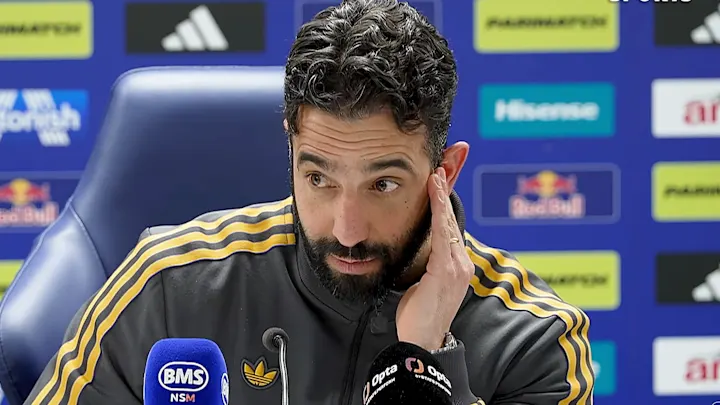
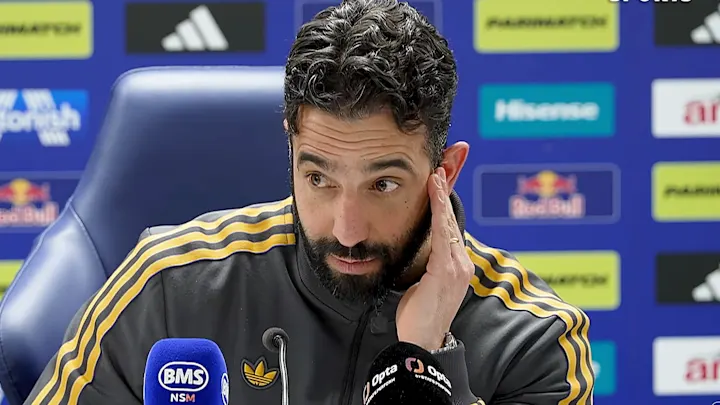
Manchester United have sacked Ruben Amorim

Since the start of 2026, sports media headlines have revolved around the strained Chelsea–Maresca relationship, Manchester United’s damaged connection with Ruben Amorim, and, most recently, Celtic’s woes, as the club moved on from Wilfried Nancy just 32 days after he succeeded Brendan Rodgers. Together, these rapid-fire changes on some of Europe’s biggest benches have turned the spotlight firmly onto managers and how little time they are given to turn things around.

All these proceedings prompted Sportingpedia to take a wider look at the coaching carousel across the continent, analysing managerial changes since the start of the 2025/26 season in 18 of Europe’s top 20 leagues, excluding Sweden and Norway, whose domestic seasons run on a different calendar and identifying where sackings have been most common, which competitions now lead the way for dismissals, and which clubs have already gone through multiple head coaches in a single campaign.

Some of the most curious findings are that since the start of the 2025/26 campaign there have already been 110 managerial changes across these leagues. Turkiye’s Super Lig stands out as the most volatile league with 17 changes, while among the traditional top five competitions the Premier League now leads the way with six dismissals, ahead of the Bundesliga, La Liga, Serie A and Ligue 1. What is most alarming, however, is that eleven clubs across eight different leagues have already made multiple managerial changes this season, meaning those teams are already on their third manager of the campaign while many of their rivals have yet to change even once.

Methodology

The study covers 18 of Europe’s top 20 leagues in the 2025/26 season, excluding Sweden and Norway because their competitions follow a different calendar. For each league, every managerial change since the start of the current campaign was counted. A “managerial change” is any instance of a head coach leaving his position, regardless of whether the departure was formally described as a sacking, resignation or mutual agreement.

Key Takeaways:

  • A total of 110 managerial changes have occurred in Europe’s top leagues since the start of the 2025/25 season
  • Among Europe’s traditional top five leagues, the Premier League leads with 6 managerial changes, ahead of the Bundesliga with 5, while La Liga, Serie A and Ligue 1 have each recorded 4
  • Turkiye’s Super Lig is the most volatile league overall, with 17 managerial changes since the start of the 2025/26 season
  • Greece’s Super League 1 and the Cyprus League follow with 10 changes each, while Belgium’s Jupiler Pro League has witnessed 9
  • Eleven clubs across Europe’s top leagues have already made multiple managerial changes in 2025/26, with two head coaches leaving at each team
  • These eleven clubs come from eight different competitions: Super Lig, Liga Portugal, the Scottish Premiership, Ekstraklasa, Greece’s Super League 1, the Cyprus League, Austria’s Bundesliga and the Premier League
  • Israel’s Liga ha’Al is the most stable league in the sample with only 2 head coach departures, while the Eredivisie and Denmark’s Superliga have seen 3 changes each

Number of managerial changes in Europe’s top leagues since the start of the 2025/26 season
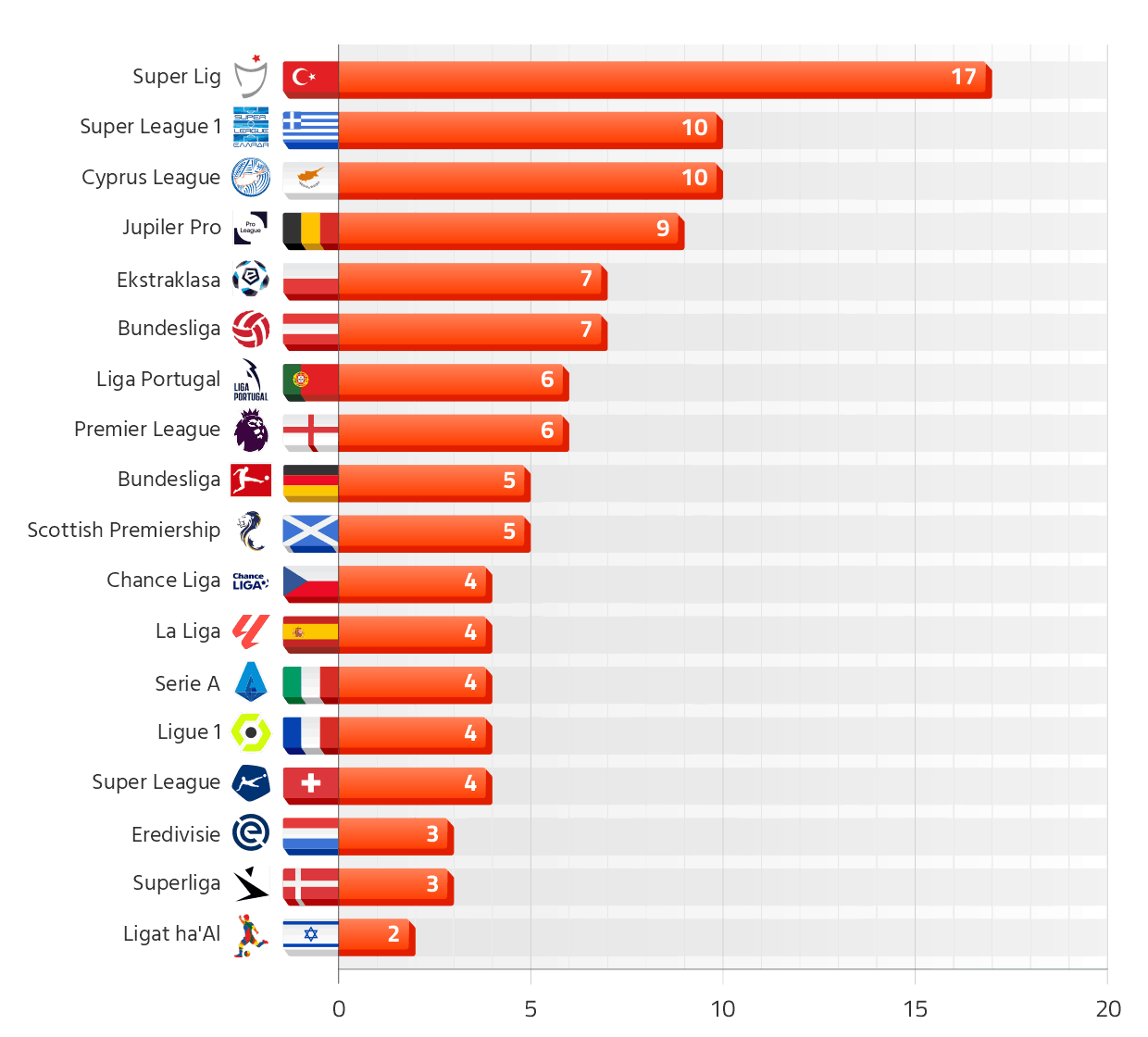
Number of managerial changes in Europe's top leagues since the start of the 2025/26 season

Data Source: Transfermarkt

At league level, Turkiye’s Super Lig clearly stands at the top of the instability table. With 17 managerial changes already recorded in 2025/26, clubs there have been quicker to replace head coaches than in any other competition included in the study.

Greece’s Super League 1 and the Cyprus League share second place with 10 changes each, underlining how rapidly clubs in those championships move when results or performances fall below expectations. Belgium’s Jupiler Pro League sits just behind them with 9 changes, confirming that coaching turnover has also been high in one of Europe’s most competitive smaller leagues.

Poland’s Ekstraklasa and Austria’s Bundesliga have each registered 7 changes so far, placing them firmly in the high-turnover bracket. Liga Portugal and the Premier League follow with 6 changes apiece. In England, that figure has been pushed up by the recent dismissals at Chelsea and Manchester United, ensuring that the Premier League now has more sackings than any of the other traditional top five leagues.

Germany’s Bundesliga and the Scottish Premiership have each seen 5 managerial changes, while La Liga, Serie A, Ligue 1, the Czech League and Switzerland’s Super League form a middle group with 4 departures each. These competitions sit between the most turbulent and the most stable environments: changes are regular, but not at the levels seen in Turkey, Greece or Cyprus.

At the calmer end of the scale, the Eredivisie and Denmark’s Superliga have each recorded 3 managerial departures since the start of the season. Israel’s Liga ha’Al has seen only 2 changes, making it the most stable league in the sample.

Clubs already on their third manager

Alongside the league-wide numbers, a small group of clubs shows just how extreme instability has become. In total, 11 teams across the 18 leagues have already worked with more than two head coach this season. In every case, two managers have left their roles in 2025/26, meaning a third coach has taken over by this stage of the campaign.

Nottingham Forest is the only Premier League club in this group. Nuno Espirito Santo’s spell at Forest ended after 629 days, and his successor, Ange Postecoglou, left the job after 39 days, leaving the team already on a third head coach for 2025/26.

Celtic are the most high-profile case in Scotland’s Premiership. Brendan Rodgers’ long tenure ended after 849 days, and his replacement, Wilfried Nancy, then remained in charge for only 32 days before also departing.

In Liga Portugal, Avs Futebol have already dismissed two managers. Jose Mota was in charge for 139 days earlier in the season before leaving his position. He was followed by Joao Pedro Sousa, whose time on the bench lasted 88 days before his departure.

Poland’s Ekstraklasa is represented by Widzew Lodz. Zeljko Sopic’s tenure as head coach ended after 161 days, and the next manager, Patryk Czubak, left the role after a 50-day spell.

Greece’s Super League 1 contributes two clubs. Panathinaikos first parted ways with Rui Vitoria after 319 days in charge, then later saw Christos Kontis depart after 36 days. AE Larisa followed a similar pattern, with Georgios Petrakis leaving after 96 days and Stelios Malezas after 61 days.

In the Cyprus League, Ethnikos Achnas have also seen two coaches come and go. Hugo Martins remained in charge for 89 days before his exit, and Igor Angelovski’s spell ended after 73 days.

Austria’s Bundesliga is represented by Wolfsberger AC. Mitja Morec was head coach for 148 days before leaving, and his successor, Andreas Gahleitner, lasted 31 days before his departure.

Turkey’s Super Lig adds three more names to the list of repeat changers. Antalyaspor dismissed Emre Belozoglu after 264 days and later moved on from Erol Bulut after a 65-day spell. Genclerbirligi parted company with Huseyin Eroglu after 307 days and then with Volkan Demirel after 37 days. Eyupspor first saw Selcuk Sahin leave after 96 days in charge, followed by Orhan Ak, whose tenure lasted 83 days before his departure.

Set against the broader picture of 111 managerial changes across 18 leagues, the fact that 11 clubs have already gone through multiple dismissals in a single season highlights how quickly pressure can escalate on the touchline and how fragile job security has become for coaches at all levels of European football.


Source link

Continue Reading

Sports

AFCON final descends into chaos, with Senegal winning in AET

Published

on


Senegal won the AFCON Sunday in contentious fashion

Senegal walked off a the AFCON final after a contentious penalty awarded late in added time

By Andrew Powell for Daily Caller covering AFCON

The final for the Africa Cup of Nations (AFCON) required extra time after both sides played to a tense 0-0 draw, culminating in dramatic scenes when Senegal’s players briefly walked off the pitch in protest after the host nation, Morocco, was given a stoppage-time penalty.

Senegal ultimately claimed a 1-0 victory in extra time, securing their second AFCON championship and their second title in five years following their triumph in 2021. However, the manner of the loss left Morocco and head coach Walid Regragui deeply dissatisfied.

Senegal manager Pape Thiaw led his squad off the field Sunday as Moroccan supporters cheered amid chaotic scenes on the pitch, with players from each team clashing over the VAR decision that granted the hosts the late penalty opportunity.

Senegal won the AFCON

Senegal walks off in AFCON final

After a 14-minute interruption, the Senegal players returned to the field, thanks in large part to left winger Sadio Mané, who went to the locker room to urge his teammates to resume play. (RELATED: TaylorMade Hits Callaway With Lawsuit Over Alleged ‘Mud Balls’ Claims)

Senegal goalkeeper Édouard Mendy then produced a crucial save to deny Morocco right winger Brahim Díaz from the spot, while additional Senegal supporters attempted to rush the pitch. Tensions also spilled over into the press area, where journalists were involved in physical altercations.

Following the final whistle, Regragui sharply criticized Thiaw’s choice to remove his team from the match and came to the defense of Díaz regarding the missed penalty kick.

“I think a lot of time passed before [Brahim] was able to take the penalty, and this put him off,” said Regragui, per ESPN. “The match we had was shameful for Africa.

“When a head coach asks his players to leave the pitch, when he’s saying things that already started in the press conference [before the match, when Senegal accused Morocco of unsporting tactics] … he needs to stay class, in victory as well as in defeat.

“What Pape [Thiaw] did tonight doesn’t honor Africa. He’s an African champion now, so he can say what he wants, but they stopped the match for over 10 minutes.

“That doesn’t excuse Brahim for the way he hit [the penalty], he hit it like that and we have to own it. We need to look forward now, and accept that Brahim missed it.”

Chaos after ward of penalty

The VAR call by referee Jean-Jacques Ndala — awarding a penalty for a foul on Díaz — sparked immediate chaos, triggering a physical confrontation between the coaching staffs and players of both teams that quickly spilled over into the stands. Senegal‘s prominent Gaindé supporter group appeared to escalate the surge, vaulting over the hoardings and onto the pitch in an attempt to reach the match officials and the Moroccan contingent.

Security personnel and riot police eventually stepped in, forming a cordon to separate the incensed fans from the playing surface as objects rained down onto the pitch. Senegalese supporters climbed onto the electronic boards lining one side of the field and began tearing them apart. (RELATED: Broncos’ Bo Nix Out For Rest Of Playoffs After Suffering Season-Ending Fractured Ankle Against Bills)

Authorities escorted several Senegal fans away from the area, while a steward was carried off on a stretcher after seemingly suffering an upper-body injury during the disorder.

At the direction of Thiaw, the Teranga Lions walked off the pitch amid the turmoil — though it remained uncertain whether the departure stemmed from immediate safety concerns or served as a protest against the referee’s late call to hand out the penalty after Senegal left-back El Hadji Malick Diouf made contact with Díaz inside the box in the sixth minute of added time.

While further scuffles erupted on the field between Morocco central midfielder Ismaël Saibari and Senegal centre-back Abdoulaye Seck, and Mendy receiving a booking for seemingly disturbing the penalty spot, Díaz eventually took responsibility for the kick. Lacking confidence, his attempted shot was scooped up with minimal effort by the goalkeeper.

Early in the first period of extra time, Senegal defensive midfielder Pape Gueye Produced a brilliant strike from right outside the box, giving Senegal a lead that the team would successfully defend through the remainder of the match.


Source link

Continue Reading

Sports

Shirt wars: which brands won big over holidays?

Published

on


Adidas and Snapdragon won big over the holidays

Sportingpedia analysed the latest trends in the shirt designs for the upcoming 2025/26 season, investigating the front-shirt sponsors and kit suppliers for all 96 clubs competing in the five major leagues, revealing where the money and brand power lie in European football.

One of the report’s most curious revelations is that travel companies (mostly Airlines) are the most common front-shirt sponsors in Europe’s top leagues, ahead of the heavily represented Finance & Insurance and Gambling sectors. Meanwhile, Adidas has secured the largest market share among kit suppliers, beating both Puma and Nike by a clear margin. Another fact that merits attention is that eight clubs will start the season without a front-shirt sponsor at all.

Key Takeaways:

  • The travel sector is a leading sponsor across all leagues, powering top clubs like Arsenal, Manchester City, Real Madrid, Milan, PSG, and Lyon, featuring major airlines including Fly Emirates, Etihad, Qatar Airways, and Riyadh Air
  • Fly Emirates sponsors four teams (Arsenal, Real Madrid, Milan, and Lyon) in four different leagues – the most of any company
  • Finance & Insurance companies rank second, sponsoring clubs like Liverpool (Standard Chartered), Brighton (American Express), Tottenham (AIA), Athletic Bilbao (Kutxabank), and Ligue 1’s Nice (Robinhood)
  • Forbidden or extremely strictly regulated in any of the other four leagues, the Gambling sector dominates the Premier League sponsorship, with their logos emerging on the front-shirt of of 11 out of 20 teams (55%)
  • 8 teams are still without a front-shirt sponsor – 3 from Italy and Spain each, 1 from England, and 1 from France
  • Kit suppliers Adidas, Puma, and Nike dominate Europe’s top leagues: Adidas leads in the Premier League, Puma is most prominent in the Bundesliga, and Nike has the strongest presence in La Liga

Front-Shirt Sponsorship Trends for 2025/26 season
in Europe’s Top 5 Football Leagues by Industry

Front Shirt Sponsorship Trends for 2025/26 season in Europe's Top 5 Football Leagues by Industry

Data Source: www.footballkitarchive.com

A total of 88 teams across the Premier League, La Liga, Serie A, Bundesliga, and Ligue 1 have confirmed their front-shirt sponsorship deals for the 2025/26 season. Companies from the Travel sector lead the way, sponsoring 12 clubs while Finance & Insurance, and Gambling firms follow closely with 11 sponsored teams each. In total, the three leading sectors – Travel, Finance & Insurance, and Gambling – account for deals with 34 clubs.

The Food & Beverage and Industrial & Automotive Manufacturing sectors are tied, each backing 9 clubs. Telecommunications sponsors appear on 7 teams’ shirts, while another 7 clubs currently have no sponsor at all. Firms from the Technology sector support 5 teams, while Construction & Materials, Real Estate & Facility Management, and Recruitment companies each sponsor 4 clubs. Only 2 teams are backed by companies in the Energy sector.

Brand Battle: Kit Suppliers in Europe’s top 5 leagues for 2025/26 Season Ranked by Team Count

Brand Battle: Kit Suppliers in Europe's top 5 leagues for 2025/26 Season Ranked by Team Count

Data Source: www.footballkitarchive.com

When it comes to kit suppliers, 18 different brands will outfit the 96 clubs in Europe’s top five leagues. Adidas tops the list with 23 teams, followed by Puma with 15 and Nike with 13. Macron provides kits for 8 clubs, Joma outfits 7, Hummel supplies 6, and Kappa is the supplier for 4. Castore, Mizuno, New Balance, and Umbro each appear on the shirts of 3 clubs. Jako supplies 2 clubs, while Acerbis, Eye Sport, Kelme, M908, Sudu, and EA7 each provide kits to just 1 team. The combined total for Adidas, Puma, and Nike reaches 51 clubs, meaning more than half of all teams in the top 5 leagues wear kits from one of these three sportswear giants.

Breakdowns by League:

  • Premier League dominated by gambling sponsors and Adidas kitsIn the 2024/25 Premier League season, gambling companies sponsor 11 of the 20 clubs, accounting for more than half the league. Travel sponsors appear on 2 teams’ shirts, while the Finance & Insurance sector supports 3 clubs. One club each is backed by companies in the Food & Beverage, Technology, and Event Management (Other) sectors.Adidas is the leading kit supplier in the Premier League with 8 clubs wearing its shirts. Nike supplies 3 teams, followed by Umbro and Castore with 2 each. One club each is outfitted by Puma, Hummel, Sudu, Macron, and Joma.
  • La Liga features industrial sector dominance in sponsorship and diverse kit suppliersIn La Liga, the Industrial Manufacturing sector leads all front-shirt sponsorship categories with 4 clubs. Telecommunications and Travel each appear on the shirts of 3 teams. Technology and Real Estate follow with 2 clubs apiece, while Finance & Insurance, Food & Beverage, and Home Decorations (Others) sponsor one club each. Three clubs currently have no front-shirt sponsor – Elche, Espanyol, and Real Sociedad.Adidas and Nike are the top kit suppliers, each outfitting 3 and 4 teams respectively. Puma supplies 3 clubs, while Macron provides kits for 3. Joma appears on 2 teams, and Kelme, Castore, Umbro, and Hummel cover the remaining clubs, with Hummel serving 2 teams.
  • Industrial and automotive brands dominate Serie A front-shirt sponsorship as Adidas leads kit supplyIn Serie A, companies from the Industrial & Car Manufacturing sector are the leading shirt sponsors, backing 4 clubs. Food & Beverage and Travel sectors follow with 3 sponsored teams each. ‘Other’ sponsors include Pharmaceutical and Entertainment (2 clubs), Finance & Insurance (1), Construction & Materials (1), and Home Decorations (1). Three clubs will begin the season without a front-shirt sponsor – Lazio, Roma, and Verona.Adidas supplies the most kits in Serie A, serving 4 teams. Puma follows with 3, while Macron and Joma provide kits for 2 clubs each. The remaining suppliers—Nike, Mizuno, M908, Acerbis, New Balance, EA7, Kappa, and Eye Sport — each support one team.
  • Finance and insurance dominate Bundesliga front-shirt sponsorship while Puma tops kit supplyIn the Bundesliga, Finance & Insurance companies are the most common front-shirt sponsors, backing 5 teams. Telecommunications firms sponsor 3 clubs, while Technology and Recruitment sectors cover 2 teams each. Other represented sectors include Industrial & Car Manufacturing, Construction Materials, F&B, Building Contractors, Home Decorations, and Bike Leasing, each with 1 sponsored team. One additional club is sponsored by a Car Manufacturer.Puma is the leading kit supplier in the Bundesliga, providing equipment for 5 teams. Adidas follows with 4, while Nike supplies 2. Jako and Hummel also support 2 clubs each. Joma, New Balance, and Mizuno each supply one Bundesliga side.
  • F&B and Travel industries lead front-shirt sponsorship in Ligue 1 while Adidas tops kit supplyIn Ligue 1, the F&B and Travel sectors each sponsor 3 clubs. Recruitment firms also back 3 teams, followed by single-club representation from Real Estate, Construction Materials, Finance & Insurance, Energy, and several others categorised under ‘Other’ — including Jewelry Retailers, Logistics, Car Dealers, and Facility Management. The only team in Ligue 1 remaining without a front-shirt sponsor is Toulouse.Adidas is the most common kit supplier, providing shirts for 4 teams. Nike and Puma each supply 3 clubs, while Kappa supports 2. Macron, Joma, Hummel, New Balance, and Mizuno each sponsor one team in the league.


Source link

Continue Reading

Sports

Miami and Indiana in the “Cuban Super Bowl.”

Published

on


CUBA

Tonight’s College Football Championship is being played at Hard Rock Stadium in Miami, and it is being called the Cuban Super Bowl, a nickname that has spread across Miami with unmistakable pride. Indiana quarterback and Heisman Trophy winner Fernando Mendoza is Cuban American and Miami‑raised, a hometown product now leading the Hoosiers onto the sport’s biggest stage. Miami head coach Mario Cristobal shares that same cultural and geographic lineage, and the two are connected by more than heritage.

GAME TIME 7:30 p.m. ABC/ESPN TV and Streaming

RADIO – SPORTS TALK FLORIDA AM 820

Cristobal and Mendoza both trace their roots to Christopher Columbus High School, the all‑boys Catholic powerhouse in the Westchester neighborhood. Cristobal graduated in 1988 before becoming a standout offensive lineman at the University of Miami. Decades later, Mendoza emerged from the same hallways and practice fields as one of Columbus’ premier quarterbacks, eventually rising to national prominence at Indiana.

The connection runs even deeper. Cristobal was once teammates with Fernando Mendoza Sr., the quarterback’s father, during their own Columbus playing days. That generational overlap adds a remarkable twist to this year’s championship storyline: the head coach of one finalist once lined up alongside the father of the opposing quarterback.

It’s a uniquely Miami narrative — family, football, culture, and legacy converging on one of the sport’s biggest nights.

More than one million Cuban Americans call Miami home. Their presence shapes culture, food, and sports passion. This championship feels deeply personal for many families.

A Community United by Culture, Pride, and Football

This game transcends typical college football stakes. It blends heritage, history, and hometown pride. It brings generations together across Miami’s neighborhoods.

The Cuban community feels seen and celebrated. The city rallies behind its coaches and its star. The “Cuban Super Bowl” becomes a cultural milestone.


Source link

Continue Reading

Trending

Copyright © Miami Select.