Connect with us

Business

Malaysia and Indonesia move to ban Musk’s Grok AI over sexually-explicit deepfakes

Published

on


Two Southeast Asian nations—Malaysia and Indonesia—have become the world’s first countries to take action against Elon Musk’s Grok chatbot and its ability to generate deepfake images. 

On Jan. 10, Indonesia announced it would temporarily restrict access to Grok. Meutya Hafid, the nation’s Communication and Digital minister, wrote in a statement that the ban was imposed to protect “women, children and the larger community” from fake pornographic content created by AI. 

Then, the next day, the Malaysian Communications and Multimedia Commission (MCMC) said it would also “temporarily restrict” access to Grok following “repeated misuse … to generate obscene, sexually explicit, indecent, grossly offensive, and non-consensual manipulated images.”

In a statement, MCMC said it had issued notices to both X and xAI—Grok’s corporate parents—on Jan. 3 and Jan. 8 respectively, yet deemed their responses “insufficient to prevent harm or ensure legal compliance.”

Both Indonesia and Malaysia have strict rules against online pornography. Indonesia, home to the world’s largest Muslim population, has been particularly aggressive, and has charged both Indonesian and foreign OnlyFans creators under its 2008 Pornography Act. 

On Jan. 9, X restricted image generation to paying users in a bid to constrain a flood of deepfaked images, where users would ask Grok to alter images of women, to show them dressed in revealing clothing. Victims have attacked X for allowing the nonconsensual creation of sexualized content, including of minors. Government officials, too, are considering taking action against X and Grok.

xAI sent an email with only the text “Legacy Media Lies” after Fortune reached out for comment on Indonesia and Malaysia’s ban. 

Persistent safety lapses

Government moves against X and Grok were likely inevitable, given how easy it became to generate deepfaked content. 

“Grok’s guardrails are easy to bypass,” says Chew Han Ei, a senior research fellow at the Lee Kuan Yew School of Public Policy in the National University of Singapore (NUS). “When a system can be nudged so readily into producing or amplifying harmful synthetic content, that points to a design weakness.”

Indonesia and Malaysia’s moves against Grok and X comes amid broader worries in the region about social media and deepfakes. 

Several governments throughout Asia have passed regulations against the production of deepfakes, usually in the context of preventing cybercrime, fraud, and election interference. In 2024, South Korea criminalized watching or producing deepfake pornography. 

Last year, both Australia and Malaysia banned access to social media for under-16s, citing concerns about online dangers like cyberbullying, sexual exploitation and financial scams. On Monday, Meta disclosed that it had closed 550,000 accounts across Facebook, Instagram and Threads to comply with Australia’s new ban. 

“Governments are becoming less willing to tolerate a release-first, fix-later approach. If safeguards are not credible, access to the tool becomes a legitimate policy question,” Chew says.

Join us at the Fortune Workplace Innovation Summit May 19–20, 2026, in Atlanta. The next era of workplace innovation is here—and the old playbook is being rewritten. At this exclusive, high-energy event, the world’s most innovative leaders will convene to explore how AI, humanity, and strategy converge to redefine, again, the future of work. Register now.


Source link

Continue Reading

Business

Molson Coors CEO: We’re doing our part to solve society’s ‘occasion problem’ – and we’re getting some unexpected help

Published

on


Source link

Continue Reading

Business

A cautionary Hollywood tale: the Ellisons’ lose-lose Paramount positioning

Published

on


A cautionary Hollywood tale: the Ellisons’ lose-lose Paramount positioning | Fortune

Jeffrey Sonnenfeld is Lester Crown Professor of Leadership Practice at the Yale School of Management and founder of the Yale Chief Executive Leadership Institute. A leadership and governance scholar, he created the world’s first school for incumbent CEOs and he has advised five U.S. presidents across political parties. His latest book, Trump’s Ten Commandments, will be published by Simon & Schuster in March 2026.
Stephen Henriques is a senior research fellow of the Yale Chief Executive Leadership Institute. He was a consultant at McKinsey & Company and a policy analyst for the governor of Connecticut.



Source link

Continue Reading

Business

Jeff Bezos tells Gen Z entrepreneurs to gain work experience before launching new companies
Published

on


Some of Big Tech’s greatest success stories are from college dropouts. Mark Zuckerberg launched Facebook in 2004 from his Harvard University dorm room (and later dropped out). Bill Gates also left Harvard and cofounded Microsoft with Paul Allen in 1975. 

But Jeff Bezos, founder of the world’s largest online retailer Amazon, said Zuckerberg and Gates are the “exception” to the idea that all major tech companies were founded by college dropouts and that a degree doesn’t matter as much these days. 

While it’s “possible” to be 18, 19, or 20 years old and drop out of college to become a great entrepreneur, Bezos said these tech leaders are an exception.

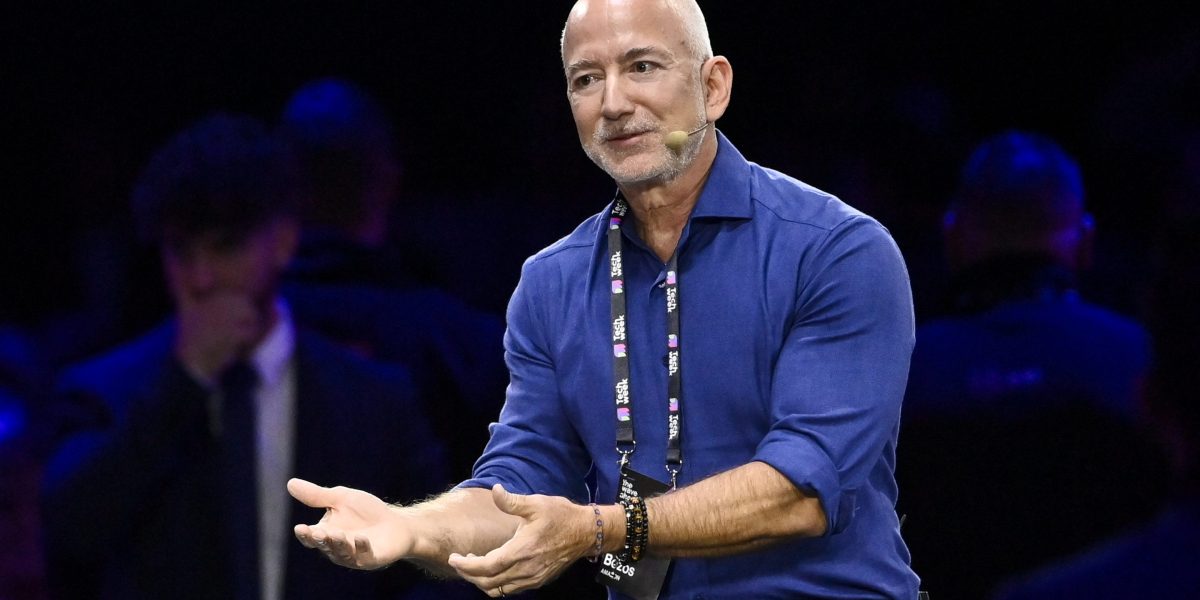
“I always advise to young people: Go work at a best-practices company somewhere where you can learn a lot of basic fundamental things [like] how to hire really well, how to interview, etc.,” Bezos said during an interview at Italian Tech Week last fall. “There’s a lot of stuff you would learn in a great company that will help you, and then there’s still lots of time to start a company after you have absorbed it.”

Working at a company, instead of immediately trying to start one, “increases your odds” of being successful, he added. 

Bezos, now the third-richest person in the world at a $268 billion net worth, founded Amazon when he was 30 years old after about a decade of work experience. Both Gates and Zuckerberg, on the other hand, were just 19 years old when they launched Microsoft and Facebook, respectively. Still, Zuckerberg is the sixth-wealthiest person in the world with a $231 billion net worth, and Gates is the 16th-richest at a $118 billion net worth. 

But Bezos says that “extra 10 years of experience actually improved the odds that Amazon would succeed.” And succeed it did: Today, the online retailer has a whopping $2.64 trillion market cap.

Not only did Bezos have work experience, but he also finished college. He graduated summa cum laude—the highest honors—from Princeton University in 1986 with a bachelor’s degree in engineering. 

He was also elected to honor societies Phi Beta Kappa and Tau Beta Pi, and also served as president of the Princeton chapter of the Students for the Exploration and Development of Space. That academic focus later came to fruition in 2000 with Bezos’s aerospace-tech company Blue Origin, which he’s described as the “most important work” he does. Blue Origin is a private company, so its valuation has never been disclosed, but Bezos has said he thinks it will eventually be bigger than Amazon.

“That would always be my advice: I finished college, and I enjoyed college,” Bezos said. “I think it’s been helpful to me.”

Still, younger generations continue to question the value of a college degree. As the cost of college continues to grow and available jobs for newer grads shrink, many are starting to question the real return on investment for a degree. Even Jim Farley, the CEO of Ford, said during a recent company conference last week, going to college “should be a debate.”

“Nothing in the history of Western civilization has gotten more expensive, more quickly,” added Mike Rowe, a longtime vocational advocate. “Not energy, not food, not real estate, not even health care, [nothing has been inflated more] than the cost of a four-year degree.”

A version of this story was published on Fortune.com on October 6, 2025.

More on entrepreneurship:

Join us at the Fortune Workplace Innovation Summit May 19–20, 2026, in Atlanta. The next era of workplace innovation is here—and the old playbook is being rewritten. At this exclusive, high-energy event, the world’s most innovative leaders will convene to explore how AI, humanity, and strategy converge to redefine, again, the future of work. Register now.


Source link

Continue Reading

Trending

Copyright © Miami Select.