Connect with us

Business

Maduro is now in the U.S. to face criminal charges after deposed Venezuelan leader smiles while escorted by DEA agents

Published

on


Deposed Venezuelan leader Nicolás Maduro arrived in the United States to face criminal charges after being captured in an audacious nighttime military operation that President Donald Trump said would set the U.S. up to “run” the South American country and tap its vast oil reserves to sell to other nations.

Maduro landed late Saturday afternoon at a small airport in New York following the middle-of-the-night operation that extracted him and his wife, Cilia Flores, from their home in a military base in the capital, Caracas — an act that Maduro’s government called “imperialist.” The couple faces U.S. charges of participating in a narco-terrorism conspiracy.

The dramatic action capped an intensive Trump administration pressure campaign on Venezuela’s autocratic leader and months of secret planning, resulting in the most assertive American action to achieve regime change since the 2003 invasion of Iraq. Legal experts raised questions about the lawfulness of the operation, which was done without congressional approval. Venezuela’s vice president, Delcy Rodriguez, meanwhile, demanded that the United States free Maduro and called him the country’s rightful leader as her nation’s high court named her interim president.

Some Venezuelan civilians and members of the military were killed, said Rodríguez, who didn’t give a number. Trump said some U.S. forces were injured, but none was killed.

Speaking to reporters hours after Maduro’s capture, Trump revealed his plans to exploit the leadership void to “fix” the country’s oil infrastructure and sell “large amounts” of oil to other countries.

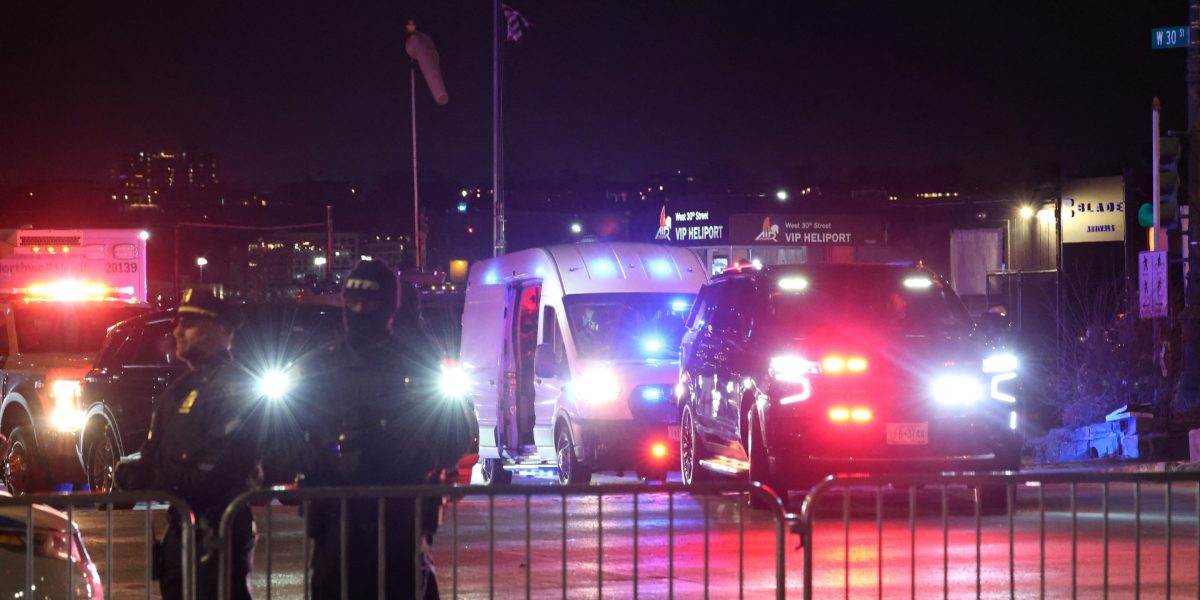
After arriving at a small airport in New York City’s northern suburbs, Maduro was flown by helicopter to Manhattan, where a convoy of law enforcement vehicles, including an armored car, was waiting to whisk him to a nearby U.S. Drug Enforcement Administration office.

A video posted on social media by a White House account showed Maduro, smiling, as he was escorted through that office by two DEA agents grasping his arms.

Trump says US will ‘run the country’

The Trump administration promoted the ouster as a step toward reducing the flow of dangerous drugs into the U.S. The president touted what he saw as other potential benefits, including a leadership stake in the country and greater control of oil.

Trump claimed the U.S. government would help lead the country and was already doing so, though there were no immediate visible signs of that. Venezuelan state TV aired pro-Maduro propaganda and broadcast live images of supporters taking to the streets in Caracas in protest.

“We’re going to run the country until such time as we can do a safe, proper and judicious transition,” Trump said at a Mar-a-Lago news conference. He boasted that this “extremely successful operation should serve as warning to anyone who would threaten American sovereignty or endanger American lives.”

Maduro and other Venezuelan officials were indicted in 2020 on narco-terrorism conspiracy charges, and the Justice Department released a new indictment Saturday of Maduro and his wife that painted his administration as a “corrupt, illegitimate government” fueled by a drug-trafficking operation that flooded the U.S with cocaine. The U.S. government does not recognize Maduro as the country’s leader.

The Trump administration spent months building up American forces in the region and carrying out attacks on boats in the Caribbean Sea and eastern Pacific Ocean for allegedly ferrying drugs. Last week, the CIA was behind a drone strike at a docking area believed to have been used by Venezuelan drug cartels — the first known direct operation on Venezuelan soil since the U.S. campaign began in September.

Early morning attack

Taking place 36 years to the day after the 1990 surrender and seizure of Panama leader Manuel Antonio Noriega following a U.S. invasion, the Venezuela operation unfolded under the cover of darkness early Saturday. Trump said the U.S. turned off “almost all of the lights” in Caracas while forces moved in to extract Maduro and his wife.

Gen. Dan Caine, chairman of the Joint Chiefs of Staff, said U.S. forces had rehearsed their maneuvers for months, learning everything about Maduro — where he was and what he ate, as well as details of his pets and his clothes.

“We think, we develop, we train, we rehearse, we debrief, we rehearse again and again,” Caine said. “Not to get it right, but to ensure we cannot get it wrong.”

Multiple explosions rang out that morning, and low-flying aircraft swept through Caracas. Maduro’s government accused the United States of hitting civilian and military installations, calling it an “imperialist attack” and urging citizens to take to the streets. The explosions — at least seven blasts — sent people rushing into the streets, while others took to social media to report what they saw and heard.

Restrictions imposed by the U.S. government on airspace around Venezuela and the Caribbean expired early Sunday, Transportation Secretary Sean Duffy said on X, an announcement that suggested any further immediate major U.S. military action was unlikely. “Airlines are informed, and will update their schedules quickly,” he posted.

Under Venezuelan law, Rodríguez would take over from Maduro. Rodríguez, however, stressed during a Saturday appearance on state television that she did not plan to assume power, before Venezuela’s high court ordered that she become interim president.

“There is only one president in Venezuela,” Rodriguez said, “and his name is Nicolás Maduro Moros.”

Some streets in Caracas fill up

Venezuela’s ruling party has held power since 1999, when Maduro’s predecessor, Hugo Chávez, took office, promising to uplift poor people and later to implement a self-described socialist revolution.

Maduro took over when Chávez died in 2013. His 2018 reelection was widely considered a sham because the main opposition parties were banned from participating. During the 2024 election, electoral authorities loyal to the ruling party declared him the winner hours after polls closed, but the opposition gathered overwhelming evidence that he lost by a more than 2-to-1 margin.

Venezuela’s capital remained unusually quiet Sunday with few vehicles moving around and convenience stores, gas stations and other businesses closed. A road typically filled with runners, cyclists and other fitness enthusiasts on Sundays only had a handful of people working out the day after Maduro was deposed.

The presidential palace was guarded by armed civilians and members of the military. At a nearby plaza, only a street sweeper and a soldier stood, and across the street, a church remained close for a second day in a row.

Caracas resident David Leal arrived to the lot where he parks vehicles for a living only to quickly realize that he would likely not see any clients for a second day.

“People are still shaken,” Leal, 77, said.

Questions of legality linger

Whether the United States violated any laws, international or otherwise, was still a question early Sunday. “There are a number of international legal concepts which the United States might have broken by capturing Maduro,” said Ilan Katz, an international law analyst.

Pope Leo XIV, who last month had expressed concern about growing U.S. threats of military intervention in Venezuela, raised alarms during his Sunday noon blessing and said the good of the Venezuelan people must prevail above everything else. History’s first U.S. pope demanded an end to violence and for Venezuela’s sovereignty to be guaranteed.

In New York, the U.N. Security Council, acting on an emergency request from Colombia, planned to hold a meeting on U.S. operations in Venezuela on Monday morning.

Lawmakers from both American political parties have raised reservations and flat-out objections to the U.S. attacks on boats suspected of drug smuggling. Congress has not approved an authorization for the use of military force for such operations in the region.

Connecticut Rep. Jim Himes, the top Democrat on the House Intelligence Committee, said he had seen no evidence that would justify Trump striking Venezuela without approval from Congress and demanded an immediate briefing by the administration on “its plan to ensure stability in the region and its legal justification for this decision.”

This story was originally featured on Fortune.com


Source link

Continue Reading

Business

A Supreme Court ruling to undo Trump tariffs would be fastest way to revive job growth, Zandi says

Published

on


Moody’s Analytics chief economist Mark Zandi warned the labor market is stagnating and placed part of the blame on President Donald Trump’s tariffs.

But the Supreme Court, which is due to rule soon on the administration’s global tariffs, could provide relief and help revive job growth, he said in a social media post on Sunday.

That comes after the latest monthly jobs report showed payrolls rose by 50,000 in December, while the unemployment rate edged down to 4.4%. For all of 2025, employers added just 584,000 jobs, a sharp decline from 2 million jobs in 2024 and the weakest year outside of a recession since the early 2000s.

Since Trump shocked global markets with his “Liberation Day” tariffs in April, there has been no job growth, Zandi said, adding that subsequent revisions will likely show net declines.

“This reflects the direct effects of the tariffs on manufacturing, transportation and distribution, and ag-related businesses, which are steadily losing jobs, as well as the indirect uncertainty hit to hiring by most other businesses,” he explained.

Indeed, trade-exposed industries suffered steep losses last year. The manufacturing sector, for example, has hemorrhaged 70,000 jobs since April. Tens of thousands have also been lost in mining and logging as well as warehousing.

Meanwhile, the health care and social services are among the few industries that are hiring steadily. Without those two sectors, the U.S. economy would have seen payrolls drop for the year.

“Other factors are certainly at play, including highly restrictive immigration policies, DOGE cuts, and artificial intelligence; however, the global trade war’s fingerprints are all over the ailing job market,” Zandi added. “Thus, the fastest way to boost the job market would be for the Supreme Court to declare the reciprocal tariffs unlawful and for lawmakers to let them become a thing of the past.”

Justices are expected to hand down a decision any day now on Trump’s ability to impose tariffs under the International Emergency Economic Powers Act (IEEPA).

That law has been used for the bulk of Trump’s trade war, including the so-called reciprocal tariffs and fentanyl-related duties. The administration has also leveraged the IEEPA tariffs to secure trade deals with the European Union, Japan, South Korea and others.

But if the Supreme Court rules against Trump, that won’t put an end to his tariff regime. Other levies are based on separate laws and aren’t under consideration at the high court.

New tariffs could also be imposed outside IEEPA, though those would take longer to roll out with some offering only shorter periods to tax imports.

While administration officials have expressed confidence that they have alternate ways to enact tariffs, Trump may not immediately jump at the chance.

As the affordability crisis has become top of mind for lawmakers, Trump has rolled back some duties on coffee, pasta and other staples, while delaying tariffs on furniture.


Source link

Continue Reading

Business

Elon Musk told X users to upload their medical information to train AI bot Grok

Published

on


In Elon Musk’s world, AI is the new MD. The X owner is encouraging users to upload their medical test results—such as CT and bone scans—to the platform so that Grok, X’s artificial intelligence chatbot, can learn how to interpret them efficiently.

He’s previously said this information will be used to train X’s artificial intelligence chatbot Grok on how to interpret them efficiently.

Earlier this month, Elon Musk reposted a video on X of himself talking about uploading medical data to Grok, saying: “Try it!”

“You can upload your X-rays or MRI images to Grok and it will give you a medical diagnosis,” Musk said in the video, which was uploaded in June. “I have seen cases where it’s actually better than what doctors tell you.

In 2024, Musk said medical images uploaded to Grok would be used to train the bot.

“This is still early stage, but it is already quite accurate and will become extremely good,” Musk wrote on X. “Let us know where Grok gets it right or needs work.”

Musk also claimed in his response Grok saved a man in Norway by diagnosing a problem his doctors failed to notice. The X owner was willing to upload his own medical information to his bot. 

“I did an MRI recently and submitted it to Grok,” Musk said in an episode of the Moonshots with Peter Diamandis podcast released on Tuesday. “None of the doctors nor Grok found anything.”

Musk did not disclose in the podcast why he received an MRI. XAI, which owns X, told Fortune in a statement: “Legacy Media Lies.”

Grok is facing some competition in the AI health space. This week OpenAI launched ChatGPT Health, an experience within the bot feature that allows users to securely connect medical records and wellness apps like MyFitnessPal and Apple Health. The company said it would not train the models using personal medical information.

AI chatbots have become a ubiquitous source of medical information for people. OpenAI reported this week 40 million people seek health information from the model, 55% of which used to bot to look up or better understand symptoms.

Dr. Grok will see you now

So far, Grok’s ability to detect medical abnormalities have been mixed. The AI successfully analyzed blood test results and identified breast cancer, some users claimed. But it also grossly misinterpreted other pieces of information, according to physicians who responded to some of Musk’s about Grok’s ability to interpret medical information. In one instance, Grok mistook a “textbook case” of tuberculosis for a herniated disk or spinal stenosis. In another, the bot mistook a mammogram of a benign breast cyst for an image of testicles.

A May 2025 study found that while all AI models have limitations in processing and predicting medical outcomes, Grok was the most effectively compared to Google’s Gemini and ChatGPT-4o when determining the presence of pathologies in 35,711 slices of brain MRI.

“We know they have the technical capability,” Dr. Laura Heacock, associate professor at the New York University Langone Health Department of Radiology, wrote on X. “Whether or not they want to put in the time, data and [graphics processing units] to include medical imaging is up to them. For now, non-generative AI methods continue to outperform in medical imaging.”

The problems with Dr. Grok

Musk’s lofty goal of training his AI to make medical diagnoses is also a risky one, experts said. While AI has increasingly been used as a means to make complicated science more accessible and create assistive technologies, teaching Grok to use data from a social media platform presents concerns about both Grok’s accuracy and user privacy.

Ryan Tarzy, CEO of health technology firm Avandra Imaging, said in an interview with Fast Company asking users to directly input data, rather than source it from secure databases with de-identified patient data, is Musk’s way of trying to accelerate Grok’s development. Also, the information comes from a limited sample of whoever is willing to upload their images and tests—meaning the AI is not gathering data from sources representative of the broader and more diverse medical landscape.

Medical information shared on social media isn’t bound by the Health Insurance Portability and Accountability Act (HIPAA), the federal law that protects patients’ private information from being shared without their consent. That means there’s less control over where the information goes after a user chooses to share it.

“This approach has myriad risks, including the accidental sharing of patient identities,” Tarzy said. “Personal health information is ‘burned in’ too many images, such as CT scans, and would inevitably be released in this plan.”

The privacy dangers Grok may present aren’t fully known because X may have privacy protections not known by the public, according to Matthew McCoy, assistant professor of medical ethics and health policy at the University of Pennsylvania. He said users share medical information at their own risk.

“As an individual user, would I feel comfortable contributing health data?” he previously told the New York Times. “Absolutely not.”

A version of this story originally published on Fortune.com on Nov. 20, 2024.

More on AI and health:


Source link

Continue Reading

Business

Iran’s $7 monthly payments fail to ease unrest over economic crisis as Trump eyes military options

Published

on


Protests in Iran appeared to intensify over the weekend, representing the biggest challenge to the regime’s rule in years, as President Donald Trump considers ways to respond.

The mounting unrest comes as Tehran’s piecemeal efforts to address an economic crisis have done little to appease Iranians. Since protests began late last month, the government has offered words of sympathy, fired the central bank’s chief, and announced plans to provide most people with a monthly payment of about 1 million Iranian tomans—equivalent to $7.

Instead of spending $10 billion annually to subsidize imports, that money will instead go directly to 80 million Iranians in the form of credit to buy certain goods.

But the $7 monthly payments offer little relief to beleaguered consumers who are suffering from food inflation of 64%. It’s made worse by a 60% crash in the currency’s value since June, when Iran and Israel fought a 12-day war that was capped by the U.S. bombing of Tehran’s nuclear facilities.

Now, what began as a protest among merchants in Tehran’s bazaars has spread to students as well as Iran’s working and middle classes all across the country.

The security forces that keep the regime in power have not escaped hardship either. While human rights groups estimate hundreds have died from the government’s crackdown, Iranians say it’s not as severe as it could be.

“Security and law enforcement people are facing the same economic issues and high prices, themselves,” a protester in Tehran told the New York Times. “They are not fighting back wholeheartedly.”

Meanwhile, Trump has threatened Iran if the regime kills protesters and doubled down on that Friday, when he said the U.S. would “start shooting” if authorities fired on demonstrators.

With the violence worsening, Trump is looking at ways to follow through. Reports said that administration officials have already started discussing options to attack Iran again. On Sunday, sources told the Wall Street Journal that Trump will be briefed on Tuesday with Secretary of State Marco Rubio, Defense Secretary Pete Hegseth and Joint Chiefs Chair Gen. Dan Caine also due to attend.

In addition to military strikes, other options include boosting antigovernment sources online, cyber attacks, and more economic sanctions, the report said.

But the Journal added that the Pentagon hasn’t sent any forces to the region and that the redeployment of the a USS Gerald R. Ford aircraft carrier to South America means there are none in the Middle East or Europe now.

The U.S. raid on Venezuela last week to capture Nicolas Maduro could weigh on military considerations for Iran as a large armada of Navy ships remain in the Caribbean and continue to enforce a “quarantine” on the country’s oil.

But Trump has shown his appetite for more foreign intervention hasn’t abated, even as the reality of a years-long commitment to rebuild Venezuela’s shattered oil industry sets it.

On Sunday, he sent another warning via social media to Cuba, which had benefited from economic assistance when Maduro was in power but is now feeling more strains.

“THERE WILL BE NO MORE OIL OR MONEY GOING TO CUBA – ZERO!” Trump said in a post. “I strongly suggest they make a deal, BEFORE IT IS TOO LATE.”


Source link

Continue Reading

Trending

Copyright © Miami Select.