France’s LVMH reported a 1% rise in third quarter sales on Tuesday, helped by improved demand in China as the luxury goods industry grapples with a prolonged slump.
It was the first quarter of slight growth this year for the world’s largest luxury goods group, which is seen as a sector bellwether with operations spanning fashion, alcohol and retail.
Sales at the fashion and leather goods division, home to flagship brands Louis Vuitton and Dior and accounting for more than two-thirds of profits, were down 2% versus a year earlier.
The trading update beat a Visible Alpha consensus cited by HSBC that had seen flat overall sales and a 4% decline for the fashion and leather division.
Trends in Asia excluding Japan, a market dominated by China, showed “noticeable” improvement nine months into the business year, LVMH said in a statement.
Quarterly sales at the conglomerate controlled by French billionaire Bernard Arnault, which also owns brands such as jeweller Tiffany, Moet & Chandon champagne and beauty retailer Sephora, rose 1% to 18.28 billion euros ($21.17 billion). The decline in the group’s all-important fashion and leather division in the July to September period marked an improvement from the 9% drop posted after the second quarter.
The luxury sector has undergone a prolonged slump since the winding down of the post-pandemic boom. Price hikes, which fuelled profits at labels including Louis Vuitton and Dior in recent years, have weighed on appetite for handbags, especially from less wealthy clients.
Economic factors including US President Donald Trump‘s tariffs, the continuing real estate crisis in China and a recent surge in gold and silver prices, driving up production costs for jewellery, have added to the headwinds.
However, the update from the first major player in the $400-billion luxury industry to report third-quarter sales comes as more investors have turned positive on the sector.
Analysts have released a series of optimistic notes, saying brands’ push for more affordable products and what Morgan Stanley called a “burst of creativity” from new designers at most houses could mean the worst is over. LVMH shares are up 13% since the group’s last trading update on July 24.
The rally lifted LVMH, which briefly lost its crown as France’s most valuable company to rival Hermes this year, back to the top as analysts began seeing positive signs for luxury sales beyond the very high end.
Swiss watch exports fell for a fourth month as companies waited for the US agreement to ease punitive import tariffs to take effect.
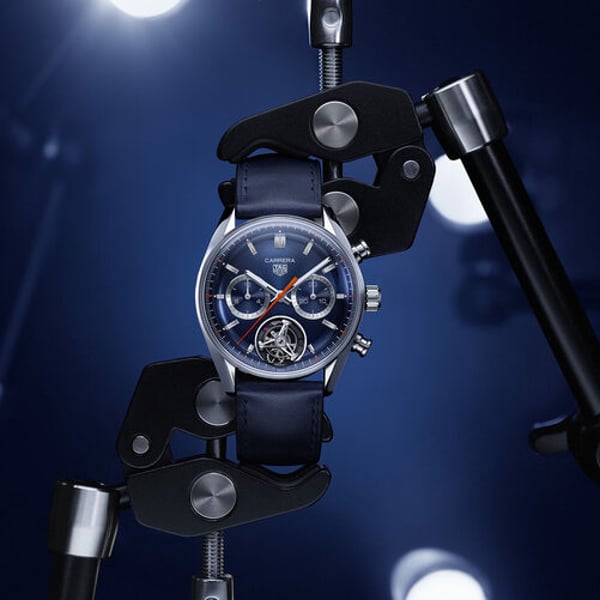
A watch by Tag Heuer – DMR/Tag Heuer
Exports dropped 7.3% in November from a year earlier, the Federation of the Swiss Watch Industry said Thursday, the most since August when President Donald Trump’s administration slapped a 39% levy on Switzerland’s products. Exports to the US, the industry’s biggest market, fell 52% last month.
Manufacturers of watches, machines, and precision instruments were among sectors hit hardest by the US trade tariffs on Switzerland, according to the country’s central bank. A deal to reduce the levy to 15% finally came on November 14, but companies only found out in December that the lower tariffs would be backdated to the day the agreement was announced.
Watch exports are likely to pick up in the coming months as the tariff deal reassures companies, Citigroup analyst Thomas Chauvet said in a note.
Still, Switzerland’s overall exports to the US rose in November, underscoring the challenging backdrop facing the watch sector. The 15% import levy is still higher than the 2% faced by companies before Trump’s trade measures.
Shares of both Richemont and Swatch Group AG slipped in early Zurich trading. Overall, exports were down in almost all price bands, and in every material, the Federation of the Swiss Watch Industry said.
Exports to Japan dropped, while the picture also turned negative in China after two months of growth. That’s dampening hopes for a recovery in luxury demand in the country, especially given its recent slow retail sales growth.
“The luxury watch sector enters 2026 with mixed fundamentals,” Vontobel analyst Jean-Philippe Bertschy said in a note. Asia comparisons will ease, he said, “but the US remains unpredictable, and discretionary spending in Europe is showing fatigue.”
Intimates and swim specialist Bravissimo Limited has filed its accounts for the period to the end of March and they showed much higher sales. However, it’s hard to get a clear picture of just how the company is faring.
Bravissimo
The UK-based company is part of Bravissimo Group Limited, which acts as its holding entity, as well as being the holding company for the US arm of the business.
That parent company was wholly acquired by Wacoal Europe Ltd partway through the period in late September last year. But the firm’s year-end date was changed to 31 March from 31 October at that point, which means the current period is 17 months against 12 months the ‘year’ before.
But with that in mind, its’s still worth looking at the figures for the UK operation.
For the 17 months reported, the company’s revenue was £79.3 million. For the comparison period (the 12 months to the end of October 2023) it was £57.6 million. Gross profit in the latest period was £49 million compared to £36.2 million for the shorter period previously. The gross profit margin for the most recent extra long ‘year’ was 61.8% compared to 6.2% in the previous year. That’s because the elongated period included two autumn seasons and autumn and winter sales typically have lower margins due to fewer swimwear pieces being shifted (swimwear has higher margins).
But the company said that despite the challenging inflationary environment cost were well controlled and the reported operating profit for the 17 months was £1.4 million. Had the firm being reporting its financial year as it did previously, that figure would have been £2.6 million, up from £2.5 million the year before.
Bravissimo also said that it had more active customers at the end of the latest period compared to the previous year and its website traffic was up as well, although retail store footfall dropped slightly. The website conversion rate edged upwards and the retail conversion rate was broadly stable.
In the previous year, the company said it had fully recovered from the effects of the pandemic, but it’s likely that the current year will feature worse results than those just filed.
In June 2025, the company said a warehouse fire meant disruption and delays to supply chains for its online customers. The fire was quickly extinguished, but the disruptions involving having to find temporary storage facilities. The brand stopped accepting orders online or over the phone until the issue was resolved.
It only reported being back online in late September but at least it said the business saw a 70% year-on-year rise in total sales on the day of its relaunch. Lingerie sales alone were up 90% compared to the same day last year.
Pepco’s preliminary results for FY25 showed the European value retail giant turning in a “strong financial performance” as it said “significant strategic execution delivers [a] transformational year”.
Pepco
The results, for the 12 months to the end of September, showed revenue rising 8.7% to €4.5 billion. Like for like (LFL) revenue growth was 2.6% after a 3% fall in the previous year. The gross profit margin rose to 48% from 47% and underlying EBITDA on an IFRS 16 basis was up 10.3% at €865 million. On a pre-IFRS 16 basis it was up 10.6% at €531 million. Underlying profit after tax rose 19.7% to €219 million.
All that came as the sale of Poundland was successfully completed in June 2025, “significantly simplifying the group structure”.
Pepco’s FMCG exit was also completed including the conversion of most Pepco plus stores in Iberia, “generating encouraging results”.
The company also saw an improved performance in Poland and Western Europe in general and the acceleration of its digital journey with a new website, app and loyalty scheme ready for launch in Q1 FY26.
It also said that the Dealz chain is now fully independent and the divestment process is intended to start next year as it explores strategic options for the business.
The big event during the year was the aforementioned sale of Poundland, the UK operation that had been a drain on the wider business in recent periods. With that now divested, it’s clear that the company is able to move forward and it confirmed that FY26 underlying EBITDA is expected to grow at least 9%.
That view is boosted by current trading. In the first financial quarter-to-date (1 October to 13 December 2025), Pepco LFL revenues have risen 3.9% excluding FMCG (LFL of +0.3% including FMCG).
It saw a solid start to the quarter in October but this was partially offset by a weaker November in line with the broader market, before returning to growth in December.
Dealz, as mentioned, is next to be divested but for now it’s dragging down the overall company performance, Pepco saying that this reflects “challenging trading conditions across all categories, particularly in health and beauty”.
Commenting on the results overall, CEO Stephan Borchert said: “2025 was a real turning point… the group has executed at exceptional pace, delivering significant progress in a short timeframe. The decision to refocus on Pepco and exclusively on our core categories of clothing and general merchandise has been validated by these strong results, in particular our gross margin and free cash performance, which were both ahead of expectations.
“We opened 247 net new stores with strengthened store economics and returns on capital for Pepco across our geographies, as we progressed our disciplined opening plans in both Western Europe, and Central and Eastern Europe. The performance of Western Europe has become a clear growth engine, exceeding our initial expectations. It is clear this region is now prepared for future accelerated growth.
“The development of our digital capabilities is progressing as per plan, and we are on track for launch during calendar Q1 2026.”








 Politics8 years ago