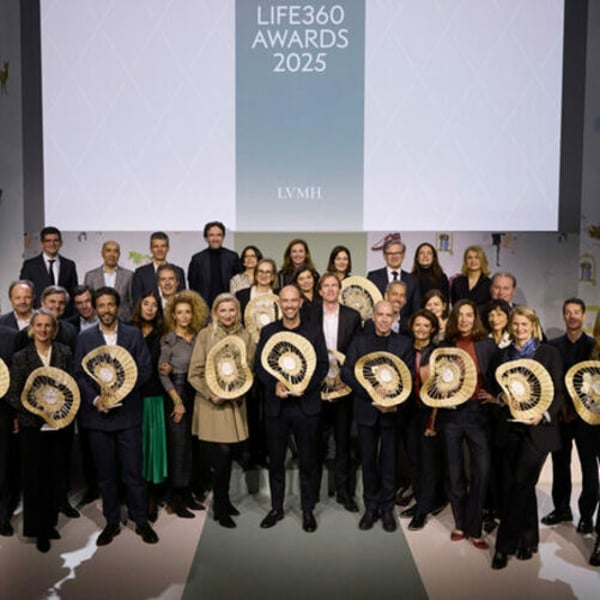
LVMH Moët Hennessy Louis Vuitton presented its first Life 360 Awards to recognise environmental progress in the group, in the same week as it celebrated earning the coveted CDP triple ‘A’ score.
A snapshot of LVMH’s Life 360 Awards – Lucas Barioulet
Held inside LVMH’s global HQ on Paris’ Avenue Montaigne on Wednesday evening, the group presented awards to 13 winning initiatives. These were selected from 187 submitted projects by 41 Maisons in a carefully staged presentation designed to highlight the environmental transformation undertaken by LVMH.
Teams from LVMH brands from several continents joined via video link- from Tiffany in New York and Chandon in Sao Paulo to Loro Piana in Milan and champagne marques gathered in Epernay.
“The Life 360 Awards illustrate how our Maisons are advancing the group’s environmental roadmap. This collective momentum confirms that these issues are at the very heart of our strategy… The winning initiatives point us in a clear direction: a responsible form of luxury, underpinned by concrete and ambitious action,” said Antoine Arnault, image and environment, LVMH, and the driving force behind the project.
Arnault, eldest son of LVMH’s chairman and controlling shareholder Bernard Arnault, in particular celebrated that LVMH had again been recognised with a CDP triple ‘A’ rating for its action on climate, forests, and water.
The giant French luxury behemoth underlined that its Life 360 environmental program (LVMH Initiatives For the Environment), is structured around five pillars: Climate, Biodiversity, Creative Circularity, Traceability & Transparency, and Stakeholders. With the group keen to publicly highlight successful initiatives and results.
All told, it claimed to have achieved a 55% reduction in its direct greenhouse gas emissions, reaching its 2026 target two years ahead of schedule. The preservation and regeneration of more than 3.8 million hectares of natural habitats. An increase to 33% in the share of recycled materials used in products and packaging. And the reduction of around one-third in its indirect emissions.
“The award-winning initiatives reflect the quality of the work carried out collectively around Life 360. They demonstrate tangible progress and create genuine momentum across the group by encouraging the sharing of the most effective solutions between our Maisons and with our supplier partners,” said Hélène Valade, environmental development director, LVMH.
The winning projects were selected by a jury composed of Group executives and experts.
Among the winners, Tiffany & Co. installed significant solar capacity at the Maison’s diamond cutting and polishing facility in Botswana, reducing greenhouse gas emissions, as well as training and hiring local craftspeople for the project.
Moët Hennessy reduced its transport-related carbon footprint, by notably increasing the share of maritime and rail transport. That led, in 2025, to a reduction of nearly 50% in transport-related carbon emissions compared with 2019.
Other awards went to Celine, Louis Vuitton, Rimowa, Chaumet, Christian Dior Couture, and Christian Dior Parfums, the latter for an ambitious strategy aimed at gradually phasing out virgin fossil-based plastics from customer.
While Guerlain played on its historic links to bees in an awareness-raising initiative on the role of these insects, delivered by employees and aimed at primary-school pupils around the world. And, via Women For Bees, a program in partnership with UNESCO enabling women to become beekeepers.
In terms of transparency, Bulgari dreamed up its own Digital Passport, via micro-engraving on each creation, readable via a smartphone scan using Al- revealing gemmological certificates, origin, and craftsmanship.
In addition to these awards, the jury presented a special ‘coup de cœur’ Prize to Moët Hennessy in recognition of its Living Soils, Living Together program, where the Champagne and Wines & Spirits labels work to reduce their environmental footprint.
Among which, Château Galoupet, a Cru Classé Côtes de Provence acquired by LVMH in 2019, has already been certified organic since 2023- deploying a regenerative viticulture approach. Covering crops on 100% of the vineyard, more than 2.6 km of agroforestry hedgerows, regenerative hydrology structures, increased soil organic matter, and the installation of numerous shelters for biodiversity.
If at times, the mood seemed a tad self-congratulatory among LVMH executives, one was also struck by the sense that the Group’s senior management had put real pressure on many brands to come up with genuine environmentally friendly solutions. Which made the whole event a plausible reason for applause and optimism.