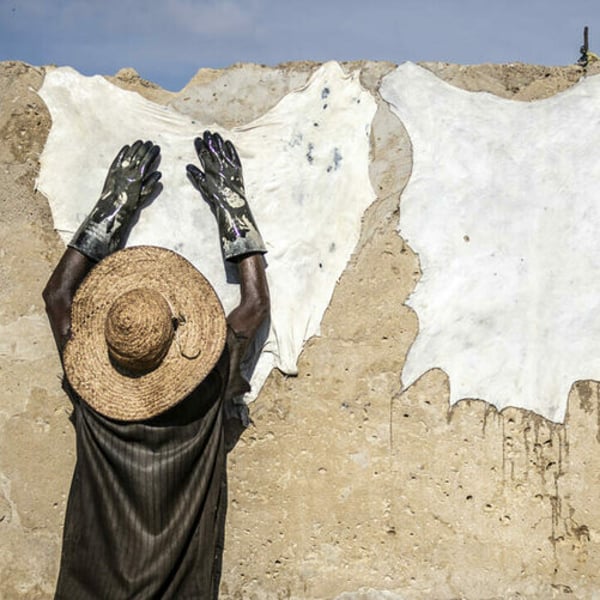
Most Nigerian leather, often semi-finished, is exported to Europe and Asia and turned into luxury items bearing international brand labels, with zero trace of its origins.
However, with her homegrown brand, Isi Omiyi creates high-end pieces aimed at reclaiming Nigeria’s leather identity.
In her apartment in the Lagos metropolis, she has created a boutique corner where bags, wallets and shoes are carefully displayed on shelves — some carrying price tags of up to $1,500.
“Leather is part of our heritage. I can’t just stand by and watch others receive all the credit for work that we started here,” the 56-year-old designer told AFP.
Her mission is to amplify “Made in Nigeria” craftsmanship.
She “would like these foreign brands to indicate on their products: ‘originally from Nigeria’ and ‘made in Italy,’ ‘made in France,’ or elsewhere, because most of them don’t,” Omiyi said.
According to the country’s export promotion agency, Nigeria exports 90% of its leather, primarily to Italy and Spain, which together account for around three-quarters of the total volume.
Leather exports generate about $600 million in annual revenue, said Oluwole Oyekunle, a researcher at the Nigerian Institute of Leather and Science Technology in Samaru, in northern Kaduna state.
Kano, cradle of tanneries
In Kano, a state in northern Nigeria, major international luxury brands source leather through intermediaries, who link them with tanners.
The state counts 11 tanneries.
Ztannery, operational since 2010, takes daily delivery of dozens of fresh goat and sheep hides from across Nigeria and neighboring countries. They are sorted and treated over a period of nine days.
“We process from zero to semi-finished leather, which is 80% of the whole process,” said company owner Abbas Hassan Zein, 47.
Intermediaries ship the hides to Europe, where they undergo further treatment before being sold to luxury brands like “Gucci, Ferragamo, Prada, Louis Vuitton — all the big names,” Zein added.
“And this is where the process goes from ‘Made in Nigeria,’ and the balance 10% of the finished leather is lost and becomes ‘Made in Italy’ or ‘Made in China,’” he added.
Modern tanneries with state-of-the-art machinery, such as Ztannery, only accept large orders paid in dollars or euros, thereby cutting off access for local designers who would prefer to pay in their local currency.
Many turn to the traditional Majema tannery, founded in 1932 in the heart of Kano city.
Here, everything is done manually. Dozens of tanners clean and dye hides directly on the earthen floor amid plastic bags and bottles.
“Our customers come from the north and south, and we also export to neighboring countries such as Niger, Cameroon, Chad, Cotonou (Benin), and Europe,” said tannery manager Mustapha Umar, 52, standing in front of goat hides hanging from wires, waiting to be dyed the next day.
‘Expression of heritage’
In 2017, Femi Olayebi, founder of the Nigerian brand FemiHandbags, created the Lagos Leather Fair — an annual event that brings together approximately 100 leather professionals in Nigeria’s commercial hub.
“There was a need for a platform dedicated to designers, products, and leather suppliers, demonstrating that Nigerians, with their own resources, are capable of creating items that are worth purchasing,” said Olayebi.
Public and private ventures are growing in the sector in Africa’s most populous country.
In Kano, Indian, Chinese, and some European producers — not necessarily from the big-name labels — “have started showing interest in coming here to do the manufacturing,” said Tijjani Sule Garo, of GB Tannery, a family business spanning three generations.
In August, the Lagos state government launched a leather goods factory in the Mushin neighborhood, aiming to create 10,000 jobs. The site is located near one of the country’s largest leather markets.
To compete against global leather industry giants, Olayebi stresses the need for “better machines, better access to high-quality Nigerian leather, and above all, better training.”
For David Lawal, 26, a brand executive at Morin.O, it all boils down to promoting a Nigerian identity.
Many customers seek a “timeless expression of heritage,” narrated through leather products created in Nigeria and crafted by Nigerians, said Lawal.
Not a label, not a lobby, not even a legal entity. That is how Arielle Lévy, president of the Une Autre Mode Est Possible (UAMEP) collective, characterises this nascent union. Animer, an acronym for “Acteurs Nationaux Indépendants Mode Engagée Régénérative,” aims to shine a light on all the initiatives undertaken by fashion stakeholders, from producers to brands, who are advancing responsible, regenerative fashion in France.
The union was founded by eight collectives involved in regenerative fashion – UAMEP
The union was officially launched on Monday January 19, following the petition initiated by Arielle Lévy against Shein in response to the watering down of the anti–fast fashion law. Titled “Paris deserves better than Shein,” the petition drew nearly 140,000 signatures. “I wanted us to unite because I realised how strong the civic voice was,” explains Arielle Lévy. “These collectives are doing superb work and, at a certain point, there is a desire to close ranks, to make society together,” she says.
“Breaking the isolation of initiatives across the regions”
In addition to UAMEP, a number of other collectives are behind Animer, including Fashion Revolution France, L’Âme du Fil (Angers), Collectif Baga (Marseille), Café Flax (Clermont-Ferrand), Le Comptoir de la mode responsable (Poitiers), Le Conservatoire de la Mode Vintage (Isère), and La Grande Collecte/Textile Lab (La Rochelle). “It’s a union of independent collectives, committed to their local areas and sharing the same societal project,” Arielle Lévy emphasises.
The union hopes to represent all French territories – Collectif Baga
The union plans to focus its efforts on the ground, working across supply chains, regions, practices and even our shared imagination. With “hundreds” of stakeholders already on board via the various founding collectives, Animer is built on ten key ideas: dignity, value-sharing, traceability as a common language, less and better, circular design, smart re-localisation, carbon sobriety, inclusion and plurality, cooperation rather than “sterile competition”, and proof through action.
Animer’s founders plan to bring together all the initiatives active in regenerative fashion across the country. The union hopes to become a preferred interlocutor in defending a societal project focused on respect for the earth, and for men and women. With the help of Fashion Revolution, it aims to act in the national interest by engaging the general public and the country’s institutions.
This article is an automatic translation. Click here to read the original article.
French cosmetics giant L’Oreal said on Wednesday it will set up a beauty tech hub in the south Indian city of Hyderabad with an initial investment of over 35 billion rupees ($383.4 million).
L’Oréal
The hub aims to be a global base for AI-driven beauty innovation, create 2,000 tech jobs through 2030, and speed up the rollout of advanced AI beauty solutions, the company said in a statement.
Nicolas Hieronimus, L’Oreal’s CEO, and the state government of Telangana formalized the partnership at the World Economic Forum, Davos.
Telangana has rapidly emerged as a key investment and technology hub in southern India.
Bilateral trade between India and France stood at $15 billion in 2024, and Indian Prime Minister Narendra Modi and French President Emmanuel Macron have been forging warmer ties.
The two sides have also been working to recast their tax treaty since 2024 to modernize it by adapting global standards on tax transparency, Reuters reported in December.
Swarovski on Tuesday announced the appointment of Sindhu Culas to the role of president, general manager, North America at the Austrian jewelry maker.
Sindhu Culas – Courtesy
Based in the luxury firm’s New York City office, Culas will be responsible for “maximizing the Swarovski physical and digital presence and overall brand affinity in the U.S.,” according to a press release.
“We are thrilled to welcome Sindhu to Swarovski. Her vast leadership experience and passion for the brand make her an exceptional addition to our team,” said Kolja Kiofsky, chief commercial officer, Swarovski.
“With Sindhu guiding our next chapter in North America, we are looking ahead to an exciting future filled with creativity, operational excellence, and meaningful growth under our LuxIgnite strategy.”
A retail veteran with over 25 years of experience across omni‑channel retail and institutional investment management, Culas joins the crystal jewelry maker from G-Star, where she served as CEO of North America at the British denim and apparel brand.
She began her career as a buyer and planner at Macy’s, Talbots, and Lord & Taylor before being promoted to strategy and brand management at Macy’s. Later on, the executive served as senior vendor manager at Amazon and as senior vice president of e‑commerce and strategy for Calvin Klein.
“Watching Swarovski’s brand repositioning and momentum in recent years has been inspiring,” said Culas, in response to her new appointment.
“I’m excited to join this exceptional team, collaborate across the business, and help strengthen our position while accelerating growth throughout North America. It’s a remarkable moment for the brand, and I’m thrilled to contribute to the journey ahead.”