Connect with us

Business

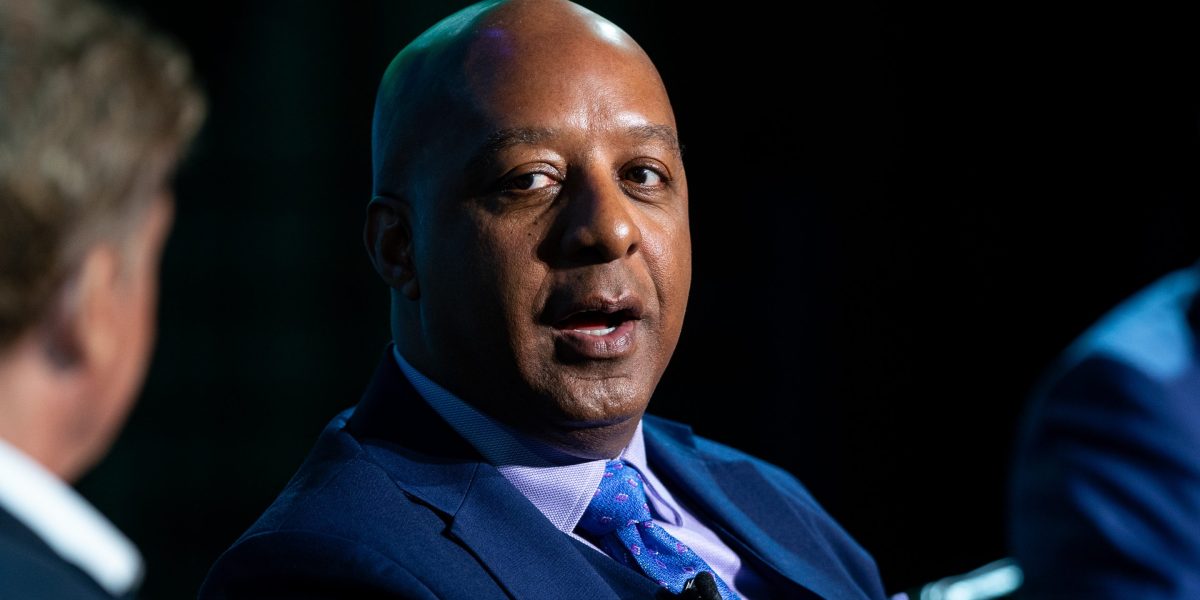
Lowe’s CEO used to make $4.35 an hour working at Target. His secret to climbing the corporate ladder was volunteering for jobs ‘nobody else wanted’

Published

on


Some professionals got their start working in retail—but not nearly as many of those same workers made it all the way to the top of a Fortune 500 company. But Marvin Ellison did. 

Ellison got his start making just $4.35 per hour working part-time at Target while he was in college at the University of Memphis. Now he’s president, CEO, and chairman of Lowe’s, a $127 billion home-improvement giant and one of only eight Black Fortune 500 CEOs. While that’s less than 2% of the entire group, it’s a record-high share of Black CEOs on the list. 

Reflecting on the fact he’s only one of a few Black CEOs on the Fortune 500, Ellison said he has mixed emotions. 

“On one hand, I feel incredibly privileged and blessed to be in this role because it gives me a chance to hopefully be a positive role model and create a pathway for other people who look like me,” Ellison said in a November 2022 interview with Daymond John, a Black entrepreneur most famous for his hip-hop apparel company FUBU and serving as an angel investor on Shark Tank.

“I’m really disappointed that … we still have such a significant gap in the capability that exists out there and the opportunities of individuals that look like me to be in a role like this,” said Ellison, who leads a Fortune 50 company with more than 1,700 stores and 300,000 associates in the U.S., according to Lowe’s

Marvin Ellison’s strategy for defying the odds

Ellison got his start as a part-time employee, but he was “fortunate to land in a company that believed in developing people.” So he “grinded it out for 15 years,” eventually reaching a director-level position at Target before moving into the home-improvement industry. 

But what earned Ellison top leadership roles at both retail and home-improvement companies was his drive to differentiate himself from other candidates. He did this by taking on jobs and assignments that “nobody else wanted,” he said. 

“I didn’t have great pedigree, I didn’t have an Ivy League education. I didn’t have any stellar international opportunities or stints on my résumé,” Ellison said. “I’m competing against all of these exceptionally talented people on paper; I had to find a way to differentiate myself.”

That strategy drove Ellison up the ranks of Target and on to Home Depot, where he spent 12 years in senior-level operations roles. He also served as executive vice president of U.S. stores for the company from 2008 to 2014, “dramatically improving customer service and efficiency across the organization,” according to Lowe’s. The retail chain snagged Ellison after his intermediary stint as chairman and CEO of J.C. Penney. Ellison also earned his MBA from Emory University and serves on the board of directors for FedEx.

Lowe’s ranks No. 52 on the Fortune 500 and appears on Fortune’s lists of America’s Most Innovative Companies and the World’s Most Admired Companies. It shouldn’t come as a surprise, then, Lowe’s is rubbing elbows with Nvidia to develop AI technologies for use in its retail stores. Lowe’s now has more than 50 active AI models used for sourcing logic, inventory planning, and pricing—as well as generally “creating an environment that’s easier to sell, shop, and work.”

“We’re preparing to be at our best when the cycle turns up, and we know that’s going to happen,” Ellison said in a May 2024 CNBC interview. “When it happens, we’re going to take meaningful market share based on the work and investments we’ve put into the business.”

How Ellison is paving a path for other Black executives

Ellison’s approach to diversity, equity, and inclusion initiatives look different from other CEOs. While many executives threw money at the issue or made performative hires in the aftermath of George Floyd’s murder in 2020, Ellison is getting more hands-on. 

“Talk less and do more,” Ellison said. “I just wanted to fix it. We didn’t go out and make some big public announcement. I didn’t do a series of interviews. I didn’t put any white papers out. I just said, ‘We’re gonna fix this by making it a priority.’”

Lowe’s now has a supplier diversity program that helps underrepresented businesses grow and create more jobs, and the company is also a member of several regional supplier diversity councils. But Ellison’s company itself is also prioritizing more diverse hires and professional development. 

They “may not be the conventional candidate based on the background you look at,” but Lowe’s has identified core leadership behaviors that employees train people on, Ellison said. “Now we’re creating this pipeline of talent throughout the organization, not based on what your résumé looks like, but based on your results and your leadership characteristics and what you do every day. That’s a transitional change for us.”

A version of this story appeared on Fortune.com on June 19, 2024.

More on Black CEOs:


Source link

Continue Reading

Business

IWG CEO warns a 4-day week isn’t coming any time soon, despite what Bill Gates and Elon Musk say

Published

on


Billionaire Microsoft cofounder Bill Gates, JPMorgan CEO Jamie Dimon, Nvidia’s boss Jensen Huang, and Elon Musk have all made the same prediction in recent years: The workweek is about to shrink. Automation will take over routine tasks, they argue, freeing workers’ time and pushing a four-day work week toward becoming standard. Gates has even floated the idea of a two-day workweek.

But Mark Dixon, CEO and founder of International Workplace Group (IWG) CEO isn’t buying it. From his vantage point, running the world’s largest flexible office provider—with more than 8 million users across 122 countries and 85% of the Fortune 500 among its customers—the math doesn’t add up.

“Everyone is focused on productivity, so no time soon,” Dixon says flatly.

“It’s about the cost of labor,” Dixon explains to Fortune. The U.S. and U.K. are experiencing significant cost-of-living crises. At the same time, he says, businesses are experiencing a “cost of operating crisis.” 

“Everyone’s having to control their labor costs because all costs have gone up so much, and you can’t get any more money from customers, so therefore you have to get more out of people.”

Essentially, companies can’t afford to pay the same wages for fewer hours, and they can’t pass the difference on to customers. So any time ‘freed’ by automation is far more likely to be filled with new tasks than handed back to workers. 

Elon Musk says work will be optional in the future—but this CEO says AI may create more work, not less

Silicon Valley’s loudest voices frame AI as a route to more leisure. The world’s richest person and the boss of Space X, Tesla and X, Elon Musk has gone as far as predicting work will be completely “optional” and more like a hobby, in as little as 10 years. 

In reality, Dixon suggests that this scenario would only happen if there’s not enough work to go around, rather than bosses suddenly becoming benevolent. But in his eyes, AI will most likely create more—not less—work. 

Every major technological shift, he argues, has followed a similar arc: fear of displacement, followed by an expansion of opportunity.

“AI will speed up companies’ development, so there’ll be more work, it’ll just be different work,” he says.

In 19th-century Britain, Dixon recalls English textile workers protesting against new automated machinery, fearing it threatened their livelihoods, lowered wages, and de-skilled their craft during the Industrial Revolution. They were called Luddites.

“They went around the country smashing up the looms to stop progress. But look, in the end, you’ve heard of the Industrial Revolution. That’s what came from those looms and factory production.” As mass production made goods more available, retail grew; more managers were needed to oversee the machines; the middle class grew, and so on. 

Likewise, there was a similar palpable fear when computers first burst on the scene in the 1980s. The 1996 book Women and Computers detailed people fearing becoming “a slave” to machines and feeling aggressive towards computers.”

But since the explosion of the PC (and then the internet, the Cloud, social media, and so on), most professions have undergone a digital rebrand—instead of disappearing altogether. 

Copywriters now use laptops instead of typewriters; designers rely on Adobe Photoshop instead of pen and paper; and a plethora of IT roles were created along the way. 

“It’s impossible to stop progress,” Dixon concludes.  

“Companies have to do what companies have to do, and it’s really important for young people coming into the marketplace to work a little bit harder on really selecting the right jobs, the right avenue, getting extra skills in things like AI. Whatever job you’re going to do, you’ve got to be good at tech.”


Source link

Continue Reading

Business

Jerome Powell to attend Supreme Court oral argument on Lisa Cook’s attempted firing from Federal Reserve

Published

on


Federal Reserve Chair Jerome Powell will attend the Supreme Court’s oral argument Wednesday in a case involving the attempted firing of Fed governor Lisa Cook, an unusual show of support by the central bank chair.

The high court is considering whether President Donald Trump can fire Cook, as he said he would do in late August, in an unprecedented attempt to remove one of the seven members of the Fed’s governing board. Powell plans to attend the high court’s Wednesday session, according to a person familiar with the matter, who spoke on condition of anonymity.

It’s a much more public show of support than the Fed chair has previously shown Cook. But it follows Powell’s announcement last week that the Trump administration has sent subpoenas to the Fed, threatening an unprecedented criminal indictment of the Fed Chair. Powell — appointed to the position by Trump in 2018 — appears to be casting off last year’s more subdued reponse to Trump’s repeated attacks on the central bank in favor of a more public confrontation.

Powell issued a video statement Jan. 11 condemning the subpoenas as “pretexts” for Trump’s efforts to force him to sharply cut the Fed’s key interest rate. Powell oversaw three rate cuts late last year, lowering the rate to about 3.6%, but Trump has argued it should be as low as 1%, a position few economists support.

The Trump administration has accused Cook of mortgage fraud, an allegation that Cook has denied. No charges have been made against Cook. She sued to keep her job, and the Supreme Court Oct. 1 issued a brief order allowing her to stay on the board while they consider her case.

If Trump succeeds in removing Cook, he could appoint another person to fill her slot, which would give his appointees a majority on the Fed’s board and greater influence over the central bank’s decisions on interest rates and bank regulation.

Join us at the Fortune Workplace Innovation Summit May 19–20, 2026, in Atlanta. The next era of workplace innovation is here—and the old playbook is being rewritten. At this exclusive, high-energy event, the world’s most innovative leaders will convene to explore how AI, humanity, and strategy converge to redefine, again, the future of work. Register now.


Source link

Continue Reading

Business

Down Arrow Button Icon

Published

on


Investors are trying to remain level-headed as tensions between the U.S. and Europe escalate, with many drawing on experience from Liberation Day as a tool for how to navigate current geopolitical volatility.

Analysts are, understandably, uneasy. Their concern stems from President Trump’s claim that a bevy of European nations would face new tariffs within a matter of weeks if they did not support America’s bid to purchase Greenland, currently a territory of NATO member country Denmark, which is not putting the island up for sale.

At the time of writing, the VIX volatility index is up 27% over the past five days, its highest since April last year when the Oval Office announced sweeping tariffs on every nation on the planet. While markets in the U.S. are yet to have the opportunity to react to the news after being closed for the Martin Luther King holiday, assets in Europe are looking pale.

Germany’s DAX is down 1.57% at the time of writing, London’s FTSE is down 1.4% and France’s CAC 40 is down 1.2%. Asia is similarly queasy, Tokyo’s Nikkei 225 is down 1.11% while Hong Kong’s Hang Seng Index is down 0.29%. A preview for U.S. trading comes in the form of futures, with the S&P 500 trending down 1.75% at the time of writing.

Meanwhile, gold prices—a barometer for investors fleeing to safety—are climbing higher still, up 1.17% overnight.

However, the damage could have been worse: investors don’t even need to cast their minds back a year for inspiration. Markets plummeted following Trump’s Rose Garden address on April 2, his so-called Liberation Day, despite the fact many of his threatened tariffs were delayed within a matter of days. And so the ‘TACO’ trade was born: Trump Always Chickens Out.

Jim Reid of Deutsche Bank noted to clients this morning that there’s “room for bigger moves” in markets, and highlighted that Trump’s duties imposition on key trading partners is already on shaky ground. This is on account of an imminent Supreme Court ruling on whether the White House’s initial round of tariffs were carried out legally. This “might end up further constraining Trump’s room for maneuver on tariffs. However, no one knows when this will come through (apart from maybe the judges).”

“The market has been burnt before by overreacting to tariff threats,” Reid continued. “Obviously, there was Liberation Day but more recently Trump’s escalation with China in October prompted a -2.71% decline for the S&P 500 on that day, before he then met with Xi and the trade truce was extended by a year.”

Over at UBS, chief economist Paul Donovan described a rational market: “Investors and the U.S. administration are likely to keep focus on the U.S. bond market, which weakened modestly in the wake of Trump’s latest tariff threats. The implications of additional tariffs are more U.S. inflation pressures and a further erosion of the USD’s status as a reserve currency. So far, bond investors do not seem to be taking the threats too seriously.”

Markets also “dismissed” another barb from Trump aimed at French President Macron, over duties levied on champagne and Bordeaux if the European leader refuses to cough up $1 billion to join the Board of Peace for Gaza.

Unconvinced traders

Further evidence of TACO traders comes from Polymarket. At the time of writing, only 17% of betters believe all the tariffs Trump has threatened against Europe will go into effect on February 1. A further minority of 40% believe any tariffs will go into effect in a fortnight’s time.

Odds are also declining on a country-to-country basis. For example, Denmark leads Polymarket’s polls as the most likely country to face levies from the U.S., but that still sits as the outlying outcome at 40% and decreasing. Meanwhile France’s odds of tariffs are at 38%, and Norway is at 37%.

Potentially buoying the idea that the president will make another U-turn is political polling, especially with midterm elections approaching in November. Trump’s approval ratings have been declining across a number of outlets, with nine in 10 Americans telling a Quinnipiac survey they were against taking Greenland using military force. A further Reuters/Ipsos poll found just 17% of voters support Trump’s efforts to acquire Greenland.

However, if investors—or foreign governments—rely too heavily on the notion that Trump will chicken out, they could shoot themselves in the foot. After all, if the White House sees markets behaving in a fairly stable manner, then this could give him the confidence to push ahead with the very plans that investors were betting against. As Deutsche Bank’s Henry Allen framed Trump’s August 1 tariff deadline last year: “The paradox is that as markets discount the tariffs and perform strongly, that’s actually making the higher tariffs more likely as the administration grows in confidence.”


Source link

Continue Reading

Trending

Copyright © Miami Select.