Connect with us

Fashion

Louis Vuitton unveils architectural and culinary landmark in Beijing
Published

on


Published


January 14, 2026

LVMH is doubling down on China, having opened several major flagships in the country in December. Encouraged by early indicators of a luxury sales rebound, the group is weighing further expansion to capitalise on China’s economic recovery.

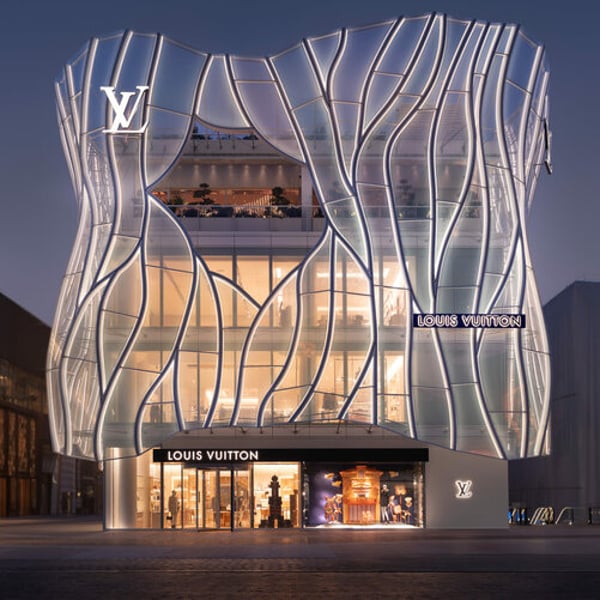
The new Louis Vuitton store’s façade is treated as an elegant, sparkling, and translucent “garment” rather than a mere shell – Louis Vuitton

Following the success of its ship-shaped flagship in Shanghai opened mid-2025, the key LVMH brand has pivoted its strategic focus toward ‘hyper-physical’ immersive retail environments, deep-rooted cultural synergy, and the scaling of high-impact regional flagships. With the opening of its new emblematic building in the vibrant heart of Sanlitun, Beijing, Louis Vuitton has set another global benchmark for luxury retail and architecture. 
 
Architecture and fashion dialogue

As Louis Vuitton’s long-standing architectural partner, Jun Aoki envisioned a space that harmoniously balances local cultural heritage with a sense of global openness. The initial inspiration for the façade was the Taihu Stone, which is central to traditional Chinese garden design. 
 
“Beijing is a city of ‘transplanted’ nature, where the mountain’s spirit lives within the scholar’s rock,” architect Aoki Jun told FashionNetwork.com. “We envisioned this store as a stone found in such a garden, shaped by the four ancient principles of traditional Chinese scholar’s rock appreciation: the slenderness of Shòu(瘦) establishing the store’s upright and poised character; the rhythmic wrinkles of Zhòu(皱)imbuing the walls with a rugged, rock-like texture; the hollowed depth of Lòu(漏)creating intriguing pathways and framed vistas; and the luminous transparency of Tòu(透)ensuring the essential light and openness for a commercial space. It is more than a structure; it is a condensed landscape.”
 
The design also takes its inspiration from a Nicolas Ghesquière dress presented during a Louis Vuitton spring/ summer show in 2016, illustrating the fertile dialogue between architecture and fashion at the maison. The façade is treated as an elegant, sparkling, and translucent “garment” rather than a mere shell.
 
An immersive experience with gastronomy
 
The excellence of the building continues inside, where the retail space extends over four levels. It offers the entirety of the Louis Vuitton universe, including men’s and women’s leather goods, ready-to-wear, jewellery, shoes, perfumes, beauty, accessories, and the new Maison collection. Four private lounges are dedicated to the exclusive experience of Very Important Clients.  

The LV Café embodies the maison's desire to offer guests a complete and immersive lifestyle experience, intertwining design, culture, and gastronomy
The LV Café embodies the maison’s desire to offer guests a complete and immersive lifestyle experience, intertwining design, culture, and gastronomy – Louis Vuitton

The interior architecture, conceived by the maison’s Architecture Studio, focused on sequencing spaces and creating superimposed voids to generate surprising vertical perspectives and total immersion in natural light. The customer’s journey is thus a constant mix of viewing the brand’s extensive product offer and contemplating the façade’s delicate lace.
 
Summiting the building is the very first Louis Vuitton Café in Beijing. This space, set to become a new urban meeting point and a place of openness to the city, is completed with a private dining room and a remarkable 250 square metres of outdoor spaces, including a rooftop event bar. The Café embodies the maison’s desire to offer guests a complete and immersive lifestyle experience, intertwining design, culture, and gastronomy. 
 
Pivot to emotional retail
 
The era of pure acquisition has been superseded by a new focus in modern luxury, according to Bain & Company senior partner Bruno Lannes. He states that intangible experiences and deep emotional connections now hold the primary power to drive growth. As a result, physical retail requires a fundamental transformation: brands must concentrate resources on fewer, grander flagships that serve as sanctuaries for delivering powerful emotion, sensory immersion, and tailored personal engagement, rather than just being points of sale.
 
This philosophy is powerfully manifested in the architecture of Louis Vuitton’s new Beijing building. “Beijing represents a fascinating ‘centrality’- it accepts the world’s influences yet organises them into a logic that is purely its own,” said Aoki Jun. “As brands like Louis Vuitton move toward a holistic lifestyle offering, they must protect the ‘vibration’ of the destinations they inhabit.”
 
Betting on a market resurgence, Louis Vuitton is preparing for a bold new chapter in 2026. This vision was reinforced by LVMH CEO Bernard Arnault’s frequent presence in China in 2025, where he championed a strategy of cultural synergy. By scouting local craftsmanship and integrating Chinese heritage into its design DNA, the brand has transformed its flagships into emotive landscapes that offer more than just products-they offer a deep, immersive connection to the local soul. 
 
Moving beyond its role as a traditional luxury supplier, Louis Vuitton is emerging as a pioneer of a comprehensive lifestyle offering. By weaving its heritage of travel into the realms of dining and cultural dialogue, the brand is embarking on a transformative second chapter in China.
 
By Sissi Chu
 

Copyright © 2026 FashionNetwork.com All rights reserved.


Source link

Continue Reading

Fashion

N Brown promotes Rogers to new COO post

Published

on


Published


January 14, 2026

Fashion and homewares digital retail platform N Brown Group has its first chief operating officer. Natalie Rogers has been promoted to the newly created role “strengthening N Brown’s leadership team as the group enters the next phase of growth driven by operational efficiency and disciplined execution”.

N Brown COO Natalie Rogers

The retailer said the creation of the COO role “brings greater focus and accountability to operational execution across people, technology and supply chain, strengthening end‑to‑end delivery and enabling clearer alignment between strategy and performance”. 

The role will also support “faster decision‑making, improved operational efficiency and consistent execution as the Group continues to evolve its digital and financial services capabilities”, it added.

Rogers joined N Brown in 2024 as chief people and sustainability officer, having led a number of “critical initiatives supporting the group’s business transformation”, including the design and implementation of a new operating model and a multi-year cultural programme.

She was also instrumental in delivering the first “double materiality assessment, ensuring customer expectations and stakeholder insights directly informed sustainability priorities across the group”, it added.

As COO, “Natalie will use her experience of embedding cultural shifts and leading complex change to continue driving forward N Brown’s ongoing business transformation”.

Steve Johnson, executive chair and CEO, added: “Providing the best possible experience for our customers starts with having an efficient, well-aligned and effective business. The creation of the role reflects our focus on end-to-end execution of our transformation strategy. 

“Natalie has a proven track record of delivering large scale organisational change both within N Brown and across other organisations, making her ideally placed to drive forward operational efficiency.”

Copyright © 2026 FashionNetwork.com All rights reserved.


Source link

Continue Reading

Fashion

Retail/consumer goods is UK and Europe’s most distressed corporate sector – report

Published

on


Published


January 14, 2026

It’s tough out there and will probably get tougher. Europe’s retail and consumer goods sector emerged as the most “distressed” in Q4 2025, rising to its highest level since the global financial crisis, according to a new report.

Public domain

And the outlook is “materially fragile moving into 2026”, according to the aptly-named Weil European Distress Index (WEDI).

The quarter saw acute pressure on both liquidity and profitability, citing “weak demand, persistent cost inflation and tighter consumer spending continued to squeeze margins”. 

Looking ahead, distress in the sector is expected to deepen further in 2026, citing “rising input costs – including increases in the UK minimum wage – begin to feed through more fully”. 

Ongoing uncertainty in global supply chains, as trade settlements remain in flux, adds further downside risk, it added.

In all commerce, “liquidity and profitability pressures remain acute and distress is becoming increasingly uneven across sectors and countries”, the report continued. “As a result, corporate distress is expected to rise through 2026, reflecting weaker investment conditions, elevated borrowing costs and continued uncertainty around trade policy and geopolitical risk. This is likely to drive a widening divergence, with pressure intensifying in more exposed sectors and countries while others remain comparatively resilient.”

And while the UK was ranked third behind Germany and France in terms of distress levels in the final quarter of 2025, it has still seen “elevated pressure across liquidity, profitability and risk metrics, amid subdued business confidence and cautious investment”.

Adding to the bleak outlook, Neil Devaney, partner and co-head of Weil’s London Restructuring practice, said:“Distress remains persistent and increasingly uneven, driven by pressure on liquidity and investment. That divergence is most pronounced in Retail and Consumer Goods, which is set to be the most challenged sector in 2026.

“The sector is becoming more polarised, with smaller and mid-sized retailers under the greatest strain, while businesses with stronger balance sheets and established omnichannel models prove more resilient. In the UK, recent Budget measures – including higher National Insurance and Minimum Wage costs – are set to add further pressure into 2026. With growth expected to offer little relief over the coming years, these pressures are unlikely to ease quickly.”

Copyright © 2026 FashionNetwork.com All rights reserved.


Source link

Continue Reading

Fashion

British customer engagement specialist SaleCycle buys French conversion expert Beyable

Published

on


Translated by

Nicola Mira

Published


January 14, 2026

On January 13, British customer engagement and cart reactivation specialist SaleCycle bought Beyable, a French company whose solutions for customer experience personalisation and site visit conversion will merge into a unique platform following the acquisition.

Salecycle

The platform, covering all stages of the conversion funnel, is designed to address the challenges faced by brands in transforming site visits into purchases. An element that has become especially strategic given rising customer acquisition costs for e-tailers, now more than ever keen on monetising site traffic.

“By combining identity resolution tools… and onsite personalisation, we are creating a platform that will smartly help brand engage with and convert each visitor,” said Fabien Sanchez, CEO of SaleCycle.

In practice, SaleCycle’s identification and multi-channel re-engagement solutions (via email, SMS, WhatsApp etc) will be boosted by the behavioural scoring and personalisation technologies developed by Beyable since 2014. The two companies’ complementary solutions target becoming a relevant alternative to those offered by US tech giants.

The acquisition will also help Beyable, which includes names like APC, Sisley and Saint-Gobain among its clients, to expand internationally. “Joining forces with SaleCycle enables us to extend our vision into a global dimension,” said Julien Dugaret, CEO of Beyable. Dugaret founded the company with Florian Papillon, Saidi Mohamed and Julien Delhomme.

The value of the transaction has not been disclosed. The newly created group has a portfolio of some 300 brands in the retail, travel and luxury sectors, among them Balenciaga, Breitling, Lacoste, Adolfo Dominguez and L’Occitane.

Copyright © 2026 FashionNetwork.com All rights reserved.


Source link

Continue Reading

Trending

Copyright © Miami Select.