Connect with us

Fashion

Lisbon Fashion Week dates confirmed for March

Published

on


Published


January 8, 2026

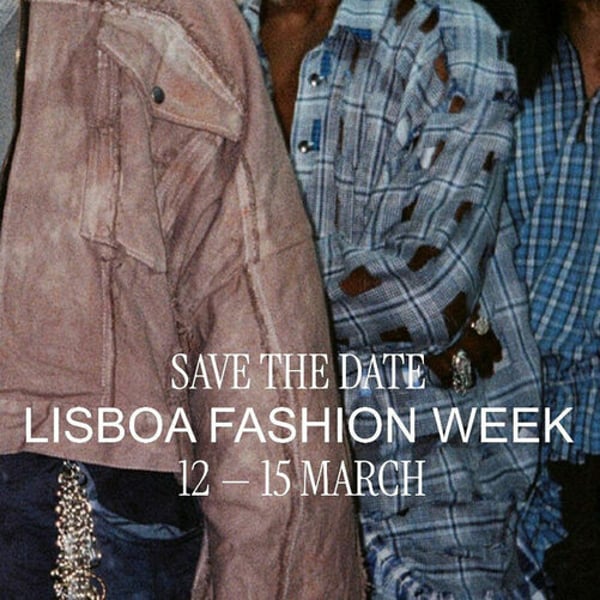
The ModaLisboa Association, the organisation behind Lisbon’s catwalk shows, has just announced the dates for the next edition of Lisboa Fashion Week (LFW), which returns to the Portuguese capital from March 12 to 15.

ModaLisboa

This will be the 66th edition of the event, which takes over the entire city, radiating out from Pátio da Galé, where most of the runway shows are held, to various strategic locations across Lisbon connected to fashion, the arts and the city’s multicultural fabric—Lisbon was cosmopolitan long before the Kingdom of Portugal was founded.

The industry awaits the next theme and the full programme, with dates and times for the initiatives that include the runway shows, talks, performances and more, which, as usual, should reach newsrooms within the next few days.

Until then, ModaLisboa simply said: “Mark your diaries, book your flights, start the countdown. @lisboafashionweek is back,” stated the invitation on its social media channels, namely Instagram.

This article is an automatic translation.
Click here to read the original article.

Copyright © 2026 FashionNetwork.com All rights reserved.


Source link

Continue Reading

Fashion

As natural resources dwindle, luxury fashion must pursue sustainability says Square Management study

Published

on


Published


January 11, 2026

Long defined by rarity, artisanal excellence, and desirability, the luxury sector now faces an unprecedented equation: how can it continue to create value without further increasing pressure on natural and social resources? This is the question addressed by the report “Business models for sustainable luxury,” published by the consultancy Square Management, which offers an in-depth analysis of the transformation of luxury business models through the lens of planetary boundaries.

Repair is one of the pillars of sustainable fashion – Shutterstock

The study’s first finding is that luxury occupies a strategic position in the ecological transition. With global sales of 364 billion euros in 2024 and considerable symbolic weight, it wields significant influence across the creative industries as a whole. Yet this influence plays out against a backdrop of multiple pressures: the growing scarcity of raw materials (gold, leather, cashmere); tighter regulation (the CSRD directive, the AGEC law, the Green Deal); the increasing integration of ESG criteria into financial valuation; evolving consumer expectations; and shifting cultural norms around consumption.

A strategy to be implemented globally

In the face of these shifts, the study shows that marginal adjustments are no longer enough and urges the luxury sector to undertake a profound transformation of its business models. To frame this reconfiguration, the report draws on the circular economy’s “9Rs” framework, which ranks sustainability strategies from the least to the most transformative, from recycling to calling into question overproduction.

The study highlights a wide variety of models already in play. The least ambitious strategies focus on waste-to-energy (Recover) or the recycling of raw materials (Recycle), with examples including Guerlain‘s refillable bottles and Prada‘s Re-Nylon line. More structurally significant are upcycling approaches (Repurpose, Remanufacture, Refurbish), which turn unsold items and dormant stock into creations with high symbolic value: Balenciaga, Jean Paul Gaultier, Coach, and Jeanne Friot exemplify this blend of circularity, creativity, and storytelling.

Reducing production and buying less: two key ideas for sustainability

Repair is a crucial lever. By extending product lifespans, it avoids the most emissions-intensive stages of the life cycle. Maisons such as Hermès, Chanel, and Cartier have made it a pillar of their client relationships, while platforms such as Tilli are helping to structure this practice at scale. Re-use and rental are also fast-growing markets, driven by younger generations: 65% of luxury consumers say they are interested in buying second-hand, according to the “True-Luxury Global Consumer Insights” report (BCG-Altagamma, 2023), a figure that is rising steadily.

When it comes to sustainability, the luxury industry must embrace its leadership role by fundamentally transforming the way it operates.
When it comes to sustainability, the luxury industry must embrace its leadership role by fundamentally transforming the way it operates. – Shutterstock

The most transformative models are those aimed at reducing production itself, namely Reduce, Refuse (superfluous purchases), and Rethink. On-demand manufacturing, pre-orders or limited production, as practised by Gabriela Hearst or MaisonCléo, help limit unsold stock while reinforcing exclusivity. Some houses go further still, committing to regenerative models: Kering invests in regenerative agriculture, while Chloé embeds social and environmental impact at the heart of every product as a mission-driven company. However, the report emphasises that these transformations face major obstacles.

The limits of the “do less harm” philosophy

Internally, many obstacles are cited to the introduction of circular models: complex logistics, high costs, cognitive resistance, and a cultural attachment to ownership. To overcome these, the study’s authors identify several key factors, including enhanced traceability (notably via blockchain), co-opetition between players to pool costs and, above all, the ability to reframe sustainable luxury symbolically, not as a renunciation, but as a new form of prestige.

The study also highlights a strategic shift: luxury can no longer settle for “doing less harm.” It is now expected to create positive, measurable, and shared value that is compatible with planetary boundaries. A transformation that profoundly redefines the very notion of desirability.

This article is an automatic translation.
Click here to read the original article.
Copyright © 2026 FashionNetwork.com All rights reserved.


Source link

Continue Reading

Fashion

Aritzia surpasses $1 billion in revenue as brand demand surges

Published

on


Published


January 11, 2026

Canadian fashion retailer Aritzia announced on Thursday a 42.8% increase in net revenue for the third quarter ended November 30, driven by strong demand across all channels and all geographies. 

Aritzia surpasses $1 billion in Q3 revenue as brand demand surges. – Aritzia

Aritzia posted net revenue of $1.04 billion, marking the highest quarterly revenue in the company’s history. Comparable sales increased 34.3 percent, with double-digit growth across retail and e-commerce and in both Canada and the United States. 

By region, in the United States, net revenue increased 53.8% to $621.1 million, compared to $403.7 million in Q3 2025. Net revenue in Canada increased 29.0% to $419.2 million, compared to $325.0 million in Q3 2025.

Retail revenue rose 35.1 percent to $657.3 million, while e-commerce revenue surged 58.2 percent to $383.0 million. Over the past 12 months, Aritzia opened 13 new boutiques and repositioned four, bringing its total global store count to 139.

Net income rose 87.5 percent to $138.9 million, while adjusted net income per diluted share climbed 54.9 percent to $1.10.

“Our performance was fueled by unparalleled demand for our everyday luxury offering. This was driven by our digital initiatives, which included the launch of our app, our new boutique openings and our strategic marketing investments. Our impressive growth in the United States continued as net revenue increased 54%, highlighting our expanding awareness and the tremendous momentum of the Aritzia brand,” said Jennifer Wong, chief executive officer.

Momentum has continued into the fourth quarter, according to Wong, who cited strong holiday demand for the Winter assortment and effective execution across Aritzia’s three growth pillars: geographic expansion, digital growth and increased brand awareness.

Looking ahead, Aritzia expects fourth-quarter net revenue between $1.10 billion and $1.125 billion, representing growth of 23 to 26 percent. For the full fiscal year, the company forecasts net revenue of $3.615 billion to $3.64 billion, up approximately 33 percent from fiscal 2025.

Copyright © 2026 FashionNetwork.com All rights reserved.


Source link

Continue Reading

Fashion

Millie Bobby Brown launches teen fashion brand with Walmart

Published

on


Published


January 11, 2026

Actress Millie Bobby Brown has launched Mills by Millie Bobby Brown, a new fashion brand for teens and young women created exclusively for Walmart in collaboration with Delta Galil USA.

Millie Bobby Brown launches teen fashion brand with Walmart. – Millie Bobby Brown

Serving as founder and creative guide, Bobby Brown drew inspiration from her own early experiences with fashion, positioning the brand as exciting, attainable, and inclusive.

“Mills is all about embracing those earlier moments of fashion exploration. I want everyone to feel comfortable and free to find what style makes them feel like the best version of themselves,” said Bobby Brown.

“This collection is made for the fashion curious girl to play in, experiment with, and make their own with a fun selection of colorways, graphics and special details. It was very important to me for this brand to be accessible to millions through our collaboration with Walmart!”

The debut collection spans ready-to-wear, sleepwear and intimates, featuring flirty cuts and playful, cheeky details. Feminine touches such as floral appliqués, embroidery and lace finishes are woven throughout the assortment, while practical design elements, including built-in shorts and bras, prioritize comfort and ease.

The assortment includes dresses, skirts, tops, denim, sleepwear, bralettes, briefs and coordinated intimates sets. Pricing is positioned to be highly accessible, starting at $10.50 for intimates and reaching $26.50 for wide-leg jeans.

“Walmart is on a journey to democratize fashion and Mills by Millie Bobby Brown delivers on the trend-right style and aesthetic our customers are looking for at the incredible prices that Walmart is known for,” said Ryan Waymire, senior vice president fashion, Walmart U.S. 

“Mills by Millie Bobby Brown is an exciting new brand that stands for style and quality and offers tremendous value that only Walmart can. We are excited for the launch, and we know that our customers are going to love it.”

Mills by Millie Bobby Brown is Bobby Brown’s latest brand expansion following the success of Florence by Mills Beauty, Florence by Mills Coffee, Florence by Mills Pets and Florence by Mills Fashion.

It is available now on Walmart.com and in approximately 750 Walmart stores nationwide. The partnership was facilitated by Bobby Brown’s licensing agency, IMG Licensing.

Copyright © 2026 FashionNetwork.com All rights reserved.


Source link

Continue Reading

Trending

Copyright © Miami Select.