
Fashion
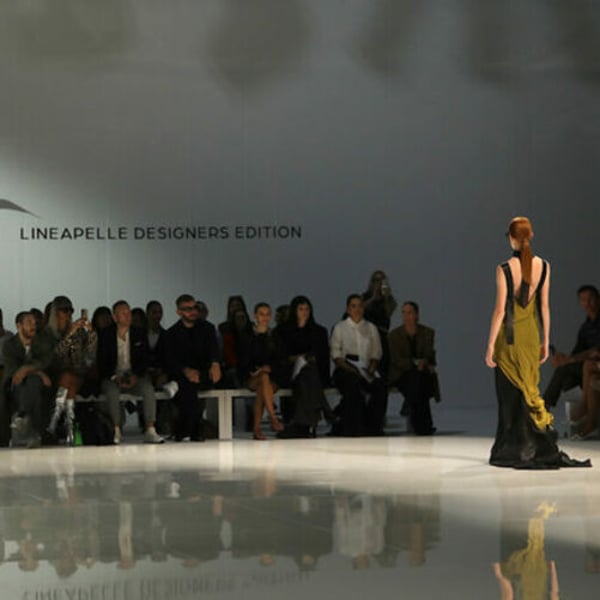
Lineapelle’s eighth Designers Edition unites 17 creatives in Milan

Translated by
Nazia BIBI KEENOO
Published
September 10, 2025
Lineapelle is gearing up for its 106th edition, which will take place from September 23 to 25 at the Fiera Milano Rho exhibition spaces, featuring 1,150 exhibitors from 37 countries. Meanwhile, the show presented today in Milan the eighth edition of its Designers Edition project, which aims to promote the image and excellence of Italian leather through the collections of creatives from around the world.
From September 23 to 29, in conjunction with Women’s Fashion Week, the event will support 17 designers and brands, who will bring fashion shows, installations, and artistic contaminations to life. For this edition, the event moves the fashion shows from the Rho exhibition center to the heart of Milan, in Piazza Giuseppe Tomasi di Lampedusa, next to Spazio Lineapelle. The nine fashion shows, organized inside a tensile-structure greenhouse called the “Leather Fashion Hub,” will feature 1972 Desa, Agg Anton Giulio Grande, Alberto Zambelli, Chronos Corps, Leonardovalentini | Laboratorio Riciclo Pelle, Lorenzo Seghezzi, Maragno, Marco Rambaldi, and Mastewal. Meanwhile, Spazio Lineapelle will host presentations by the brands Absent Findings, Amato Daniele, Biagini, Dienèe, DOYS, Dúběn, PabePabe, and TVL | TheVerticaline.
“It is very important for us to support young creatives. We have been doing this since 1984, and in a more structured manner since 2020, with the opening of our dedicated space and the “About Leather” exhibition. Since its inception, the Designers Edition project has hosted over 50 fashion shows and presentations, attracting more than 9,000 guests. We also take the creativity of young Italian designers abroad, with our events in London, New York, Tokyo, and China,” explained Fulvia Bacchi, Lineapelle CEO and general manager of UNIC – Italian Tanneries. “In addition, we support both students and managers in the industry with leather training courses: between 2024 and 2025 we held 270, with the participation of more than 7,000 people. We collaborate with 75 institutes in Italy and 30 abroad, and we are in the process of forming agreements with several universities in Japan and Korea. Soon we will open a Lineapelle Space in Korea, a kind of ‘materials library’ for students.”

UNIC – Italian Tanneries and Lineapelle also collaborate with numerous organizations, including Camera Moda Fashion Trust. Its co-founder and co-CEO, Umberta Gnutti Beretta, who spoke at the conference, explained, “In addition to an annual donation, Lineapelle has decided to support the young people followed by the Fashion Trust also with training courses, providing them with the materials to work on and helping them economically in producing their creations. We share a belief: that young people are truly the engine and hope of the industry.”
Additionally, Lineapelle has established the LP Fashion Studio space at its headquarters, located at Via Brisa 3 in Milan. The space constantly hosts hundreds of students—both Italian and international—and organizes lessons and visits for academies, fashion schools, professional training institutes, and delegations (both domestic and foreign). LP Fashion Studio offers, with its 20,000 samples including leathers and accessories, an international overview of past and future trends, representing a unique resource in the world for all designers and researchers in the leather sector.
“A key message we want to convey with all these initiatives is that leather, unlike what the uninitiated think, is a sustainable material, as it is derived from slaughterhouse waste that would otherwise have to be disposed of. It is also sustainable because it lasts a long time,” Bacchi concludes. “Italian tanneries are recognized for the excellence of their products, which meet all the circularity and sustainability requirements demanded by designer labels, who are in fact buying our tanneries to ensure the best. Italy accounts for 70 percent of Europe’s leather production and 25 percent of the world’s leather production. By promoting the creation of leather clothing and accessories, we are promoting Made in Italy and our country’s economy.”
This article is an automatic translation.
Click here to read the original article.
Copyright © 2025 FashionNetwork.com All rights reserved.



Published
December 10, 2025
From safeguarding intellectual property to securing their own use of artificial intelligence, the fashion industry is still finding its feet with AI. Unsurprisingly, the topic took centre stage at the Assises Juridiques de la Mode, du Luxe et du Design, held in Paris on December 9 and organised by Lexposia.
“In 2024, we submitted 2.5 million reports of counterfeit content to platforms,” explained Nicolas Lambert, LVMH’s director of online brand protection. “That’s nothing new, but AI has made it increasingly easy to generate infringing content. At the moment, for example, we’re seeing a proliferation of online ads for counterfeit Advent calendars from Sephora, Dior and other group brands.”
Alexandre Menais, general counsel for the L’Oréal group, was also on hand to bear witness to this acceleration. In his view, the growing presence of this new technology calls for fresh thinking about interactions between the company and the machine, and in particular how those interactions are used.
“With an intelligent agent, the question arises of who owns that interaction,” stressed the legal expert. “One of the risks I see is that the rules companies set, which mandate the use of closed AI, will be widely flouted. Many employees will be tempted to test AI outside the established framework.”
Christiane Féral-Schuhl, a lawyer specialising in this field, identified this risk as well. For the former bar chair and former president of the Conseil National des Barreaux, it is urgent to raise employees’ awareness of the differences between a closed AI, trained on creations and data for which rights‑holders have given their consent, and an open AI system. The latter dispenses with rights‑holders’ consent by relying on the “text and data mining” (TDM) exception.

“These AIs are ogres that swallow up all this ‘training data’, and to counter this you can build your own AI system, using protected data within a controlled framework. If an employee prefers to use an open system, they feed the machine and, in effect, share their work and creations with others — including their competitors — who may exploit it to produce infringing works.”
Féral-Schuhl also emphasised the questions to be asked of AI tool suppliers. Some stipulate in their terms that a customer’s work may be used to improve the service for all customers — which, in a creative context, should obviously be prohibited.
Frédéric Rose runs IMKI, which designs bespoke generative AI for brands such as The Kooples and G-Star. The specialist notes that AI is becoming more sophisticated. “It will soon be able to draft patterns and technical execution files,” he estimates. “It’s already getting more and more precise, and is becoming capable of specifying materials, fabric weights (grammage) or stitching types.”
This level of detail now makes it possible to spot counterfeits — for rights‑holders and consumers alike.
“Some AIs have safeguards and refuse to respond, but others give you suggestions on where to find the best dupes,” said Lambert. “Between the AI and the customer, it’s a private channel that I can’t investigate. But maybe tomorrow AI will be able to identify suspicious behaviour. Perhaps we need to imagine, as with YouTube, a DMCA‑style mechanism (a rights‑holder takedown mechanism, editor’s note) preventing an AI from pointing users to a counterfeit product.”
“And if AI is exploited for creative purposes, we also need to define red lists of iconic elements, specific signatures, which could lead a creation to resemble that of an established brand,” said Féral-Schuhl.
She also points to the emergence of “watermarking” (or digital tattooing) of data used to train AI, which could in time be subject to copyright protection and prevent its use in AI agents’ creative processes. This comes on top of “information tagging” that records the date and place of AI‑generated creations.
The vice‑president of French unicorn Mirakl, which develops marketplaces for major retailers, Hugo Weber, for his part, spoke about the contribution AI could make to already highly efficient algorithms.
“Amazon Prime is not a logistics issue: if you’re delivered the next day, it’s because in 95% of cases your purchase was already in shipping, because the algorithm is very efficient,” summarised the specialist.
He also cautioned against turning the Shein case into a trial of marketplaces, pointing out that European, American and Chinese players all have different notions of responsibility.
The Shein case was also raised by Benoît Loutrel, chair of the online platforms working group at ARCOM (Autorité de Régulation de la Communication Audiovisuelle et Numérique).
“We’re moving from preventive action by regulators to enforcement action by the courts. I think that the next stage will involve civil law, particularly in the case of artificial intelligence,” said the specialist.
Faced with the rise of ARCOM equivalents in other European countries, he hopes to see French digital sovereignty anchored within the broader European Union framework now taking shape.
This article is an automatic translation.
Click here to read the original article.
Copyright © 2025 FashionNetwork.com All rights reserved.


Gwen Stefani and Blake Shelton Shop Together Amid Divorce Rumors

UK retail tycoon Mike Ashley uses Frasers shares as collateral for loan

Gelien Perez, Willy Marrero win runoffs for Hialeah City Council
-

 Politics8 years ago
Congress rolls out ‘Better Deal,’ new economic agenda
-
Entertainment8 years ago
New Season 8 Walking Dead trailer flashes forward in time
-
Politics8 years ago
Poll: Virginia governor’s race in dead heat
-
Entertainment8 years ago
The final 6 ‘Game of Thrones’ episodes might feel like a full season
-
Entertainment8 years ago
Meet Superman’s grandfather in new trailer for Krypton
-
Politics8 years ago
Illinois’ financial crisis could bring the state to a halt
-
Business8 years ago
6 Stunning new co-working spaces around the globe
-
Tech8 years ago
Hulu hires Google marketing veteran Kelly Campbell as CMO