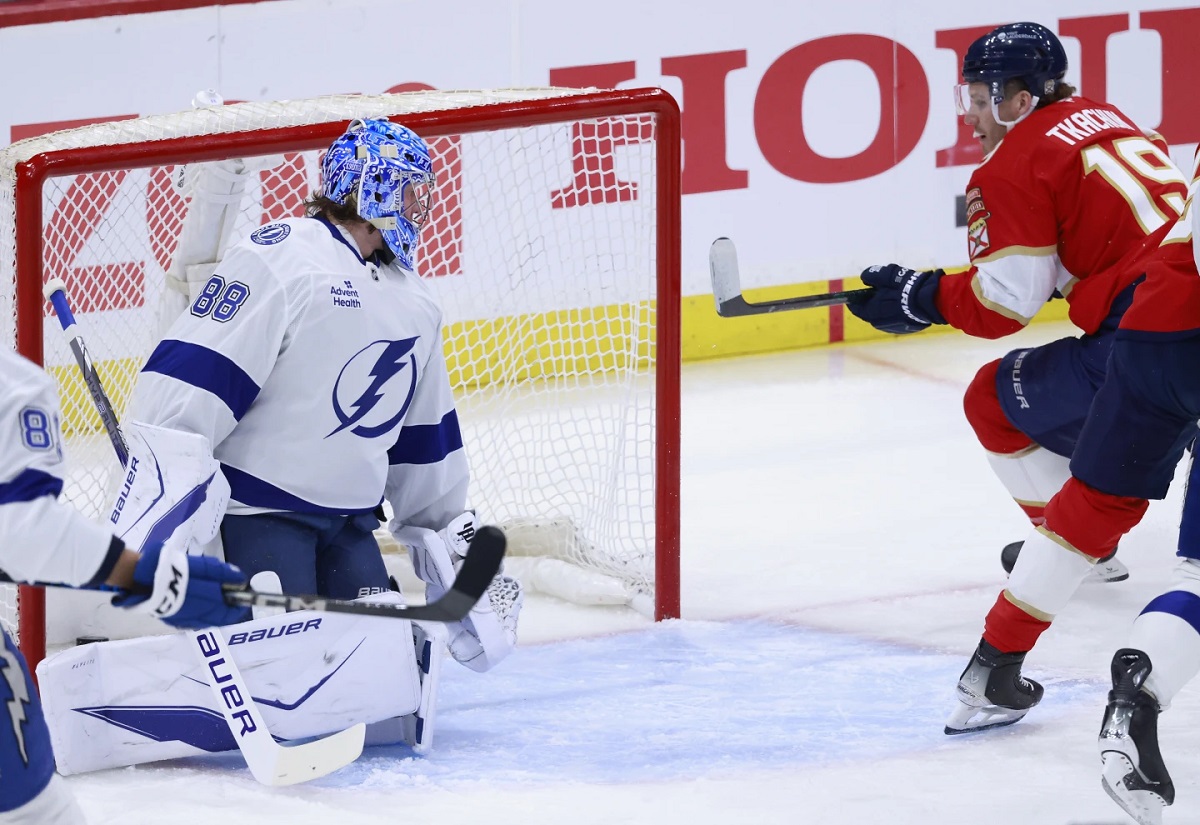
Florida Panthers left wing Matthew Tkachuk (19) scores against Tampa Bay Lightning goaltender Andrei Vasilevskiy (88) during the first period in Game 3 of an NHL hockey Stanley Cup first-round playoff series, Saturday, April 26, 2025, in Sunrise, Fla. (AP Photo/Rhona Wise)
Three weeks left in the regular season and the Tampa Bay Lightning are exactly where you’d expect them to be—near the top of the NHL.com Super 16, firmly in the Stanley Cup conversation, and still very much a problem for the rest of the league.
But this week’s rankings also shine a bright, uncomfortable light on the one thing that could derail another deep run: the puck going in Tampa Bay’s net far too often.
NHL.com slotted the Lightning fifth in its March 26 Super 16, behind Colorado, Dallas, Buffalo and Carolina. That’s respect for a team that has lived in the contender tier for a decade. It’s also a warning label for what has to change between now and Game 1.
The numbers that should worry Tampa Bay
Before the Olympic break, Tampa Bay looked like a classic Lightning team: fast, structured, and stingy. They were allowing 2.51 goals per game and just 26.7 shots on goal—numbers that scream “cup-caliber.”
Since the league came back from the break, those numbers have flipped in the wrong direction:
Goals against: 3.67 per game in 15 games
Shots against: 29.1 per game
That’s not a small wobble. That’s a full-on trend.
You don’t have to be a numbers nerd to see the impact. Buffalo has surged past Tampa Bay in the Atlantic, and the Sabres’ rise is one of the big storylines in this week’s Super 16. While Buffalo is being praised for its momentum, Tampa Bay is being questioned for something that used to be a strength—team defense.
Vasilevskiy’s dip: symptom or cause?
When the Lightning struggle defensively, the conversation always circles back to Andrei Vasilevskiy. He’s been the safety net, the cheat code, the reason Tampa Bay could survive mistakes and still win playoff series.
Through the first three-quarters of the season, NHL.com had Vasilevskiy as its Vezina Trophy pick. In 37 games before the break, he posted a .920 save percentage, exactly the kind of elite goaltending that has defined his career.
Since the Olympic break?
Save percentage: .896 in 12 games
That’s not disastrous, but it’s not Vasilevskiy. The question—fair or not—is whether this is about him, or about what’s happening in front of him.
Is the structure off? Are the Lightning giving up more high-danger looks? Are the minutes and mileage finally catching up with a goalie who has carried a massive workload for years?
The truth is probably a mix of all three. But with the playoffs looming, the “why” matters less than the “what now?”
Structure, buy-in, and the playoff clock
The Lightning have reinvented themselves more than once during this run. They’ve gone from track-meet skill to heavy, layered, playoff-style hockey. They’ve lost stars, replaced key depth, and still found ways to stay relevant every spring.
That’s why this defensive slide feels more like a test than a verdict.
Tampa Bay doesn’t need to become a trap team. They don’t need to win every game 2–1. But they do need to get back to:
Cleaner exits: Fewer turnovers in their own zone that turn into extended shifts and tired legs.
Net-front control: Clearing second and third chances so Vasilevskiy isn’t facing multiple looks on the same sequence.
Discipline: Limiting penalties that put pressure on the penalty kill and tilt momentum.
The Lightning have the personnel to do it. The question is whether they can tighten up quickly enough with the schedule shrinking and the standings tightening.
Buffalo’s rise raises the stakes in the Atlantic
The Super 16 isn’t just a snapshot of where teams are—it’s a reminder of who’s coming.
Buffalo sits third in the rankings and has already jumped Tampa Bay for first in the Atlantic. The Sabres haven’t been to the playoffs since 2011, but they’ve been the hottest team in the league for months and they’re playing like a group that doesn’t know it’s supposed to be nervous.
For Tampa Bay, that changes the equation:
Home-ice advantage in the first round is no longer a given.
A potential Lightning–Sabres series suddenly looks like a coin flip instead of a mismatch.
Every defensive lapse now has a direct impact on seeding, matchups, and the path back to the Final.
The Lightning have been the hunted for years. Now, at least in the division, they’re the ones doing some chasing.
Why Tampa Bay is still dangerous
Here’s the part that should comfort Lightning fans in Tampa Bay and across Florida: even with the defensive issues, this team is still fifth in the Super 16 for a reason.
The core is intact. Nikita Kucherov, Brayden Point, Victor Hedman, Steven Stamkos—this group has seen every kind of playoff series and found ways to win them.
The offense can still overwhelm. When Tampa Bay gets rolling, they can erase mistakes with three goals in ten minutes.
Vasilevskiy’s ceiling hasn’t changed. If he finds his rhythm again, the entire conversation flips overnight.
The Super 16 isn’t saying the Lightning are broken. It’s saying they’re vulnerable in a way we’re not used to seeing—and that the margin for error is thinner than it’s been in years.
The bottom line for Tampa Bay
From a Tampa Bay lens, this week’s Super 16 is less about where the Lightning are ranked and more about what they’re being asked.
Can they clean up their defensive game in time? Can Vasilevskiy’s numbers bounce back to the level that has defined his career? Can they hold off Buffalo’s charge—or at least be ready for a first-round fight that feels more like a conference final?
The answers will define not just this season, but how long this championship window stays open.
For now, the Lightning are still in the top five, still feared, still relevant.
But the clock is ticking, and for a team that has built its legacy on getting it right when it matters most, the next three weeks might be as important as any stretch of hockey they’ve played in years.