Connect with us

Business

‘Let’s not be naive’: Ray Dalio warns the global rule-based order is already ‘gone,’ toppled by America’s debt crisis and raw power

Published

on


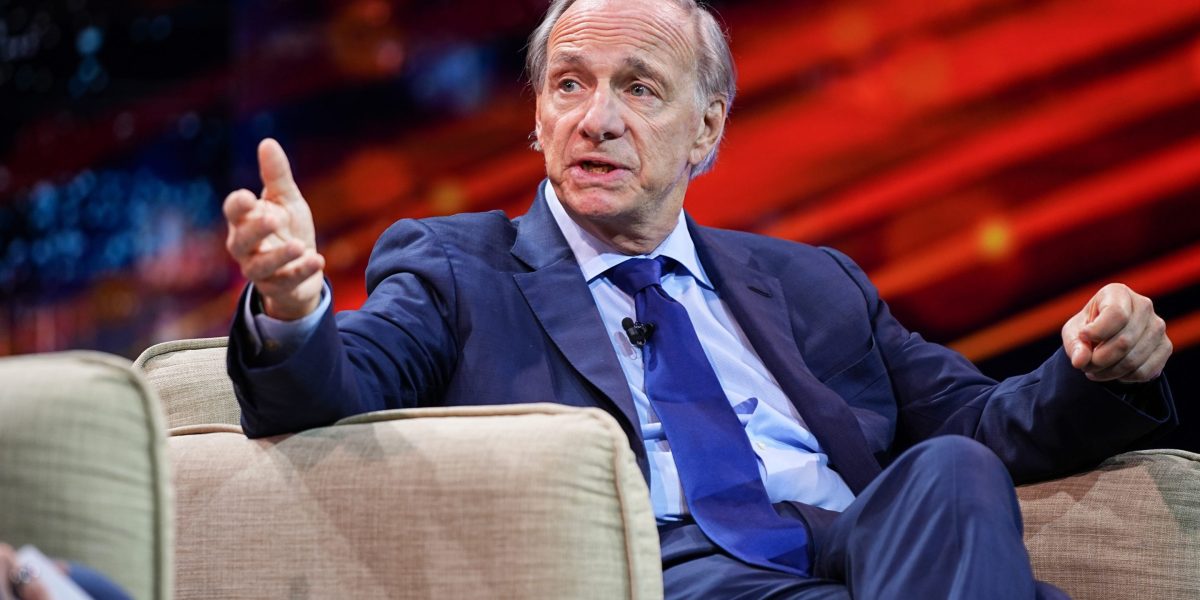
Bridgewater Associates founder Ray Dalio, speaking to Fortune‘s Kamal Ahmed at the World Economic Forum in Davos, Switzerland, issued a stark warning to global leaders and business executives: Stop pretending the old rules still apply. In a candid assessment of the current geopolitical landscape, Dalio argued the fate of the post-World War II global order—much debated amid President Donald Trump’s pursuit of Greenland and unsettling of the NATO alliance—is a moot point.

“Let’s not be naive and say, ‘Oh, we’re breaking the rule-based system,’” Dalio said. “It’s gone.”

The billionaire founder of the largest hedge fund in history added that as a student of financial history, he pays close attention to the economic cycles of the last 500 years and sees cycles repeat themselves over time.

“And what I learned through that exercise is the same thing happens over and over again,” he said. “And it’s like a movie for me. It’s like watching the same movie happen.”

According to Dalio, five specific forces interact to drive the movie plot forward, with the “money-debt cycle” serving as the MacGuffin that kicks things off. The roots of the current instability, Dalio explained, lie in the monetary decisions made during the past several decades. Since 1971, when the U.S. under President Richard Nixon broke the dollar’s link to gold, Dalio notes, governments have consistently chosen to “print money” rather than allow debt crises to naturally play out. This behavior occurs when debt-service payments rise faster than incomes, squeezing spending. After more than half a century of this, he argued, repeating a consistent warning in his public remarks on the subject, the world is now witnessing a “breakdown of the monetary order,” evidenced by central banks altering their reserves and buying gold.

The previous day, Dalio had said in an appearance on CNBC’s “Squawk Box,” from the sidelines of the annual meeting in Davos, fiat currencies and debt as a storehouse of wealth were “not being held by central banks in the same way” anymore. He pointed to a decoupling in which the U.S. markets have underperformed foreign markets in specific metrics, a trend visible in the changing balance sheets of global central banks.

The core of Dalio’s concern lies in the transition from trade disputes to what he terms “capital wars.” He alluded to how U.S. Treasury bonds were the bedrock of global reserves for decades, but now, Dalio said the sheer supply of debt being produced by the U.S. is colliding with a shrinking global appetite to hold it.

“There’s a supply-demand issue,” Dalio noted, adding “you can’t ignore the possibility that … maybe there’s not the same inclination to buy U.S. debt.”

This reluctance is driven by geopolitical friction. According to Dalio, in times of international conflict, “even allies do not want to hold each other’s debt,” preferring instead to move capital into hard currencies. This shift forces the issuer of the debt to monetize it, a phenomenon Dalio summarized bluntly: “We’re increasingly buying our own money. That’s… the lesson of all this.”

As Dalio was speaking on Monday, markets weathered a global selloff as they digested the revelation that President Donald Trump was demanding U.S. possession of Greenland in revenge for not getting the Nobel Peace Prize in 2025. He had texted the Prime Minister of Norway Jonas Gahr Støre in anger about this, according to confirmed reports over the weekend, even though the Nobel Prize committee is separately operated from the government of Norway. But Dalio’s Tuesday remarks came amid calmer markets, as Trump reiterated his request for Greenland but clarified he would not authorize use of force to acquire it.

This economic instability feeds directly into the collapse of political norms, Dalio told Fortune on Wednesday. He argued the multilateral world order established in 1945—characterized by institutions such as the United Nations and the World Trade Organization—was arguably a “naive system” from the start, as it relied on representation without guaranteed enforcement.

“What happens when the leading power doesn’t want to abide by the vote?” Dalio asked. “Do you really expect that there’s going to be a United Nations vote or a World Court that’s going to resolve these things?”

The result, he argued, is a definitive shift from a multilateral system to a unilateral one. Dalio posited the central question of our time has become: “Who makes the rules, who enforces the rules, and how are you going to deal with that?”

Perhaps the most chilling aspect of Dalio’s analysis is the erosion of legal authority in favor of brute force. “Power matters more” than the law, he told Fortune, noting conflicts are increasingly decided by who controls the military, the police, and the National Guard. This trend is visible not only internationally but within nations, where democracy is threatened by populism and a growing belief the system is corrupt.

When asked if this rupture should strike fear into corporate boards and CEOs who have long relied on stable global rules, Dalio responded ignoring the truth is far more dangerous.

“I think what always scares me is the lack of realism,” he said.

Dalio advised leaders to stop relying on a dissolving rule-based system and instead focus on “jurisdiction questions,” seeking out places where people are “like-minded” and mutually supportive. Whether dealing with international boundaries or domestic regulations, Dalio insists businesses must now face the hard reality the era of assured legal protection is ending.

“Will law prevail?” Dalio asked. “Internationally, everybody is having to deal with that question.”

As confidence in institutions, the law itself, and fiat-denominated debt erodes, Dalio highlighted to CNBC the quiet but significant resurgence of gold. He emphasized gold should not be viewed merely as a speculative asset but as “the second-largest reserve currency” in the world. He noted in the previous year, gold was the “biggest market to move,” and it performed far better than tech stocks as central banks diversified their holdings. JPMorgan CEO Jamie Dimon had similar remarks in an interview with Fortune at the Most Powerful Women conference in October, when he said for the first time in his life, it had become “semi-rational” to have gold in your portfolio.

However, Dalio’s outlook was not entirely defensive. He said he sees the current era as a bifurcation between the decaying monetary order and a “wonderful technological revolution,” echoing Trump’s remarks onstage earlier that day about the “economic miracle” taking place. In that regard, at least, might may end up making right.

This story was originally featured on Fortune.com


Source link

Continue Reading

Business

Down Arrow Button Icon

Published

on


Nestled in the heart of Bangkok’s Chinatown, the Ong Ang Canal served as a vital trade artery in the 18th century. Over time, it became heavily polluted, and even earned a reputation as the city’s dirtiest canal.

Last month, as part of a broader government effort to revitalize the canal, Siam Cement Group (SCG), Thailand’s oldest cement firm, unveiled the country’s first 3D-printed pedestrian bridge across its waters. 

The bridge is part of SCG’s drive to bring new construction materials to Southeast Asia, Surachai Nimlaor, who helms its operations in cement and green solutions, tells Fortune in a Jan. 20 interview. 

The company first started applying 3D printing tech to construction in the early 2020s, including the 2023 construction of the world’s first 3D printed medical center in Saraburi, Thailand. 

“When we use 3D printing, we can shorten construction time and create buildings with unique shapes that conventional builders may not be able to achieve,” says Nimlaor.

The process involves creating a digital model, slicing it for the 3D printer, and then allowing the printer’s robotic arms to set down concrete, layer-by-layer, to form structures. By removing the need for traditional molds or formwork, it enables freeform architecture which includes sculptural curves and undulating walls. SCG’s 3D printed medical center, for instance, has fluid facades that would be difficult to execute with conventional cast concrete.

Courtesy of Siam Cement Group

This technology could be especially valuable for Thailand, where an aging population and a workforce wary of construction jobs is shrinking the sector’s pool of available workers. Nimlaor explains that the industry has been forced to turn to foreign workers from neighboring countries like Cambodia and Myanmar. (According to 2025 data from Cambodia’s Ministry of Labour and Vocational Training, there are over 1.2 million Cambodian workers in Thailand, many of whom are employed in construction.)

Still, 3D printed buildings are often only one or two storeys tall, Nimlaor admits, as taller buildings introduce “material constraints around structural loads and stability.”

Thailand’s first cement firm

SCG was founded in 1913 to build Bangkok’s first cement plant, under the orders of then-King Rama VI. In the century that followed, the company expanded to focus on three core businesses: cement and building materials, chemicals, and packaging.

Today, SCG is Thailand’s largest building materials company, with a 2024 revenue of $14.5 billion. It ranks No. 21 in Fortune’s Southeast Asia 500 list, which sorts the region’s largest companies by revenue. SCG has also expanded to other parts of Southeast Asia, including packaging businesses in Malaysia and a petrochemical plant in Vietnam.

Greening the construction industry

Beyond 3D printing, SCG is also developing low-carbon cement, tackling an industry that accounts for roughly 8% of global carbon emissions, according to the World Economic Forum.

SCG is trying to formulate cement produced using biomass, like wood. This cuts the carbon emissions from the production process by as much as 20% per ton, Nimlaor claims. SCG now exports its low-carbon cement to the U.S. and Australia, where developers now prefer materials that meet ESG standards. 

“ESG has become a very strong driver in the global market,” he explains. “Many companies now have clear carbon-reduction targets and sustainability commitments.” 

SCG hopes to launch the third-generation of its low-carbon cement, which would cut carbon emissions from production by up to 40%, but Nimlaor has hopes that they can eventually cut emissions by up to 90%. 

Looking forward, SCG hopes to continue pushing the boundaries in creating greener construction materials. “Sustainability and business growth must go together,” he concludes.


Source link

Continue Reading

Business

Fortune Article | Fortune

Published

on


Bitcoin is one of the world’s most battle-tested pieces of software. Launched in early 2009, the network has run continuously without being hacked, and today feels more secure than ever. There is, however, a threat on the medium-term horizon that threatens not only Bitcoin but every other type of software that relies on current encryption technology. That threat is quantum computing and, on Wednesday, Coinbase announced it has created a board of outside experts to prepare for its eventual arrival.

The board includes academics from Stanford, Harvard, and the University of California with specialties in fields like computer science, cryptography and fintech. Formally known as the Coinbase Independent Advisory Board on Quantum Computing and Blockchain, it is also composed of experts in blockchain and security from the Ethereum Foundation, the DeFi platform EigenLayer and from Coinbase itself.

In an interview with Fortune, Coinbase Chief Information Security Officer Jeff Lunglhofer explained how the arrival of quantum computing could defeat current encryption mechanisms, including the ones employed to protect the wallets and private keys held by Bitcoin owners.

“In simple terms, modern cryptography relies on hard math problems that would take thousands of years for a modern computer to solve,” he said. “But when we have a million times the horsepower [with quantum computing], that will provide the computation power to solve them.”

While the security threat of quantum computing is real, it is unlikely to be an urgent issue for at least a decade, according to Lunglhofer. His view is consistent with other experts who note that, while companies like Google and IBM have been building quantum computers for years, the current generation of these machines can only operate at a small scale and are not close to being able to crack the algorithms that protect Bitcoin and other networks.

The purpose of the new Advisory Board, says Lunglhofer, is to explore the coming impact of quantum computing in a “non-hype based way.” This will include promoting efforts by the blockchain industry, which are already underway, to update Bitcoin and other networks so that they are resistant to quantum-based attacks.

Currently, the Bitcoin network secures wallets by means of private keys, which are long strings of random numbers and letters that are visible to their owners, but that can only be guessed by means of an impossibly long series of trial-and-error attempts. When the quantum computing era arrives, it will be possible to guess a private key using trial-and-error. In response, Lunglhofer says, blockchain experts anticipate that Bitcoin and other networks will respond by creating larger keys and, at the same time, introducing “noise” to make the location of the key harder to detect in the first place.

All of this will require blockchain networks to introduce and deploy these defensive upgrades, a process that is likely to take years. In the interim, the new Advisory Board will begin publishing research papers and issuing position statements to help the crypto industry prepare for the arrival of quantum computing. The group plans to publish its first paper, which will focus on quantum’s impact on the consensus and transaction layers of blockchain, in the next month or two.

“Quantum computing is both a technological opportunity and a security challenge. By bringing together the foremost experts in the world, Coinbase is ensuring that the blockchain ecosystem is prepared, not just reactive,” said Yehuda Lindell, Head of Cryptography at Coinbase, in a statement.


Source link

Continue Reading

Business

The Walmart C-suite reshuffle shows how the retailer sees itself now: as a tech company

Published

on


When Walmart last week announced that David Guggina, its U.S. e-commerce chief executive, would become CEO of its nearly $500 billion U.S. division, one thing stood out in his résumé: Unlike his predecessors, Guggina has no experience running stores and has never held a merchandising role, at Walmart or elsewhere. These are two classic job requirements in retail. Incoming Walmart CEO John Furner, for example, who has run U.S. operations since 2019, began his Walmart career as an hourly associate in 1993, and held roles in merchandising, operations, and sourcing.

But there’s another realm of experience that Guggina does have in spades: e-commerce, automation, and supply chain. And by putting him atop the division that generates 69% of company revenue, Walmart is signaling that it now sees itself as a tech company, as well as a retailer. Guggina has spent eight years at Walmart, after nine years at arch-rival Amazon.com. In its announcement, Walmart touted Guggina’s work in building delivery capabilities to serve 95% of U.S. households in under three hours, and said his appointment “positions him to continue to drive our goal of being America’s favorite place to shop.”

In the last decade, after years of fits and starts, Walmart has emerged as a formidable e-commerce player, with U.S. digital sales of almost $100 billion a year—still far behind Amazon, but well ahead of any other U.S. retailer. In its most recent quarter, Walmart’s U.S. e-commerce rose 27%. That has been the result of billions in investments to integrate Walmart’s 4,600 stores with its e-commerce operations. This work has helped ensure faster shipping while also integrating technology more effectively into things like inventory management, supply chain, and in-store customer service. Guggina was instrumental in those achievements, working under Furner, who will become Walmart Inc’s new CEO next week.

“This is a unique moment in retail,” Guggina said in a LinkedIn post about his appointment. “AI is changing how people shop, and customer expectations are higher than ever. But no one is more prepared to usher in the next era of retail.”

The timing of Guggina’s promotion was fitting: It came soon after Walmart moved its shares from the New York Stock Exchange to the Nasdaq exchange, where tech giants such as Amazon, Google, and Microsoft list their shares. In December, Walmart said the move underscores its “technology-forward approach.” 

Guggina isn’t the only techy whose star is rising at Walmart. The company also appointed Seth Dallaire chief growth officer for Walmart U.S., charging him with pushing Walmart U.S. further beyond traditional retail into tech-heavy lines of business—including its booming advertising, media, and online marketplace ventures. Dallaire is a veteran of Instacart and Amazon.

Walmart is considered by analysts to be well ahead of other retailers in AI-assisted shopping. In October, it announced a partnership with OpenAI to allow shoppers to browse and buy Walmart products directly inside ChatGPT, using a built-in instant checkout feature. Last week, Walmart and Google announced their own shopping tool. Also last week, Walmart’s executive vice president for AI acceleration, product and design, Daniel Danker, suggested at a conference that the company was developing auto-ordering for the replenishment of staples.

Bolstering Walmart’s tech and AI aura has had the additional benefit of lifting the company’s stock: In the last year, Walmart shares have risen 27%, double the S&P 500’s growth and trouncing Amazon’s 1% increase.

This story was originally featured on Fortune.com


Source link
Continue Reading

Trending

Copyright © Miami Select.