Connect with us

Politics

Leonardo Helicopters facility opens in the Panhandle with aim to boost aerospace industry

Published

on


‘Our state has built an environment where aerospace activities are not just welcomed, but accelerated.’

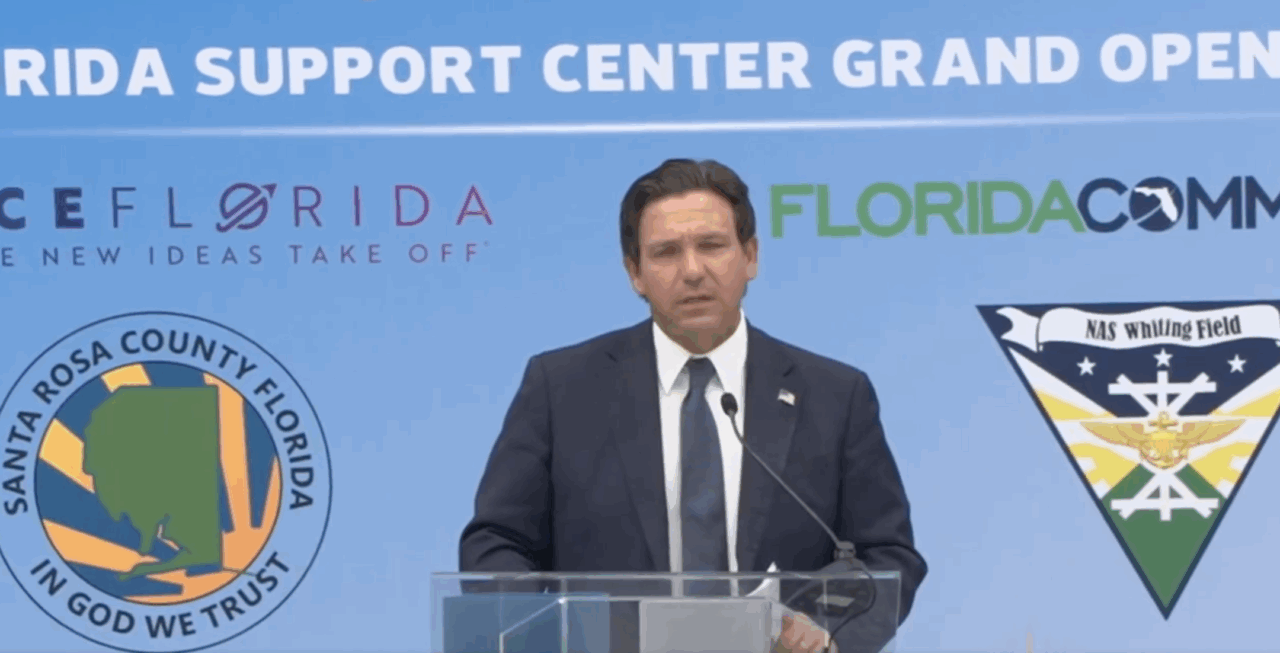
State and business leaders are celebrating the opening of a Leonardo Helicopters facility in Santa Rosa County that will give the region an economic boost with 150 high-paying jobs, they said.

Gov. Ron DeSantis, Leonardo Helicopters CEO Clyde Woltman and others spoke during a press conference at the ribbon-cutting for the company’s new Florida Support Center.

The 113,000-square-foot center in Milton is adjacent to the Naval Air Station Whiting Field and will support the Navy’s TH-73A training fleet.

“This project and as example what can be achieved when private industry and national defense come together with purpose and precision,” Woltman said. “From military readiness to civil and emergency response missions, we are both meeting the operational requirements of our partners and shaping the future of vertical flight.”

The company described how it will use the facility for aftermarket support for Leonardo’s aircraft facility. “The new facility will provide major component repair and overhaul, transmission testing and repair along with new tooling, a full-sized paint booth, and a spacious warehouse for spare parts,” the company said earlier in a press release.

Robert Long, President and CEO of Space Florida, called the facility an important milestone made possible with partnerships.

“Our state has built an environment where aerospace activities are not just welcomed, but accelerated,” Long said. “It’s no surprise that a global leader like Leonardo chose to base these activities right here in the hotbed of military aviation — Northwest Florida.”

DeSantis, who traveled with Leonardo on a trade mission to Italy last year, said the new center will help grow Northwest Florida’s economy.

“We’ve very bullish on this project,” DeSantis said. “We know it’s going to be 150 high-wage jobs, but I think you’re going to continue to see the manufacturing base and the industrial base in this part of the state continue to grow.”


Post Views: 0


Source link

Continue Reading

Politics

Bedrock, we have a problem

Published

on


William Mattox.

A funny thing happened in the Legislature last week. While the House was holding an “AI Week” to talk about all sorts of futuristic possibilities straight out of “The Jetsons,” the Senate Appropriations Committee passed a school choice “glitch bill” that seems better suited for the Stone Age of “The Flintstones.”

To its credit, the Senate wants to address a problem that has arisen in Florida’s highly popular school choice programs — namely, tracking students as they move from one mode of education to another during the school year.

Thankfully, such mid-year movements don’t occur very often. But when they do, they can throw a wrench in things because Florida’s public school computers don’t talk with our state’s scholarship program computers.

Thus, when a mid-year schooling change takes place — due to a family emergency, a bullying situation or some other reason — there’s a chance a student could end up being counted twice (once by each system).

Now, the seemingly obvious solution to this “double counting” problem would be to fix the computers and create a single point of entry for every Florida K-12 student to be registered in the state. Then, as students move from one mode of schooling to another, it would be easy to track them (and to ensure that the dollars for their education follow them wherever they go).

The Senate “glitch bill” sponsor acknowledges this. But instead of getting the techies involved, he wants Florida parents to start filing paperwork — every month! — confirming that their child is still in the scholarship program and wishes to remain there. And get this — if parents slip up and miss a deadline, their child would not receive any education funding for that month.

Bedrock, we have a problem.

Now, maybe someone in the Stone Age would find it reasonable to require parents to submit monthly attestations that they are still doing what they did last month. And maybe in the town of Bedrock it would seem fair to tell taxpayers that they can’t have any of the dollars they’ve paid into the K-12 system unless they jump through monthly hoops and barrels.

But here in the Digital Age, the Senate sponsor’s proposed remedy seems very draconian.

Which is a great shame. Because no one denies that “double counting” is a problem. And no one denies that the Senate sponsor is well meaning.

The only question is whether we need a “solution” that seems straight out of Bedrock. Or a true remedy that shows greater respect for Digital Age parents living in a world with AI.

___

William Mattox is the senior director of the Marshall Center for Education Freedom at The James Madison Institute.


Source link

Continue Reading

Politics

Property tax cuts, elimination would hit Florida’s rural communities hardest

Published

on


A new study by the Florida League of Cities warns that eliminating or slashing property taxes would hit rural communities hardest, as many already operate with little fiscal margin while relying heavily on property taxes to fund essential services.

As lawmakers weigh proposals to eliminate or sharply expand Florida’s homestead exemption, the League’s analysis finds the fiscal fallout would be uneven, placing far greater strain on rural and inland municipalities with limited revenue diversity.

In smaller cities, most of them rural, predictable ad valorem revenue is the backbone of municipal budgets, supporting police and fire protection, infrastructure maintenance, and local economic development.

“Without compensatory measures, reforms risk eroding long-term service capacity and weakening rural revitalization strategies,” the report says.

The pressure is particularly acute in rural regions such as the Panhandle, where some small jurisdictions devote all of their property tax revenue — and more from other sources — to police, fire and emergency medical services.

With narrow tax bases and limited alternatives, those communities must tap other general fund sources simply to keep essential services operating.

Infrastructure costs compound the challenge. A microsimulation conducted for the League found that public works and transportation spending is especially vulnerable in rural and coastal communities with large land areas and infrastructure-intensive responsibilities.

In many of those jurisdictions, the scale and environmental complexity of roads, drainage systems and stormwater management drive costs that are fundamentally mismatched with local taxable value.

“As policymakers consider reforms to the homestead exemption or property tax system,” the report says, “these geographic disparities underscore the need to account for infrastructure-driven fiscal stress, which cannot be easily reduced through efficiency gains or service cuts.”

The study estimates that eliminating homestead property taxes outright would result in a 38% loss of ad valorem revenue and a 14% drop in overall general fund revenue statewide, forcing millage rates to nearly double to avoid service cuts.

Large fixed-dollar exemptions of $250,000 to $500,000 would still produce revenue losses of 25% to 32%, requiring millage increases of 20% to 70% on remaining taxable properties to break even.

Researchers at Wichita State University used a microsimulation model to estimate how various homestead property tax reform proposals would affect municipal revenues across Florida.

After establishing a baseline of each city’s fiscal structure from 2018-2024, they applied reforms — including complete elimination, tiered exemptions and a 32% discount — to parcel-level values under just, assessed and taxable valuation bases.

They then calculated the resulting revenue losses and the millage rate increases needed to keep budgets whole before then breaking the results down by region, population size, housing values and income to show which communities would be most impacted.

The study comes months after DeSantis vetoed a $1 million earmark in Florida’s budget that would have funded a study on the potential impacts of eliminating property taxes. A Florida Policy Institute study released in February found that Florida would need to double its sales tax to 12% to offset the local revenue losses that ending homestead taxes would cause.


Source link

Continue Reading

Politics

American Council of Engineering Companies gives awards to 14 firms that worked on Florida projects

Published

on


The American Council of Engineering Companies of Florida (ACEC Florida) is awarding more than a dozen engineering firms responsible for Florida public projects for their work.

The projects being honored range from complex road interchanges to environmental projects. The Engineering Excellence Awards will be presented at the ACEC Florida banquet set for Feb. 13 at the Hyatt Regency in Orlando.

Of the 14 engineering companies that will be honored for their Florida work, seven firms will snag top honors known as “grand awards.” Out of those, one will be named the Florida “Grand Concepter Award” winner. All of those top seven recipients will be eligible for the national Grand Conceptor title.

“Florida’s professional engineering community are among the finest in the country, and we’re proud to recognize their extraordinary contributions and innovations,” said Richard Acree, President of ACEC Florida. “The business of engineering is delivering through design build projects that are enhancing the lives of Floridians.”

The Grand Award winners include:

— Black & Veatch for Water Resources category and an H2.0 Purification Center for JEA.

— DRMP, Inc. for Transportation category and the Wekiva Parkway Section 8 Interchange Design-Build for Florida Department of Transportation.

— Hanson Professional Services Inc. for Transportation category for the Bartow Executive Airport Digital ATC Tower for the Bartow Executive Airport Development Authority.

— Kisinger Campo & Associates, Corp. in the Studies, Research and Consulting category for the SR 429 Widening & Systemwide Flex Lanes for the Central Florida Expressway Authority.

— Taylor Engineering, Inc. for the Studies, Research and Consulting category and the Florida Department of Environmental Protection Statewide Vulnerability Assessment.

— TLP Engineering Consultants, in the Transportation Category for the State Road 417 Widening from I-Drive to John Young Parkway for the Central Florida Expressway Authority.

— WGI, in the Transportation category for the Jacksonville Transportation Authority Bay Street Innovation.

The companies named for Honor winners include:

— CHA Consulting, Inc.

— EAC Consulting, Inc.

— Hanson Professional Services Inc.

— Jacobs.

— PRIME AE Group, Inc.

— Wade Trim.

— WGI, Inc.


Source link

Continue Reading

Trending

Copyright © Miami Select.