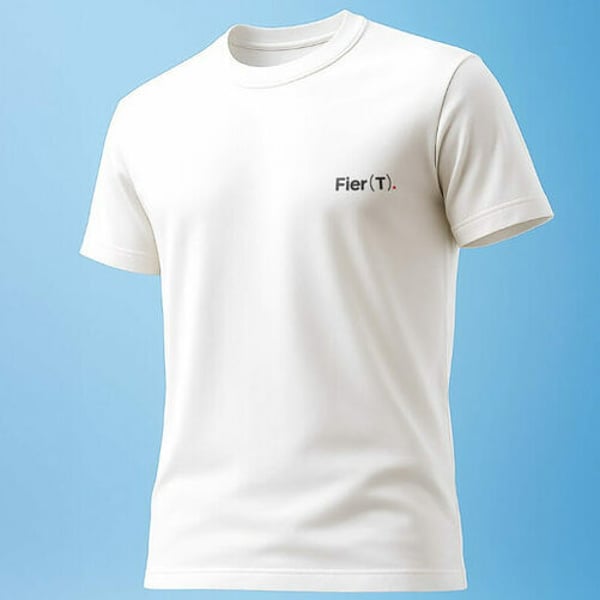
After streamlining its range and leveraging scale to bring down prices, Le Slip Français this morning unveiled its new project, “Fier(t)”: a €7.90 T-shirt aimed at the B2B market.
Le Slip Français
The announcement was made on November 18 at the brand’s Bonne Nouvelle factory, in the presence of Sébastien Martin, Minister Delegate for Industry, and former Ecology Minister Agnès Pannier-Runacher. Now claiming the title of France’s largest underwear manufacturer, Le Slip Français intends to demonstrate that its volume-led model can serve other markets.
“As we looked for markets where we could reshore production volumes, we quickly identified ‘imagewear,’ which relies chiefly on the T-shirt,” CEO Guillaume Gibault tells FashionNetwork.com. “When the government or an institution holds an event, the outfits are often made in Bangladesh; there is a genuine reputational issue at stake for them, which we can address in a positive way.”
That logic is partly literal, as Le Slip Français once again leans on automation. The production line dedicated to T-shirts has been fitted with two automated machines, dedicated respectively to the time-consuming hemming stage and to the highly technical task of attaching the sleeves. “With these, we can shave off precious seconds—and therefore manufacturing costs—on a T-shirt knitted, dyed, and assembled in France,” explains the brand’s founder.
By moving into imagewear and the B2B events market, the brand is already considering, if successful, expanding into other sought-after items, such as sweatshirts, down jackets, fleeces, and laptop sleeves. The idea remains that both organisers and recipients will appreciate the tricolour label.
However, this potential diversification of the B2B offer does not signal a return to the categories abandoned in the early 2020s, when Le Slip Français still aimed to become a generalist brand. “We are an underwear brand,” sums up Guillaume Gibault, who sees no change in the brand’s image. “We weren’t offering €40 underwear by choice. We simply didn’t yet have the industrial capability to be competitive. It just took us twelve years to crack this industrial model.”
A model that today relies in particular on mass retail. For this market, Le Slip Français has developed a shorter range, priced head-to-head with the competition: €9.90 per item, or €29.90 for three. Combining mass retail with direct sales, Le Slip Français is following the same logic as other French manufacturers, such as the Vosges sock specialist Bleu Forêt.
“Mass retail is an incredible tool for reaching the general public,” explains Guillaume Gibault. “There’s a lot of talk about exporting our products by raising prices. That’s great for luxury and for certain brands, but we mustn’t forget our domestic market: French people who are keen to support. Duralex’s fundraising campaign or the 110,000 visitors to the MIF Expo trade show proves it.”
Officially inaugurated last February, the Bonne Nouvelle factory currently employs around fifty people across 500 square metres. But it is already expanding, with a recent 150-square-metre extension. “The challenge now is to reach 5,000 square metres within 24 months, to support our growth and show that we can produce quality while remaining competitive,” explains Guillaume Gibault, who indicates that an option has already been secured on a neighbouring site. Everything is in place to “equip the buttocks of all French people” (sic).
This article is an automatic translation. Click here to read the original article.
The demerger of Unilever‘s ice cream division, to be named ‘The Magnum Ice Cream Company,’ which had been delayed in recent months by the US government shutdown, will finally go ahead on Saturday, the British group announced.
Reuters
Unilever said in a statement on Friday that the admission of the new entity’s shares to listing and trading in Amsterdam, London, and New York, as well as the commencement of trading… is expected to take place on Monday, December 8.
The longest federal government shutdown in US history, from October 1 to November 12, fully or partially affected many parts of the federal government, including the securities regulator, after weeks without an agreement between Donald Trump‘s Republicans and the Democratic opposition.
Unilever, which had previously aimed to complete the demerger by mid-November, warned in October that the US securities regulator (SEC) was “not in a position to declare effective” the registration of the new company’s shares. However, the group said it was “determined to implement in 2025” the separation of a division that also includes the Ben & Jerry’s and Cornetto brands, and which will have its primary listing in Amsterdam.
“The registration statement” for the shares in the US “became effective on Thursday, December 4,” Unilever said in its statement. Known for Dove soaps, Axe deodorants and Knorr soups, the group reported a slight decline in third-quarter sales at the end of October, but beat market expectations.
Under pressure from investors, including the activist fund Trian of US billionaire Nelson Peltz, to improve performance, the group last year unveiled a strategic plan to focus on 30 power brands. It then announced the demerger of its ice cream division and, to boost margins, launched a cost-saving plan involving 7,500 job cuts, nearly 6% of the workforce. Unilever’s shares on the London Stock Exchange were steady on Friday shortly after the market opened, at 4,429 pence.
This article is an automatic translation. Click here to read the original article.
Burberry has named a new chief operating and supply chain officer as well as a new chief customer officer. They’re both key roles at the recovering luxury giant and both are being promoted from within.
Matteo Calonaci becomes chief operating and supply chain officer, moving from his role as senior vice-president of strategy and transformation at the firm.
In his new role, he’ll be oversee supply chain and planning, strategy and transformation, and data and analytics. He succeeds Klaus Bierbrauer, who’s currently Burberry supply chain and industrial officer. Bierbrauer will be leaving the company following its winter show and a transition period.
Matteo Calonaci – Burberry
Meanwhile, Johnattan Leon steps up as chief customer officer. He’s currently currently Burberry’s senior vice-president of commercial and chief of staff. In his new role he’ll be leading Burberry’s customer, client engagement, customer service and retail excellence teams, while also overseeing its digital, outlet and commercial operations.
Both Calonaci and Leon will join the executive committee, reporting to Company CEO Joshua Schulman.
JohnattanLeon – Burberry
Schulman said of the two execs that the appointments “reflect the exceptional talent and leadership we have at Burberry. Both Matteo and Johnattan have been instrumental in strengthening our focus on executional excellence and elevating our customer experience. Their deep understanding of our business, our people, and our customers gives me full confidence that their leadership will help drive [our strategy] Burberry Forward”.
Traditional and occasion wear designer Puneet Gupta has stepped into the world of fine jewellery with the launch of ‘Deco Luméaura,’ a collection designed to blend heritage and contemporary aesthetics while taking inspiration from the dramatic landscapes of Ladakh.
Hints of Ladakh’s heritage can be seen in this sculptural evening bag – Puneet Gupta
“For me, Deco Luméaura is an exploration of transformation- of material, of story, of self,” said Puneet Gupta in a press release. “True luxury isn’t perfect; it is intentional. Every piece is crafted to be lived with and passed on.”
The jewellery collection features cocktail rings, bangles, chokers, necklaces, and statement evening bags made in recycled brass and finished with 24 carat gold. The stones used have been kept natural to highlight their imperfect and unique forms and each piece in the collection has been hammered, polished, and engraved by hand.
An eclectic mix of jewels from the collection – Puneet Gupta
Designed to function as wearable art pieces, the colourful jewellery echoes the geometry of Art Deco while incorporating distinctly South Asian imagery such as camels, butterflies, and tassels. Gupta divides his time between his stores in Hyderabad and Delhi and aims to bring Indian artistry to a global audience while crafting a dialogue between designer and artisan.