The question on Wall Street’s lips this week has been about Iran: When and how will the war end? President Trump issued some positive updates over the past 48 hours, though some analysts have pointed out there’s little verifiable action at present to support those claims.
Wall Street has been determinedly upbeat about the war in Iran resolving in a relatively short window—even the ever-skeptical Jamie Dimon, CEO of JPMorgan Chase, said he is a “little optimistic” about the long-term outcome of the current chaos in the Middle East.
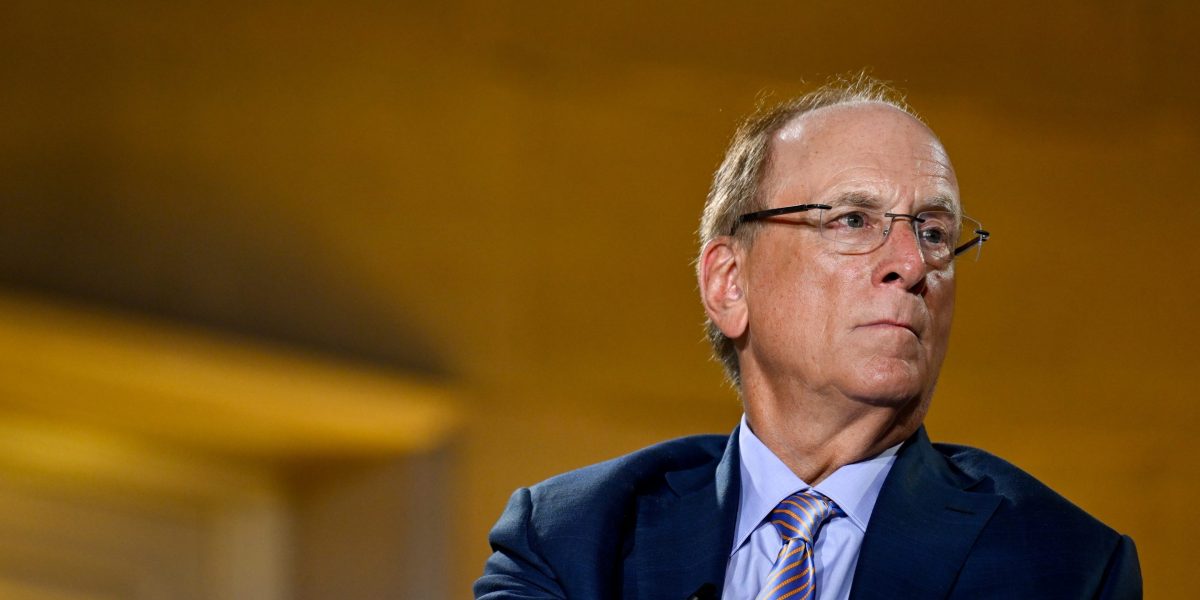
Fink also wants to be hopeful, and outlined there is a best-case scenario: “I could paint a scenario where I could see, a year from now, oil at $40 a barrel, I could see it above $150—we have two very extreme outcomes,” Fink told the BBC this morning.
“Everybody has to recognise that there’s not going to come somewhere in the middle. It’s going to be [one] of two extremes: Is Iran a country that can be accepted by the international community, can it be a country that participates in the world again?” Fink mused. Such an outcome could slash oil prices, flooding the market with supply currently choked by military threats in the Strait of Hormuz.
Iran borders the Strait of Hormuz, a narrow waterway in the Persian Gulf through which exports from the UAE, Qatar, Kuwait, and Iraq all flow. Some 20 million barrels of oil typically flow through the strait every day, about 20% of the global oil supply. Iran has said it controls the strait, littering it with mines, meaning shipmasters are too nervous to enter the waterway—only certain ships, paying a hefty price tag, have been allowed to pass by the Iranian authorities.
The worst-case scenario
Oil prices have already spiked in response to the chokehold, with analysts questioning how quickly normal trade may resume once the conflict draws to a close. If the conflict does rumble on for longer than the roughly month-long window President Trump had indicated, this will have longer-lasting impacts on gas and energy prices—a particular concern for consumers already sensitive to affordability shocks.
“Iran remains a threat,” Fink continued. “A threat to trade, a threat to the Strait of Hormuz, a threat to the peaceful coexistence of the GCC (Gulf Cooperation Council) region—I would argue that we could have years of above-$100, closer to $150 oil, which has profound implications in the economy. The $40 oil implication is one of abundance and growth; the other is an outcome of probably stark and steep recession. I don’t think anybody knows what the outcome will be.”
The U.S. and Israel, to some extent, have already achieved their aim in Iran: The country’s former supreme leader Ayatollah Ali Khamenei, was killed earlier this month. His son, Mojtaba Khamenei, now leads the country. Indeed, if the younger Khamenei is more open to working alongside the West, then Trump could easily wind down the conflict and maintain the rhetoric that he achieved his aim of eliminating a threat.
If Iran’s leadership wants to continue to be an “exporter of fear” and chooses to work against international trade, Fink added: “We’ll have global recession. Think about what it means for agricultural prices, fertilisers is a by-product from gas … it really disrupts a lot of supply chains.”