Connect with us

Business

Largest rail union backs $85 billion merger after job protections, but critics warn of monopoly risk

Published

on


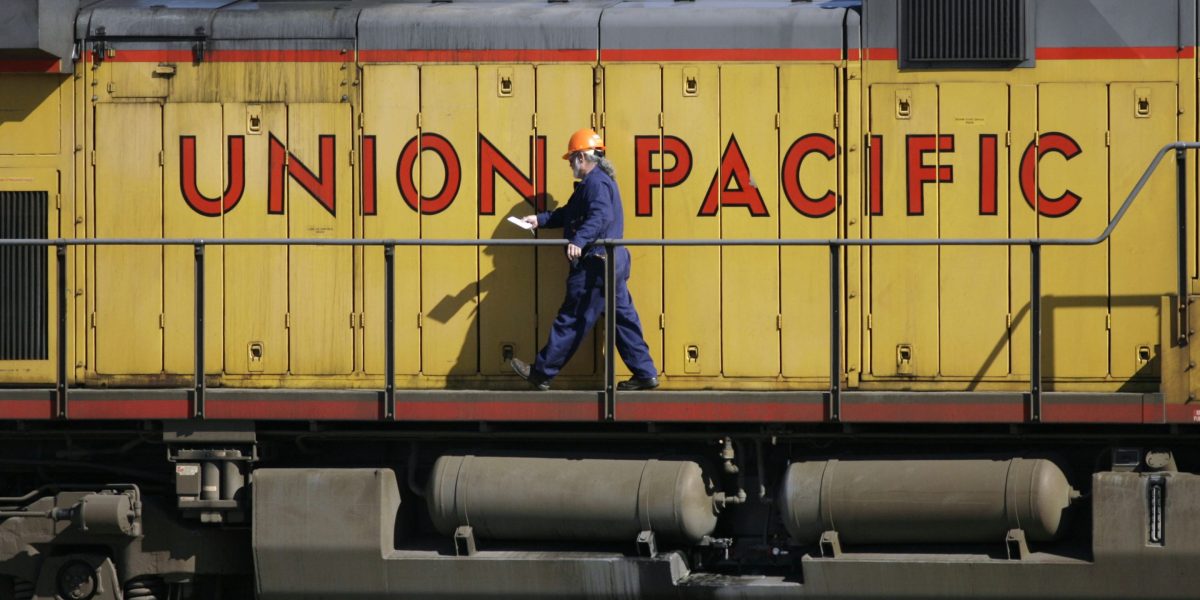
The nation’s largest railroad union joined the list of companies endorsing Union Pacific’s proposed $85 billion acquisition of Norfolk Southern Monday after securing promises to protect jobs, but other unions and chemical makers that rely on the railroads are still expressing concerns about the deal.

The SMART-TD union that represents conductors and other rail workers said Union Pacific put CEO Jim Vena’s promise not to lay off any of its workers as a result of the merger in writing and promised to protect their jobs throughout their careers. But the head of one of the next biggest unions said he doesn’t think this deal does nearly enough to protect rail jobs, so he’s not ready to support the merger that would create the nation’s first transcontinental railroad.

The union’s endorsement comes just days after President Donald Trump told reporters in the Oval Office that he deal sounds good to him, but groups like the American Chemistry Council and the Rail Customer Coalition have said they worry that allowing two of the six largest railroads to merge will only hurt competition and lead to even higher shipping rates.

The president of the Brotherhood of Maintenance of Way Employes Division union said he believes his Teamsters have enough influence with the White House that he may be able to change Trump’s mind once he gets a chance to explain some of the details and the tactics he believes the railroad will use to eliminate jobs.

Rail unions divided over the merger

But SMART-TD President Jeremy Ferguson, who initially criticized the merger and promised to oppose it, said Monday that he now believes it is for the best after the railroad promised to protect jobs.

“For generations, railroaders have worried about what mergers might mean for their jobs and whether or not they would be given the opportunity to reach retirement on the rail,” Ferguson said. “Today, we can say with confidence that the biggest railroad and the biggest rail union in America are breaking new ground. We are protecting jobs, protecting families, and protecting the future of the U.S. supply chain.”

Tony Cardwell, president of the BMWED, said his union rejected similar offer from Union Pacific a couple weeks ago because the railroad wouldn’t agree to protect workers if it decides to lease more of its tracks to short-line railroads to handle the final deliveries as it has already done in a couple locations. He said what good is a promise of a job if it means either taking a pay cut to go to work for a smaller railroad or moving across the country to keep a job with Union Pacific.

Cardwell said that until workers in those situations are protected “We’re not going to support it. In fact, we’ll vehemently deny it. And we feel like we have a close enough relationship right now with the White House that we can have an impact on this.”

Trump’s opinion of the deal could prove crucial because he’ll appoint two more Republican members of the Surface Transportation Board that will ultimately decide whether to approve the largest rail merger in history. Just last month, Trump fired one of the two Democratic members of the board.

Some shippers express concerns

The president of the American Chemistry Council trade group, Chris Jahn said he’s worried that this proposed acquisition will follow the pattern of problems that followed past rail mergers in the 1990s. Deliveries were delayed and disrupted for extended periods after both the Union Pacific-Southern Pacific deal and the Conrail acquisition.

“History has shown that mergers slash service and shift costs onto customers — and the UP–NS merger risks more of the same,” Jahn said. “President Trump has made real progress rebuilding American manufacturing. Let’s not let a monopoly undo it.”

But many companies back the plan

But more than 100 others have loudly endorsed the merger since it was announced, including major shippers of consumer goods and a major plastic maker who look forward to the prospect of faster deliveries because Union Pacific would no longer have to hand over shipments to Norfolk Southern in Chicago, which can easily add a day or two.

“By knitting together a coast-to-coast rail network, Union Pacific and Norfolk Southern are creating new efficiencies that will benefit everyone – from logistics providers like us, to our customers, to the end consumers,” said Adam Miller, CEO of Knight-Swift Transportation. His company is a major shipper that trucks metal goods to railroads and then pays them to haul the trailers across the country before Knight-Swift picks them up again with its trucks to deliver them.

Frank Vingerhoets said he believes combining the two railroads will help his company’s plastics reach their destinations more quickly and efficiently.

“It means the plastic pellets and other products we handle can reach key markets faster and more seamlessly than ever. In short, it’s a win for shippers and for the entire supply chain,” said Vingerhoets, who is president of Katoen Natie North America.

This deal faces a long review

The STB review of the deal could take up to two years to complete. The board established a high bar for major rail mergers after the problems of the past, but Union Pacific and Norfolk Southern executives have expressed confidence in their chances of gaining approval.

“I am confident we will unlock new sources of growth for the country and our industry, taking more trucks off taxpayer-funded highways, serving new markets, and keeping more railroad jobs in America,” said Vena, the Union Pacific CEO.

Fortune Global Forum returns Oct. 26–27, 2025 in Riyadh. CEOs and global leaders will gather for a dynamic, invitation-only event shaping the future of business. Apply for an invitation.


Source link

Continue Reading

Business

Trump says Netflix-Warner Bros. deal ‘could be a problem’

Published

on


President Donald Trump raised potential antitrust concerns for Netflix Inc.’s planned acquisition of Warner Bros. Discovery Inc., noting that the market share of the combined entity may pose problems. 

“Well, that’s got to go through a process, and we’ll see what happens,” Trump said when asked about the deal as he arrived at the Kennedy Center for an event, confirming that he has met Netflix co-CEO Ted Sarandos last week and complimenting the streaming company. “But it is a big market share. It could be a problem.”

The $72 billion deal would combine the world’s No. 1 streaming player with the No. 4 service HBO Max, which has raised red flags from antitrust regulators. 


Source link

Continue Reading

Business

OpenAI goes from stock market savior to burden as AI risks mount

Published

on


Wall Street’s sentiment toward companies associated with artificial intelligence is shifting, and it’s all about two companies: OpenAI is down, and Alphabet Inc. is up.

The maker of ChatGPT is no longer seen as being on the cutting edge of AI technology and is facing questions about its lack of profitability and the need to grow rapidly to pay for its massive spending commitments. Meanwhile, Google’s parent is emerging as a deep-pocketed competitor with tentacles in every part of the AI trade.

“OpenAI was the golden child earlier this year, and Alphabet was looked at in a very different light,” said Brett Ewing, chief market strategist at First Franklin Financial Services. “Now sentiment is much more tempered toward OpenAI.” 

As a result, the shares of companies in OpenAI’s orbit — principally Oracle Corp., CoreWeave Inc., and Advanced Micro Devices Inc., but also Microsoft Corp., Nvidia Corp. and SoftBank, which has an 11% stake in the company — are coming under heavy selling pressure. Meanwhile, Alphabet’s momentum is boosting not only its stock price, but also those it’s associated with like Broadcom Inc., Lumentum Holdings Inc., Celestica Inc., and TTM Technologies Inc.

Read More: Alphabet’s AI Strength Fuels Biggest Quarterly Jump Since 2005

The shift has been dramatic in magnitude and speed. Just a few weeks ago, OpenAI was sparking huge rallies in any company related to it. Now, those connections look more like an anchor. It’s a change that carries wide-ranging implications, given how central the closely held company has been to the AI mania that has driven the stock market’s three-year rally. 

“A light has been shined on the complexity of the financing, the circular deals, the debt issues,” Ewing said. “I’m sure this exists around the Alphabet ecosystem to a certain degree, but it was exposed as pretty extreme for OpenAI’s deals, and appreciating that was a game-changer for sentiment.”

A basket of companies connected to OpenAI has gained 74% in 2025, which is impressive but far shy of the 146% jump by Alphabet-exposed stocks. The technology-heavy Nasdaq 100 Index is up 22%. 

The skepticism surrounding OpenAI can be dated to August, when it unveiled GPT-5 to mixed reactions. It ramped up last month when Alphabet released the latest version of its Gemini AI model and got rave reviews. As a result, OpenAI Chief Executive Officer Sam Altman declared a “code red” effort to improve the quality of ChatGPT, delaying other projects until it gets its signature product in line.

‘All the Pieces’

Alphabet’s perceived strength goes beyond Gemini. The company has the third highest market capitalization in the S&P 500 and a ton of cash at its disposal. It also has a host of adjacent businesses, like Google Cloud and a semiconductor manufacturing operation that’s gaining traction. And that’s before you consider the company’s AI data, talent and distribution, or its successful subsidiaries like YouTube and Waymo.

“There’s a growing sense that Alphabet has all the pieces to emerge as the dominant AI model builder,” said Brian Colello, technology equity senior strategist at Morningstar. “Just a couple months ago, investors would’ve given that title to OpenAI. Now there’s more uncertainty, more competition, more risk that OpenAI isn’t the slam-dunk winner.”

Read More: Alphabet’s AI Chips Are a Potential $900 Billion ‘Secret Sauce’

Representatives for OpenAI and Alphabet didn’t respond to requests for comment.

The difference between being first or second place goes beyond bragging rights, it also has significant financial ramifications for the companies and their partners. For example, if users gravitating to Gemini slows ChatGPT’s growth, it will be harder for OpenAI to pay for cloud-computing capacity from Oracle or chips from AMD.

By contrast, Alphabet’s partners in building out its AI effort are thriving. Shares of Lumentum, which makes optical components for Alphabet’s data centers, have more than tripled this year, putting them among the 30 best performers in the Russell 3000 Index. Celestica provides the hardware for Alphabet’s AI buildout, and its stock is up 252% in 2025. Meanwhile Broadcom — which is building the tensor processing unit, or TPU, chips Alphabet uses — has seen its stock price leap 68% since the end of last year.

OpenAI has announced a number of ambitious deals in recent months. The flurry of activity “rightfully brought scrutiny and concern over whether OpenAI can fund all this, whether it is biting off more than it can chew,” Colello said. “The timing of its revenue growth is uncertain, and every improvement a competitor makes adds to the risk that it can’t reach its aspirations.”

In fairness, investors greeted many of these deals with excitement, because they appeared to mint the next generation of AI winners. But with the shift in sentiment, they’re suddenly taking a wait-and-see attitude.

“When people thought it could generate revenue and become profitable, those big deal numbers seemed possible,” said Brian Kersmanc, portfolio manager at GQG Partners, which has about $160 billion in assets. “Now we’re at a point where people have stopped believing and started questioning.”

Kersmanc sees the AI euphoria as the “dot-com era on steroids,” and said his firm has gone from being heavily overweight tech to highly skeptical.

Self-Inflicted Wounds 

“We’re trying to avoid areas of over-hype and a lot of those were fueled by OpenAI,” he said. “Since a lot of places have been touched by this, it will be a painful unwind. It isn’t just a few tech names that need to come down, though they’re a huge part of the index. All these bets have parallel trades, like utilities, with high correlations. That’s the fear we have, not just that OpenAI spun up this narrative, but that so many things were lifted on the hype.”

OpenAI’s public-relations flaps haven’t helped. The startup’s Chief Financial Officer Sarah Friar recently suggested the US government “backstop the guarantee that allows the financing to happen,” which raised some eyebrows. But she and Altman later clarified that the company hasn’t requested such guarantees. 

Then there was Altman’s appearance on the “Bg2 Pod,” where he was asked how the company can make spending commitments that far exceed its revenue. “If you want to sell your shares, I’ll find you a buyer — I just, enough,” was the CEO’s response.

Read More: Sam Altman’s Business Buddies Are Getting Stung

Altman’s dismissal was problematic because the gap between OpenAI’s revenue and its spending plans between now and 2033 is about $207 billion, according to HSBC estimates.

“Closing the gap would need one or a combination of factors, including higher revenue than in our central case forecasts, better cost management, incremental capital injections, or debt issuance,” analyst Nicolas Cote-Colisson wrote in a research note on Nov. 24. Considering that OpenAI is expected to generate revenue of more than $12 billion in 2025, its compute cost “compounds investor nervousness about associated returns,” not only for the company itself, but also “for the interlaced AI chain,” he wrote. 

To be sure, companies like Oracle and AMD aren’t solely reliant on OpenAI. They operate in areas that continue to see a lot of demand, and their products could find customers even without OpenAI. Furthermore, the weakness in the stocks could represent a buying opportunity, as companies tied to ChatGPT and the chips that power it are trading at a discount to those exposed to Gemini and its chips for the first time since 2016, according to a recent Wells Fargo analysis. 

“I see a lot of untapped demand and penetration across industries, and that will ultimately underpin growth,” said Kieran Osborne, chief investment officer at Mission Wealth, which has about $13 billion in assets under management. “Monetization is the end goal for these companies, and so long as they work toward that, that will underpin the investment case.”


Source link

Continue Reading

Business

U.S. trade chief says China has complied with terms of trade deals

Published

on


Trade Representative Jamieson Greer said China has been complying with the terms of the bilateral trade agreements and that the US is constantly monitoring commitments made by China in a bid to maintain a stable trade relationship.

“With China, it’s always we verify and we monitor and we watch the commitments. The commitments are quite specific,” Greer said Sunday on Fox News’ The Sunday Briefing. “So all of these things that we’ve agreed to with the Chinese recently are very concrete, we can monitor them with some ease, and so far, we’re seeing that they’re in compliance.”

Greer said China has gotten approximately “a third” of the way through its soybean purchase commitment for this growing season.

Bloomberg previously reported that after a series of orders placed in late October — the first of this season — China’s purchases of American soybeans appeared to have stalled. 

President Donald Trump and Chinese President Xi Jinping in late October agreed to extend a tariff truce, roll back export controls and reduce other trade barriers. But some elements of the deal — including the soybean purchases, sale of social media app TikTok and an increase in licenses to export critical rare earths from China — remain in progress.

US Treasury Secretary Scott Bessent and Greer held a video call with Chinese Vice Premier He Lifeng on Friday, according to China’s state-run news agency Xinhua, during which the officials had an “in-depth and constructive” discussion in which they vowed to keep stable ties and address “respective concerns” on trade and the economy, the outlet said.

Read More: Top US, Chinese Officials Pledge Cooperation on Trade Deal

Bessent on Sunday told CBS News’ Face the Nation that China will not speed up purchases, but they are still expected to take place this crop season and said soybean prices are up 12% to 15% since the agreement with China. He also said he divested from a soybean farm to comply with an ethics agreement

The Trump administration is expected to release its long-awaited farm aid plan this week, US Agriculture Secretary Brooke Rollins said in a cabinet meeting last Tuesday.

Asked whether chipmakers like Nvidia should give China advanced chips or if doing so would pose a security risk to the US, Greer expressed a need for the US to be cautious.

“My own view is we need to be very cautious about this,” Greer said on Fox News. “We want companies’ bottom lines to do well, but as policymakers, we need to make sure that the national security is placed first and foremost, and that’s why you’ve heard President Trump talk about the types of chips that maybe would be restricted and there’s always an open discussion on where that threshold lies, and it changes over time.”


Source link

Continue Reading

Trending

Copyright © Miami Select.