Across Botswana the lines of patients outside government clinics are lengthening, construction companies dependent on state jobs are firing workers and university students are threatening to boycott lectures after not getting the allowance increases they were promised.
Bloomberg
The economic slowdown is a sharp reversal from just a few years ago when the world’s richest diamond deposits allowed the sparsely-populated desert nation of 2.5 million people to invest in free and efficient healthcare and plow money into funding tertiary education for students both at home and abroad. Its robust finances allowed it to provide for its citizens in a way that made it the envy of southern Africa.
The discovery of gems in 1967 transformed what was a rural backwater with, at the time of independence from the UK a year earlier, only a few miles of tarred road into the richest nation per capita on the sub-Saharan African mainland. Six decades later a diamond-market crisis has turned that find into an affliction and a cautionary tale of what can happen to an economy that becomes overly reliant on one commodity.
“For decades, we have leaned and relied heavily on diamonds. While they served us well, we know painfully today that this model has reached its limits,” President Duma Boko, 55, said in an August speech. “This is no longer an economic challenge alone; it is a national social existential threat.”
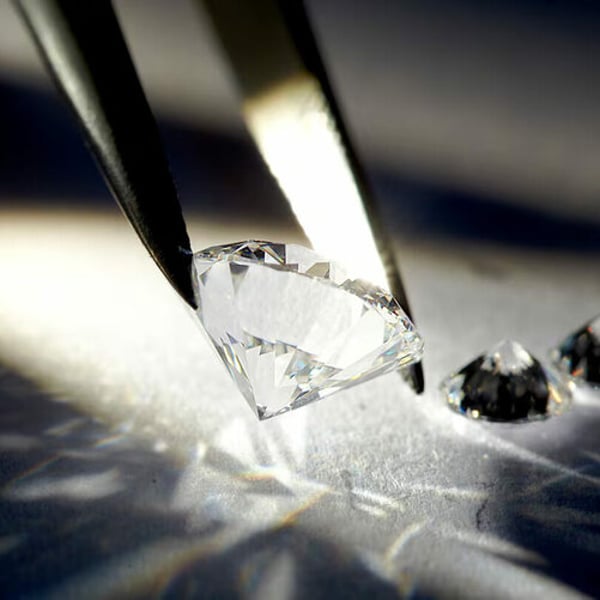
The market for natural diamonds is in crisis, with cut-price lab-grown equivalents hitting demand particularly hard in the US, the biggest market for the gems. They accounted for almost half of engagement ring purchases last year compared with 5% in 2019, according to jewelry insurer BriteCo Inc. The collapse of the luxury retail sector in China and the impact US tariffs have had on trade have also hurt the industry.
While lab gems can be produced in weeks or months, the formation of natural diamonds, made of crystallized carbon formed under extreme pressure and heat deep beneath the earth’s surface, can take billions of years before volcanic eruptions propel them upwards to depths where they can be mined or found on ocean or river beds. They also cost many times as much as their synthetic rivals.Their increasing popularity is creating the biggest disruption in the market since abundant alluvial diamonds were discovered on Namibia’s beaches early last century, causing prices to plunge, according to mining historian Duncan Money.
It’s choking off the revenue that accounts for 80% of Botswana’s exports and a third of government income. After repeated write-downs of its value Anglo American Plc is looking to sell De Beers, the world’s biggest diamond company that mines almost all of Botswana’s gems in a venture with the government.
Boko’s administration, which in October displaced a political party that had ruled since independence, is scrambling.
In July, the government engaged Malaysia’s PEMANDU Associates to advise on accelerating economic diversification and on Aug. 21 Boko took to Facebook to announce a plan for a little-known Qatari group, Al Mansour Holdings, to invest $12 billion. There was scant information about how the capital will be deployed and the same group has in recent weeks promised more than $100 billion in investment across six African countries, raising questions about the credibility of the pledge.
The president on Aug. 25 declared a public health emergency and implored pension funds and insurers to help fund the response. Government has frozen recruitment and there are shortages of medication, medical supplies and equipment, according to Kefilwe Selema, president of the Botswana Doctors Union.
“The situation is very bad,” said Galeemiswe Mosheti, a 42-year-old diabetes-sufferer who arrives at a government clinic in the capital Gaborone, at 8 a.m. and can wait as long as eight hours for his medicine compared with just an hour a year ago. “We’re spending long periods in the queue and our jobs suffer,’’ said the taxi driver who loses income every time he fetches waits to be attended to.
For construction companies dependent on government work the situation is no better.
“Most of our members have had to retrench workers,” said Tshotlego Kagiso, chairman of the Tshipidi Badiri Builders Association, the country’s largest building contractors organization, which before the current downturn had more than 800 members, some of whom can no longer afford their membership fees.
“The majority have suspended operations and many have closed altogether due to slower government spending,” he added, saying thousands of workers have lost their jobs without being able to be more specific.
The country’s economic statistics tell a story of rapid decline and belie De Beers’ marketing catchphrase, ‘A diamond is forever.’
The International Monetary Fund forecast Botswana’s 2025 fiscal deficit climbing to 11% of gross domestic product. That’s the largest budget gap since the global financial crisis in 2009, and the biggest in sub-Saharan Africa this year. Government debt will rocket to 43% of GDP in 2025, about doubling the ratio in just two years, according to data from the Washington-based lender, and exceeding a legislative limit.
In June, the finance ministry abandoned a forecast of 3.3% growth in 2025 and instead said the economy may contract 0.4%, foreign reserves have slumped 27% over the last year and Citigroup Inc. in July forecast Botswana will need to keep devaluing its managed currency, the pula. A first ever mid-term budget review is planned for as early as next month and Debswana, the country’s joint venture with De Beers, is operating at about 60% of capacity.
Botswana is “experiencing a significant decline in revenue inflows resulting in massive liquidity challenges that threaten financial stability and sustainability of government business operations,” Finance Ministry Permanent Secretary Tshokologo Kganetsano told a parliamentary committee in June.
Already, after years of limited borrowing, the country is turning to debt. It secured $304 million from the African Development Bank in May and $200 million from the OPEC fund in July and plans a domestic bond roadshow for investors on Tuesday. Its investment grade credit rating, the highest in Africa, is under threat with both Moody’s and S&P Global Ratings this year cutting its outlook to negative.
“The diamond sector is under severe pressure — both prices and volumes,” Ravi Bhatia, director and lead analyst at S&P Global Ratings, said in an interview. “They’re doing a combination of trying to diversify, fiscal consolidation and also austerity.”
While Botswana’s governments have been talking about economic diversification since the country’s first president, Seretse Khama, set up the Botswana Development Corp. in 1970 to develop copper mining and beef production, little progress has been made.
Tourism, focused on luxury safaris in the country’s Okavango Delta wetlands and a wilderness that boasts the world’s largest elephant population, is the second-biggest contributor after diamonds, accounting for just 12% of GDP. Some copper mines are being developed while huge coal deposits, barely exploited, can no longer attract the funding needed for extraction.
That’s left more than two fifths of the population under the age of 24 unemployed, according to the International Labour Organization, with the diamond mines only employing a few thousand people, and reliant on government largesse. That’s a situation Boko described as “a huge risk,” in a January interview with Bloomberg.
“We must now focus on job creation,” Boko said as he laid out ambitious plans for investment in renewable energy, technology and agriculture.
What he hadn’t bargained for was that there would be no money to pay for it.
While many other countries are reliant on a single commodity for the bulk of their earnings and go through cyclical downturns, for example oil-reliant Nigeria and Angola, for Botswana the outlook is bleaker.
“The difference with the oil cycle is that diamond prices are unlikely to ever come back,” said Charlie Robertson, author of The Time Travelling Economist, a book on how developing economies industrialize. “Its economic model is likely to cease being one of the shining lights on the African continent.”
Swarovski on Tuesday announced the appointment of Sindhu Culas to the role of president, general manager, North America at the Austrian jewelry maker.
Sindhu Culas – Courtesy
Based in the luxury firm’s New York City office, Culas will be responsible for “maximizing the Swarovski physical and digital presence and overall brand affinity in the U.S.,” according to a press release.
“We are thrilled to welcome Sindhu to Swarovski. Her vast leadership experience and passion for the brand make her an exceptional addition to our team,” said Kolja Kiofsky, chief commercial officer, Swarovski.
“With Sindhu guiding our next chapter in North America, we are looking ahead to an exciting future filled with creativity, operational excellence, and meaningful growth under our LuxIgnite strategy.”
A retail veteran with over 25 years of experience across omni‑channel retail and institutional investment management, Culas joins the crystal jewelry maker from G-Star, where she served as CEO of North America at the British denim and apparel brand.
She began her career as a buyer and planner at Macy’s, Talbots, and Lord & Taylor before being promoted to strategy and brand management at Macy’s. Later on, the executive served as senior vendor manager at Amazon and as senior vice president of e‑commerce and strategy for Calvin Klein.
“Watching Swarovski’s brand repositioning and momentum in recent years has been inspiring,” said Culas, in response to her new appointment.
“I’m excited to join this exceptional team, collaborate across the business, and help strengthen our position while accelerating growth throughout North America. It’s a remarkable moment for the brand, and I’m thrilled to contribute to the journey ahead.”
There are stories you simply couldn’t invent. The tale of Bourrienne Paris X, a finalist for the DHL 2025 Award, is one of them. The French shirtmaker for men and women, co-founded in 2017—among others—by two women with entirely different backgrounds, is now entering a phase that balances dynamic expansion with a quest for longevity, projecting growth of over 50% in 2025 and an equally high target for 2026.
Cécile Faucheur is the label’s artistic director – Bourrienne Paris X
The designer behind the Bourrienne Paris X collections is Cécile Faucheur. A former fashion design teacher, pattern cutter and stylist, she is now head of design at the brand she co-founded. Her research at the Musée de la Chemiserie in Argenton-sur-Creuse captivated both her and Charles Beigbeder (who had just taken over the Hôtel de Bourrienne in Paris), prompting them to dedicate a men’s shirting brand to the building.
Historical details and diverse trajectories
For her part, Carine Beigbeder, co-founder and CEO of Bourrienne Paris X, draws on a background that spans finance and entrepreneurship. She previously managed a listed small-cap fund at Financière Arbevel. Her analysis of companies’ business plans and strategies spurred her to take on an operational role—one she now fulfils at Bourrienne Paris X. A luxury brand, or at least on the way to becoming one, the label currently employs around ten people and is attempting to compete with luxury giants such as Hermès in a niche that has, until now, been very narrow: the shirt.
Carine Beigbeder aims to bring longevity to Bourrienne Paris X – Bourrienne Paris X
“The idea was to build a brand inspired by historical details and the shirtmakers of yesteryear. We realised that the men’s wardrobe had lost much of the richness it once had.”
Today, the Bourrienne Paris X wardrobe is rooted in both French stylistic heritage and modern fashion, having opened up to womenswear as early as its second season. This now accounts for more than half of the house’s turnover.
In search of quality materials
“For women, the shirt was a vehicle of emancipation as womenswear became uncorseted and a little freer. It wasn’t necessarily at the same time, but that’s not the point,” explained Beigbeder.
Bourrienne Paris X now goes beyond the shirt and has launched men’s trousers on pre-order, cut from a very heavy Belgian linen, “as if coated with a fine layer of beeswax, which gives it a very new and very innovative look,” in the CEO’s words.
Details play an important role in Cécile Faucheur’s work – Bourrienne Paris X
At Bourrienne Paris X, the linen comes from Belgium, the poplin from Italy, the embroidered trims inspired by the Hôtel de Bourrienne are made by a century-old manufacturer in northern France, the pleating by a Breton artisan, and the mother-of-pearl is sourced from Australia. The shirts, meanwhile, are made in Portuguese and Romanian workshops, and the house is considering other production sites elsewhere in Eastern Europe.
Priority given to digital
Soon to mark its tenth anniversary, Bourrienne Paris X is now in its third year of profitability. Struck by the Covid-19 pandemic after a loss-making start, the brand managed to “keep its head above water,” thanks to digital, which provides sufficient data to respond to its customers’ tastes. The company has self-financed its digital investments and plans to double them in 2026 to accelerate growth, a priority given that its e-commerce site generates over 50% of its sales.
Bourrienne Paris X is largely inspired by the Hôtel de Bourrienne – Hôtel de Bourrienne
Bourrienne Paris X also invests in SEO, and in Google, Pinterest and Meta campaigns tailored to each of the countries where it is sold, namely the United States, England, Switzerland, Canada and Australia. Customs duties, included in the final price across the Atlantic, are no longer an issue for the brand, thanks to the purchasing power of its American customers.
International expansion
With 60% of its sales generated abroad, the label is stocked by a number of department stores, including Le Bon Marché’s men’s department in Paris, as well as Bongénie in Geneva and Zurich, Lane Crawford in Hong Kong, and Isetan, Tomorrowland, United Arrows and Wako in Japan. This is why it is presenting its project to the DHL Prize jury this year.
The brand is a finalist for the DHL 2025 Award – Bourrienne Paris X
The brand remains based at 58 Rue d’Hauteville, opposite the Hôtel of the same name, in the 10th arrondissement of Paris. It’s not unusual for curious customers to be invited to discover the place that inspires the brand with each new collection. The brand’s desire to prioritise digital shapes its approach to welcoming investors, whose most valuable contribution would be their expertise.
For the time being, beyond the brand’s growth, Beigbeder is focused on a mission that is no less important: ensuring that Bourrienne Paris X stands the test of time. A “real challenge” consisting of remaining faithful to the house’s convictions and avoiding, as far as possible, the pull of passing trends.
Jeanne Friot: a queer manifesto to rouse Fashion Week
With her “Awake” show, Jeanne Friot literally brought her guests to their feet at the Théâtre du Rond-Point des Champs-Élysées. Making her debut on the official calendar, the French designer opened the Paris proceedings with a high-octane performance that, true to form, championed LGBTQI+ causes.
The unveiling of Jeanne Friot’s Autumn/Winter 2026 collection, blending runway and choreography conceived with choreographer Maud Le Pladec and the Ballet de Lorraine company, could not have felt more timely given recent headlines and the American president’s posturing. The thirty-something designer issued a call to wake up, with several dancers wearing T-shirts emblazoned with the slogan “It’s never too late to fight fascism“.
Beyond words, the designer opened with three powerful womenswear looks: a black tweed suit with a cropped jacket; a cocktail dress reimagined in a tartan of silver, red and purple sequins, worn by a model with gothic make-up; and a jacket-and-mini-skirt ensemble in black faux leather, heightened by a play of metal straps and buckles—one of her signatures, applied horizontally or vertically to form skirts or dresses—always nodding to the queer wardrobe.
Soon, dancers—wearing tartan catsuits paired with thigh-high boots, faux-leather mini-shorts, colourful tulle tops or black sequin hoodies—launched into breathless choreography. Then came two women in generously cut suits, one black, the other white. The two models drew closer, stared each other down, touched and kissed intensely and at length, melding like yin and yang as, all around them, the troupe ratcheted up the intensity of their stagecraft. The tableau prompted a wave of approval throughout the Parisian theatre.
Ever more exacting in her use of deadstock materials, the French designer introduced several other visually striking pieces, including a long black faux-leather coat worn over a bodysuit and teamed with metallic thigh-high boots, a houndstooth suit with a broad-shouldered jacket and micro-shorts, and an opulent dress featuring a tartan motif that unfurled from the waist into a train of colourful feathers—a true tribute to the queer community.
That community made its support unmistakable when Friot took to the stage to bow, prompting a prolonged standing ovation for a show that opened Paris Fashion Week Men’s with a bang.
Études Studio and its elegant seekers of sound
On Tuesday, for its show in the impressive Institut de Recherche et Coordination Acoustique, Études Studio staged a composition exploring the tonalities of tailoring. For this collection, christened “N°28 Résonances”, co-founders Aurélien Arbet and Jérémie Egry explained in their letter of intent that they drew inspiration from the origins of 1990s dance music and from the universe of American philosopher John Cage, who questioned the very concepts of music and silence.
To pace their mixed show in soundproofed underground spaces, the French opted for powerful music, teaming with British artist Actress, who composed the soundtrack for a show charting new horizons for Études Studio.
Of course, the brand retained its velvet jackets, hefty canvas blousons with carefully worked washes and a few hoodies (with its logo in a circle of stars on the back), faithful to its utilitarian roots. But the label introduced a compelling, reimagined tailoring proposition, with no fewer than a dozen far more formal looks—straight-cut jackets, fluid trousers and layered shirts, waistcoats and roll-neck jumpers—in black, grey or earthy tones.
Gold prospectors or sound seekers? Between Walkman headphones and cowboy hats, Études Studio refused to choose. Its earnest youths saw their wardrobe explore different material aspects—from worn-in finishes to contrasts between nylon and velvet—and a few chromatic accents, such as an intense purple puffer, or camo riffs on substantial, fuzzy knitwear in shades of green or blue, paired with long, wide scarves in matching hues. This season, the brand presented pieces in collaboration with Berlin-based Canadian artist, Jeremy Shaw.
These silhouettes were accompanied, for the first time, by leather or canvas bags bearing the brand’s logo. This leather goods range, developed in two sizes, should provide a growth driver for the independent creative label.
Valette Studio pays tribute to the New Romantics
Once again this season, Valette Studio’s fashion looked to the past. As the first day of Paris Fashion Week drew to a close, the French brand took over the Institut du Monde Arabe. In a basement room supported by large, thick stone columns, Pierre-François Valette unveiled his Autumn/Winter collection entitled “Les Nouveaux Romantiques”, born of a contemporary melancholy caused by the displacement of creation by image.
This season, Valette Studio focuses on color, frills and ruffles – Samuel Gut
Accompanied by a rock soundtrack with wild percussion, later joined by a violin, the models wore a herringbone denim trench with matching skinny jeans, a short cream dress with a shirt collar and frills that cinched the waist and framed the chest, a black leather ensemble and Louboutins, in collaboration with Louboutin on this collection.
Another dress appeared heavy yet almost bounced, covered in frills and cut from a material that looks, to the eye, like balloon rubber. Perhaps the most striking pieces were two white skirts bearing a made-up face, a watercolour rendered alternately in blue and in orange, created by Teintures de France and inspired in particular by the legendary make-up of David Bowie, the pre-eminent figure of the New Romantics. The models were sometimes adorned with silver make-up swept along the outer corners of the eyes, another nod to the stars of this early-1980s movement. At the end of the show, Pierre-François Valette was warmly applauded by the many guests as he crossed the long room to take his bows.
This article is an automatic translation. Click here to read the original article.