Business
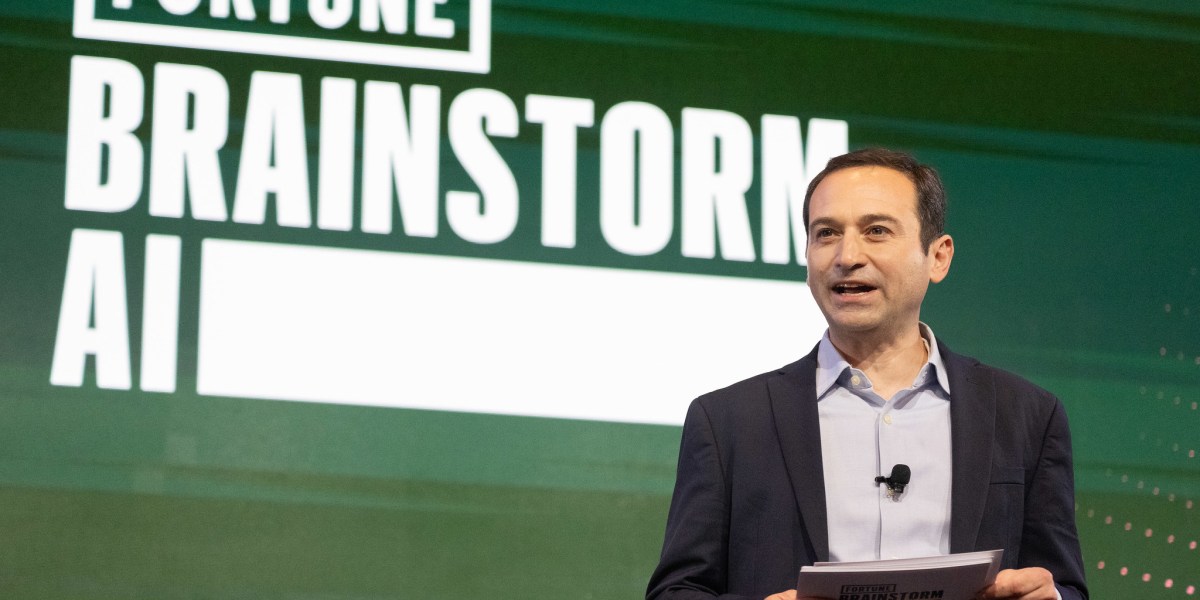
Key takeaways from Fortune Brainstorm AI Singapore 2025
Published
4 months agoon
By
Jace Porter
Hello and welcome to Eye on AI. In this edition…China launches its own AI Action Plan…Meta hires an OpenAI veteran for new “chief scientist” role, raising questions about status of AI “godfather” LeCun…what if AI doesn’t speed up scientific progress?…and economists can’t agree on the impact AI superintelligence could have.
I spent last week in Singapore at Fortune Brainstorm AI Singapore. It was our second time hosting this event in the thriving city state, and I was eager to find out what had changed since last year. Here are some of the key thoughts and impressions I took away from the conference:
The pace of AI adoption is equally fast everywhere. With previous technological waves, many Asian companies and countries lagged the U.S., Europe, and China in adoption. But that’s not the case with AI. Instead, the pace of deployment seems equally fast—and equally ambitious—everywhere.
Everyone wants AI agents. Few are actually using them yet. Everyone anticipated AI agents last year; now they’re here from OpenAI, Google, Anthropic, and others. Yet adoption still trails the hype everywhere. Why?
Agents, by their very nature, are higher risk than most kinds of predictive AI or generative AI that simply produces content. And right now, AI agents are often not that reliable. Some of the ways to make them more reliable—such as using multiple agents, each assigned a specific task within a workflow and with some agents assigned to check the work of others—are also expensive.
As a result, Vivek Luthra, Accenture’s Asia-Pacific data and AI lead, said that most businesses are using AI to assist human workers within existing workflows. In some cases, they may be using AI as an “advisor” to provide decision support. But few are automating entire workflows.
Luthra, however, predicts this will change dramatically. By 2028, he forecasts that one-third of large companies will have deployed AI agents, and that about 15% of day-to-day workflows could be fully automated. (Accenture is a sponsor of Brainstorm AI.) This is because costs will continue to come down, models will continue to become more capable and reliable, and more companies will figure out how to redesign workflows to take advantage of these new agentic properties.
AI’s impact on the job market is not easy to discern—yet. Pei Ying Chua, LinkedIn’s APAC head economist, told the conference that despite anecdotal reports that young graduates are struggling to find work, there’s not yet much evidence of this in the data on open roles that LinkedIn tracks. That said, there has been an uptick in the average number of applications required before coders land a job.
On the same panel with Chua, both Madhu Kurup, vice president of engineering at Indeed, and Sun Sun Lim, vice president at Singapore Management University, emphasized the need for employees to acquire both AI skills—techniques for prompting models, familiarity with how to build an AI agent, an understanding and of the strengths and weaknesses of different kinds of AI—as well as human “soft skills.” As AI transforms all jobs, soft skills like flexibility, resilience, and critical thinking matter more than ever, the two panelists said.
Jess O’Reilly, Workday’s general manager for ASEAN, said that she thinks AI will lead many companies to adopt an organizational structure based more around teams from diverse functional areas coming together for specific projects and then being reconfigured for the next project. She said this would be like an “internal gig economy” for employees. Traditional reporting lines and vertical organization would need to change in favor of a flatter, more dynamic org chart, she said.
Infrastructure is destiny. From several panels at Brainstorm AI Singapore, it was clear that access to AI infrastructure is going to be critical. This is true even when countries don’t want to build their own models. Just running models—what’s known as “inference”—also requires a lot of AI chips.
But building data center capacity requires big investments in energy. Rangu Salgame, CEO and co-founder of Princeton Digital Group, said that in the near-term fossil fuels, especially natural gas, would likely be used to power the data center buildout in Asia—which is not great news for climate policy. But in the medium term, he saw great potential for AI data centers to force countries to build out renewable energy capacity, such as solar power and off-shore wind.
Sovereign AI matters. Delivering it is challenging. Everyone is talking about the need for sovereign AI—and that was certainly the case in Southeast Asia, too. Governments want the ability to control their own destiny when it comes to AI technology and not become overly dependent on solutions from the U.S. and China. But achieving that independence is tricky, as was clear from several of the sessions at Brainstorm AI.
While increasingly capable open source models are giving governments some options in terms of which models they choose to build their solutions on, there are still some big constraints.
First, there’s the huge cost of building out data center capacity and constructing the power plants and upgrading national grids to support it, which I mentioned above. Then there is the issue of training AI models that are adept at local languages and also understand cultural nuance. This requires curating data sets specific to local context, said Kasima Tharnpipitchai, head of AI strategy at SCB 10X, which is building an LLM for the Thai language. “There are no tricks here, you really have to do the work,” he said. “It really is just effort. It’s almost brute force.”
Embodied AI is China’s big strength. While it often looks like the U.S. and China are evenly matched when it comes to the capabilities of AI models, China has a massive advantage when it comes to “embodied AI”—that is, AI that will live in physical devices, from robotaxis to humanoid robots. That was the message from Rui Ma, founder of Tech Buzz China, who spoke on a fascinating panel looking at the geopolitics of AI. China controls almost the entire robotics supply chain and is making rapid progress creating cheap and practical robots designed for factories, as well as general purpose humanoid robots. (One of those humanoid robots—Terri, which uses software from Hong Kong startup Auki Labs, but whose body comes from Chinese robotics company Unitree—wowed delegates at Brainstorm AI.)
There is a middle path between the U.S. and China. Singapore has consistently tried to thread a path between the two superpowers. And at Brainstorm AI the country’s digital minister Josephine Teo said that the country was finding places to act as a bridge between the U.S. and China. For instance, in late April, Singapore played a key role in hosting a meeting of AI safety researchers from both the U.S., China, and elsewhere that arrived at what is called the “Singapore Consensus”—an agreement that AI systems should be reliable, secure, and aligned with human values, as well as a shared vision about ways to ensure that is the case.
With that, here’s more AI news.
Jeremy Kahn
jeremy.kahn@fortune.com
@jeremyakahn
Before we get to the news, I want to flag my most recent Fortune magazine feature on AI darling Perplexity. If you want to know why the “answer engine” company is now worth $18 billion and why tech giants from Google to Apple are watching its every move, please give the story a read.
Note: The essay above was written and edited by Fortune staff. The news items below were selected by the newsletter author, created using AI, and then edited and fact-checked.
AI IN THE NEWS
China calls for cooperation on AI governance and a new international organization. At the World Artificial Intelligence Conference in Shanghai, Chinese Premier Li Qiang called for a global governance framework to coordinate the development of AI and work towards agreed safety standards. He called for the creation of an international organization to coordinate AI efforts and warned against AI becoming an “exclusive game” for a few nations or corporations. He also called for cooperation on the build out of data center capacity around the world, emphasized the importance of open-source AI models, and said that AI deployment should be “state led.” Li’s speech came just days after U.S. President Donald Trump unveiled his own AI Action Plan, which was designed to ensure the U.S. remains the dominant power in AI development. You can read more on Li’s speech from The Guardian here.
U.S. suspends AI hardware export control enforcement amid trade talks with China.
The Trump administration has frozen planned restrictions on U.S. technology exports to China, including Nvidia’s H20 AI chip, in an effort to preserve ongoing trade talks and secure a meeting between U.S. President Donald Trump and Chinese President Xi Jinping. This reversal—prompted in part by lobbying from Nvidia—has sparked backlash from national security officials and experts, who warn the H20 chip could accelerate China’s military AI capabilities, particularly in areas like autonomous weapons and surveillance. You can read more from the Financial Times here.
Meta hires a new chief scientist amid AI hiring spree, forcing AI “godfather” LeCun to clarify his role at the company. Meta founder and CEO Mark Zuckerberg announced that he had poached AI researcher Shengjia Zhao from OpenAI and was appointing him “chief scientist” for Meta’s new Superintelligence unit. Zhao, who helped develop ChatGPT, is just the latest in a string of researchers Meta has hired away from rival labs, including OpenAI, Google DeepMInd, and Anthropic as well as Apple. But Zhao’s title raised eyebrows among AI industry watchers as it is similar to the title long-held by Yann LeCun, the Turing Award-winner and “godfather” of AI who Zuckerberg hired back in 2013 to establish Meta’s Fundamental AI Research (FAIR) lab. LeCun, who has been openly skeptical that current approaches to AI will lead to human-level AI, let alone superintelligence, has been increasingly sidelined in Meta’s drive to develop AI models and products. LeCun was forced to issue a statement on LinkedIn clarifying that he has always been focused on long-term research into new AI methods at FAIR and that “my role and FAIR’s mission remain unchanged.” You can read more about Zhao’s hiring here in Tech Crunch and more on LeCun’s statement from Business Insider here.
Anthropic courts $150 billion valuation, even as expert warns copyright cases could jeopardize the company. Anthropic is in early talks to raise about $3 billion at a $150 billion valuation, the Financial Times reported. The amount is more than double the company’s March valuation, driven by surging revenue that is now running at a $4 billion annualized pace. But at the same time, Santa Clara University law professor Ed Lee published a blog post in which he calculated that if Anthropic loses the class action lawsuit it is facing over the alleged use of libraries of pirated books to help train its Claude AI model, the company could face “business-ending” damages totaling into the billions of dollars. For more on Lee’s analysis, see my Fortune colleague Bea Nolan here.
EYE ON AI RESEARCH
Will AI accelerate scientific progress or slow it down? Conventional wisdom is that AI is about to massively accelerate scientific progress. Indeed, hardly a week goes by without news of scientists using AI to help unlock some previously difficult or impossible task—from predicting the structure of proteins to controlling plasma in a fusion reactor. The latest example came last week with Google DeepMind unveiling an AI system called Aeneas that can pinpoint the date of Latin inscriptions—a boon to classicists and historians.
But Princeton University computer scientists Sayash Kapoor and Arvind Narayanan, who write a newsletter called “AI Snake Oil” that is deeply skeptical of much of the hype surrounding AI, argue in an essay published earlier this month that the conventional wisdom about AI and science is wrong. Rather than accelerating science, they contend, AI will slow it down.
Their argument rests primarily on AI’s ability to increase the volume of research papers being published, which makes it that much harder for scientists to find novel ideas. They also argue that AI’s ability to make accurate predictions without creating underlying theories of causation will actually decrease human understanding, not advance it. That second argument is one I also explore in my book, Mastering AI, and I think it is a real possibility. But, I think Narayan and Kapoor don’t give enough credit to AI tools such as DeepMind’s AlphaFold to rapidly expand the boundary of scientific discovery.
FORTUNE ON AI
Many students in China are choosing to learn AI mostly out of ‘guilt or shame,’ not because they enjoy it, study finds—by Sasha Rogelberg
Is a ‘pretty good’ Alexa+ good enough to pull off a comeback almost two years after Amazon’s revamped voice assistant was first announced?—by Jason del Rey
Walmart—yes, Walmart—says AI agents are its future—by Jason del Rey
Satya Nadella on the ‘enigma of success’ in the age of AI: A thriving business, but 15,000+ layoffs —by Nick Lichtenberg
AI is driving mass layoffs in tech, but it’s boosting salaries by $18,000 a year everywhere else, study says—by Nino Paoli and Nick Lichtenberg
Agentic AI systems must have ‘a human in the loop,’ says Google exec—by Sheryl Estrada
AI CALENDAR
Sept. 8-10: Fortune Brainstorm Tech, Park City, Utah. Apply to attend here.
Oct. 6-10: World AI Week, Amsterdam
Oct. 21-22: TedAI San Francisco. Apply to attend here.
Dec. 2-7: NeurIPS, San Diego
Dec. 8-9: Fortune Brainstorm AI San Francisco. Apply to attend here.
BRAIN FOOD
What would AI superintelligence do to the economy? That question is increasingly being debated among economists as more AI companies begin to talk about artificial superintelligence (ASI) as achievable in the next decade. The Economist has an excellent feature covering the various and contradictory views of economic experts. If the AI boosters are right, almost all economic value will accrue to owners of capital. But some funny things can happen during the transition—with wages for workers who are still employed going up, not down. One thing that is clear from the analysis is that, so far, the financial markets, for all their enthusiasm about companies such as Nvidia that are closely linked to the AI boom, are discounting the likelihood of ASI. The whole article is well-worth a read.
You may like
Business
‘You have an entire culture, an entire community that is also having that same crisis’: Colorado coal town looks anxiously to the future
Published
25 minutes agoon
December 6, 2025By
Jace Porter
The Cooper family knows how to work heavy machinery. The kids could run a hay baler by their early teens, and two of the three ran monster-sized drills at the coal mines along with their dad.
But learning to maneuver the shiny red drill they use to tap into underground heat feels different. It’s a critical part of the new family business, High Altitude Geothermal, which installs geothermal heat pumps that use the Earth’s constant temperature to heat and cool buildings. At stake is not just their livelihood but a century-long family legacy of producing energy in Moffat County.
Like many families here, the Coopers have worked in coal for generations — and in oil before that. That’s ending for Matt Cooper and his son Matthew as one of three coal mines in the area closes in a statewide shift to cleaner energy.
“People have to start looking beyond coal,” said Matt Cooper. “And that can be a multitude of things. Our economy has been so focused on coal and coal-fired power plants. And we need the diversity.”
Many countries and about half of U.S. states are moving away from coal, citing environmental impacts and high costs. Burning coal emits carbon dioxide that traps heat in the atmosphere, warming the planet.
President Donald Trump has boosted coal as part of his agenda to promote fossil fuels. He’s trying to save a declining industry with executive orders, large sales of coal from public lands, regulatory relief and offers of hundreds of millions of dollars to restore coal plants.
That’s created uncertainty in places like Craig. As some families like the Coopers plan for the next stage of their careers, others hold out hope Trump will save their plants, mines and high-paying jobs.
Matt and Matthew Cooper work at the Colowyo Mine near Meeker, though active mining has ended and site cleanup begins in January.
The mine employs about 130 workers and supplies Craig Generating Station, a 1,400-megawatt coal-fired plant. Tri-State Generation and Transmission Association is planning to close Craig’s Unit 1 by year’s end for economic reasons and to meet legal requirements for reducing emissions. The other two units will close in 2028.
Xcel Energy owns coal-fired Hayden Station, about 30 minutes away. It said it doesn’t plan to change retirement dates for Hayden, though it’s extending another coal unit in Pueblo in part due to increased demand for electricity.
The Craig and Hayden plants together employ about 200 people.
Craig residents have always been entrepreneurial and that spirit will get them through this transition, said Kirstie McPherson, board president for the Craig Chamber of Commerce. Still, she said, just about everybody here is connected to coal.
“You have a whole community who has always been told you are an energy town, you’re a coal town,” she said. “When that starts going away, beyond just the individuals that are having the identity crisis, you have an entire culture, an entire community that is also having that same crisis.”
Phasing out coal
Coal has been central to Colorado’s economy since before statehood, but it’s generally the most expensive energy on today’s grid, said Democratic Gov. Jared Polis.
“We are not going to let this administration drag us backwards into an overreliance on expensive fossil fuels,” Polis said in a statement.
Nationwide, coal power was 28% more expensive in 2024 than it was in 2021, costing consumers $6.2 billion more, according to a June analysis from Energy Innovation. The nonpartisan think tank cited significant increases to run aging plants as well as inflation.
Colorado’s six remaining coal-fired power plants are scheduled to close or convert to natural gas, which emits about half the carbon dioxide as coal, by 2031. The state is rapidly adding solar and wind that’s cheaper and cleaner than legacy coal plants. Renewable energy provides more than 40% of Colorado’s power now and will pass 70% by the end of the decade, according to statewide utility plans.
Nationwide, wind and solar growth has remained strong, producing more electricity than coal in 2025, as of the latest data in October, according to energy think tank Ember.
But some states want to increase or at least maintain coal production. That includes top coal state Wyoming, where the Wyoming Energy Authority said Trump is breathing welcome new life into its coal and mining industry.
Planning for the future
The Coopers have gone all-in on geothermal.
“Maybe we’ll never go back to coal,” Matt Cooper said. “We haven’t (gone) back to oil and gas, so we might just be geothermal people for quite some time, maybe generations, and then eventually something else will come along.”
While the Coopers were learning to use their drill in October, Wade Gerber was in downtown Craig distilling grain neutral spirits — used to make gin and vodka — on a day off from the Craig Station power plant. Gerber stepped over his corgis, Ali and Boss, and onto a stepladder to peer into a massive stainless steel pot where he was heating wheat and barley.
Gerber’s spent three decades in coal. When closure plans were announced four years ago, he, his wife Tenniel and their friend McPherson brainstormed business ideas.
“With my background in plumbing and electrical from the plant it’s like, oh yeah, I can handle that part of it,” Gerber said about distilling. “This is the easy part.”
He used Tri-State’s education subsidies for classes in distilling, while other co-workers learned to fix vehicles or repair guns to find new careers. While some plan to leave town, Gerber is opening Bad Alibi Distillery. McPherson and Tenniel Gerber are opening a cocktail bar next door.
Everyone in town hopes Trump will step in to extend the plant’s life, Gerber said. Meanwhile, they’re trying to define a new future for Craig in a nerve-wracking time.
“For me, my products can go elsewhere. I don’t necessarily have to sell it in Craig, there’s that avenue. For someone relying on Craig, it’s even scarier,” he said.
Questioning the coal rollback
Tammy Villard owns a gift shop, Moffat Mercantile, with her husband. After the coal closures were announced, they opened a commercial print shop too, seeing it as a practical choice for when so many high-paying jobs go away.
Villard, who spent a decade at Colowyo as administrative staff, said she doesn’t understand how the state can throw the switch to turn off coal and still have reliable electricity. She wants the state to slow down.
Villard describes herself as a moderate Republican. She said political swings at the federal level — from the green energy push in the last administration to doubling down on fossil fuels in this one — aren’t helpful.
“The pendulum has to come back to the middle,” she said, “and we are so far out to either side that I don’t know how we get back to that middle.”
___
The Associated Press’ climate and environmental coverage receives financial support from multiple private foundations. AP is solely responsible for all content.
Business
Netflix’s $5.8 billion breakup fee for Warner among largest ever
Published
56 minutes agoon
December 6, 2025By
Jace Porter
Netflix Inc.’s $72 billion acquisition of Warner Bros. Discovery Inc. includes one of the biggest breakup fees of all time — a $5.8 billion penalty that Netflix has agreed to pay its target if the deal falls apart or fails to win regulatory approval.
At 8% of the deal’s equity value, the fee is well above the average even in big-ticket dealmaking, signaling Netflix executives’ confidence they can convince global antitrust watchdogs to let the transaction go ahead. The average breakup fee in 2024 was equal to about 2.4% of the total transaction value, according to a report from Houlihan Lokey.
Netflix’s multibillion-dollar pledge is also a sign of how heated the bidding war got for control of the iconic Hollywood studio. As part of a sweetened proposal earlier this week, rival suitor Paramount Skydance Corp. had more than doubled the proposed breakup fee in its offer to $5 billion.
Warner Bros., meanwhile, would have to pay a $2.8 billion reverse breakup fee if its shareholders vote down the deal. If Warner Bros. were to accept a rival offer, the new buyer, in effect, would be on the hook for that fee.
Here are some of the biggest breakup fees in M&A history, according to data compiled by Bloomberg:
AOL/Time Warner Inc.
Deal value: $160 billion
America Online Inc. agreed to pay a fee of about $5.4 billion if it backed out of its agreement to buy Time Warner Inc. Time Warner would pay about $3.9 billion if it broke up the transaction under certain conditions.
Percentage of deal value: 3.4%
Outcome: Completed
Pfizer/Allergan
Deal value: $160 billion
The breakup fee could have been as high as $3.5 billion, but the merger had a contingency that it would be lower if there were changes to tax law. Pfizer ended up paying just $150 million after the US cracked down on corporate tax inversions
Percentage of deal value: 2.2% (but paid less than 0.1%)
Outcome: Terminated
Verizon/Verizon Wireless
Deal Value: $130 billion
Breakup Fee: This deal for Vodafone’s stake in Verizon Wireless was complicated. Verizon promised to pay a breakup fee to Vodafone of $10 billion if it couldn’t get financing for the deal, or $4.64 billion if its board changed its recommendation to shareholders to vote in favor of the transaction. Meanwhile, Vodafone would have owed $1.55 billion to Verizon if its board changed its mind, and either side would have had to pay $1.55 billion to the other if shareholders turned down the transaction. Vodafone also would have had to pay that $1.55 billion if an unfavorable tax ruling made it too onerous to complete the deal.
Percentage of deal value: 7.7%
Outcome: Deal completed
AB InBev/SAB Miller
Deal value: $103 billion
Breakup fee: AB InBev agreed to pay a breakup fee of $3 billion if it failed to get approval from regulators or shareholders and instead walked away from what was then the biggest corporate takeover in UK history.
Percentage of deal value: 2.9%
Outcome: Completed
AT&T/T-Mobile USA
Deal Value: $39 billion
Breakup fee: AT&T agreed to pay Deutsche Telekom a $3 billion breakup fee in cash, as well as transferring radio spectrum to T-Mobile and striking a more favorable network-sharing agreement.
Percentage of deal value: 7.7%
Outcome: Withdrawn after regulatory opposition
Google/Wiz
Deal value: $32 billion
The companies agreed that Google would pay a breakup fee of about $3.2 billion — a huge chunk of the transaction value — if the deal didn’t close.
Percentage of deal value: 10%
Outcome: Completed
Business
A Thanksgiving dealmaking sprint helped Netflix win Warner Bros.
Published
1 hour agoon
December 6, 2025By
Jace Porter
The Netflix Inc. plans that clinched the deal for Warner Bros. Discovery Inc. started to shape up around Thanksgiving.
A deadline was looming: Warner Bros. had asked bidders, which also included Paramount Skydance Corp. and Comcast Corp., to have their latest proposals and contracts in by the Monday after the holiday, following a round about a week earlier. The suitors were told to put their best foot forward.
While most Americans were watching football and feasting on turkey, Netflix executives and advisers hunkered down to finalize a binding offer and a $59 billion bridge loan from banks, one of the biggest of its kind. That gave the streaming company the ammunition to make a mostly cash-and-stock bid that helped it prevail over Comcast and David Ellison’s Paramount, according to people familiar with the matter.
The resulting $72 billion deal, announced Friday, is set to bring about a seismic shift in the entertainment business — if it can survive intense regulatory scrutiny and a potential fight from Paramount. This account of Netflix’s surprise victory in the biggest M&A auction of the year is based on interviews with half a dozen people involved in negotiations. They asked not to be identified because the details are confidential.
The sales process had kicked off with several unsolicited bids from Paramount Skydance, itself a newly formed company after a merger this year orchestrated by Ellison. He’s now the studio’s chief executive officer and controlling shareholder, with backing from his father, Oracle Corp. billionaire Larry Ellison.
Paramount’s early move gave it a head start in the bidding process weeks before other would-be buyers got access to information. But the post-Thanksgiving deadline for second-round bids became a turning point by giving Netflix time to catch up and assemble the documents it needed, some of the people said. And since the streaming giant was bred in the fast-paced ethos of Silicon Valley, it could move quickly.
When the binding bids arrived that Monday, Netflix’s offer emerged as superior, the people said.
One issue was the Warner Bros. camp had doubts about how Paramount would pay for the company, which owns sprawling Hollywood studios, the HBO network and a vast film and TV library. Paramount’s offer included financing from Apollo Global Management Inc. and several Middle Eastern funds, and it had conveyed that its bid was fully backstopped by the Ellisons. Still, Warner Bros. executives were privately concerned about the certainty of the financing, people familiar with the matter said.
Representatives for Netflix and Warner Bros. declined to comment.
‘Noble’ vs ‘Prince’
In the weeks leading up to the finale, Warner Bros. advisers set up war rooms at various hotels in midtown Manhattan. A core group holed up at the Loews Regency, which has long been a convening spot for the city’s movers and shakers.
Inside Warner Bros., the situation was known as “Project Sterling.” The company called itself by the code name “Wonder.” The team referred to Netflix as “Noble,” while Paramount was “Prince” and Comcast was “Charm.”
At Netflix, Chief Financial Officer Spencer Neumann served as the point man while corporate development head Devorah Bertucci organized people day-to-day. Chief Legal Officer David Hyman and Spencer Wang, vice president of finance, investor relations and corporate development, also were key architects, with all of them reporting into co-CEOs Ted Sarandos and Greg Peters.
The contours of the deal were shaped in a way befitting of a tech company: mostly over video chat or phone rather than in person. Virtual war rooms were set up. While strategizing or discussing diligence on Zoom, participants would raise virtual hands or make suggestions over chat rather than unmuting and slowing down the meeting. Google Docs were used to review and edit documents together in real time.
Talks heated up this week, with Warner Bros. advisers in continuous dialogue with the bidders and negotiating contract language and value. Comcast said it would merge its NBCUniversal division with Warner Bros. Paramount offered to more than double its proposed breakup fee to $5 billion to sweeten its deal and outshine rivals.
In the end, Warner Bros. determined Netflix had the best offer and the company was the most flexible on key terms. On Wednesday, Paramount lobbed an aggressively worded letter to Warner Bros. board saying the sales process was “tainted.” It also identified what it saw as regulatory risks in the Netflix proposal, one sign that a winning outcome was slipping away for Paramount.
Netflix found out Thursday evening New York time that it had won. Executives and advisers were assembled on a video call when they got the official word, sparking a moment of jubilation before everyone snapped into action. By 10:25 p.m., Bloomberg News broke the news that a deal was imminent.
Even Sarandos made it sound like the ending was a twist on a conference call with investors. “I know some of you are surprised that we’re making this acquisition, and I certainly understand why,” he said. “Over the years, we have been known to be builders, not buyers.”
Regardless of whether Paramount reemerges to try and top the bid, Netflix will have work ahead of it. It has agreed to pay a $5.8 billion breakup fee to Warner Bros. if the transaction fails on regulatory grounds. The company also has to digest its largest acquisition ever.
“It’s going to be a lot of hard work,” co-CEO Peters said on the conference call. “We’re not experts at doing large-scale M&A, but we’ve done a lot of things historically that we didn’t know how to do.”
Prince’s Former Collaborator Rushed to Hospital Over Apartment Fire
‘You have an entire culture, an entire community that is also having that same crisis’: Colorado coal town looks anxiously to the future
Katy Perry and Justin Trudeau Go Instagram Official, Share Pics & Vids Together
Trending
-
Politics8 years agoCongress rolls out ‘Better Deal,’ new economic agenda
-
Entertainment8 years agoNew Season 8 Walking Dead trailer flashes forward in time
-
Politics8 years agoPoll: Virginia governor’s race in dead heat
-
Entertainment8 years agoThe final 6 ‘Game of Thrones’ episodes might feel like a full season
-
Entertainment8 years agoMeet Superman’s grandfather in new trailer for Krypton
-
Politics8 years agoIllinois’ financial crisis could bring the state to a halt
-
Business8 years ago6 Stunning new co-working spaces around the globe
-
Tech8 years agoHulu hires Google marketing veteran Kelly Campbell as CMO
