
Politics
Ken Welch, Jane Castor and Bruce Rector talk elections, Rays, ICE crackdown at Tiger Bay State of the Bay
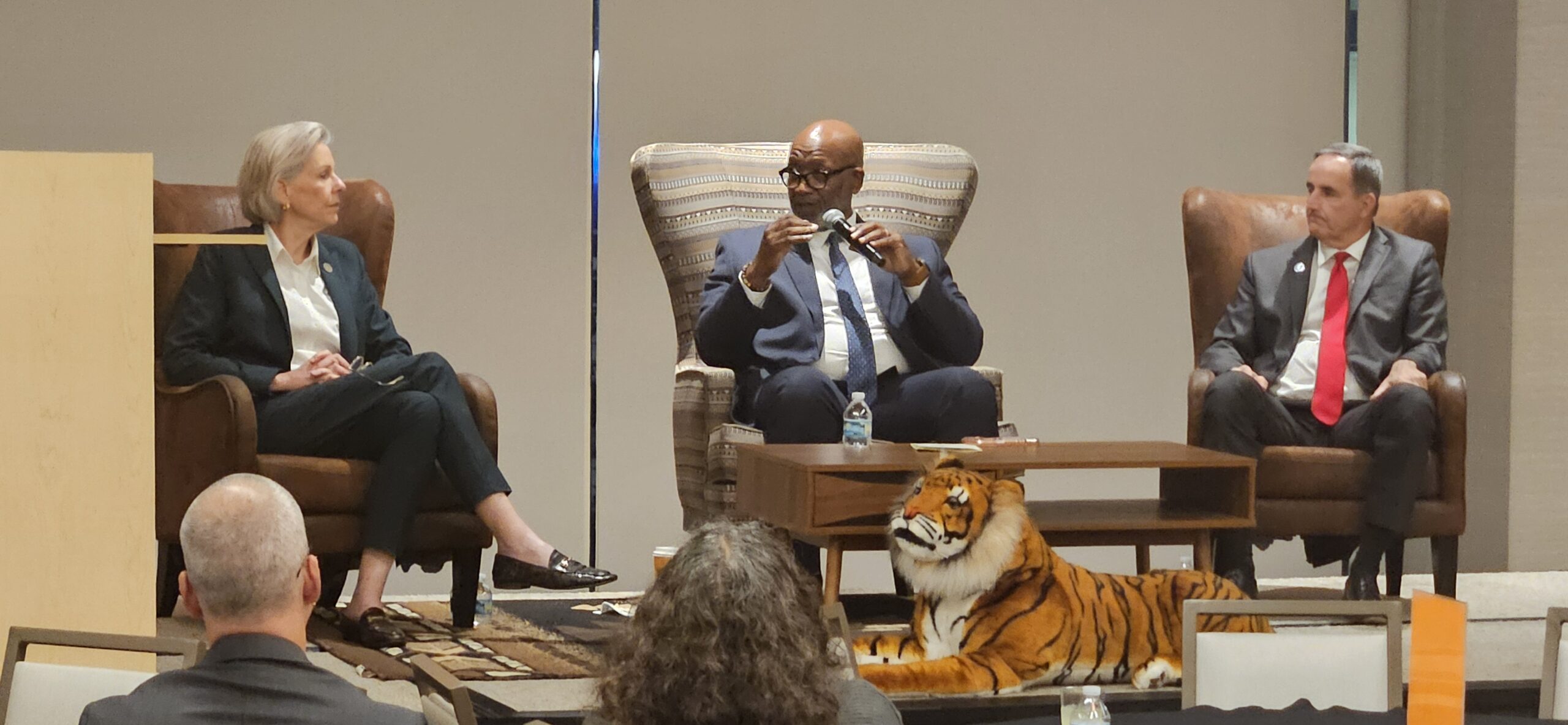
Three Tampa Bay Mayors largely agreed on the need for regional cooperation, infrastructure investment and resistance to state efforts to cut property taxes during a Suncoast Tiger Bay Club State of the Bay forum Tuesday evening. But it was questions from members coaxing St. Petersburg Mayor Ken Welch into tipping off his re-election plans that was perhaps the biggest takeaway.
Welch, Tampa Mayor Jane Castor and Clearwater Mayor Bruce Rector appeared together at the event, fielding questions on everything from the Tampa Bay Rays and immigration enforcement to property taxes, housing affordability and storm resilience.
Asked about upcoming mayoral race, Welch confirmed he will seek a second term and plans to file for re-election within the next two weeks – adding that he will host a campaign kickoff Feb. 18. Welch said he intends to run on his record, citing the city’s response to COVID-19, the Historic Gas Plant District redevelopment effort, hurricane recovery and major infrastructure investments.
“We’ve faced challenges like no other administration has faced — the combination of COVID, the Historic Gas Plant, and four hurricanes,” Welch said.
He added that he believes the city has assembled a strong team, but that “you don’t change quarterbacks in the middle of the playoffs. Ask the Denver Broncos.”
Outside of Welch’s upcoming contest, the three Mayors echoed similar sentiments on key issues. They agreed on the regional importance of transportation and infrastructure projects and warned against state-led efforts to cut property taxes. Still, with mayoral elections approaching in St. Petersburg and Tampa, the political context cast each of their remarks in a different light.
While the forum largely focused on shared challenges and policy priorities, Welch’s unannounced campaign looms large as state lawmakers consider proposals that could reduce property tax revenues.
Welch’s comments came as he prepares to launch a re-election bid already clouded by scrutiny of his political operation. The committee supporting his campaign, the Pelican Political Action Committee, reported $207,500 in unauthorized expenditures allegedly taken by its former registered agent Yolanda Brown. His tenure has also faced heightened public scrutiny, drawing challengers including St. Petersburg City Council member Brandi Gabbard, who attended the forum, and potentially former Gov. Charlie Crist, who has publicly said he is considering a run.
Meanwhile, Castor, who is term-limited, spoke broadly about leadership transitions, arguing that Tampa and the broader region have benefited from leaders who build on their predecessors’ work rather than sharply changing direction. Rector, whose term does not expire this election cycle, joked that “the Mayor of Clearwater is not up until 2028, but I think he’s crushing it.”
Welch: Campaign launch amid state pressure and long-term commitments

Welch told Tiger Bay Club members that stable local revenue, community trust in policing and sustained infrastructure investment are essential as St. Petersburg confronts storm recovery, growth pressures, federal immigration enforcement efforts, and uncertainty surrounding the Tampa Bay Rays. It was only after questions from the audience that he directly addressed his looming campaign.
He pushed back on growing pressure from state leaders to rein in local government spending, using the forum to preemptively rebut a press conference tied to the Governor’s Department of Government Efficiency initiative scheduled for Wednesday. Welch said he expects state Chief Financial Officer Blaise Ingoglia to criticize city budgets, but argued the effort is less about transparency and more about building a political case for cutting property taxes statewide.
“This wasn’t an audit,” Welch said. “This was a solution that they already knew what they wanted to say, that property taxes should be lowered. They were solving for X.”
Welch said cities already undergo regular financial audits and warned that reducing property taxes would directly affect public safety and core services, noting that police and fire departments account for the bulk of municipal spending. He added that rising insurance costs, not local tax bills, are the primary driver of affordability challenges for Florida residents.
Welch argued that blanket tax-cut proposals fail to account for the structural constraints cities face, particularly as St. Petersburg continues storm recovery efforts and advances long-delayed investments in stormwater, wastewater and neighborhood infrastructure. He warned that constraining local revenue would force cities to defer projects, reduce maintenance and potentially impact first responders.
“They want to run on this issue of cutting property taxes, when in St. Pete 98.5% of our property taxes go for police and fire,” he said.
Beyond taxes, Welch also addressed the future of the Historic Gas Plant District and the Tampa Bay Rays. He described the Gas Plant redevelopment as a multi-decade effort that must balance economic development with community commitments around equity, housing and opportunity.
While Welch said St. Petersburg remains focused on meeting its obligation to provide a home for the Rays at Tropicana Field through 2028, he acknowledged uncertainty surrounding the team’s long-term future as discussions about a potential relocation to the Hillsborough College Dale Mabry campus in Tampa have kicked off.
“There’s a way to end this relationship in a way that builds relationships going forward,” Welch said. “The Rays know they still need a million folks from this side of the Bay to come over to wherever the new stadium is. And so, I do think this community is owed something for the promises that were made, and that’s what I’ve been conveying to the Rays.”
When asked about immigration enforcement, Welch sharply criticized recent actions by U.S. Immigration and Customs Enforcement (ICE) that resulted in the deaths of two U.S. citizens in Minneapolis. He referenced St. Petersburg’s 287(g) agreement with ICE, emphasizing that the city’s participation is limited and does not include immigration sweeps or targeted enforcement. Welch said maintaining community trust is essential to public safety and argued that local police departments should focus on crime prevention.
“What we saw in Minneapolis is just wrong, period,” Welch said. “It’s just black and white. It’s a violation of our principles. It’s a violation of our first, second and fourth amendments.”
Noting that cities do not control school district decisions, Welch also said strong public schools are essential to workforce development and economic growth. He highlighted city-funded partnerships aimed at literacy and after-school programming as examples of how local governments can help fill gaps.
Welch later returned to his campaign rationale, saying he is seeking a second term to continue the work already underway.
“We’re going to run on our record,” Welch said.
Castor: Continuity, transit challenges and regional stakes
Castor emphasized continuity, fiscal stability and long-term planning, cautioning Tampa’s next Mayor against abrupt policy reversals. She said Tampa has benefited from leaders who build on their predecessors’ work rather than sharply changing direction. While she did not name names, Castor’s predecessor, former Mayor Bob Buckhorn, is planning to run again to also be her successor. Buckhorn has long been viewed as a staunch Castor ally — and vice versa — and is unlikely to enter office, if elected, on a platform that seeks to undo her work. Meanwhile, Tampa City Council member Bill Carlson, a Buckhorn and Castor foe, is also expected to run, so Castor’s caution may have been directed at him.
She said transportation remains one of the most underestimated challenges facing the Tampa Bay region, arguing the problem is not a lack of ideas but a lack of sustainable funding and time.
“I often say that we’re so far behind on transportation that we think we’re first,” Castor quipped.
She said the Tampa Bay region could also do more to create more water-based transit options.
“When you think about that you can do it pretty quick, the water’s there,” she said. “You need the vessels and you need some docks and parking.”
Beyond transportation, Castor highlighted Tampa’s rapid growth and the resulting need for sustained investment in infrastructure, including stormwater systems and utilities, particularly as the city confronts more frequent and severe storms. She echoed Welch’s concerns about proposals to cut property taxes, warning that such measures would force cities to make difficult tradeoffs.
“Our budgets are already thin,” Castor said.
Castor argued calls to cut property taxes misdiagnose the problem. She instead blames rising insurance costs. Castor said local governments are already operating with lean budgets and cautioned that sweeping tax cuts would shift costs elsewhere rather than meaningfully lowering the overall burden on families.
“I say, instead of saying a ‘property tax,’ when people pay off their mortgage, then you can call it a ‘service fee’ because that’s what you’re paying for,” she suggested to the crowd.
Castor said regional coordination has become increasingly important as Tampa Bay communities pursue federal grants and planning funds for transportation projects, including collaboration across Hillsborough, Pinellas and Pasco counties. She said competing as a region — rather than city-by-city — is critical to remaining competitive for funding and long-term infrastructure investment.
She also addressed the Tampa Bay Rays, praising Welch’s role in negotiations surrounding the team and emphasizing the importance of keeping the franchise in the Tampa Bay region, even if it ultimately relocates from St. Petersburg to Tampa.
“There’s no other leader who has come as close to getting that deal done as Mayor Welch has,” Castor said.
Castor, a former Tampa police chief, also criticized ICE’s approach to immigration enforcement, drawing a distinction between deporting individuals who commit crimes and aggressive federal actions targeting people without criminal records. She said data she has seen shows that more than 70% of people deported had no criminal history.
“So you’re looking at individuals that want to come to this country for the same reason that our ancestors came to this country, in most cases, to make a better life for themselves and their families,” she said.
“I think that’s something that we can all support. Showing individuals that are just being grabbed, or are showing up for the process to become a citizen and to be grabbed and deported, is not something that any of us should agree to as Americans.”
Castor said a recent call with the U.S. Conference of Mayors and police chiefs from around the country included remarks from the Minneapolis police chief that there are five times as many ICE officers as local police officers in the city, despite ICE agents receiving significantly less training.
“What’s happening now is not who we are as a country,” Castor said.
Rector: Infrastructure realities and Clearwater’s redevelopment puzzle
Rector, the only Republican of the trio of Mayors, told Tiger Bay Club members that many of the city’s most expensive infrastructure and redevelopment challenges are largely invisible to the public.
He cautioned that proposed property tax cuts could have significant consequences for local governments, particularly as cities confront aging infrastructure and more frequent severe storms.
“We’ve got infrastructure issues throughout Tampa Bay that need to be addressed, and if we have another storm event that can put pressure on them it could be a big, big problem,” Rector said.
Addressing questions about vacant buildings and downtown land use, Rector acknowledged that revitalization presents unique challenges in Clearwater. In recent years, a significant share of downtown commercial property has been purchased by entities affiliated with the Church of Scientology, leaving many buildings unoccupied and limiting the city’s ability to influence how those properties are used.
Rector said the city’s strategy has been to invest in public amenities and infrastructure it does control, with the goal of generating enough momentum to encourage reinvestment over time. He said Clearwater’s amphitheater, parking infrastructure and new hotel development have already begun changing perceptions of downtown and attracting private interest.
“We can’t control what we can’t control,” Rector said.