
Politics
Ken Welch campaign in turmoil after $200K-plus stolen from PAC, stagnant fundraising

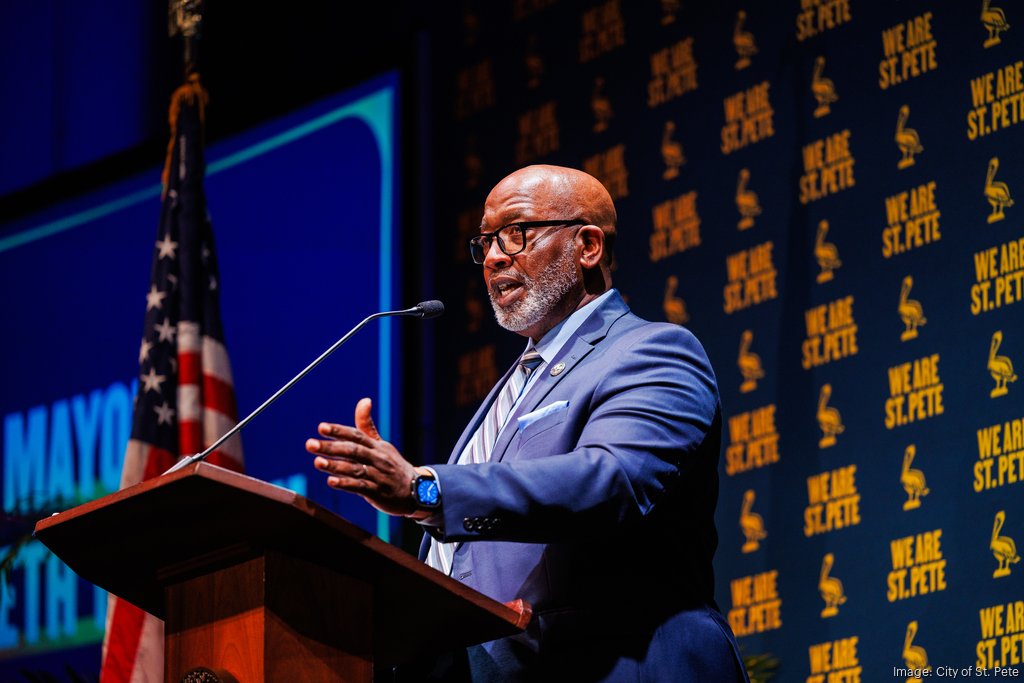
St. Petersburg Mayor Ken Welch got robbed blind. Sort of.
The committee supporting his re-election, the Pelican Political Action Committee, suffered $207,500 in unauthorized expenditures that appear to have been taken by the committee’s registered agent, Yolanda Brown. Brown is the founder of Brown Financial & Consulting Services Group, which frequently provides campaign finance services for Democratic political candidates.
Brown’s phone number appears to have been disconnected, and Florida Politics was unable to reach her for comment.
The committee transferred funds beginning Aug. 6 from the PAC to O’Reilly Business LLC, a private business active in Florida for which Brown is the registered agent.
On Aug. 6, the committee in two separate transactions transferred $100,000 and $25,000 to the business, followed by a $20,000 transfer on Oct. 3, $25,000 on Oct. 6, $20,000 on Oct. 8, $10,000 on Oct. 15, and $2,500 and $5,000 on Oct. 30. All of the expenditures are listed as “unauthorized” in the committee’s amended third-quarter report and its new fourth-quarter report.
Asked about the missing funds, those affiliated with the committee said committee officials will speak with state and federal law enforcement to determine next steps.
Adrienne Bogen, an advisor for Welch, said they terminated the contract with Brown “immediately upon discovering” the improper transactions and appointed a new treasurer.
“While we assumed the funds would be returned and the former treasurer provided us a transaction receipt for a wire transfer of the funds back to the committee, the funds have yet to be returned. Accordingly, we are in the process of notifying the appropriate state and federal authorities.”
Bogen also offered a statement supporting Welch, though without responding to the possible theft.
“Mayor Welch has spent his time in office delivering real results for the people of St. Petersburg, advancing historic investments in affordable housing, expanding infrastructure improvements across neighborhoods, strengthening public safety, and supporting economic growth that creates jobs and opportunity,” she said in a prepared statement.
Under his leadership, the City has increased housing resources, invested in streets and stormwater infrastructure, and prioritized community-driven solutions to improve quality of life. The Mayor shows up every day focused on governing, listening, and getting things done for St. Petersburg.”

This isn’t the first time Welch has had an issue with a political committee. The state revoked his original committee, the Pelican PAC, citing its failure to file timely reports, its failure to appoint a replacement Treasurer after one resigned, and its failure to maintain a registered office and registered agent. Its closure prompted the creation of the new committee, which is now facing its own troubles.
And the loss of more than $200,000 is even more problematic for Welch, given that his fundraising was largely stagnant in the most recent quarter, October through December. The committee raised just $48,225 in the fourth quarter, down nearly six figures from the more than $142,000 raised in the third quarter.
With fundraising slowing and unauthorized fund distributions, Welch has just about $32,000 on hand.
That is a significant disadvantage for the incumbent Mayor, who faces credible opposition in this year’s re-election contest. City Council member Brandi Gabbard has already said publicly that she intends to run, and former Mayor Charlie Crist has said he’s seriously mulling a bid. St. Pete Shines, a political committee expected to support his eventual campaign, launched late last year and raised $725,000 in just 49 days.
“I’m sad to see this happen to my longtime friend, Ken Welch. It is a shame he is facing campaign finance challenges again,” said Michelle Todd Schorsch, the Chair for St. Pete Shines, referring to Welch’s past troubles with his previous political committee.
“While we are hopeful the situation is appropriately addressed with law enforcement, St. Pete Shines will continue its work supporting leaders who can support the city of St. Petersburg today, tomorrow and beyond,” she added.
To put Welch’s fundraising position into perspective, he had two banner fundraising months for his now-defunct committee, one in September 2021 of more than $233,000 and another the following month of nearly $179,000. Not counting his political committee, Welch’s official campaign raised more than $500,000.
It’s important to note that Welch does not oversee his PAC, and, by design, he cannot. Political committees cannot directly coordinate with candidates’ campaigns. Brown was involved in Welch’s first mayoral PAC, but was assigned only after problems came to light. She has also worked with him since his first mayoral run.
It’s not clear yet whether the new committee will be able to recoup any of the lost funds.
The Pelican Political Action Committee’s fourth quarter fundraising included a $25,000 check from the Tampa Bay Rays, but other than that, not a single contribution exceeded $2,500.
Welch has not filed to run for re-election yet, and therefore does not have a campaign account. The only candidate filed to date is Maria Scruggs, who has run for office unsuccessfully several times before, including against Welch when he was a Pinellas County Commissioner.
While Welch has plenty of time to bridge the funding gap — the Primary is Aug. 18, with a General Election runoff, if necessary, scheduled for Nov. 3 — slow fourth-quarter fundraising suggests to potential opponents that Welch may be an incumbent worth challenging.
“It’s clear from the extensive support we received for St. Pete Shines’ mission to identify and support a leader who can usher St. Petersburg into its next chapter, and the comparatively lackluster support for maintaining the status quo, that our fine city is ready for fresh perspectives and experienced leaders. We will continue to work tirelessly to ensure the city has the support needed to grow and thrive for current and future generations,” Todd Schorsch said.

As Florida continues to grow and flourish, the state stands at a pivotal moment for its future. Florida’s state colleges play a critical role in that growth, driving economic mobility, strengthening communities, and fueling the state’s economic engine.
A recent Lightcast report, “The Economic Value of the Florida College System,” issued in October by the Association of Florida Colleges, offers clear evidence that the “Great 28” state colleges are not only educating students and upskilling today’s workforce — they are powering Florida’s prosperity. An investment in the Florida College System (FCS) truly pays dividends for the state.
In fiscal year 2023–24, the Florida College System generated $56.7 billion in added income to Florida’s economy, representing roughly 3.7% of the state’s total gross product. FCS colleges supported 640,484 jobs statewide, meaning one in 24 Florida jobs is connected to a state college, its students, or its alumni.
These figures are not abstract. They represent real livelihoods, thriving small businesses, strong regional economies, and communities positioned to grow and prosper.
For students, an FCS education is a smart and life-changing investment. The Lightcast analysis shows that for every dollar students invest in tuition, fees, and forgone income, they receive $6.30 in lifetime earnings — a 21.2% average annual rate of return that outperforms many traditional investments. Collectively, students enrolled in 2023–24 will earn $14.5 billion more over their lifetimes than they would have without attending a state college.
Taxpayers also see substantial returns. Every $1 invested in the Florida College System yields $2.40 in added tax revenue and reduced public spending over students’ working lives. A more skilled workforce lowers demand for social services, generating $13.30 in social savings for every dollar invested during the same period.
At its core, the Florida College System is about building human capital. FCS institutions offer associate and bachelor’s degrees, workforce certificates, skills-based training, continuing education, and professional development — delivered both in person and online — and tailored to meet Florida’s evolving economic needs. Alumni contribute to industries ranging from advanced manufacturing and health care to technology, education, and the skilled trades. The $51 billion in added income generated by alumni underscores the lasting value of an FCS education.
As Chair of the FCS Council of Presidents and President of Seminole State College, I view Florida’s state colleges as far more than postsecondary institutions. They create pathways to economic mobility, strengthen community resilience, and support long-term prosperity statewide. The Council appreciates Gov. Ron DeSantis’ budget recommendation of $1.9 billion for the Florida College System, which will have a significant impact when reinvested in students and communities.
The Lightcast report confirms what has long been evident: investing in the Florida College System is one of the most cost-effective investments Florida can make. Every dollar invested delivers measurable benefits to students, taxpayers, communities, and the broader economy.
As Florida attracts new residents, expands industries, and navigates global economic challenges, the Florida College System stands ready — educating today’s workforce, preparing for tomorrow’s opportunities, and powering the state’s future success. When Florida invests in the Florida College System, it invests in itself.

___
Dr. Georgia Lorenz is president of Seminole State College and Chair of the Florida College System Council of Presidents.

Florida policymakers are convening for the final Legislative Session of Gov. Ron DeSantis’ tenure, as well as the last for House Speaker Danny Perez and Senate President Ben Albritton. As always, education policy sits at the top of the agenda, and the Foundation for Florida’s Future is urging lawmakers to act on priorities that will shape student outcomes for years to come.
Reading: Invest in literacy
Florida’s reading scores on the National Assessment of Educational Progress (NAEP) have fallen to their lowest levels since before 1999. Meanwhile, states such as Mississippi — drawing inspiration from reforms that originated in Florida — are now outperforming us.
While a broad recommitment to literacy is necessary, lawmakers can make an immediate, high-impact investment by ensuring every elementary school has a dedicated reading coach. These highly trained instructional leaders work directly with teachers to improve reading instruction schoolwide.
Today, nearly 800 elementary schools report having no active reading coach. Because not all districts prioritize funding for proven literacy strategies, policymakers should establish a dedicated literacy coach fund and require participating districts to better align reading plans with state priorities. This approach would give students a much-needed boost while providing the state greater accountability over literacy outcomes.
School choice: Protect Florida’s progress
Florida has been the gold standard for school choice for two decades, distinguished by its scale and responsiveness to families. That progress, however, is not guaranteed.
Current concerns about tracking and funding students stem from technological limitations, not bureaucratic failures. Adding new administrative requirements for parents and schools would be a mistake. The solution to a technology problem should be technological.
Florida can look to other states with education scholarship account programs that have successfully addressed these challenges. Investing in modern student tracking systems and adopting a common data governance standard such as EdFi — already used in Texas, Indiana, and Arizona — would strengthen accountability without discouraging participation.
Additional bureaucracy would stifle innovation, deter families, and risk turning a life-changing scholarship program into a difficult-to-navigate government system. Lawmakers should proceed with caution.

Generative AI: Implement reasonable guardrails
Florida has led the nation in protecting students from the harms of social media and cell phone use in schools. The next step is establishing reasonable guardrails for Generative Artificial Intelligence.
Policymakers should focus on two priorities. First, protecting student data by requiring transparency, auditing of interactions, and robust parental notice and controls.
Second, the state must prevent minors from accessing Generative AI products that use addictive, human-like deception to form relationships. These interactions pose serious emotional risks, tragically illustrated by the experience of Florida’s Megan Garcia and the loss of her son, Sewell. These powerful technologies should not be allowed to reach children unchecked.
Higher education accountability: Capture return on investment
The One Big Beautiful Bill requires colleges and universities receiving federal student aid to report annual wage outcomes for graduates. Programs whose graduates consistently earn less than high school diploma-only workers will no longer qualify for federal aid.
Florida can reinforce this accountability by ensuring the same data reported federally is also shared with the state, giving students and policymakers clearer insight when choosing degree programs.
Florida already boasts one of the nation’s strongest higher education systems, but transparency and incentive alignment remain essential to keeping student outcomes front and center.
Policy changes lives. While this is a lame-duck year for many state leaders, Florida has an opportunity — and a responsibility — to deliver meaningful reforms that keep the state at the forefront of education policy.
To view the full policy agenda, click here.
___
Patricia Levesque is executive director of the Foundation for Florida’s Future.

Last Call – A prime-time read of what’s going down in Florida politics.
First Shot
After months of speculation, Jay Collins is officially in the race for Governor, launching his campaign with a Fox News exclusive that leaned heavily on biography, service, and continuity with the DeSantis era — even as the Governor himself declined to offer an endorsement.
“I’m running for Governor because leadership is forged under pressure, not in soundbites. I served over 23 years in the United States military, mainly as a Green Beret, where accountability is real, decisions have consequences, and service comes before self. That experience shaped how I lead and why I believe public office is a public trust,” Collins said.
Collins praised Gov. Ron DeSantis in his announcement, casting himself as a results-oriented conservative focused on law enforcement, public safety, and maintaining Florida’s national profile. DeSantis, however, struck a notably noncommittal tone when asked about Collins’ bid just minutes before the announcement.
“Jay’s a good guy. He served this country admirably as a Green Beret,” DeSantis said in Davie. “If I get involved in the Primary, you’ll know it. It’ll be at a time and place of my choosing.”
First elected to the Senate in 2022 after defeating Janet Cruz, Collins briefly flirted with a congressional run before switching to the state Senate with a field-clearing endorsement from DeSantis. Since becoming Lieutenant Governor, he has embraced a far more visible role than his predecessors, earning national media hits — and occasional controversy — along the way.
But visibility alone may not close the gap. Collins enters the race with roughly $900,000 in his political committee, Quiet Professionals FL, well behind Byron Donalds and Paul Renner, who have raised more than $35 million and $5.4 million, respectively.
Donalds, who entered the race with Donald Trump’s endorsement, remains the early front-runner in polling — a poll released last week showed Donalds would lead Collins 45%-6% if he were a candidate.
Evening Reads

—”Donald Trump is trying to change how the Midterm Elections are conducted” via Patrick Marley and Yvonne Wingett Sanchez of The Washington Post
—”Today is the day that Democrats’ chances of winning the Senate got real” via Chris Cillizza of So What
—”Fed changes course and takes on Trump’s political fight” via Colby Smith of The New York Times
—”Banana Republicanism” via Jonathan Chait of The Atlantic
—“Fifty people control the culture” via Ted Gioia of The Honest Broker
—“The speed-obsessed Texas wildcatter in pole position for Venezuela’s energy riches” via Benoît Morenne of The Wall Street Journal
—”Uber costs down after Florida tort reform” via Janelle Irwin Taylor of Florida Politics
—”Florida deregulated nursing schools. Scam colleges and failing students followed” via Annie Martin of the Orlando Sentinel
—“Nick DiCeglie brings thoroughbred decoupling effort to the Senate” via Janelle Irwin Taylor of Florida Politics
—”Kathryn and Brian Ballard’s latest FSU gift punctuates long history of giving back” via Peter Schorsch of Florida Politics

Quote of the Day
“Jay’s a good guy. … If I get involved in the Primary, you’ll know it. It’ll be at a time and place of my choosing. And so we’ll see.”
— Gov. Ron DeSantis, minutes before Lt. Gov. Jay Collins announced his campaign for Governor.
Put it on the Tab
Look to your left, then look to your right. If you see one of these people at your happy hour haunt, flag down the bartender and put one of these on your tab. Recipes included, just in case the Cocktail Codex fell into the well.
Ron DeSantis says James Uthmeier is still reviewing potential charges against Nicolás Maduro. We’re still reviewing whether the Attorney General gets a Guarapita.
U.S. Rep. Randy Fine’s bill to annex Greenland and admit it to the union is a long shot, but he gets a 51st State for the effort.
It looks like St. Petersburg Mayor Ken Welch was served a Daylight Robbery by the person running his political committee.


Breakthrough Insights

Tune In
Lightning aiming for 10 straight wins, first place
The Tampa Bay Lightning can move into first place in the NHL’s Eastern Conference standings as they face the Flyers in Philadelphia tonight (7 p.m. ET, WXPX, ESPNT+).
Just over halfway through the season, the Lightning trail the Detroit Red Wings by a point in the standings. With a victory over the Flyers and a Red Wings loss to the Carolina Hurricanes, the Lightning would jump to the top of the standings.
Tampa Bay has won nine straight games, including a 7-2 victory on Saturday night in Philadelphia. Nikita Kuvherov scored a pair of goals in the win. He has recorded at least two points in all nine of the games in the current winning streak. Goaltender Andrei Vasilevskiy has won seven straight games in the streak.
The winning streak came after three straight losses by the Lightning and seven defeats in a nine-game stretch.
After tonight’s game, the road trip continues. Tampa Bay visits Pittsburgh, St. Louis, and Dallas before returning home for a Jan. 20 meeting with San Jose. The Lightning will enjoy a six-game homestand starting Jan. 26 that includes an outdoor game against the Boston Bruins at Raymond James Stadium on Feb. 1.
___
Last Call is published by Peter Schorsch, assembled and edited by Phil Ammann and Drew Wilson, with contributions from the staff of Florida Politics.


Investing in Florida’s future — how state colleges power economic growth

Smart Organization Electronics and Calendars on Amazon

THG upbeat as Beauty sees strong Q4
-

 Politics8 years ago
Congress rolls out ‘Better Deal,’ new economic agenda
-
Entertainment8 years ago
New Season 8 Walking Dead trailer flashes forward in time
-
Politics8 years ago
Poll: Virginia governor’s race in dead heat
-
Politics8 years ago
Illinois’ financial crisis could bring the state to a halt
-
Entertainment8 years ago
The final 6 ‘Game of Thrones’ episodes might feel like a full season
-
Entertainment8 years ago
Meet Superman’s grandfather in new trailer for Krypton
-
Business8 years ago
6 Stunning new co-working spaces around the globe
-
Tech8 years ago
Hulu hires Google marketing veteran Kelly Campbell as CMO