Connect with us

Politics

Ken Babby sets hard date for new ballpark, inspires confidence in new Rays leadership
Published

on


Ken Babby, the new CEO of the Tampa Bay Rays following its sale, is setting the tone for what could be a new chapter in Rays baseball that leaves the controversies of the past more than a decade behind through decisive action on identifying a new permanent home.

Speaking on the newly launched “Hunks Talking Junk” podcast, hosted by College HUNKS Hauling Junk and Moving co-founder Nick Friedman, Babby said the ownership group has set an aggressive timeline.

“We intend to open a new ballpark by April of 2029,” Babby said. “That’s not a date we picked casually. We’ve studied comparable projects across the league, and we believe Tampa Bay deserves certainty and momentum.”

While his pledge to identify a new ballpark location is promising, it’s perhaps his ability to face reality that is most impressive.

“In North America, at least in my eyes, there’s not a professional sports team in more crisis and has more headwinds than the Tampa Bay Rays,” Babby said. “But there’s also no better place and no better community to take on that challenge.”

As he has said in previous public remarks, Babby again emphasized that the new owners aren’t just looking for a stadium. Their broader vision calls for a large-scale, mixed-use development that will serve as an economic engine for the Tampa Bay region — where the team has said they hope to remain — and as a tool to make baseball a more solid financial bet in a market that has seen success in television engagement, but has lacked in-person game attendance.

“We’re not just building a ballpark,” he said. “We’re looking to build a mixed-use development — work, live, play — that creates jobs, attracts major companies and delivers lasting economic impact for Tampa Bay.”

Babby, along with owners Patrick Zalupski and Bill Cosgrove, are looking to Atlanta as a model of a successful stadium development — specifically, the Atlanta Braves Battery district, where Truist Park is located.

Access to land will be the biggest challenge, but also the most important consideration, the new owners have previously said.

“We spend a lot of time — and we talk about this publicly — on The Battery in Atlanta, which everybody should check out,” Babby said. “It’s probably the singular best comparison we can find right now in North America to what building a true community looks like.”

They are looking for about 100 acres to accommodate hotel, office, retail, restaurant and entertainment space. Speaking at a press conference in October shortly after the MLB team’s sale was finalized, Zalupski didn’t say if the ownership group had identified any possible locations, but said there are more sites that meet the team’s criteria than one might imagine.

Owners have also acknowledged that a public subsidy would be a part of any deal, though few specifics have been offered.

On the podcast, Babby stressed the need for transparency and efficiency.

“Most ownership groups take a deep breath and say, ‘We’ll come back to you in a few years,’” Babby said. “That’s just not how we’re wired. There’s too much fatigue in the community for that approach.”

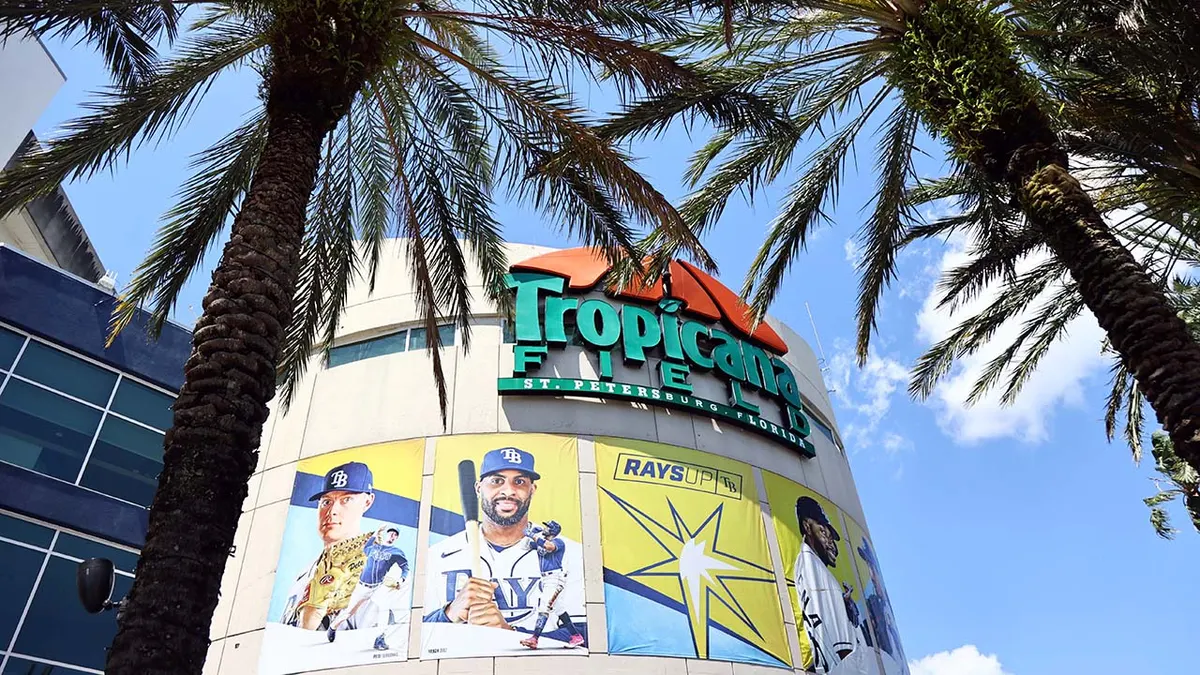
Fatigue there is. Talks of a new Rays stadium have been ongoing since not long after the team even started playing at Tropicana Field, and they’ve spanned at least four St. Petersburg Mayors.

Focus seems to have shifted from St. Pete to Tampa. Owners have clearly stated they intend to keep the team in the Tampa Bay region, but that Tampa is the more likely site.

Punctuating that expectation, the Tampa Bay Rays, long a top donor to local political campaigns, donated both to political committees supporting St. Pete Mayor Ken Welch and to former Tampa Mayor Bob Buckhorn, who is planning a comeback to Tampa City Hall. But while the Rays cut a $25,000 check to Welch, they gave $50,000 to Buckhorn, an early sign that bets are being hedged and interest is wandering across the Bay.

While that may come as a disappointment to fans in Pinellas County, studies have long shown that Tampa offers a more viable future home for the team, if for no other reason than geography.

The thought process goes that major league sports teams need to have a significant fanbase within a 30-minute drive from a stadium. Pinellas County is hamstrung there because it’s on a peninsula, meaning half of the area located within 30 minutes of Tropicana Field is over water and, thus, uninhabited by people.

Nevertheless, Babby touted the franchise as a civic asset for the whole region.

“This is Tampa Bay’s team,” Babby said. “We may own it, but we’re stewards of a community asset. That responsibility is something we take very seriously, both on and off the field.”

“We believe baseball deserves a forever home right here in Tampa Bay. We’re committed to making that happen,” he added.

For too long, the Tampa Bay area has grappled with stadium talks — whether a battle between Tampa and St. Pete or storm-delayed plans that crumbled. The issue has toppled mayoral campaigns and plagued incumbents.

With Babby and the new owners, it appears resolution may finally be on the horizon.


Source link

Continue Reading

Politics

Florida TaxWatch adds COO, economist, research fellow, event marketer

Published

on


Florida TaxWatch is bulking up its leadership and research bench.

The independent, nonpartisan government watchdog just announced four hires as former Lt. Gov. Jeff Kottkamp begins his tenure as President and CEO. The hires add operational, economic modeling and event-planning capacity to the Tallahassee organization.

Ray Monteleone, President of Paladin Global Partners and a longtime Florida TaxWatch Board member, will serve as Chief Operating Officer.

The group also hired Garrett Gouveia as a research economist, named Florida State University graduate student Rylan Clark as a Florida TaxWatch Research Fellow, and brought on Samantha Castaline, who previously worked for the organization as a consultant, as a full-time event marketing specialist.

Kottkamp said in a statement that Monteleone’s experience will help Florida TaxWatch “continue to lead the way with timely, accurate and insightful research” on issues affecting Florida.

“His depth and breadth of experience will be a tremendous asset to our organization as we continue to lead the way with timely, accurate and insightful research into issues impacting the nation’s third largest state,” he said.

Kottkamp also pointed to the research additions as a boost to Florida TaxWatch’s data-driven work, saying Gouveia will help analyze and expand the group’s data and that Clark will support its research output.

Castaline’s move into a full-time role, Kottkamp continued, positions the organization well in growing its events footprint and statewide initiatives.

He also teased more staffing announcements as Florida TaxWatch aims to expand its reach.

“Stay tuned,” he said.

Monteleone is a CPA and consulting executive whose background includes strategic management, mergers and acquisitions, compensation consulting and executive mentoring, with clients spanning health care, technology, manufacturing, education, financial institutions and nonprofits.

His civic and professional involvement includes Leadership Florida, multiple advisory and audit roles, and past leadership in Broward County education and civic organizations.

Gouveia, from West Palm Beach, is tasked with building economic models and contributing research on forces shaping Florida’s economy. A Florida State University graduate, he earned bachelor’s and master’s degrees in applied economics and has worked with tools including Python, SAS, Power BI and SQL.

His prior research includes work on education economics and environmental policy, including an award-winning master’s project examining the economic fallout from the oyster industry collapse in Apalachicola.

Castaline, a communications specialist and former event manager for cannabis giant Trulieve, will manage Florida TaxWatch’s events calendar and help develop new statewide initiatives.


Source link

Continue Reading

Politics

Former U.S. Senate staffer Aileen Rodriguez to challenge Joshua Wostal

Published

on


Conservative firebrand Joshua Wostal will face opposition this year in his re-election campaign for Hillsborough County Commission, District 7.

Aileen Rodriguez, a former regional director for former Republican U.S. Sen. Mel Martinez, has filed paperwork to run. Rodriguez, a Democrat, is so far the only candidate challenging Wostal.

Rodriguez is a career public relations expert, having run her own PR firm, AR Public Affairs and Strategic Solutions, since 2009. She also worked from 2014 to 2017 as a senior manager of executive affairs for the Hillsborough County Aviation Authority.

Prior to that, she served as marketing communications director for the Helios Education Foundation and Communications Director for the 2012 Tampa Bay Host Committee for the Republican National Convention.

Rodriguez was previously registered as a Republican but changed her political affiliation in 2019, saying the GOP left her and no longer reflected her values as a Christian.

In her campaign announcement late Thursday, Rodriguez alluded to Wostal’s controversial, often combative management style from the dais.

“I see an opportunity to bring common sense and decency to our County Commission. The incumbent has consistently demonstrated an inability to engage in our political process in a civil manner,” she said. “I am running to serve everyone in Hillsborough County, regardless of political affiliation, and bring local government back to the people of Hillsborough County whose voices are drowned out by special interests.”

Rodriguez was born in Puerto Rico, a U.S. territory, and raised in the Tampa Bay area. Her campaign will focus largely on the affordability crisis that is plaguing not just Hillsborough County residents, but those throughout the region, state and nation.

“While some folks pretend to care about protecting the wallets of our residents, I will listen to constituents, and work with public and private partners to find real solutions that reduce everyday costs,” Rodriguez said.

“Citizens need our County Commission to be focused on investing in affordable housing, childcare, and public transportation. These are the financial stressors families are facing every day. I look forward to being a genuine champion for the people of Hillsborough County and providing the considerate, dedicated, and empathetic servant leadership our residents deserve.”

Rodriguez also said she would prioritize infrastructure spending and expanded transportation options to break gridlock in Hillsborough County, calling such moves “common sense.”

District 7 is elected countywide, where Republicans hold a voter registration advantage with nearly 292,000 voters compared to nearly 273,000 Democrats. With another more than 217,000 independent voters, Rodriguez’s experience as both a Republican and Democrat could help bridge the voter registration gap by enticing moderate voters.

That could be especially true in a Midterm Election year expected to favor Democrats amid frustration with federal policies under the Donald Trump administration and GOP trifecta in Washington.

Historically, the party in power in the White House suffers losses in Midterm years, and this year is not expected to be any different. But it’s worth noting that in the last Midterm cycle, in 2022, Republicans overperformed in Florida even as they underperformed elsewhere in the nation.

That was also the same year the Hillsborough County Commission flipped red, with the defeat of two incumbent Democrats, shifting the board from a 5-2 Democratic advantage to a 4-3 Republican majority. Wostal was first elected that year, defeating incumbent Democrat Kimberly Overman with more than 52% of the vote despite being significantly underfunded.

The GOP grew that advantage further in 2024, and the board now has just two Democratic members.

Wostal immediately ruffled feathers after his election in 2022 by leading efforts to delay a property tax referendum to boost teacher pay, which ultimately received broad support when it passed in 2024. Wostal had pushed successfully to move the referendum from the 2024 ballot — a Presidential Election year with higher voter turnout — to 2026. The Hillsborough County School District sued, and ultimately won, putting the measure before voters in 2024 as originally intended.

Some took to calling him “Hostile Wostal,” according to the Tampa Bay Times.

Wostal also once spoke out against a longtime county health care tax that serves the poor.

As of the end of 2025, Wostal had already raised more than $108,000 for his race, with only about $1,000 of that spent. Because she only just filed to run, Rodriguez has not yet reported any fundraising.

Two Democrats had previously filed to challenge Wostal: former state Rep. Adam Hattersley and Mark Nash, who has sought office unsuccessfully before. Both have since withdrawn from the race.


Source link

Continue Reading

Politics

Creative Loafing Tampa Bay sold, now under local ownership

Published

on


San Antonio-based Chava Communications has sold Creative Loafing (CL) Tampa Bay to a group of current employees and two new partners.

It’s the first time in 18 years the local alt-weekly publication will be under local control. Chava Communications had owned it since 2023. Prior to that, it was owned by Cleveland-based Euclid Media Group from 2018 until 2023; SouthComm Inc., in Nashville, from 2011 to 2018; and the New York-based Atalaya hedge fund from 2009 until 2011.

The new owners include CL Tampa Bay Publisher James Howard, Editor-in-Chief Ray Roa, Senior Account Executive Anthony Carbone and Digital Editor Colin Wolf.

“We’re now our own overlords,” said Roa, who started at the publication in 2011 as a freelancer before being hired as music editor in 2016. “I’m really excited for the next chapter of a publication I’ve been reading for more than half of my life.”

Howard has been with the publication for 31 years, and Carbone has been there for 26. Wolf is returning to CL after a 10-month sabbatical.

“When this offer came in front of us, I knew we had the team to continue growing our publication, website, events, newsletters and audience for our readers and clients,” Howard said. “We’re proud of the journey we had with our past owners and grateful for this opportunity.”

The new partners include Tampa trial lawyer Mike Trentalange and John T. Fox, a public affairs consultant. Additional details about the deal were not disclosed.

Chava Communications will continue to operate the Orlando Weekly, San Antonio Current and the Local Culture Creative agency.

“We’re proud of the work accomplished at Creative Loafing Tampa Bay and excited to hand over the reins to a team that knows Tampa better than anyone. We look forward to continuing to collaborate on future projects,” Chava Communications co-owner Cassandra Wagner said.

The sale, announced late Thursday after the transaction closed, will not affect other CL staffers, including Creative Director Jack Spatafora, Marketing and Events Director Leigh Wilson and Managing Editor Selene San Felice.

The sale comes less than two months after the Tampa Bay Journalism Project launched. The project allows CL Tampa Bay and other community websites to collaborate to bring more news and information to readers across the Tampa Bay region without a paywall. The project is nonprofit and donor-driven.


Source link

Continue Reading

Trending

Copyright © Miami Select.