The holiday season is on a budget this year. American households are entering the next festive few weeks with constrained spending power, a result of weak real income growth and a softened labor market that is disproportionately affecting younger and lower-income workers, according to a comprehensive financial health report from the JPMorgan Chase Institute.
The analysis, which leverages deidentified financial data from Chase customers, suggests that the period of relying on pandemic-era excess cash liquidity is now “in the rearview mirror,” and many consumers are facing a spending season where budgets are “tempered by tepid income growth.” For consumers who are “relatively disadvantaged by high housing costs and hold less stock market wealth”—a group that disproportionately includes younger and lower-income individuals—they may have “justenough to spend, but not enough to splurge” this year.
These findings come at the end of a year when voter anger about the cost of living unseated Democrats from the White House and installed President Donald Trump for a second, non-consecutive term, only to see voters back Democrats across the board in offyear elections. Many of the benefactors, including New York City Mayor-elect Zohran Mamdani, stressed the “affordability” problem that many are facing, while Trump’s approval ratings on the economy have plummeted.
Gen Z has born the brunt of what Federal Reserve Chair Jerome Powell memorably called a “low-hire, low-fire” labor market, where it’s looking pretty frozen. “Kids coming out of college and younger people, minorities, are having a hard time finding jobs,” Powell told reporters in September. Several weeks later, Goldman Sachs economists warned that “jobless growth” might become a permanent feature of the economy. Many economists have embraced a term from the Biden years that aligns with what JPMorgan is finding: “the K-shaped economy,” with diverging paths for wealthier and lower-income Americans.
To be sure, while JPMorgan’s report does not touch on the political scene and the affordability politics of 2025, it paints a picture of a tenuously balanced economic environment, full of friction with low real income and insufficient wealth accumulation among key demographics.
Real income stagnation mirrors recessionary period
Median real income growth has sustained a weak trend for several months, with the October 2025 reading for prime-age individuals (aged 25–54) settling at only 1.6% in real terms. This low sustained pace is near the range observed during the weak labor market of the early 2010s, a period when the unemployment rate averaged 7%. This was, as the institute says, “when the unemployment rate was still elevated from the Great Recession,” although the current unemployment rate sits notably lower than that period, at 4.3%.
While nominal income growth remains roughly consistent with pre-pandemic levels, the higher pace of consumer price increases means real purchasing power gains are low.
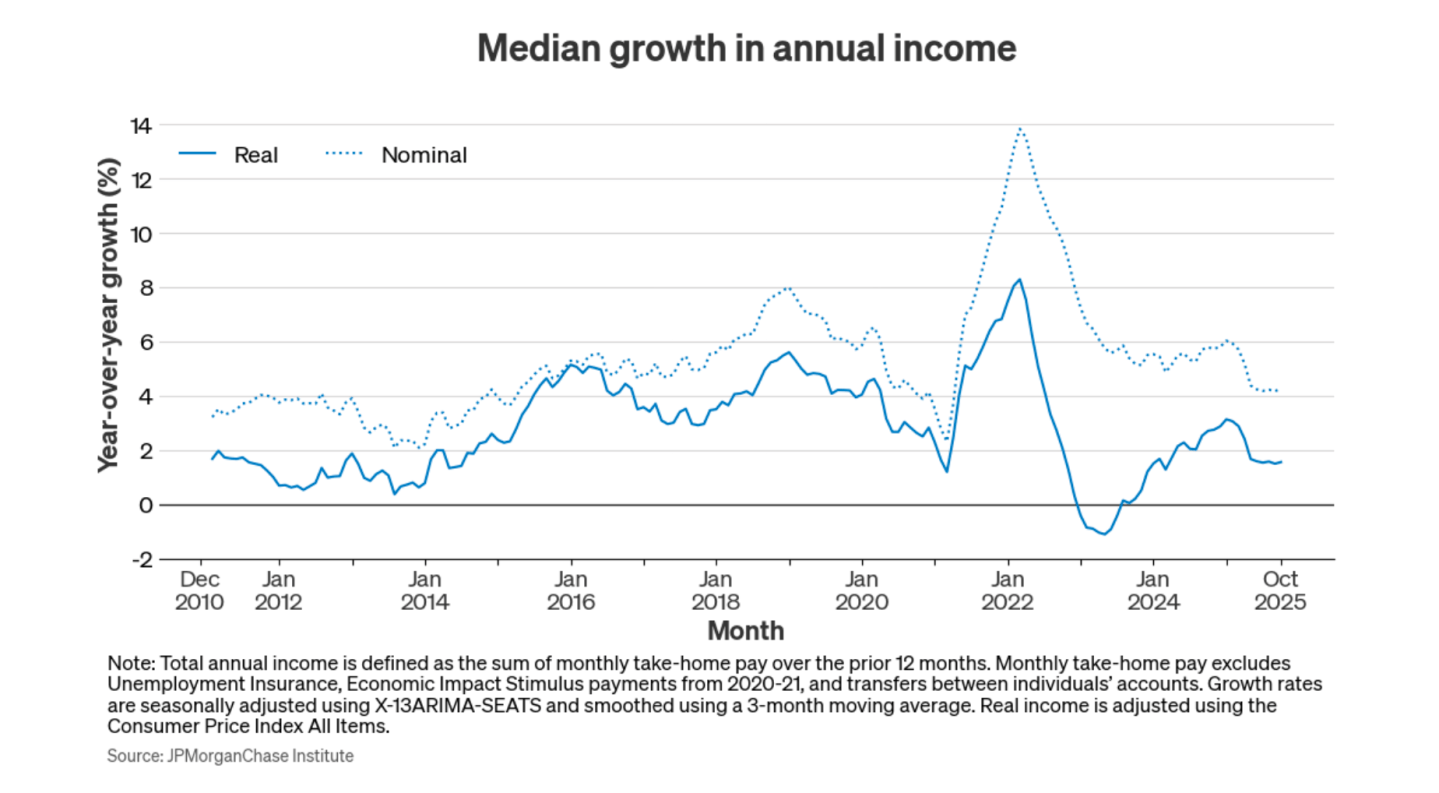
This general stagnation is proving particularly challenging across demographics. Young people “continue to underperform the typical early career growth pattern” as income growth for individuals aged 25–29 is currently below historic trends for younger workers. Younger workers typically rely on job switching to rapidly advance their careers. However, the current slowdown in hiring is hindering this typical rapid pace of income advancement.
The downturn in overall income growth is also impacting older demographics. Workers aged 50-54 are now experiencing negative real year-over-year income growth. And since older workers generally face slower annual gains, a combination of weakening in the labor market and an uptick in inflation can more easily send their purchasing power into negative territory. Negative real growth for older workers can lead to challenging adjustments, particularly for lower-wealth individuals who have not benefited from years of strong gains in housing and stock prices.
Flat balances offer little cushion
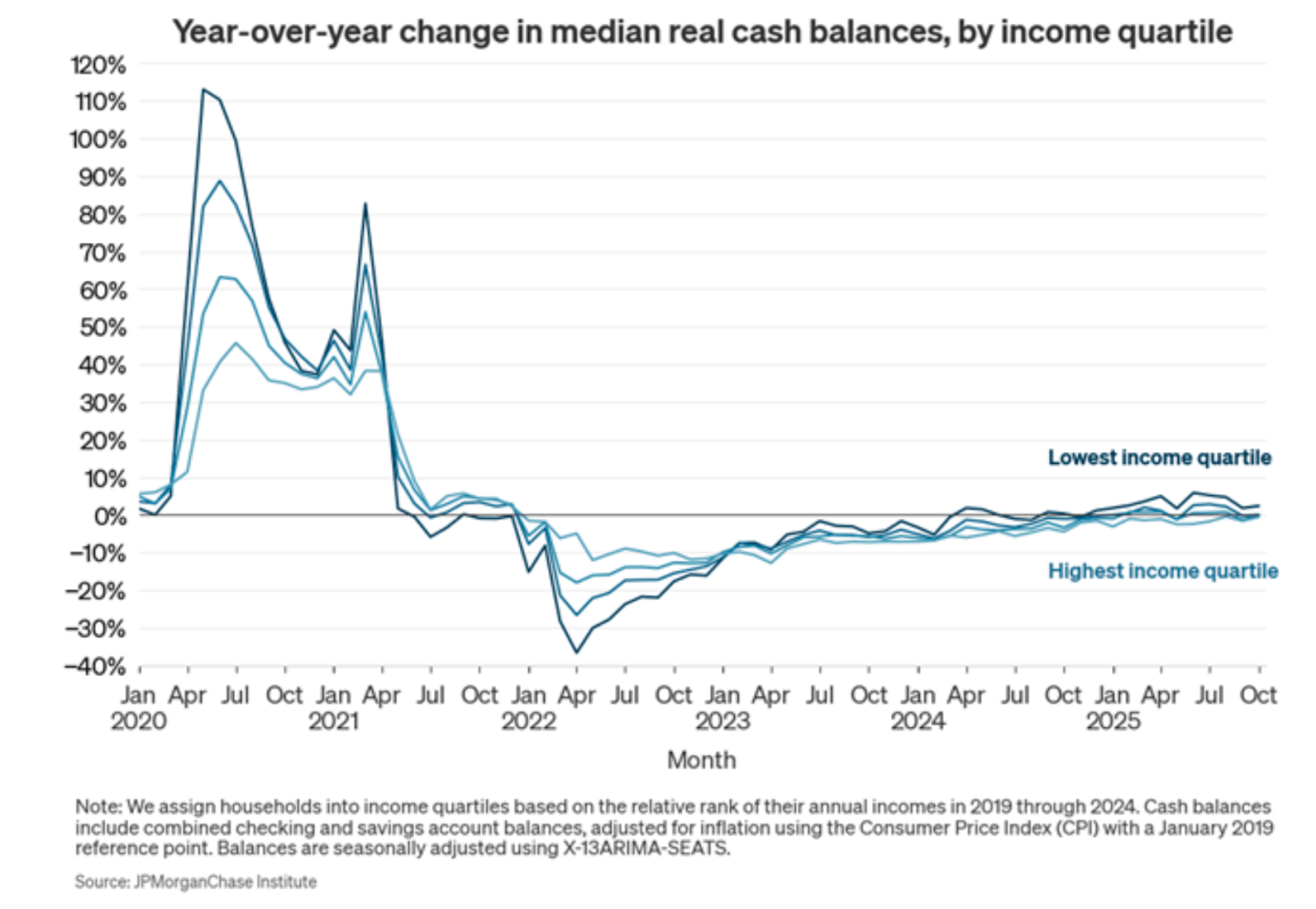
Households’ median real cash balances have remained flat since early 2024, holding steady throughout most of 2025. This stability marks a deviation from pre-pandemic trends, where real balances typically grew steadily at an annual rate of just over 6% as households aged. If balances had grown at that historical rate since 2020, they would be up 40% in October relative to 2019; instead, they are only up 23%.
This flat growth indicates that households are not accumulating additional cash reserves in their checking and savings accounts.
Although high-income households have continued to see slight declines in their bank balances (only 2% negative in October 2025), potentially due to transfers to higher yield accounts or investment brokerage accounts, low-income households returned to positive year-over-year bank balance growth in September 2024. Despite these shifts in savings strategy, the approximation of total cash reserves—including investment transfers—shows that growth has been positive for all income groups for at least the last year.
Going into the end of the year, consumers with constrained budgets may look to stock market gains to augment spending. However, the report cautions that these stock market gains are “highly unequally distributed,” leaving younger and lower-income groups with less financial cushion as they navigate stagnant real purchasing power.
For this story, Fortune used generative AI to help with an initial draft. An editor verified the accuracy of the information before publishing.
China’s hotels are welcoming record numbers of travelers, yet room rates are sinking—a paradox many operators blame on Trip.com Group Ltd.
For Gary Huang, running a five-room homestay in the scenic Huzhou hills near Shanghai was supposed to secure his family’s financial future. Instead, he and other hoteliers in China’s southeastern Zhejiang province say nightly rates have fallen to levels last seen more than a decade ago, as Trip.com’s frequent discount campaigns force them to cut prices simply to remain visible on China’s dominant booking platform.
“The promotion campaigns now are almost a daily routine,” said Huang, who asked to use his self-given English name out of concern of speaking out against Trip.com. “We have to constantly cut prices at least 15% to attract travelers. We have no choice but to go along with the price cuts.”
Trip.com has been central to China’s post-pandemic travel rebound, connecting millions of travelers with small operators like Huang. But for many hotels, visibility—and sometimes survival—comes at the expense of profits.
That dynamic is now at the heart of Beijing’s antitrust probe. Regulators allege Trip.com is abusing its market position, with analysts citing deflation across the sector as the government’s main concern. Interviews with lodging operators, industry groups and travel consultants describe a system where constant price-cutting and opaque policies are eroding profitability, even as demand rebounds.
Trip.com has said it’s cooperating with the government’s investigation. The company’s stock dove more 16% since the probe was announced a week ago.
Revenue per room—a key hotel metric—was flat across China in 2025, even as other Asian markets saw gains, according to Bloomberg Intelligence. Marriott International Inc.’s revenue per room in China fell 1% most of last year, while Hilton’s China room revenue trailed its regional peers.
The company controls about 56% of China’s online travel market, according to China Trading Desk, and has grown into the world’s largest booking site. Its dominance has helped fuel domestic tourism’s recovery—nearly 5 billion trips were logged in the first three quarters of 2025—but operators say the benefits are being offset by falling room yields.
“The market has developed unevenly and innovation is lacking due to monopolistic practices,” said He Shuangquan, head of the Yunnan Provincial Tourism Homestay Industry Association that represents some 7,000 operators. “The entire online travel agency sector is stagnating in a pool of dead water.”
‘Pick-one-of-two’
The broader challenge is oversupply and cautious consumer spending. In regions like Yunnan, hotel capacity has tripled since the pandemic, just as travelers tightened budgets. Consultants note that while people are traveling more, they’re spending less—leaving hotels slashing rates to fill empty beds and posting billions in losses.
For operators like Huang, the paradox is stark: the platform that delivers customers is also accelerating the race to the bottom. The complaints center around Trip.com’s “er xuan yi,” Mandarin for pick-one-of-two exclusivity arrangements—a practice that Chinese regulators have repeatedly vowed to stamp out.
Trip.com categorizes merchants into tiers with “Special Merchants” enjoying the most visibility and traffic, Yunnan Provincial Tourism’s He said. However, these top-tier merchants are typically prohibited from listing on rival platforms like Alibaba’s Fliggy, ByteDance’s Douyin or Meituan. Merchants who aren’t bound by these exclusive arrangements report being effectively compelled to offer the lowest prices on Trip.com’s online booking platform Ctrip, or risk facing a raft of measures like lowered search rankings.
Good morning. The atmosphere here at the World Economic Forum in Davos is all about nervous excitement as the Trump administration descends on the normally quaint but currently chaotic ski town in the Alps.
President Donald Trump will be making remarks just a couple hours from now, and Fortune will be reporting live from USA House on the main promenade, with insights from government officials and chief executives during and immediately following the president’sconversation. Keep an eye on our livestream, here https://fortune.com/2026/01/21/ceos-davos-buy-into-the-agentic-ai-hype/.
Elsewhere around town, CEOs are setting their agendas for the year. Here’s what’s top of mind for a few of them:
This will actually be the year of agentic AI. The first time I heard the term “agentic AI” was at Davos last year. For all the hype around it, does the average CEO really know what it is or how to deploy it? And is AI good enough yet for agents to replace or even significantly assist human employees? The answer appears to be yes. Google Gemini head Demis Hassabis told me that Gemini 3 achieved some milestones that allow agentic AI to truly proliferate in terms of its capabilities. ServiceNow CEO Bill McDermott is also an emphatic “yes,” and says he is already using it to do things like automate his IT department (without doing layoffs, he stresses; he says he has repurposed employees instead). He thinks other CEOs are ready to do the same.
Get ready for Google glasses—for real, this time. A decade ago, Google launched its Google Glass eyewear to widespread mockery. Hassabis thinks the timing was just off; at the time there was no super app to go on the platform. AI has changed that, and Hassabis is bullish on Gemini glasses being the future form for consumer AI. Meta is betting the same thing, and OpenAI is also reportedly considering a super-device, but it doesn’t seem like either can match Gemini’s capabilities any time soon.
There’s artificial intelligence, and now there’s also “energy intelligence.”Schneider Electric CEO Olivier Blum says that nailing energy intelligence is his mission this year. By that he means he wants to capture data from various energy sources into a single “data cube,” filter it, and use agentic AI so customers can manage it all in one place to find opportunities to save power and money. “Our job is to make sure we go to the next level of energy technology to make energy more intelligent,” he told me yesterday. If he can achieve it, he sees a 7%-10% annualgrowth opportunity ahead.
Greenland: national panic or national security risk? I’ve heard various reactions to President Trump’s desire for a full U.S. takeover of the huge island—from outrage to vigorous support. If he does get his wish (which some here think is likely), could Europe retaliate by making life harder and more restrictive for big U.S. tech companies? That was one CEO’s consideration. Said another: “Clear-eyed people can agree that that is a national security concern. And having a national security concern is not just a U.S. concern, it’s also a NATO concern.” They were optimistic that the in-person meetings this week would help move the matter in a positive direction. You can follow all our Davos coverage—including Fortune live interviews today with Ray Dalio, Dara Khosrowshahi and more—right here.—Alyson Shontell
The annual Edelman Trust Barometer, revealed at Davos every year, shows an “insular” mindset permeating the business world, with 70% of respondents not wanting to talk to, work for, or even be in the same space with anyone with a different world view. Richard Edelman says CEOs must adopt a sense of urgency in addressing the crisis; they need to sense that “time is running out.”
The Fortune 2026 World’s Most Admired Companies list
Fortune published the 2026 World’s Most Admired Companies this week, an annual ranking in collaboration with Korn Ferry that surveys executives, directors, and analysts across a range of industries. Apple made the top of the list among leaders in all industries for the 19th year in a row—read who else made the cut.
Netflix co-CEOs boost the case for the Warner Bros. deal
Netflix co-CEOs Ted Sarandos and Greg Peters praised the streaming company’s planned acquisition of Warner Bros. Discovery during its earnings call on Tuesday, selling the deal as a boost to its streaming business and a production boost for America. Investors, however, remain worried that the deal will push Netflix away from its core business, and the stock dropped almost 5% after hours.
The markets
S&P 500 futures are up 0.19% this morning. The last session closed down 2.06%. STOXX Europe 600 was down 0.41% in early trading. The U.K.’s FTSE 100 was down 0.02% in early trading. Japan’s Nikkei 225 was down 0.41%. China’s CSI 300 was up o.09%. The South Korea KOSPI was up 0.49%. India’s NIFTY 50 was down 0.3%%. Bitcoin was at $89K.
In a major effort to close the global health equity gap, the Gates Foundation and OpenAI are partnering on “Horizon1000,” a collaborative initiative designed to integrate artificial intelligence into healthcare systems across Sub-Saharan Africa. Backed by a joint $50 million commitment in funding, technology, and technical support, the partnership aims to equip 1,000 primary healthcare clinics with AI tools by 2028, Bill Gates announced in a statement on his Gates Notes, where he detailed how he sees AI playing out as a “gamechanger” for expanding access to quality care.
The initiative will begin operations in Rwanda, working directly with African leaders to pioneer the deployment of AI in health settings. With a core principle of the Foundation being to ensure that people in developing regions do not have to wait decades for new technologies to reach them, the goal in this partnership is to reach 1,000 primary health care clinics and their surrounding communities by 2028.
“A few years ago, I wrote that the rise of artificial intelligence would mark a technological revolution as far-reaching for humanity as microprocessors, PCs, mobile phones, and the Internet,” Gates wrote. “Everything I’ve seen since then confirms my view that we are on the cusp of a breathtaking global transformation.”
Addressing a Critical Workforce Shortage
The impetus for Horizon1000, Gates said, is a desperate and persistent shortage of healthcare workers in poorer regions, a bottleneck that threatens to stall 25 years of progress in global health. While child mortality has been halved and diseases like polio and HIV are under better control, the lack of personnel remains a critical vulnerability.
Sub-Saharan Africa currently faces a shortfall of nearly 6 million healthcare workers, ” a gap so large that even the most aggressive hiring and training efforts can’t close it in the foreseeable future.” This deficit creates an untenable situation where overwhelmed staff must triage high volumes of patients without sufficient administrative support or modern clinical guidance. The consequences are severe: the World Health Organization (WHO) estimates that low-quality care is a contributing factor in 6 million to 8 million deaths annually in low- and middle-income countries.
Rwanda, the first beneficiary of the Horizon1000 initiative, illustrates the scale of the challenge. The nation currently has only one healthcare worker per 1,000 people, significantly below the WHO recommendation of four per 1,000. Gates noted that at the current pace of hiring and training, it would take 180 years to close that gap. “As part of the Horizon1000 initiative, we aim to accelerate the adoption of AI tools across primary care clinics, within communities, and in people’s homes,” Gates wrote. “These AI tools will support health workers, not replace them.”
AI as the ‘Third Major Discovery‘
Gates noted comments from Rwanda’s Minister of Health Dr. Sabin Nsanzimana, who recently announced the launch of an AI-powered Health Intelligence Center in Kigali. Nsanzimana described AI as the third major discovery to transform medicine, following vaccines and antibiotics, Gates noted, saying that he agrees with this view. “If you live in a wealthier country and have seen a doctor recently, you may have already seen how AI is making life easier for health care workers,” Gates wrote. “Instead of taking notes constantly, they can now spend more time talking directly to you about your health, while AI transcribes and summarizes the visit.”
In countries with severe infrastructure limitations, he wrote, these capabilities will foster systems that help solve “generational challenges” that were previously unaddressable.
As the initiative rolls out over the next few years, the Gates Foundation plans to collaborate closely with innovators and governments in Sub-Saharan Africa. Gates wrote that he himself plans to visit the region soon to see these AI solutions in action, maintaining a focus on how technology can meet the most urgent needs of billions in low- and middle-income countries.