Connect with us

Politics

Joseph Ladapo says no scientific research or data led to call for end to vaccine mandates in Florida
Published

on


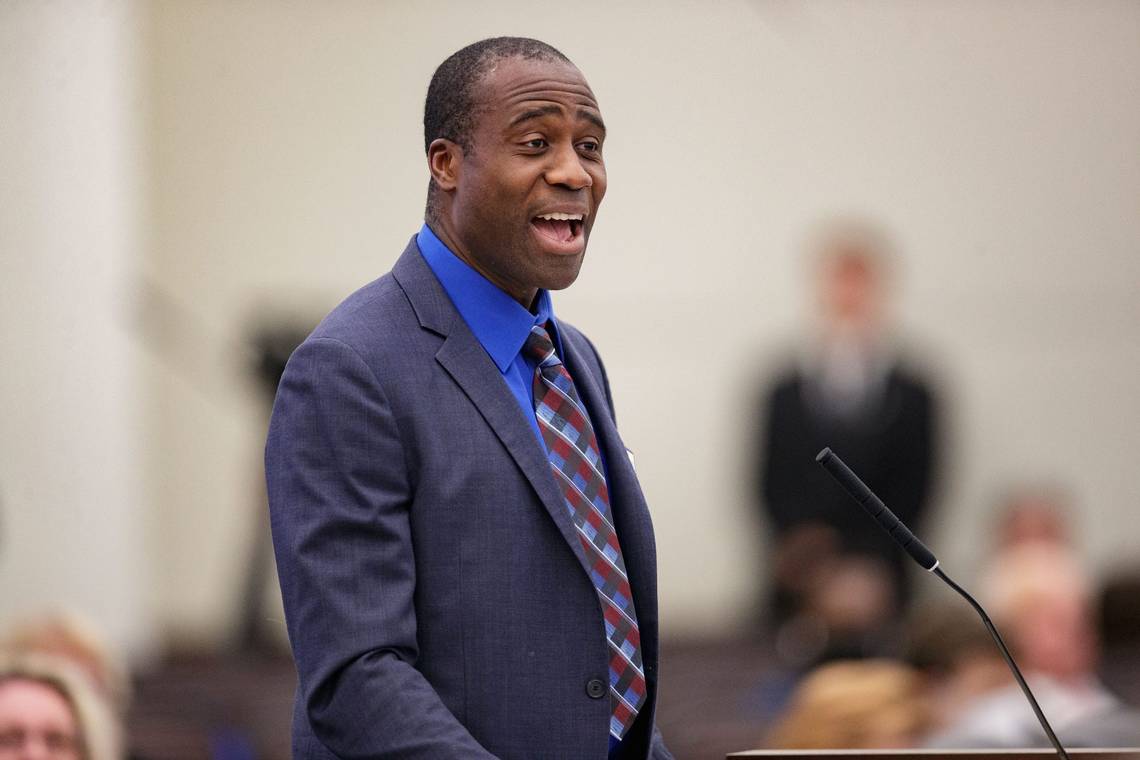
Florida Surgeon General Joseph Ladapo defended his decision and plans to end all state-mandated vaccines on CNN Sunday morning during questioning from the network’s anchor Jake Tapper.

Right off the bat, Tapper asked Ladapo if the state used scientific analysis or data to arrive at the decision to work toward ending vaccine requirements. The move would end vaccine mandates even for school children in the Sunshine State and Lapado said his office did not use scientific comparisons.

“Absolutely not,” Ladapo said bluntly on CNN. “… There’s this conflation of the science and, sort of, what is the right and wrong thing to do.

“You (Tapper) mentioned Whooping Cough, that is an example and part of this issue of informed consent. That’s an example of a vaccine that is ineffective. The data show that is ineffective at preventing transmission, so mandates with that really don’t have anything to do with the notion of transmission.”

The state currently has in place pre-K-12 immunization requirements for polio, measles-mumps-rubella, chicken pox, Hepatitis B and other diseases. Ladapo said Thursday that those mandates drip “with disdain and slavery.” He added the state has no right to tell parents what they should put in a body which is “a gift for God.”

Going upon that theme, Ladapo told Tapper that medical decisions such as medications and mandates are overreach by the state. Ultimately, he said Sunday, it’s not the government’s call.

“This is an issue, very clearly, of parent’s rights. So, do I need to analyze whether it’s appropriate for parents to be able to decide what’s appropriate to go into their child’s bodies? I don’t need to do analysis on that,” Ladapo said.

Tapper followed up asking if Ladapo did any analysis at all along with projections what health impacts might result by lifting vaccine mandates in public schools, which no other state in the country is doing. He pointed out a Washington Post-KFF poll shows 82% of parents in Florida favor vaccine mandates in public schools.

“My history, if you will, is I share what I believe is the right thing to do, whether it is popular or not,” Ladapo said, adding he did such during the COVID-19 outbreak that began in 2020 and he claimed the lock downs were not appropriate while speaking out against the virus vaccines for children.

Tapper responded he was “kind of shocked” Ladapo didn’t do any analysis projecting what might happen to school children should vaccine mandates end in Florida.

Ladapo added he considers the issue an ethical issue and is out to protect the “individual sovereignty” of the bodies of Floridians.


Post Views: 0


Source link

Continue Reading

Politics

House subcommittee backs bill to regulate e-bikes in Florida, establish task force

Published

on


A House panel is on board with legislation that aims to increase regulations of electronic bikes and scooters in Florida.

Rep. Yvette Benarroch, a Naples Republican and co-sponsor of the House bill (HB 243), presented it before the House Government Operations Subcommittee. She offered a committee substitute bill, which the panel unanimously approved.

It’s identical to a measure that was approved by the Senate Transportation Committee Tuesday.

E-bikes especially have gained unflattering attention in recent years as they have been involved in more and more accidents. Benarroch during her presentation provided a list of about a half-dozen fatalities involving e-bikes on Florida roads recently.

“Unfortunately, this bill was inspired by tragedy,” Benarroch said during her presentation. “Young people have been seriously injured.”

She added that the number of e-bike accidents is not going down and there needs to be more data collected to understand how profound the issue is. She said she’s been working on the bill for about the past half-year.

“There are many others whose stories do not make the headlines,” Benarroch said. “The call to act is immediate.”

Benarroch’s bill is identical to Sen. Keith Truenow’s measure (SB 382). The Tavares Republican amended his original bill to include provisions establishing an “electric bicycle task force,” which are also included in the House proposal.

That task force would collect data on e-bike and scooter accidents, provide recommendations on enforcement, and submit a report to the Florida Department of Highway Safety and Motor Vehicles.

The bill would also limit e-bikes to operating at 10 mph on sidewalks if a pedestrian is within 50 feet.

Several law enforcement organizations, hospitals and School Boards supported Benarroch’s bill Wednesday.

Rep. Linda Chaney, a St. Petersburg Republican and Chair of the House subcommittee, said she was thankful for Benarroch’s work on the measure because local municipalities have approached the e-bike issue with inconsistent measures.

“There are a lot of different areas in our state with different laws, depending on how fast the bike goes, how you peddle it if you have a motor (and) there’s a lot of confusion out there. … This is going to have far-reaching impact,” Chaney said.

Two actions in North Florida in 2024 demonstrate the wide range of approaches to dealing with e-bikes.

Two 15-year-old boys were seriously injured in St. Johns County alone last year. The St. Johns County Commission passed a resolution in August to join forces with the Sheriff’s Office and the St. Johns County School District to promote more awareness and safety for the operators of e-bikes, as well as e-scooters and other electronic motorized devices.

The County Commission’s measure promised joint education with the St. Johns County Sheriff’s Office and the St. Johns County School District.

St. Johns County Sheriff Rob Hardwick said the resolution’s timing was right.

The Palm Coast City Council in 2025 also passed an ordinance that makes it illegal for e-bike owners to modify their vehicles so they can exceed state-defined speed limits on streets, sidewalks or paths.


Source link

Continue Reading

Politics

Charlie Kirk Day of Remembrance bills advance in Senate, House

Published

on


An annual day to remember fallen conservative icon Charlie Kirk is closer to becoming law after meetings of the Senate Education Postsecondary Committee and the House Governmental Operations Subcommittee.

The panels voted on party lines to devote Oct. 14 to remember the activist and commentator who spoke for a generation on the Right before he was gunned down while addressing a Utah university crowd.

Under bills from Sen. Jonathan Martin and Rep. Yvette Benarroch (SB 194, HB 125), the Governor would be compelled to issue a proclamation every Oct. 14  — Kirk’s birthday — for the “Charlie Kirk Day of Remembrance.”

“This bill would have this day be a day of remembrance and recognition of Charlie Kirk’s influence on civic engagement, youth leadership, and constitutional education. It does not create a state holiday or mandate closures,” Martin said Wednesday.

Martin extolled Kirk’s “alternative viewpoint” and willingness to debate, saying “what he was doing when he was assassinated goes to the very core of who we are as Americans.”

“The First Amendment does not exist to protect comfortable speech,” Benarroch said. “It exists to protect speech we disagree with. It exists to protect debate, House Bill 125 is not about asking anyone to agree with Charlie Kirk. It is not about endorsing every statement he ever made. It is not about elevating a personality. This bill is about what happens when violence replaces debate.”

Ahead of the Senate vote and after numerous members of the public cited various racially provocative things Kirk said into live microphones, an amendment from Sen. Shevrin Jones creating the gubernatorial option for a George Floyd day of remembrance was rejected, saying his killing, like Kirk’s, changed “public consciousness.”

Jones noted that when he was in the House, legislation like the main bill wouldn’t have advanced, which he framed as a measure of how far to the right discourse in the Capitol has moved in just the last few years.

“We’re passing days of remembrance of an individual who … probably wouldn’t spit on me if I was on fire,” Jones said, before his amendment was turfed.

These bills are part of several efforts to remember the founder of Turning Point USA.

A proposed road renaming in Miami-Dade, an honorary naming of the Florida Civics and Debate Initiative championship trophy, and Attorney General James Uthmeier’s Combat Violent Extremism Portal all exemplify state leaders’ effort to pay tribute to a leading advocate for the kind of unapologetic conservatism Florida Republicans embrace.


Source link

Continue Reading

Politics

Education consortium leaders will bring concerns of Florida’s rural schools to Tallahassee

Published

on


Educators from rural counties will host a breakfast at the Governor’s Club on Thursday morning. The event, scheduled in the midst of Rural County Days in Tallahassee, will touch on concerns for Florida’s small School Districts.

“In rural school districts, everybody knows each other. These are truly community schools,” said John Selover, Executive Director of the Panhandle Area Educational Consortium. That consortium is one of three such regional entities hosting the event, along with the Heartland Educational Consortium and North East Florida Educational Consortium.

Jim Norton, Gulf County Superintendent of Schools and Florida’s longest-serving Superintendent, noted that rural counties more often have long-serving, elected Superintendents who boast a particular understanding of families’ educational needs.

“Small county educators are convened to discuss things important to education,” he said. “One size does not fit all.”

Selover said the event created an opportunity for Superintendents and officials from Florida’s 37 small counties to come together in the state’s capital city during the Legislative Session.

Education consortiums are authorized by statute and allow smaller counties to share resources and services, such as risk management pools for property and casualty insurance, financial administration, professional development and cooperative purchasing.

The Panhandle consortium, for example, includes 13 county School Districts, along with a pair of schools run by Florida A&M University and Florida State University in the region. Those university-headed schools and other ones around Florida operate independent of School Districts and thus are able to participate in the consortiums.

The meeting also occurs as lawmakers tackle a number of issues surrounding education and policy in public schools, including the impact of universal school choice and the expansion of Schools of Hope charter school operations, matters that have financially impacted districts of all sizes.

Officials said the breakfast marks a chance for lawmakers to communicate directly with school leaders on policy, and many Superintendents plan to visit with lawmakers in the Capitol during the trip as well.


Source link

Continue Reading

Trending

Copyright © Miami Select.