John Lewis Partnership (JLP) is getting back on track its first-half results seemed to show on Thursday, as it appeared unperturbed by a wider loss that included a number of one-off items such as higher tax, investment costs and a packaging levy.
The six months to 26 July saw sales rising 4% to £6.2 billion as customer satisfaction reached a high and both the eponymous department stores and Waitrose supermarkets “outperformed their markets”.
Looking beyond the shock of much higher losses, its results statement did contain good news for the employee-owned company that just a few years ago seemed to be sabotaging its own operations by shedding experienced retail execs, looking for growth in areas wholly unconnected to retail and falling behind its peers in terms of tech and systems. That saw its previous good results being interrupted and staff (‘Partner’) bonuses being cancelled.
But new management with a strong background in retail seems to be turning things around.
The company said its results show “positive momentum as a direct result of our customer focused investments”. Those investments are designed to drive long-term, sustainable growth and in the first half it accelerated its investment in store upgrades, digital services and essential modernisation to its technology and supply chain.
As mentioned, the result was that 4% increase in group sales while total revenue grew 5% to £5.4 billion. Its customer numbers also rose 4% and it saw “pleasing growth” in its loyalty schemes.
JLP’s loss before tax and exceptional items was £33 million, with the figure significantly impacted by one-off costs that it hadn’t had to deal with a year earlier. On a like-for-like basis, that same loss was broadly flat compared to last year’s £4 million deficit and was partly driven by heavy investment designed to drive long-term growth.
With exceptional items included, the loss before tax was £87 million with £54 million of exceptional items relating to its ongoing transformation and non-cash asset impairments. A year ago that loss had been £29 million.
The net loss was £62 million, wider than the £19 million deficit of H1 2024, with Partner bonuses, tax and exceptional items denting the latest figure to the tune of £29 million.
The company expects the majority of its sales and profit to come in the second half and said its investments have been helping to build momentum over the first half.
Looking at its individual operations, Waitrose supermarket sales rose 6% to £4.1 billion with a 3% rise in volumes. Adjusted operating profit was £110 million.
Meanwhile John Lewis sales rose 2% to £2.1 billion. The company said it has attracted more customers through its commitment to operating quality, style and value, “which has resonated strongly”. The retailer has been investing heavily in John Lewis with big initiatives in both fashion and beauty, adding new fashion labels for instance and upgrading beauty spaces.
It undertook a major refurbishment of its Liverpool store, added more omnichannel shopping options including ‘deliver from store’ and rapid online delivery and the recent return of its 100-year-old Never Knowingly Undersold promise “has continued to drive sales, relevance and value for money perceptions”.
It said: “These investments and a renewed focus on compelling value, compounded by a sales mix shift towards Technology and Beauty, impacted gross margin in the short term.”
The adjusted operating loss was £53 million in the first half, down £4m, including incremental non-like-for-like taxation costs of £7 million from the new EPR packaging levy and incremental National Insurance Contributions.
It added that its first-half investment “allows us to look forward with confidence; our focus is now heading into peak where we see significant opportunity for all our core assortments”.
Chairman Jason Tarry said of all this: “Our clear focus on accelerating investment in our customers and our brands is working: more customers are shopping with us, driving sales, and helping Waitrose and John Lewis outperform their markets. We achieved our highest recorded levels of positive customer satisfaction.
“The investments we are making, combined with our plans for peak trading, provide a strong foundation for the remainder of the year. While we are reporting a loss in the first half, we’re well positioned to deliver full year profit growth, which we’ll continue to invest in our customers and Partners.”
Designer Brands Inc., the Columbus, Ohio-based owner of the DSW Designer Shoe Warehouse, The Shoe Company and Shoe Warehouse retail chains, announced on Tuesday that net sales decreased 3.2% in the third quarter ended November 1.
Designer Brands Q3 sales dip 3.2%. – DSW
The company achieved net sales of $752.4 million. Comparable sales fell by 2.4%, with the U.S. retail segment down 1.5%, Canada retail down 6.6%, and the brand portfolio segment’s direct-to-consumer channel plunging 21.5%.
Reported net income attributable to the company reached $18.2 million, or $0.35 per diluted share. Adjusted net income was $19.6 million, or $0.38 per diluted share.
“Our third quarter performance represents another meaningful step forward in our transformation, as we demonstrated continued sequential improvement across multiple financial and operating metrics,” said Doug Howe, chief executive officer.
“Stronger consumer demand and improved in-store execution drove improved comparable sales in the third quarter compared to the second quarter. Our team also delivered a meaningful increase in gross profit and diligently managed expenses, which helped drive an increase in operating income over last year.”
Looking ahead, the company expects net sales to decline between 3% and 5% in fiscal 2025. Adjusted operating profit is projected in the range of $50 million to $55 million.
Howe added, “I’m encouraged that this positive momentum has extended into the early part of the fourth quarter, reinforcing the progress of our strategic initiatives and positioning us well as we close out the year. While macroeconomic pressures persist, we are confident in our ability to navigate the near-term environment and continue making progress on our long-term strategies.”
In 2025, Zalando has stepped up its pace in the Iberian Peninsula with two key moves: it entered Portugal and expanded its offering in Spain with the launch of its beauty category there. These two developments align with the German platform’s ambition to be more than a purely transactional tool; it aims to be a place of inspiration and entertainment for its customers.
Zalando takes stock of 2025 in the Iberian Peninsula – Shutterstock
One of Zalando’s milestones on a global- and, of course, Iberian- scale was its entry into Portugal last October, a launch accompanied by its suite of technological tools, such as its AI assistant, available in Portuguese, and partnerships with local brands to help them, in a two-way relationship, reach a European audience.
Portugal is the company’s 26th market, and its activities in southern Europe are grouped within the cluster led by Eloisa Siclari, which includes Portugal, Spain, and Italy. Portuguese customers have access to a catalogue of more than 200,000 items and, although it has been operating in the country for just over two months, the European giant notes Portuguese consumers’ strong propensity to shop the streetwear category.
Zalando’s arrival in Portugal also strengthens the link between the Portuguese and Spanish markets: the platform’s logistics centre in Illescas (Toledo) serves Portuguese customers, cementing the complex’s status as “a key logistics hub in southern Europe.” The same centre has expanded its operations in recent months into the beauty category, supporting the German e-tailer’s expansion into this segment.
New key partnerships in the Spanish market
Zalando describes Spain as “a fundamental market,” both for its potential and because Spanish brands are “a key growth driver” for the platform and a “valuable asset” for its customers. In 2025, the German company signed agreements with Spanish labels such as Bimba y Lola, Hoff, Aristocrazy, Tous, Brownie and, more recently, Unode50.
The company maintains that brands find in it not only another sales channel, but a “gateway” to more than 52 million customers in the continent’s key markets. It illustrates this with the performance of Singularu, a Spanish jewellery brand with 80 stores in Spain and turnover of €30 million in 2024, which is relying on the German giant for its European expansion in e-commerce. According to figures provided by Zalando, the jewellery brand grew 117% year-on-year in 2025 on the platform, with more than 10 million visits (up from 5.7 million a year earlier), and 74% of its sales via the e-tailer coming from Germany, Belgium, Poland, and Italy.
Singularu is one of the Spanish brands featured on Zalando
“6% of the audience with brand affinity interacts with Singularu; in other words, the brand already ‘resonates’ on Zalando, but there is still much to capture by expanding coverage to audiences adjacent to trend-led jewellery,” explained the business.
“On a platform it’s difficult to project what your brand is all about, but Zalando allows us to reach audiences we can’t access otherwise. And we can do that with our visual proposition and by deciding what we want to communicate. We are very happy with this relationship, which is increasingly close, and the results back it up,” said Fernando Peris, vice-president of e-commerce and marketplaces at Singularu.
“Why does Zalando choose to collaborate with local brands? In Spain, for example, consumers demand Spanish brands. It is beneficial for them, but also for us as a platform. The fact that local brands have an international clientele is also a success; there are brands with a lot of potential. And there is some national pride there,” said Eloisa Siclari, Zalando’s managing director for southern Europe.
Also in 2025, Zalando marked one year since the launch of its revamped Plus programme in the Spanish market, rolled out in summer 2024. By 2026, it plans to expand the programme and offer customer experiences, “going beyond transactional benefits”.
And beyond Iberia? Next year is shaping up to be one of expansion for the European company: it plans to enter new markets, as well as strengthen its in-house logistics and bolster its operations.
This article is an automatic translation. Click here to read the original article.
Calvin Klein opened on Tuesday a new global flagship in New York City, marking the brand’s return to its hometown.
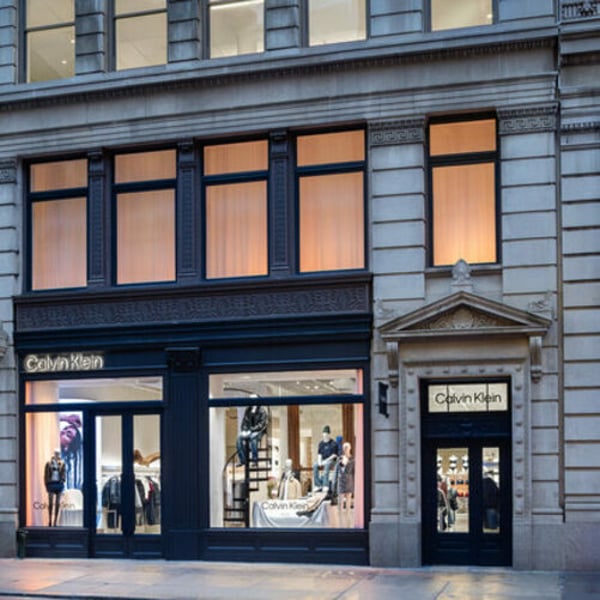
Calvin Klein opens new flagship store in SoHo, New York. – Calvin Klein
Located at 530 Broadway in SoHo, the over 3,000-square-foot store draws inspiration from New York’s signature loft apartments, characterized by open wood ceilings, cast columns and concrete flooring, paired with neutral tones and stainless steel fixtures.
Meanwhile, the store’s exterior is finished in the brand’s charcoal tone, with large windows displaying a seasonal visual concept created in partnership with Perron Studios.
The store features curated spaces with denim and underwear at the center of the assortment, alongside men’s and women’s apparel and accessories. Beginning in spring 2026, the location will offer select styles from Calvin Klein Collection during designated periods. To mark the opening, the SoHo flagship is releasing a limited capsule collection of tees, sweatshirts, hats and totes featuring custom Calvin Klein SoHo branding.
“We are proud to return to one of the world’s most fashionable cities – and the birthplace of our iconic brand – with an elevated retail expression,” said David Savman, global brand president, Calvin Klein.
“This new global flagship, located just steps from our landmark Houston Street billboard, is a tribute to Calvin Klein’s New York heritage. It represents both the evolution of our retail experience and a tangible expression of the world of Calvin Klein. Calvin Klein embodies a distinctive, global way of living that meets culture, and this store is the latest step on our journey of taking our brand to the next level.”
The store follows recent flagship openings in Paris and Tokyo and reflects the company’s strategy to create premium lifestyle destinations built around its minimalist design DNA.
“New York is central to the DNA of the Calvin Klein brand,” added Stefan Larsson, CEO, PVH Corp.
“This homecoming is a key milestone as we build Calvin Klein into one of the most desirable lifestyle brands in the world. Step by step, we’re deepening brand relevance, driving consumer engagement and strengthening brand positioning across North America and globally.”